
Something felt different about the political and media climate in late April and early May 2026. A late-night joke, a streaming platform’s editing room, and the federal government’s broadcast regulatory arm all collided in a matter of weeks. The collision pulled Melania Trump back to the center of one of the most charged press freedom debates in recent American history. What started as a roast-style quip about an age gap became, in the administration’s telling, something far more sinister. And what Netflix quietly cut from a comedy special became its own flashpoint in a broader story about who gets to joke about the First Family and what happens when they do.
To understand why this moment landed with such force, you have to understand what came before it.
The backdrop is a Trump administration that has repeatedly demonstrated a willingness to use federal regulatory power to respond to criticism from the entertainment industry. The targets have shifted and the pretexts have changed. The pattern has become familiar enough that media lawyers, First Amendment scholars, and even some conservatives have started to name it publicly.
The Kimmel Joke That Set Off a Chain Reaction
On April 23, 2026, late-night host Jimmy Kimmel aired a segment on Jimmy Kimmel Live! styled as a mock version of the upcoming White House Correspondents’ Dinner. In the skit, Kimmel pretended to address Melania directly, joking that the First Lady had “a glow like an expectant widow.” The line was framed as a roast-style observation about the couple’s 23-year age gap. Donald Trump is 79; Melania is 56.
Two days later, on April 25, the actual White House Correspondents’ Dinner at the Washington Hilton was thrown into chaos. On Saturday, April 25, the Trumps and other attendees were rushed off stage and evacuated from the White House Correspondents’ Dinner in Washington, D.C., after gunshots were heard. Law enforcement officers responded inside the Washington Hilton after authorities said suspect Cole Allen opened fire at a Secret Service checkpoint. Allen is charged with one count of attempt to assassinate the President of the United States, transportation of a firearm and ammunition in interstate commerce with intent to commit a felony, and discharge of a firearm during a crime of violence.
The timing transformed what had been a standard late-night dig into something much more combustible. Though the joke aired three days before the shooting, critics immediately drew a line between Kimmel’s words and the violence at the Hilton. While the Trumps were not harmed, the timing led critics to revisit the joke and question its tone.
The Trump Administration Responds
The White House did not wait long. White House press secretary Karoline Leavitt called Kimmel’s comments “completely deranged” during a press briefing Monday, adding that that type of rhetoric has “led crazy people to believe crazy things, and they are inspired to commit violence because of those words.”
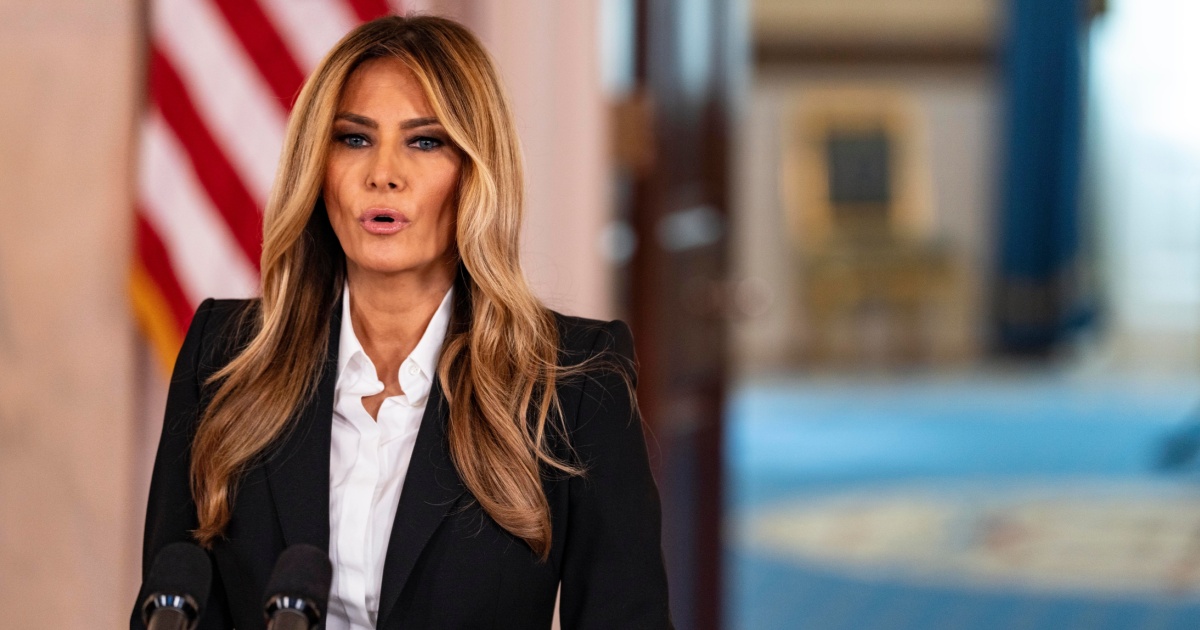
Melania Trump made a rare and public statement. She wrote on X: “His monologue about my family isn’t comedy – his words are corrosive and deepens the political sickness within America. People like Kimmel shouldn’t have the opportunity to enter our homes each evening to spread hate.”
Kimmel’s hateful and violent rhetoric is intended to divide our country. His monologue about my family isn’t comedy- his words are corrosive and deepens the political sickness within America.
— First Lady Melania Trump (@FLOTUS) April 27, 2026
People like Kimmel shouldn’t have the opportunity to enter our homes each evening to…
President Trump escalated further. In a post on Truth Social, the president characterized Kimmel’s joke as a “despicable call to violence,” adding: “This is something far beyond the pale. Jimmy Kimmel should be immediately fired by Disney and ABC.”
Melania also accused Kimmel of hiding behind the network. She called him a “coward” who “hides behind ABC because he knows the network will keep running cover to protect him,” and called out ABC’s leadership for trying to “enable Kimmel’s atrocious behavior at the expense of our community.”
Kimmel Fires Back
Kimmel did not stay quiet. On his show Monday night, Jimmy Kimmel said the joke he made about first lady Melania Trump was a “light roast” and was “not, by any stretch of the definition, a call to assassination.” He explained the intent plainly: the joke was “obviously a joke about their age difference” and “the look of joy we see on her face every time they’re together.”
Then Kimmel turned the critique back on the First Lady directly. He said: “I agree that hateful and violent rhetoric is something we should reject. I think a great place to start to dial that back is having a conversation with your husband about it.”
He also noted the irony of the president demanding his firing. When Trump, during an arrival ceremony for King Charles III, joked about his parents’ 63-year marriage and told Melania “That’s a record we won’t be able to match, darling, I’m sorry,” Kimmel asked his audience, “Wait a minute, did he just make a joke about his death?” Kimmel then observed that “only Donald Trump would demand that I be fired for making a joke about his old age and then a day later go out and make a joke about his old age.”
The controversy intensified public interest in Kimmel’s anti-Trump commentary. Monday night’s monologue racked up more than four million views in less than 24 hours.
The FCC Steps In
What happened next was not just a social media fight. The federal government’s communications regulator entered the conflict directly. The FCC ordered that “Disney’s ABC is hereby directed to file license renewals for all of their licensed TV stations within 30 days – in other words, by May 28, 2026.”
The licenses for ABC’s eight stations were not due for renewal until 2028 at the earliest, with some not due until 2031. The FCC’s demand for early review of ABC’s TV station licenses is unprecedented.
ABC’s eight owned local TV stations are: WABC-TV New York, KABC-TV Los Angeles, WLS-TV Chicago, WPVI-TV Philadelphia, KTRK-TV Houston, KGO-TV San Francisco, WTVD-TV Raleigh-Durham, N.C., and KFSN-TV Fresno, Calif.
The agency cited Disney’s diversity, equity, and inclusion practices as the basis for the review, not Kimmel’s joke directly. But the timing was impossible to ignore. The FCC order came just one day after President Donald Trump publicly demanded ABC fire late-night host Jimmy Kimmel.
Legal analysts were skeptical of the official justification. While the FCC has the authority to revoke broadcast licenses, both actions face a high legal bar, according to Andrew Jay Schwartzman, a public interest lawyer specializing in media, who spoke with CBS News. “This weapon certainly hasn’t been deployed against a major broadcaster in many decades,” Schwartzman also told CNN. Separately, Katie Fallow, deputy litigation director of Columbia University’s Knight First Amendment Institute, told CBS News that the FCC’s action is “a way to put pressure on Disney and ABC to achieve different programming and to get them to fire Jimmy Kimmel,” adding that the timing is “highly suspect.”
A Pattern of FCC Pressure
This was not an isolated move. It fit a well-documented escalation by FCC Chair Brendan Carr, a Trump appointee, against Disney and ABC. The previous month, Carr had reopened a complaint against WPVI-TV over ABC’s moderation of the September 2024 presidential debate between Trump and Kamala Harris, and in March 2025 he had launched an investigation into Disney’s diversity, equity, and inclusion practices, threatening to revoke ABC’s broadcast license over those practices.
In September 2025, Carr had already used the FCC’s power to threaten ABC over a previous Kimmel controversy. Carr threatened to investigate TV stations for “news distortion” if they didn’t drop Kimmel following Kimmel’s comments about MAGA trying to score political points in the aftermath of Charlie Kirk’s killing. He threatened ABC and its affiliates: “We can do this the easy way or the hard way. These companies can find ways to change conduct and take action, frankly, on Kimmel, or there’s going to be additional work for the FCC ahead.”
That threat had real consequences. From September 17 through September 22, 2025, ABC and its corporate parent, the Walt Disney Company, suspended production of Jimmy Kimmel Live!, following criticism from conservatives and public pressure from Trump administration officials. On September 22, 2025, Disney and ABC announced that Jimmy Kimmel Live! would resume production on September 23.
The suspension generated massive public backlash. Protests took place outside of Disney’s offices and studios in Los Angeles, Burbank, and New York, with calls for boycotting Disney products and cancelling subscriptions to the company’s streaming services spreading across social media, while Google searches for “cancel Disney Plus” and “cancel Hulu” spiked in the days following Kimmel’s suspension.
This time, Disney chose to fight rather than fold.
Disney and ABC Push Back
Disney responded to the FCC’s action by saying that “ABC and its stations have a long record of operating in full compliance with FCC rules and serving their local communities with trusted news, emergency information, and public-interest programming.” The company added that it was “confident that record demonstrates our continued qualifications as licensees under the Communications Act and the First Amendment and are prepared to show that through the appropriate legal channels.”
ABC formally accused the FCC of violating its First Amendment rights. In a Friday filing with the FCC, ABC centered its criticism on a regulatory complaint about its popular daytime talk show “The View.” Carr had questioned whether shows like “The View” were “bona fide news programs,” which are granted certain First Amendment protections by Congress. ABC said the FCC’s scrutiny was “unprecedented, beyond the Commission’s authority, and counterproductive to the Commission’s stated goal of encouraging free speech and open political discussion.”
The FCC’s lone Democratic commissioner, Anna Gomez, was blunt about what she believed was really happening. Gomez said the recent actions were “not a series of coincidental regulatory actions,” writing that “the goal was clear: use regulatory pressure to force his removal from the air and send a message to every other broadcaster about the cost of critical coverage.”
Even some conservatives objected. Senator Ted Cruz, a MAGA loyalist who nonetheless thought the FCC stepped over the line, said: “It is not government’s job to censor speech, and I do not believe the FCC should operate as the speech police.” Dozens of Democratic lawmakers made similar statements. Senator Ed Markey called the FCC move “authoritarian censorship.”
Legal experts say Disney would likely prevail in a prolonged legal fight. Licensees normally apply for renewals every eight years, and licenses are virtually never revoked. The legal standard for revoking a broadcast license is extraordinarily high. According to Schwartzman, “There’s no way they would try to revoke the license. The legal standard is insurmountable. Revocation places the entire burden on the FCC to demonstrate that the broadcaster is engaged in the most gross forms of abuse of rules and misconduct.”
The View Caught in the Crossfire
The FCC’s aggressive posture extended beyond Kimmel. Earlier in 2026, the FCC initiated enforcement proceedings against ABC over what Carr alleged were violations of the equal time rule involving political candidates by “The View.” ABC accused the agency of actions that “threaten to upend decades of settled law and practice and chill critical protected speech.” The FCC demanded ABC’s affiliates apply for a review of whether “The View” qualifies as a “bona fide” news program, a classification that would exempt it from the decades-old equal-time rule.
The Footage Nobody Saw on Netflix
While the Kimmel firestorm dominated headlines, a separate but connected story emerged from a streaming platform. Netflix aired a live roast of Kevin Hart on May 10, 2026, as part of their biennial comedy festival, Netflix Is a Joke Fest. The Netflix roast special, hosted by Shane Gillis, featured Pete Davidson, Chelsea Handler, Regina Hall, Draymond Green, Tony Hinchcliffe, and Sheryl Underwood, who took turns making fun of Hart and each other.
After the special aired, comedy writer Madison Sinclair revealed a joke that had been removed before Netflix made the recording available to stream. Sinclair, a comic writer hired to come up with some of the jokes read by the participants in the roast, shared her nixed jokes in a feature published by Variety. One of them, targeting Tony Hinchcliffe, went: “Tony is like Melania: The only thing relevant about him is that he opened for Trump once.”
The joke was aimed at Hinchcliffe, a comedian with his own prior Melania-adjacent controversy. Tony Hinchcliffe is known for performing at Trump’s campaign rally in Madison Square Garden in October 2024, during which he made disparaging and discriminatory jokes, including describing Puerto Rico as a “floating island of garbage.”
Although the joke was part of the live event, Netflix removed it from the final cut, which is now available to stream on the platform. Netflix did not publicly explain why the joke was cut. Several other jokes were also cut from the Netflix special, including ones about Lizzo’s weight, #MeToo, and Hart’s participation in the controversial Saudi government-funded Riyadh Comedy Festival last fall.
The Netflix cut fits a broader pattern. The streaming giant’s decision to remove a Melania reference from a comedy special, even one that was performed live, reflects how thoroughly the current political climate has conditioned entertainment companies to think carefully before any joke involving the First Family makes it to a permanent platform. The context of the Kimmel controversy, then still fresh, made the calculus obvious. No regulatory threat was necessary. The political climate alone was sufficient.
Read More: Poll Reveals How Popular Melania Trump Is Compared To Other First Ladies
What This Means for Free Speech
The combined story, a late-night joke, an FCC license threat, and a streaming edit, amounts to something larger than any single controversy. What has emerged is a documented pattern of regulatory and political pressure aimed at limiting criticism of the Trump administration on broadcast television, with comedy as the primary battlefield.
As FCC Commissioner Gomez wrote, the administration “tasked the FCC to escalate its campaign against ABC by targeting Jimmy Kimmel. The goal was clear: use regulatory pressure to force his removal from the air and send a message to every other broadcaster about the cost of critical coverage.”
The FCC’s action against Disney’s eight stations is unlikely to result in license revocation. The legal bar is too high, and the process would take years. But as multiple analysts noted, the process itself is the point. The order that Disney must start trying to renew its station licenses, years ahead of schedule, is widely seen as an act of retaliation. The cost of fighting federal regulators, even when you’re likely to win, is enormous. That cost is its own form of leverage.
Jameel Jaffer, executive director at the Knight First Amendment Institute at Columbia University, said the action against ABC is part of a broader attempt by Trump to “consolidate control over what Americans see and hear on the radio, television, and social media.”
What to Do Now
The events of April and May 2026 represent a stress test for press freedom and comedic speech in the United States. Several concrete facts define where things stand.
First, the Kimmel “expectant widow” joke was made three days before the White House Correspondents’ Dinner shooting, a fact that has not been disputed. Kimmel’s defense, that the line was a joke about the age gap between a 79-year-old president and his 56-year-old wife, is consistent with the joke’s literal text.
Second, the FCC’s decision to order an accelerated license review of Disney’s eight ABC stations, years before those licenses were due, has no modern precedent. “This weapon certainly hasn’t been deployed against a major broadcaster in many decades,” Schwartzman told CNN. Legal experts widely expect Disney to prevail if the matter goes to court, but the process will be lengthy and expensive.
Third, Netflix’s quiet removal of a Melania Trump reference from the Kevin Hart roast, a joke that aired live but was cut from the on-demand version, shows the chilling effect spreading beyond broadcast television to streaming platforms that face no FCC jurisdiction at all.
For readers who care about press freedom, the most practical thing you can do is pay attention. Follow coverage of the FCC license proceedings as they develop. Support organizations like the Knight First Amendment Institute that litigate these cases in the public interest. And notice when comedy disappears, whether from a late-night monologue or a streaming edit, because the absence of a joke can tell you as much as the joke itself. The question ahead is whether public pressure remains strong enough to counterbalance sustained institutional weight, or whether comedy and broadcast news increasingly shape themselves around what the current administration will tolerate.
AI Disclaimer: This article was created with the assistance of AI tools and reviewed by a human editor.
Read More: Trump’s Actions in 2026 Are Igniting Anger at Home and Across the World