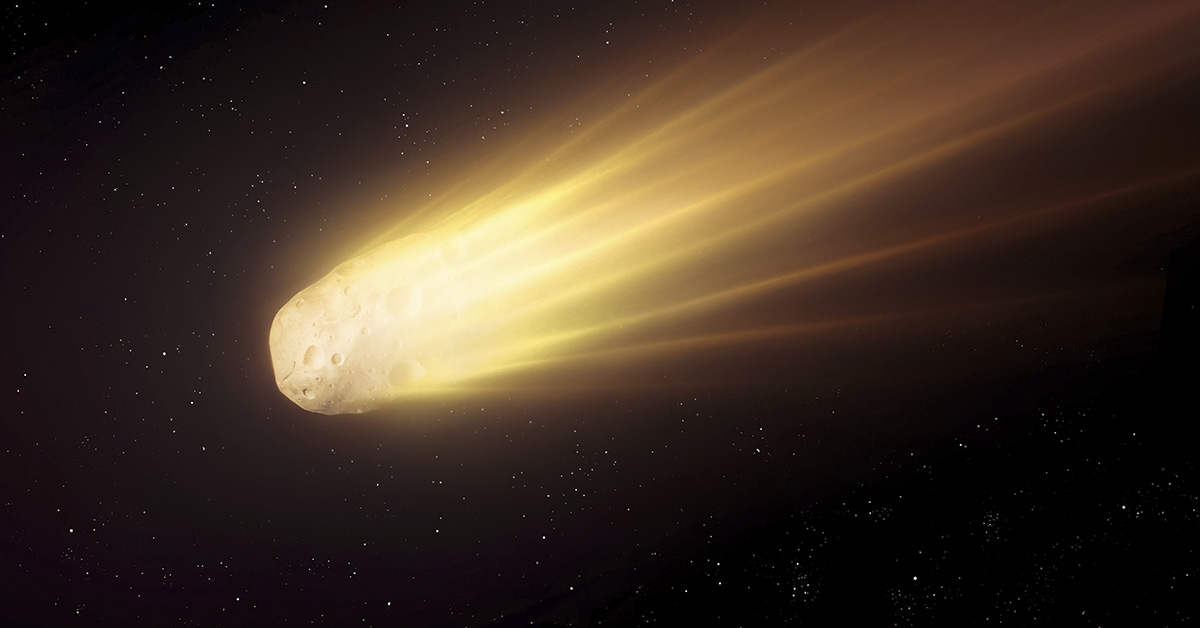

A massive interstellar object is racing through our solar system at breakneck speed, and scientists are scrambling to understand what might be the largest cosmic visitor ever detected. Comet 3I/ATLAS, discovered back in July of this year, is the third known object from deep space, outside of our solar system.
The comet poses no threat to Earth and will remain at a safe distance from Earth. It is predicted that the closest distance 31/ATLAS will come to Earth is approximately 1.8 astronomical units (roughly 170 million miles or 270 million km). On Sunday, around October 30, 2025, the comet will reach its closest point to the Sun, inside Mars’ orbit. The comet is projected to be at a distance of approximately 1.4 au (130 million miles, or 210 million km) from the Sun.
Comet 3I/ATLAS’s unusual trajectory and unprecedented size have ignited debates and theories as to what the object could be. A controversial theory put forward by Avi Loeb, a Harvard astrophysicist and his team is that the interstellar object might be some form of “alien technology.”
3I/ATLAS and Its Significance
The colossal interstellar object was first spotted in Chile by NASA’s ATLAS survey telescope on 1 July, 2025. When astronomers initially saw it, they were not entirely sure exactly what they were looking at. Barrelling at 61 km per second relative to the Sun, the object appeared as a faint blip against the crowded star fields near the galactic center. Within hours, follow-up observations revealed its hyperbolic trajectory, meaning the origins of our cosmic guest may be from another star system altogether.
The discovery itself was almost accidental. Earlier images before the discovery show that 3I/ATLAS had been visible as early as June 14, 2025. The chances are that it was likely overlooked due to the interstellar object passing through a dense cluster of stars in the backdrop of the Milky Way’s centre. The observations were first submitted to the Minor Planet Center (MPC) when the NASA-funded Asteroid Terrestrial-impact Last Alert System (ATLAS) first discovered the comet in July. Amateur astronomers and professional observatories across the globe provided observations to the effort, with the MPC collecting 122 observations from 31 different observatories within days of the official announcement.
An Interstellar Anomaly
This Manhattan-size interstellar wanderer is the third confirmed interstellar object to ever visit our solar system, following ‘Oumuamua in 2017 and comet 2I/Borisov in 2019. What makes 3I/ATLAS particularly special is its incredible magnitude and physical properties. It could potentially be thousands of times more massive than its 2 predecessors and is a “major anomaly” that could give us new insight into interstellar space.
What particularly surprised astronomers is the comets’ bizarre orbits. Unlike average comets that follow elliptical orbits around the Sun, 3I/ATLAS travels on an unbound, hyperbolic path with an eccentricity of 1.2. This means that it will pass through our solar system once, never to return. Its hyperbolic excess velocity of approximately 36 miles (58 km) per second validates its deep space origins, as no gravitational displacement caused by other solar system planets could account for such extreme speed.
A Giant Among Cosmic Pebbles
The size disparity between 3I/ATLAS and its predecessors is tremendous. The first interstellar object, ‘Oumuamua, discovered in 2017, measured roughly 400 meters in length, which is about the size of several city blocks. Comet 2I/Borisov, discovered in 2019, has an estimated diameter of approximately 0.6 miles (1 km). By contrast, 3I/ATLAS dwarfs both with a nucleus potentially spanning roughly 1 to 3 miles across, with recent estimates suggesting it could be even larger.
‘Oumuamua and 2I/Borisov remain small, while 3I/ATLAS allegedly exceeds 33 billion tons. This makes 3I/ATLAS 3 to 5 orders of magnitude more massive than its predecessors. To put this in perspective, that is roughly equivalent to 33 billion compact cars compressed into a single cosmic snowball.
The mass estimate comes from trajectory analysis conducted by Harvard astrophysicist Avi Loeb and his team. By measuring how little the comet’s path deviated from pure gravitational motion despite its active loss of gas. They determined that 3I/ATLAS must be incredibly massive to resist the subtle pushes from its own gas emissions. The comet is shedding material at a rate of up to 60 kgs per second which is enough to erode a millimeter-thick layer from its surface over 6 months.
An Unusual Path Through the Cosmos
3I/ATLAS’s trajectory makes the comet come into close vicinity of 3 planets in our solar system. The comet is predicted to make its way close to Venus, into the orbit of and close to Mars. Finally, it will have a close brush with Jupiter on its way out back into deep space. On October 3, 2025, it approached within 17.4 million miles (28 million kms) of Mars which made it close enough for spacecraft orbiting the Red Planet to capture detailed observations. The European Space Agency’s Mars Express and ExoMars Trace Gas Orbiter successfully photographed the comet during this encounter, providing some of the closest views yet obtained.
Following its Mars encounter, 3I/ATLAS will reach its closest point to the Sun on October 29, 2025, passing just inside Mars’ orbit at a distance of 210 million kilometers. During this perihelion approach, the comet will be moving faster than 150,000 miles per hour as solar heating increases. It will then continue outward, making a relatively close pass by Jupiter in March 2026 before heading back into interstellar space forever.
A Chemical Fingerprint from Another World
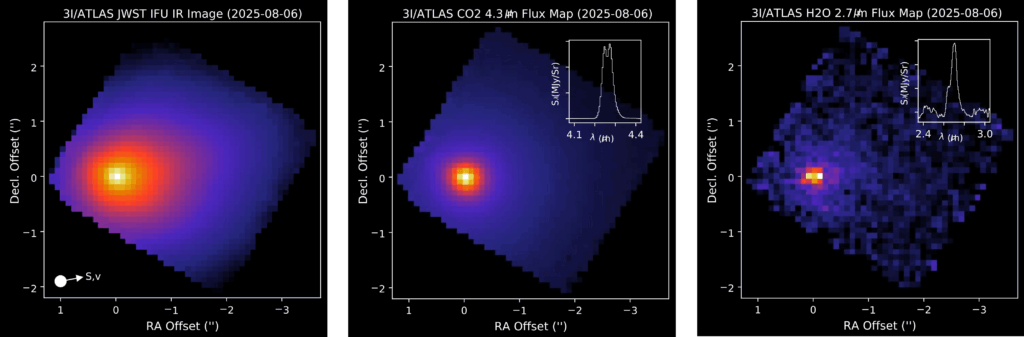
The James Webb Space Telescope sent the first images back to astronomers and they discovered something bizarre. NASA’s James Webb Space Telescope detected an unusually high ratio of carbon dioxide to water in the comet’s coma (envelope surrounding the comet’s nucleus). These ratios are the highest ever recorded for any comet. The unusual carbon dioxide-to-water ratio measured at 7.6 to 1, could give us insight into the comet’s mysterious origins.
The comet may have formed in the outer reaches of its birth system, where carbon dioxide naturally freezes out of the gas. Alternatively, billions of years of exposure to cosmic radiation during its interstellar journey may have created a “cooked shell” on the surface where carbon dioxide ices accumulated.
The James Webb observations also detected water ice, carbon monoxide, and carbonyl sulfide in 3I/ATLAS’s coma. Interestingly, while carbon dioxide dominates, the carbon monoxide abundance appears more typical of solar system comets. NASA’s SPHEREx mission independently confirmed the carbon dioxide-rich composition and detected an extensive gas envelope stretching over 348,000 kilometers in radius.
“Alien” Technology Speculation vs. Actual Science
Many astronomers and scientists celebrate the scientific prospects of the comet, while some researchers pursue something otherworldly. Harvard astrophysicist Avi Loeb suggests that 3I/ATLAS could be alien technology or something extraterrestrial and not a comet. Loeb, who previously made similar controversial claims about ‘Oumuamua, argues that several characteristics of 3I/ATLAS warrant serious consideration of artificial origins.
The evidence Loeb cites includes the comet’s unusual trajectory, which he describes as “intelligently directed” to pass close to potentially habitable planets. The object’s retrograde orbit would theoretically allow it to approach Earth “with relative impunity”. Loeb has even proposed that the comet could gather “astrometric measurements” of planetary orbits to plan the most efficient approach strategy.
However, the scientific community largely rejects Loeb speculations. Many critics note that Loeb has a pattern of associating unusual astronomical objects to extra-terrestrial origins without sufficient evidence. Peers question his methodology and argue he bypasses normal scientific review for media attention.
A Scientific Gold Mine
In spite of the controversy, astronomers and scientists view 3I/ATLAS as an opportunity for scientific discovery. Scientists infer 3I/ATLAS likely orbited a star before ejection. Gravitational interactions ejected it and sent it toward our solar system. Researchers speculate that the comet was ejected from its star system by an encounter with a giant planet or another star. According to initial studies, 3I/ATLAS could be between 3-14 billion years old, which is older than our solar system, which is 4.6 billion years old. 3I/ATLAS offers rare insight into the environments around other stars billions of years ago.
Multiple NASA and international spacecraft are coordinating observations as the comet approaches its most active phase near the Sun. The Hubble Space Telescope has provided the sharpest images of the nucleus, while the James Webb Space Telescope analyzes its chemical composition in incredible detail. NASA’s Perseverance Mars rover has captured images of 3I/ATLAS during the comet’s close approach to the Red Planet.
The Very Large Telescope’s detection of hydrogen cyanide production rates shows the comet becoming more active as it approaches the Sun. On September 14, the cyanide production rate had climbed to 4.5 × 10²⁵ molecules per second, creating a visible coma 180,000 kilometers across. A bizarre finding from researchers indicates that the comet’s tail points towards the sun and not away from it.
Observation by Vera Rubin Telescope
Rubin caught 3I/ATLAS by chance during its Science Validation phase. The telescope imaged the region from June 21 to July 7. Those dates bracketed the July 1 discovery by ATLAS. The early images delivered the sharpest views then available. Rubin’s 8.4-meter aperture and 3.2-gigapixel camera captured a detailed coma. The coma expanded about 58% as the comet came closer towards the Sun. The images revealed the comet has a rare sunward-pointing tail appeared, likely from anisotropic dust emission. Overall, 19 images came from planned validation operations.
The Rarity Problem
One of the most puzzling aspects of 3I/ATLAS is simply that we found it at all. Given the limited supply of heavy elements in interstellar space, astronomers would expect to discover thousands of smaller objects before encountering one of 3I/ATLAS’s size. Astronomers have detected only three interstellar objects in our solar system. These detections suggest large objects like 3I/ATLAS may be more common than expected. Alternatively, we may simply be getting lucky with our discoveries.
A Vanishing Act and Future Encounters
As 3I/ATLAS approaches its closest point to the Sun, it will temporarily be hidden from Earth’s view due to the Sun’s solar glare overshadowing the comet. This temporary disappearance will occur in late October 2025, as the comet enters its most active phase. Despite the obstruction, spacecraft positioned around the solar system will continue monitoring the comet during this crucial period.
The comet is expected to reappear in Earth’s skies by early December 2025, allowing ground-based telescopes to continue their observations. By then, the close solar encounter should have significantly increased the comet’s activity, potentially revealing new details about its composition and structure.
After passing our Sun, 3I/ATLAS will begin its final trajectory out of our solar system. It will make a relatively close pass by Jupiter in March 2026, also being the last opportunity for detailed observations before it returns to the depths of interstellar space. Unlike periodic comets like Hailleys comet that cyclically return, this cosmic visitor will never be seen again once it leaves our neighborhood.
Lessons from an Ancient Wanderer
Whether 3I/ATLAS proves to be a natural relic from another star system or something more alien, its passage through our solar system has already changed our understanding of interstellar objects. The comet’s massive size, unusual chemistry, and trajectory challenge existing models of what we should expect from interstellar visitors.
The detection of such diverse chemistry in the comet suggests that planetary systems around other stars may form under conditions very different from our own. If 3I/ATLAS has indeed been wandering the galaxy for several billion years, it carries within it, a record of cosmic stories from when the universe was much younger.
Read More: Comet Last Seen Around 80,000 Years Ago to Make Close Approach to Earth