
Somewhere inside a 1,600-year-old mummy, tucked against its abdomen, lay one of the most famous poems ever written. The archaeologists who found it had no idea what they were looking at, not at first. They had opened mummies at this Egyptian site before. They had found ritual texts, magical formulas, sealed bundles of papyrus. The contents were always religious, always expected. This time, something was different.
The site is the ancient city of Oxyrhynchus, now the modern town of Al Bahnasa, roughly 200 kilometers south of Cairo. It’s a place archaeologists have been picking through for well over a century, and it never seems to run out of surprises. But what a Spanish-Egyptian team pulled from the ground in late 2025 has no real precedent in the history of archaeology. Inside a Roman-era mummy, they found a sheet of papyrus bearing a passage from Homer’s Iliad, one of the oldest and most enduring works in all of human literature.
Nobody had ever found anything like it before, and nobody is entirely sure what to make of it.
A City That Changed How We Read the Ancient World
To understand why this discovery matters so much, you need to understand where it was found. The Al Bahnasa necropolis, the Egyptian site identified with ancient Oxyrhynchus, was one of the most important cities of Greco-Roman Egypt, located approximately 190 kilometers south of Cairo, next to the branch of the Nile known as Bahr Yussef. The region rarely saw rain, the floodwaters of the Nile never reached it, and those conditions conspired to preserve organic material, including papyrus, for thousands of years.
The Oxyrhynchus Papyri were discovered during excavations by two British archaeologists, Bernard Grenfell and Arthur Hunt, between 1896 and 1907. Tens of thousands of documents dating over a period of about a thousand years were found in the town’s ancient garbage dump. The collection, now housed at the University of Oxford, comprises over 500,000 fragments of literary and documentary texts dating from the third century BCE to the seventh century CE. Among them: fragments of Sophocles plays, early Christian gospels, personal letters, tax receipts, and, yes, other passages from Homer. Approximately 70 percent of all the ancient Egyptian literary papyri so far discovered come from Oxyrhynchus, including copies of well-known standard works and previously unknown works by some of antiquity’s greatest authors.
But all of those papyri came from rubbish heaps and storage rooms. What the Institute of Ancient Near East Studies (IPOA) at the University of Barcelona’s team found inside this mummy came from somewhere no literary text had ever been found before.
The Discovery Inside Tomb 65
The Oxyrhynchus Archaeological Mission, run by the Institute of Ancient Near East Studies (IPOA) at the University of Barcelona and led by Maite Mascort and Esther Pons, identified a papyrus containing a fragment of Homer’s Iliad inside a Roman-era tomb dating to approximately 1,600 years ago. During the campaign carried out between November and December 2025, Núria Castellano’s team discovered a Roman-era mummy in Tomb 65 of Sector 22 that featured an unusual element: a papyrus placed on the abdomen as part of the embalming ritual.
Upon examination, the team revealed a sheet of papyrus inside the mummy’s abdomen containing text from the Iliad, Homer’s epic account of the siege of Troy. The passage is from Book II of the poem, in which Homer cataloged the Greek ships that came to do battle with Troy after Helen, queen of Sparta and daughter of Zeus, was taken there by Paris, the son of the king of Troy. This section of the poem is known as the Catalog of Ships, a detailed roll call of the Greek coalition forces, and it’s one of the most recognizable sections of the entire epic.
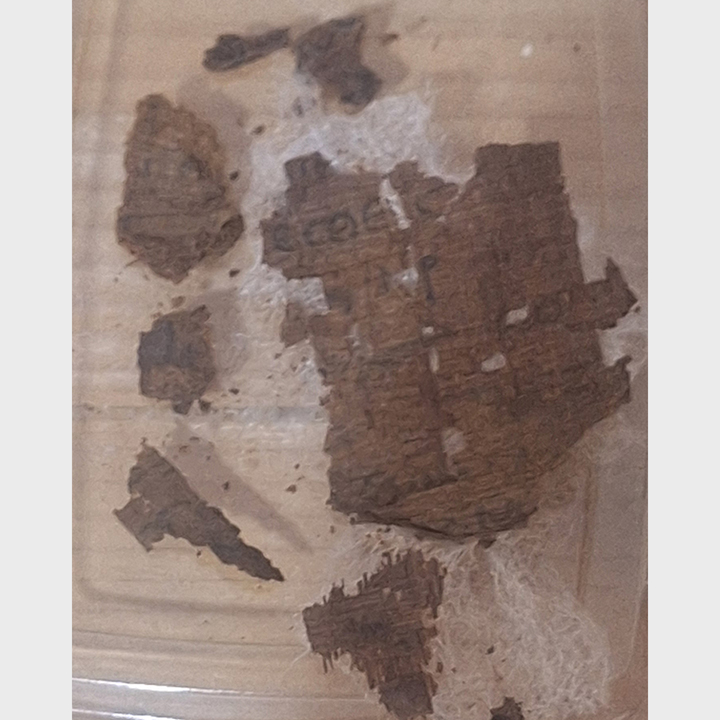
Image Credit: University of Barcelona
Researchers confirmed that the mummy was a male individual, though the investigation is still ongoing. They noted that the person was an adult. Beyond that, little is known about who he was in life. What the team does know is that the text was found in poor condition, and researchers studied it carefully in a lab using noninvasive techniques. They had not yet had the opportunity to study it using high-tech methods such as X-rays, which might allow them to read it better. The team had done all they could without destroying the papyrus, which would have been located at the site of the ancient city of Oxyrhynchus.
The discovery is exceptional: it is the first time in the history of archaeology that a Greek literary text has been found deliberately incorporated into the mummification process.
The Rest of the Tomb
The mummy with the Iliad papyrus was not the only remarkable find from this excavation. The excavation revealed a funerary complex comprising three limestone chambers in which Roman-era mummies and decorated wooden sarcophagi were found, many of them in a state of disrepair due to past looting.
A joint Spanish-Egyptian team unearthed a number of mummies from the Roman-era necropolis, some in wooden coffins, some wrapped in bandages decorated with geometric patterns, three with gold tongues and one with a copper tongue placed inside their mouths. That detail, gold tongues, is worth pausing on. The gold tongue-shaped amulet was placed in the mouth of the deceased person during a special burial ritual to ensure their ability to speak in the afterlife before the court of Osiris, the god of the underworld. The practice is connected to the tradition outlined in the Book of the Dead, the ancient Egyptian collection of funerary spells and magical texts. According to Britannica, the Book of the Dead was made up of spells placed in tombs and believed to protect and aid the deceased in the hereafter, with passages aimed at preserving the body and ensuring the dead could speak, breathe, and eat in the afterlife.
The chambers also housed the cremated remains of adults and an infant, as well as animal remains, notably cats, wrapped in cloth. The team discovered a collection of small terracotta and bronze statues, including representations of the god Harpocrates and a figure of Cupid.
For anyone wondering who these people were, the honest answer is: we don’t know much. What the presence of gold artifacts and professional mummification does tell us is that these were families of some means. The process of mummifying somebody was long, and it took specially trained priests with detailed knowledge of human anatomy around 70 days to complete. It was expensive, which is why it’s mainly the wealthy and royal ancient Egyptians archaeologists find mummified in sarcophagi. If you’re curious about what modern imaging has revealed when researchers have examined Egyptian mummies discovered centuries ago, the findings are just as striking.
What Homer Was Doing in an Egyptian Tomb
Here is where the story gets genuinely puzzling. Finding Homer at Oxyrhynchus is not, by itself, unusual. Papyrologist Leah Mascia, who was involved with the mission, explained that finding a copy of the Iliad in a city like Oxyrhynchus was certainly not unusual. “In the Greco-Roman period, texts such as the Iliad circulated across all Egypt; they were used in educational settings, and copies were even owned by private citizens.”
The poem’s ubiquity made sense given the cultural context. The Iliad and the Odyssey were widely used as school texts in ancient Greek and Hellenistic cultures, and they were the first literary works taught to all students. Particularly in the Hellenistic and Roman periods, the Iliad’s first few books were studied far more intently than the Odyssey. When Egypt came under the rule of Alexander the Great in 332 BCE, Greek became the primary language used in government documents, and the culture it carried, including Homer, spread with it.
What nobody had ever seen before was a Homer passage used as part of the embalming ritual itself. In previous campaigns, the Oxyrhynchus Archaeological Mission had already documented papyri written in Greek in similar positions inside mummies, but all of them contained magical or ritualistic content. Archaeologists had found papyrus texts in other Roman-era mummies before, but in most cases their contents were magical or ritualistic. Researchers believe they were elements related to the protection of the individual.
Little is known about the role of the papyrus in the embalming process, though one possible explanation is that papyri of this kind acted as a kind of signature of the embalmer who had mummified the body. Another theory, offered by Biblical Archaeology Review, connects the poem’s themes to the burial itself. The Iliad is an epic deeply concerned with mortality, fame, and memory, and its heroes confront death while seeking a form of glory that lives on through story. The presence of this text near the burial suggests that, alongside traditional preparations enabling the deceased to speak, there may have been some hope that the living would in turn speak the memory of those individuals into eternity.
That’s a compelling idea. But the lead researcher on the papyrus is careful not to over-reach. Ignasi-Xavier Adiego, a professor of classical, Romance, and Semitic languages at the University of Barcelona, acknowledged in a statement that this was not the first time the team had found Greek papyri bundled, sealed, and incorporated into the mummification process, but that until now their content had been mainly magical. The discovery of what appeared to be ritual instructions written on other papyri had led some to theorize that they had some sort of protective function. “The idea that a papyrus containing a literary text would have fulfilled this same function is much stranger,” he added.
You can look at this differently: if people in Greco-Roman Egypt already believed that words placed inside a mummy held power, perhaps a family that loved Homer, or an embalmer who did, made a different choice about which words to use.
For a fascinating parallel in the field of ancient discovery, this piece on the Antikythera mechanism shows how ancient Greek civilization continued to astonish researchers with artifacts whose purposes remain only partly understood centuries after their creation.
What Oxyrhynchus Keeps Giving
The campaign that produced this find is part of a long-running operation with deep roots. The University of Barcelona’s Oxyrhynchus Archaeological Mission was launched in 1992, led by Professor Josep Padró. It is one of the Spanish archaeological missions with the longest and most consistent track record in Egypt. The project’s latest campaign, carried out between November 2025 and February 2026, concluded with finds of exceptional historical and archaeological significance.
And the team isn’t done yet. Co-director Maite Mascort noted that many other papyri from the site are still undergoing restoration, and the team cannot rule out that some other literary text may also appear. That means the papyrus with the Iliad fragment may not be the only one of its kind. It may simply be the first that has survived long enough, and intact enough, to be identified.
Read More: 9,000-Year-Old City Found Near Jerusalem That Rewrites History
What This Means for How We See the Ancient World
There are two ways to think about this discovery. The first is purely archaeological: a team of researchers has documented something that has never been documented before in the history of their field. No Greek literary text had ever previously been found deliberately built into a mummy. That’s a clean, unambiguous breakthrough, and it opens entirely new questions about how Roman-era Egyptians understood the relationship between literature, death, and the afterlife.
The second way to think about it is more human. Whoever chose to place those lines from the Iliad inside this body, whether the embalmer, the family, or someone else entirely, was making a deliberate decision. They selected a specific text, from a specific book, describing a specific moment in a poem about war, fate, and the fragility of human glory. They placed it near the abdomen of a dead man and sealed it inside. The researchers don’t yet know why. The excavation is still ongoing, the papyrus is still being studied, and the answers, if they come at all, will arrive slowly. Archaeologists hope further analysis will reveal whether this person truly loved Homer, or whether the embalmers simply had something else entirely in mind.
What this discovery reminds us, perhaps most of all, is that the ancient world was far more complex and far more literate than we often give it credit for. The line between the sacred and the literary was not always a firm one. A poem that shaped an entire civilization may, for at least one person 1,600 years ago, have felt like exactly the right thing to carry into eternity.
AI Disclaimer: This article was created with the assistance of AI tools and reviewed by a human editor.
Read More: Stunning Ancient Egyptian Artifacts Unearthed in Secret Chamber 14 Meters Underground