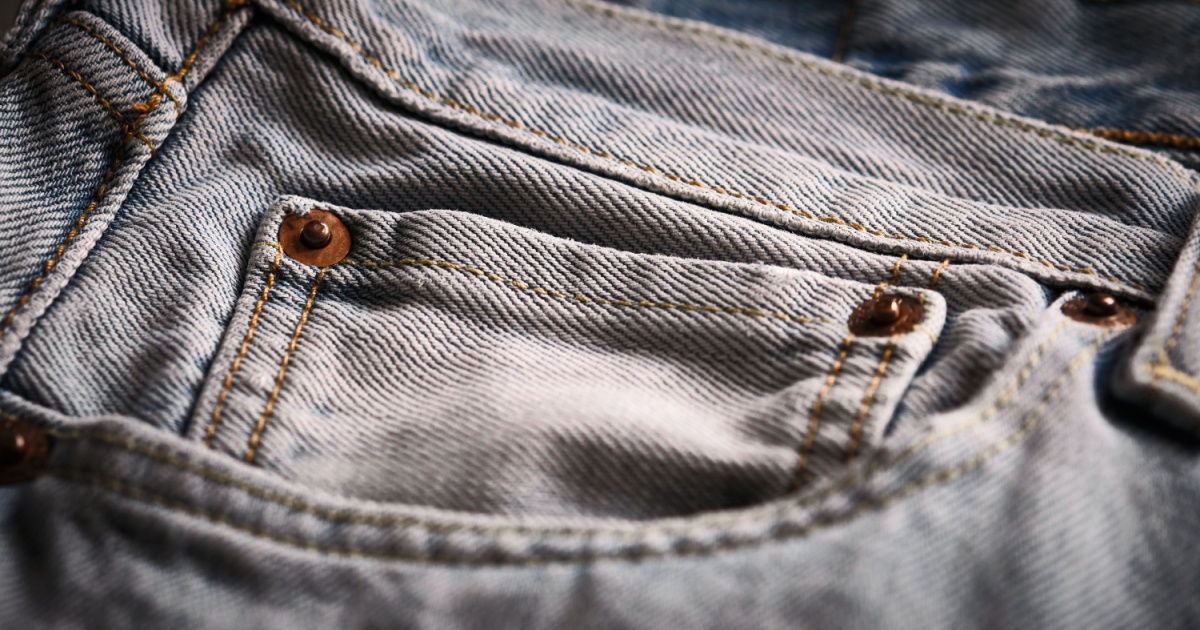

Look down at your jeans right now. Go ahead. Whether they’re dark indigo, faded, or years past their best, they almost certainly have a handful of small copper-colored metal studs near the pockets. Most people who’ve owned jeans their entire lives couldn’t tell you what those little dots are actually called, let alone why they’re there. The answer isn’t hidden exactly, but it’s the kind of thing that got buried under 150 years of fashion trends and brand mythology.
The story starts somewhere most people wouldn’t expect: not in a fashion house, not in a factory, and not in the mind of the name that became synonymous with denim. It starts in a small tailor shop in Reno, Nevada, with an immigrant who was running out of money and had a customer with a very specific complaint about her husband’s pants.
What came next changed American clothing forever. And the tiny metal detail you’ve been sliding your fingers past for years has been carrying that story ever since.
A Tailor, A Problem, and a Stroke of Luck
Jacob William Davis was born on May 14, 1831, and came to the United States as a young man from Riga, a port city in what is now Latvia. By 1868, he had settled in Reno, Nevada, which was then a small railroad town, and by 1869 he had opened a tailor shop on the main street. In that shop, Davis made practical items – tents, horse blankets, wagon covers – for railway workers. The heavy-duty cotton duck cloth and denim he used came from a dry goods company in San Francisco called Levi Strauss & Co.
In December 1870, Davis was asked by a customer to make a pair of strong working pants for her husband, who was a woodcutter. To create suitably tough pants, he used duck cloth and reinforced the weak points in the seams and pockets with the same copper rivets he used on other items. Word of those pants spread quickly among laborers along the railroad. Davis began making the riveted work pants in duck cotton and, by 1871, in denim. Before long, he couldn’t keep up with demand.
The problem was that Davis couldn’t afford to patent the idea. He didn’t have the $68 needed to pay for a patent application. So in 1872, he approached one of his fabric suppliers, Levi Strauss from San Francisco. Strauss paid for the patent while Davis moved to San Francisco to oversee production.
On May 20, 1873, San Francisco businessman Levi Strauss and Reno tailor Jacob Davis were granted a patent to create work pants reinforced with metal rivets, marking the birth of one of the world’s most famous garments: blue jeans. The patent, number 139,121, was titled “an Improvement in Fastening Pocket Openings” – and the riveted blue jean was born.
Why the Pockets Kept Falling Apart
To understand why the rivets mattered so much, you have to understand what life looked like for the people wearing those pants.
By the late 19th century, what we now call jeans – then more commonly known as “waist overalls” – had become the standard uniform of hard labor in the United States. Gold miners, railroad workers, farmers, and teamsters all relied on the garment’s sturdy material to endure long days of physically demanding work.
The problem wasn’t the fabric. One of the most common complaints workers had was that pocket corners and other stress points would wear out and tear prematurely. Miners carried heavy rocks and tools in their pockets. Farmhands hoisted gear. Railroad workers hauled equipment all day. The repeated stress at the pocket corners and the base of the fly simply overpowered the stitching, and pants would split right where they were needed most.
The rivet innovation introduced metal rivets to reinforce common points of stress on pants, particularly at pocket openings and seams, solving the long-standing issue of garments tearing under strain, according to Levi Strauss & Co.. But simple solutions, applied at the right moment, tend to last. This one lasted more than 150 years.
The original patented pants had four pockets in total: three on the front, including the small pocket above the larger right front pocket, and one riveted back pocket on the right side beneath the leather patch. Copper rivets kept the pockets from ripping and made the openings stronger and more secure.
The Patch, the Partnership, and the Patent That Rewrote Clothing
What happened after May 20, 1873 was rapid. Levi Strauss brought Davis to San Francisco to oversee the first manufacturing facility for “waist overalls,” as the original jeans were known. At first they employed seamstresses working out of their homes, but by the 1880s, Strauss had opened his own factory.
Less than two years later, on March 16, 1875, they secured a reissue of their patent, expanding the scope beyond “pantaloons” to include “other garments” with riveted pocket openings or seams. By broadening their claim, they ensured the versatility of their invention across different types of apparel. The reissued patent also emphasized the use of rivets to strengthen seams under constant strain.
When the original patent expired in 1890, rivets became a standard feature of jeans broadly. That’s when Levi’s began campaigning their claim to the invention. The company went on to trademark other distinctive details over the following decades – including the two-horse label, the red tab, and the arcuate back-pocket stitching – building a brand identity around authenticity and durability that persists to this day.
When Rivets Became a Problem
The rivets worked brilliantly for miners and railroad workers. For everyone else, they became a source of complaints. When Levi Strauss & Co. first manufactured its patent-riveted denim overalls in 1873, they added a single pocket to the back right side of the pants. Like the front pockets, rivets placed at the top corners of the back pockets prevented them from tearing.
But copper on furniture is not a welcome combination. The back pocket rivets remained a key feature of the pants for almost 40 more years – until someone complained. And then someone else. And yet another until the company got the message. The rivets scratched furniture and saddles and were becoming a nuisance.
In 1937, Levi’s made the switch, taking the rivets undercover and patenting the new process as U.S. Patent No. 1999927, according to a 2022 report from Levi Strauss & Co.. The back pocket rivets were sewn over rather than removed, preserving the structural benefit while eliminating the scratching problem. By 1966, Levi’s decided to remove the rivets altogether from the back pockets and replace them with heavy stitching – known as bar tack stitching – a fix that remains to this day.
The fly rivet had a similarly eventful history. One early Levi’s design included a rivet at the base of the fly. That feature was removed during World War II to cut back on the use of raw materials needed for the war effort. This decision was also rumored to have been inspired by the discomfort the small piece of metal caused when it heated up while sitting around a campfire. Whether that story is apocryphal or not, the crotch rivet never came back.
That Tiny Pocket Has Its Own Story
Almost everyone who wears jeans has wondered about the small pocket nested inside the larger front right pocket. It’s too small for a phone, awkward for car keys, and baffling to most people who encounter it. According to Levi Strauss & Co.’s pocket history, the small pocket on the right front side is called a “watch pocket,” since it was intended to store a pocket watch – a typical possession during the late 1800s.
Its purpose was specifically to protect 19th-century pocket watches – bulky, fragile timepieces that were essential equipment for cowboys, miners, railroad workers, and other manual laborers who made up the original target market for blue jeans. Before the wristwatch existed, a pocket watch on a chain was how working people kept time, and it needed a secure, protected place to sit while its owner was doing physically demanding work.
The curious small pocket is present on the oldest pair of jeans in the Levi’s archive, confirmed through archival research by the company’s historian and design director. You can read more about that discovery on the Levi Strauss & Co. archives page. During World War II, the rivets on the watch pocket were removed to save metal needed for the war effort – one of a series of wartime design compromises that quietly reshaped what jeans looked like. The rivets on the watch pocket were removed but reappeared after the war, unlike the crotch rivet.
If you’ve ever wondered about other everyday products that carry a hidden origin story, the canola oil origin story follows a surprisingly similar arc: a practical problem, an unexpected solution, and a brand name that obscured the real story for decades.
Do Rivets Still Do Anything Today?
Strictly speaking, modern manufacturing has made rivets structurally optional. Thanks to modern industrial technologies, the seams on today’s jeans are so robust that rivets are usually no longer necessary for stability. High-quality fabrics are now woven to be particularly tear-resistant. Modern jeans are also made with high-quality threads and improved stitching techniques, meaning the seams can withstand high levels of wear even without additional rivet reinforcement.
Even though some jeans don’t have rivets at all – and even though most jeans wearers in the 21st century don’t need the durability rivets offer – the detail remains because it’s become a defining feature of jeans. Brands keep them partly for tradition, partly because customers expect them, and partly because removing them would feel like removing something essential from the garment’s identity. Today, the metal studs on jeans are not essential for durability, since seams are more modern and allow the pants to better withstand tension. However, brands keep them as a tribute to history and as a symbol of authenticity.
The front pocket rivets, for what it’s worth, do still offer some functional reinforcement at stress points. If you regularly carry heavy items in your pockets or work with your hands, the copper studs at the pocket corners are doing something real. For most people in 2026, though, they’re a 153-year-old design detail that outlasted the conditions that created it.
Read More: Canola Oil’s Surprising History
What This Means for You
Next time you pull on a pair of jeans, take a second to notice those little copper dots. The patent that created them was granted on May 20, 1873 – before the telephone was in common use, before the light bulb was patented, and before most of the modern world existed. They solved a real problem for real people doing brutal physical work, and that solution proved durable enough to outlast everything.
The broader takeaway here isn’t just trivia. The story of the jeans rivet is a reminder that design details we take completely for granted often carry specific, practical origins. The watch pocket was designed for an accessory that hasn’t been standard for over a century. The back-pocket rivets were quietly removed in the 1960s. The crotch rivet disappeared during wartime. What remains on your jeans today is a curated selection of 19th-century engineering decisions, filtered through decades of customer complaints, wartime resource constraints, and evolving fashion.
That’s a lot of history for a pair of pants you probably put on without thinking this morning.
AI Disclaimer: This article was created with the assistance of AI tools and reviewed by a human editor.
Read More: Things Americans Think Are Normal But the World Finds Weird