
Somewhere in the middle of Zambia, hot springs bubble quietly through the savanna. They look unremarkable. Travelers pass them. Locals have known them for generations. But the gas rising from that warm, trembling water has just set the scientific world humming – because it carries a chemical signature that was never supposed to be reachable this far from any known tectonic boundary.
That signature belongs to Earth’s mantle – the vast, semi-molten layer of rock that sits tens of miles beneath the crust. The fact that it’s showing up at the surface in central Africa is not supposed to happen in a geologically “quiet” zone. And yet, here it is. Rising. Measurable. Undeniable.
What scientists think this means is almost too large to fully absorb. If they’re right, Africa may be in the very earliest stages of splitting apart – and the crack is forming along a fault zone that geologists had, until recently, written off as dormant.
The Rift That Wasn’t Dead
Geologists long thought the Kafue Rift was dead. But experts now say it has shown signs of activity in recent decades, with growing evidence suggesting it could be turning into a new continental rift – one that could eventually become a new boundary between tectonic plates, creating a brand-new sea in the process.
The Kafue Rift is part of a 2,500-kilometer-long zone of rifts running from Tanzania to Namibia, a system that may ultimately reach the mid-Atlantic ridge. That’s a remarkable claim, and for years it remained mostly speculative. Geologists had spotted suspicious hints: odd topography, unusual heat readings, subtle shifts in the ground. But geological suspicion is one thing. Chemical proof is another.
Prior studies had gathered suggestive clues – earthquakes too faint for humans to feel but strong enough for instruments to detect, elevated underground temperatures, and minute changes in ground elevation spotted from satellites – all suggesting the area could be tectonically active. What was missing was direct geochemical evidence that the crust had actually broken through to the mantle below.
What the Hot Springs Revealed
That missing piece arrived in May 2026, when researchers published their findings in a study in Frontiers in Earth Science. The scientists visited eight geothermal wells and springs across Zambia – six within the suspected rift zone and two outside it. They collected gas samples from freely bubbling water and analyzed them in the laboratory to identify the isotopes of each element present. Isotopes are different forms of an element, present in different proportions in the crust versus the mantle, which made them ideal for pinpointing the origin of the gases.
The team was primarily hunting for helium – specifically, the ratio between two of its forms. Researchers focused on the ratio between helium-3 and helium-4, looking for a telltale sign that the springs had a connection with Earth’s mantle, the layer sandwiched between the crust and the core that’s hundreds of miles thick.
Rūta Karolytė, who led the study as a postdoctoral research fellow at the University of Oxford, explained the core finding to CNN: “We found more helium-3 than you’d normally find in the crust, which is generally a signal of mantle fluids coming up into the water.”
The helium couldn’t have come from the atmosphere, because the isotope ratios weren’t consistent with what’s found in air. Nor could it have come purely from the crust, because there was simply too much of the mantle-sourced variety present. The samples from the Kafue Rift also contained a proportion of carbon dioxide consistent with mantle fluids.
The two control springs sampled outside the rift zone? They didn’t show a similar increase in the helium-3 ratio – which tells researchers the signal isn’t random background noise. It’s specific to the rift.
Reading the Signal
To understand why this matters, it helps to know how rift systems actually work. Continental rifting happens when tectonic forces slowly stretch and thin Earth’s lithosphere – the rigid outer shell. Over geological timescales, these processes can split continents apart and eventually form new ocean basins.
Continental breakup doesn’t usually begin with dramatic volcanic eruptions or giant cracks opening in the ground. In its earliest stages, the process is much quieter, marked by slowly stretching crust, subtle fault movement, and gases escaping upward through fractures deep underground. That quiet profile makes early rifts extraordinarily hard to detect – which is exactly what makes the Kafue findings significant.
Mike Daly, a visiting professor in Earth sciences at the University of Oxford and a co-author of the study, described what a rift actually is: “A rift is a large break in the Earth’s crust that creates subsidence and associated elastic uplift. A rift may become a plate boundary, but commonly a rift’s activity ceases before the point of lithospheric break-up and plate boundary formation.”
In other words, not every rift goes all the way. Most stall out before reshaping geography. The question with the Kafue Rift is whether this one has staying power. And the helium data, according to researchers, suggests it just might.
Helium isotopes provide a signal of early-stage rifting. Using the more mature East African Rift System as a model, scientists predict that with time, carbon dioxide will become more prominent as volcanic centers develop. The Kafue samples currently show a pattern consistent with the very earliest stages of that sequence – similar to early segments of the East African Rift before it became the well-known geological feature it is today. You can read more about the mysterious deep-Earth structures already known to sit beneath Africa in this piece on giant mystery structures found beneath the continent.
A Pathway Across a Continent
The implications reach far beyond Zambia. Folarin Kolawole, an assistant professor of Earth and environmental sciences at Columbia University who was not involved in the study, called the findings novel and exciting, describing them as providing a “strong confirmation” that mantle fluids are flowing directly upward through newly forming rift zones. “The key significance of a new plate boundary in southwestern Africa,” he wrote, “is that we now have an established pathway for the continent to break up from eastern Africa all the way through Botswana and Namibia to the Atlantic Ocean.”
If confirmed, this would indicate a partitioning of the Nubian Plate from the newly recognized San Plate, connecting the African Rift System to the Mid-Atlantic Ridge via the Walvis Ridge. That is a continental-scale reorganization of Earth’s surface geology – unfolding in geological slow motion, but real and measurable right now.
The comparison to the East African Rift is useful here. Scientists believe East Africa is already undergoing continental rifting through the well-known East African Rift System. That system, visible in the spectacular lakes and escarpments of Kenya and Tanzania, has been developing for millions of years. As Daly noted, the East African Rift has many features that suggest it will ultimately become a major continental break-up zone – but its rate of rifting is slow, and mid-ocean ridges on almost all sides of Africa tend to inhibit further east-west or north-south extension.
That’s part of what makes the southwestern system so interesting to researchers. Scientists say the Southwest African Rift System may actually have structural advantages over the East African system when it comes to forming a future tectonic boundary.
How Long Would This Take?
Here’s where the science meets reality: none of this will happen on any human timescale. Daly indicated the transformation could occur within a few million years at the fastest – though the process might take between 10 and 20 million years.
Estella Atekwana, a distinguished professor of Earth and planetary sciences at the University of California, Davis, who was not involved in the study but reviewed the findings, offered a striking way to frame the discovery: “This does not mean Africa is splitting apart tomorrow; these processes unfold over millions of years. But scientifically, it would be like catching a plate boundary in the act of being born.”
That framing is key. The planet’s tectonic plates have been rearranging themselves since long before life existed. The plates slide over the mantle at roughly the same speed as human fingernail growth, and it was that movement, about 200 million years ago, that began separating a giant landmass called Pangea into the continents we recognize today. What researchers may be looking at in Zambia is the earliest detectable whisper of the next great reshaping – one that will be finished long after our species is gone.
Caveats the Scientists Are Clear About
This is a preliminary result, and the researchers are the first to say so. Atekwana noted that more evidence along the whole proposed boundary is needed to determine whether the mantle’s helium signal is continuous or only local. “This is one important line of evidence, not the final word. It supports the hypothesis of early-stage rifting, but confirming a new plate boundary requires a full plate-boundary-scale test,” she said.
The current result is preliminary in part because the samples come from just six sites within a highly concentrated area. The Southwest African Rift System stretches for thousands of kilometers. Whether the mantle connection detected in Zambia extends continuously along that entire corridor – or is a localized anomaly – is the central question still to be answered.
According to Daly, the team is already working on follow-up studies to expand their analysis to the broader region. If similar mantle-derived anomalies are found elsewhere, it would provide further compelling evidence for a plate boundary capable of splitting a continent.
The researchers also caution against over-reading the geological endgame. Karolytė was careful to note that an active rift developing “doesn’t necessarily mean that in 100 million years you’re going to have an ocean there. But it is a possibility.”
The Unexpected Upside for Zambia
While the big-picture geology plays out over millions of years, the economic potential of an active rift is much more immediate. In the near term, Zambia could benefit economically by harnessing geothermal energy, as plants are already emerging in the area. The landlocked nation could also potentially collect the helium rising from the rift, which is in high demand with several applications in medicine and the tech industry.
The rifting process releases helium that has accumulated in rocks over geological timescales, with concentrations reaching 2.3% in surface fluids. This element has critical applications in medicine and high-tech industries, and the elevated levels have already attracted commercial interest.
Rift systems in their early stages offer potential for geothermal energy that could benefit local economies. Unlike mature rifts, where mantle fluids arrive mixed with volcanic gases, early-stage rifts offer cleaner and more manageable access to the Earth’s internal heat. That’s a meaningful distinction: the Kafue Rift’s relative youth, scientifically speaking, is actually an asset when it comes to resource extraction. For a country like Zambia, where energy access and resource development are ongoing national priorities, the timing of this research is potentially significant.
Read More: Scientists Warn Of Huge Underwater Volcano Expected To Erupt After Swelling Was Spotted
What This Means for the Bigger Picture
Catching a tectonic plate boundary in the process of forming is, as the scientists involved have noted, an extraordinary event in geological terms. Most of what we know about how continents split apart comes from studying rifts that are already well-developed – places like the East African Rift or the ancient seams preserved in geological records. A system this young gives researchers a rare window into the beginning of the process, before volcanism and major seismic activity have complicated the picture.
As Karolytė put it: “If the Kafue Rift is part of a newborn plate boundary, it gives us a rare opportunity to study the birth of a plate boundary before volcanism, large earthquakes, and major surface deformation have overprinted the original conditions.”
The short version: what’s happening beneath Zambia right now is, on a geological timescale, the equivalent of a birth announcement. Africa’s future shape – unrecognizable to any human who might live to see it – is already, invisibly and slowly, being decided. According to phys.org’s report on the study, the team’s next phase of research, which is already underway, aims to test whether that mantle connection extends across the full length of the rift corridor. If it does, the case for a new tectonic plate boundary will be considerably stronger.
For now, the hot springs of Zambia keep bubbling. And with each bubble, a little more of Earth’s deep interior escapes to the surface – carrying a story about where this continent is, very slowly, headed.
Why This Discovery Matters Right Now
Science rarely gets to witness a beginning. It studies endings, echoes, and ancient records carved into rock. That’s what makes the Kafue Rift findings genuinely unusual: researchers may be watching the very first measurable chapter of a geological story that will take tens of millions of years to complete.
For most of us, the idea of a continent splitting apart feels abstract – something out of a documentary about deep time, not something happening underneath a real place where real people live. But the hot springs, the helium, and the mantle signal rising through Zambia’s crust are not abstract. They are concrete, chemical, and measurable. The scientists involved are careful not to overstate what a single study can prove. But they are also clear that what the data shows is real, specific, and worthy of serious attention.
The practical takeaway is this: follow the next phase of research. If the mantle connection detected in Zambia is confirmed to extend continuously along the Southwest African Rift corridor, the scientific case for a genuinely new plate boundary – and everything that implies for Africa’s geological future – will be on very solid footing. That confirmation won’t come from one study. It will come from the slow accumulation of evidence from many sites, over many years. The Kafue hot springs have opened the door. The science that follows will tell us just how wide it goes.
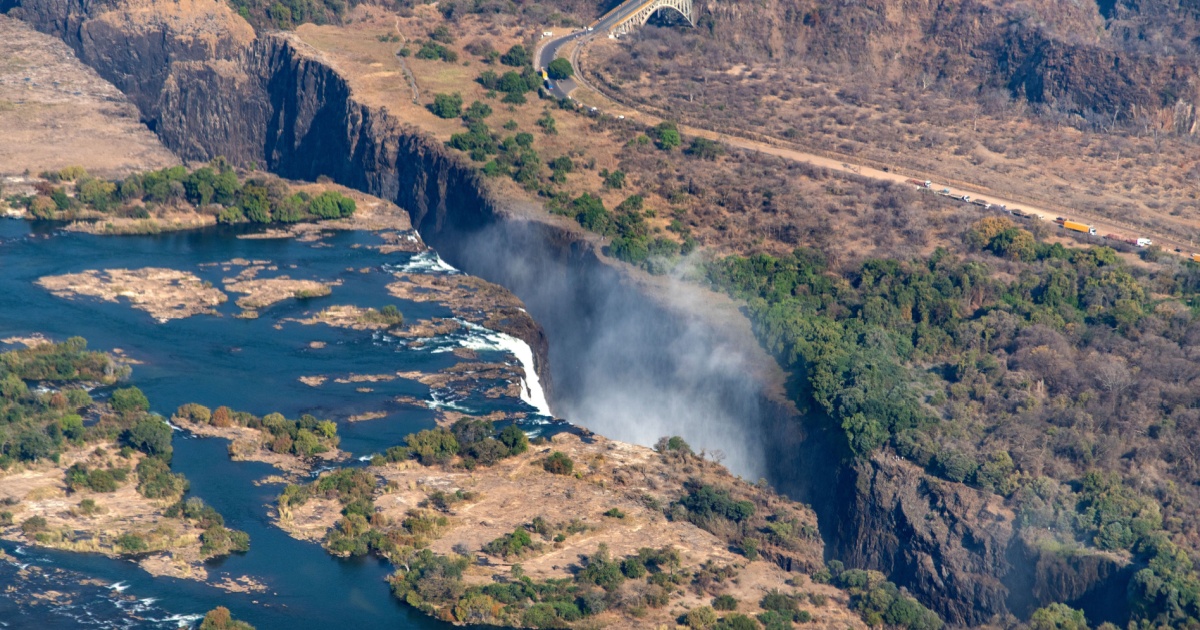
Editor’s Note: The lead image is an aerial helicopter photo of Victoria Falls and is used for representational purposes of Zambia. The image does not depict the Kafue Rift fault zone.
AI Disclaimer: This article was created with the assistance of AI tools and reviewed by a human editor.
Read More: Food Shortage Kills Tens of Thousands of Penguins Off African Coast