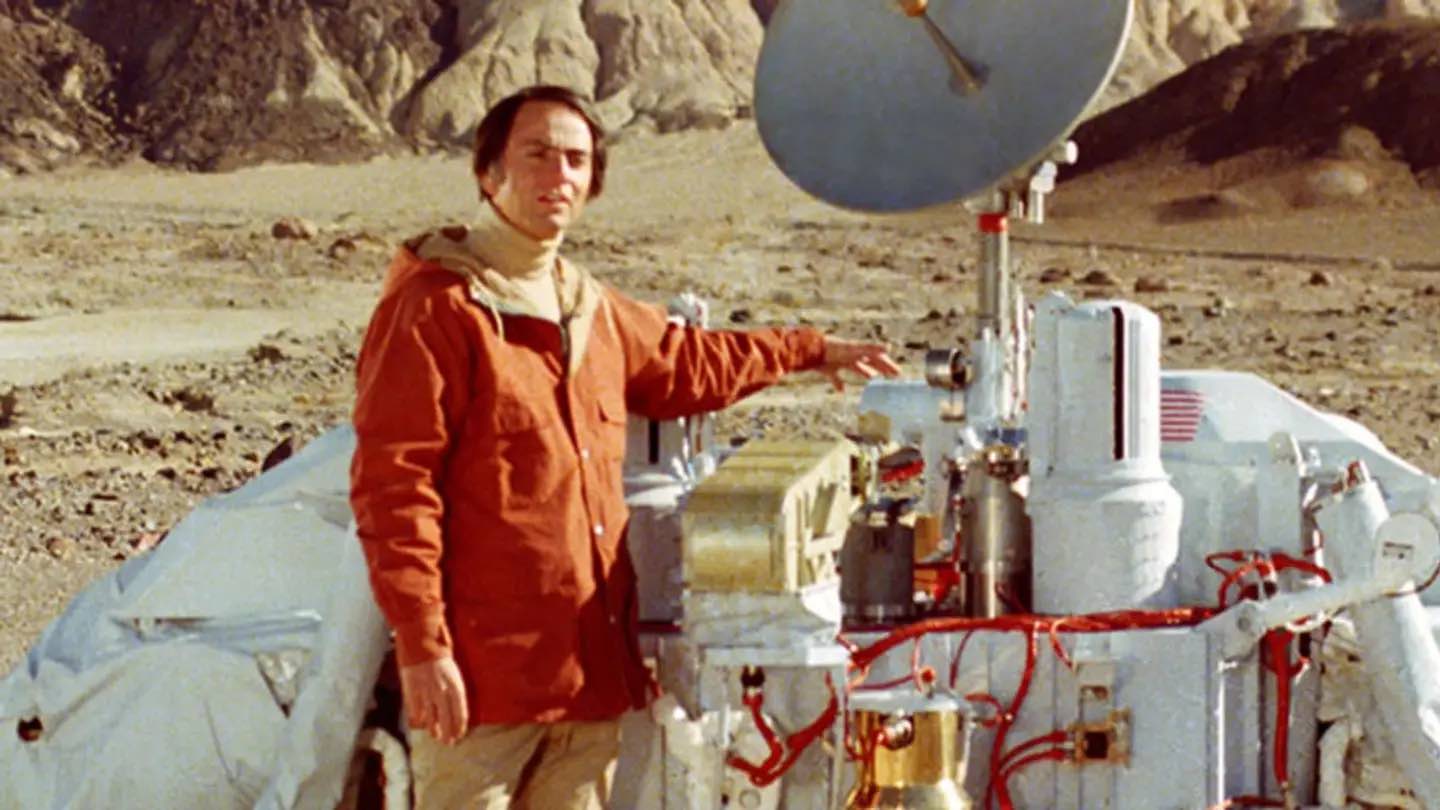

There are moments when someone says something so precisely true that it doesn’t age. It just waits. Thirty years after Carl Sagan last appeared on television, his words from a single interview keep resurfacing online, shared by people who feel like he must have known something the rest of us were only beginning to understand. They feel less like a prediction and more like a diagnosis written in advance.
Sagan died in December 1996 at the age of 62. But in one of the last interviews he gave, sitting across from journalist Charlie Rose, he said something quietly devastating. He didn’t raise his voice. He didn’t make it partisan. He simply described the conditions under which a democracy becomes vulnerable to the people who most want to exploit it. And somehow, it sounds more urgent today than it did when he said it.
What was the warning, exactly? And what does it actually mean to take it seriously in 2026?
Who Carl Sagan Was, and Why His Voice Still Carries
Before getting to what he said, it helps to understand why Sagan’s words carry the weight they do. He wasn’t a political commentator or a polemicist. He was a scientist, an educator, and probably the most effective science communicator the 20th century produced.
His 1980 television series Cosmos: A Personal Voyage was the most widely watched series in the history of American public television until Ken Burns’s The Civil War aired a decade later. It won two Emmys and a Peabody Award, and went on to be broadcast in more than 60 countries, reaching over 500 million people. That kind of reach, for a science documentary, is almost unimaginable now. But it reflects what Sagan had that so few scientists possess: the ability to make people feel that understanding the universe was something they were personally invited to do.
A cosmologist and science educator, Sagan made a name for himself in popular culture as an author of more than a dozen books bridging the gap between scientific complexity and the people who live in it. Intelligent and eloquent, he had a way of making science palatable for the average person, always advocating for healthy skepticism and the scientific method to seek answers to questions about our world.
The warning that resurfaces again and again was taken from his 1995 book The Demon-Haunted World: Science as a Candle in the Dark. The book was published just a year before his death, and it reads, in retrospect, like someone who understood exactly where things were heading.
The Warning Itself
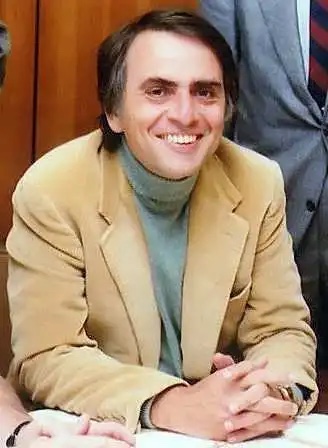
In a 1996 interview with journalist Charlie Rose, filmed just a few months before his death, Sagan stressed the importance of public science education and pointed out that technology was progressing faster than the general public could understand it.
His first concern was structural. He told Rose: “We’ve arranged a society on science and technology in which nobody understands anything about science and technology, and this combustible mixture of ignorance and power sooner or later is going to blow up in our faces. I mean, who is running the science and technology in a democracy if the people don’t know anything about it?”
That’s a practical, civic question. If the voters don’t understand the technology shaping their lives, then the choices made about it, from healthcare policy to artificial intelligence to pharmaceuticals, are effectively made without the public’s informed participation. The form of democracy remains, but its substance hollows out.
The second part of what he said is the part that has circulated most widely. He argued that “science is more than a body of knowledge, it’s a way of thinking. A way of skeptically interrogating the universe with a fine understanding of human fallibility. If we are not able to ask skeptical questions to interrogate those who tell us that something is true, to be skeptical of those in authority, then we’re up for grabs for the next charlatan, political or religious, who comes ambling along.”
That word, “charlatan,” is specific. A charlatan isn’t someone who is simply wrong. A charlatan is someone who performs authority without having earned it. Someone who uses confidence, spectacle, and the appearance of knowledge to occupy the space that real expertise would otherwise fill. Sagan wasn’t predicting a particular person. He was describing a condition that a scientifically illiterate public creates for that kind of person to walk straight into.
The Connection to Democracy
Sagan explicitly tied scientific skepticism to the health of democratic governance, and he traced the idea back to the founding of the republic.
He invoked Thomas Jefferson directly: “It wasn’t enough, he said, to enshrine some rights in the Constitution and the Bill of Rights, the people had to be educated and they have to practice their skepticism and their education. Otherwise, we don’t run the government, the government runs us.”
This is a key distinction. Sagan wasn’t arguing for scientific literacy so people could pass a test or score well in a quiz. He was arguing that the ability to think critically, to ask who benefits from a claim, to demand evidence before accepting an assertion, is the mechanism through which citizens retain actual power. Without it, you have elections but not self-governance.
He once imagined a future America “in which key manufacturing industries have slipped away to other countries, where people have lost the ability to set their own agendas or knowledgeably question those in authority, and no one representing the public interest can even grasp the issues.” His line from The Demon-Haunted World is particularly stark: “Once you give a charlatan power over you, you almost never get it back.”
That sentence lands differently now than it might have in 1995. The fact-checking website Snopes has confirmed these passages as authentic Sagan quotes, noting they come directly from the published book.
Where Things Stand Now
Whether Sagan’s warning has “come true” is a question that depends heavily on your political perspective. What is easier to measure, objectively, is the landscape of trust and belief he was worried about.
A 2025 survey by the Pew Research Center, used as a standard measure of public opinion on science, found trust in science ticking up slightly, but also found that the results highlight a significant partisan split on many key issues. Many more Republicans are distrustful of scientists compared with Democrats, a partisan divide that has existed for decades and grew sharply during the Covid-19 pandemic.
The data on conspiracy beliefs tells a parallel story. A 2025 nationwide survey asked over 1,000 people whether they agreed with a series of statements mixing conspiracy beliefs with basic scientific facts. Between 9 and 38 percent of respondents agreed with the conspiracy statements, and comparing results with a 2021 version of the same survey shows minor shifts leaning toward greater acceptance of conspiracies or less support for science.
Respondents who were more likely to get their science-related information from social media or AI programs tended toward more conspiracist beliefs. Sagan couldn’t have predicted social media, but the mechanism he described, where people who lack the tools to evaluate claims become vulnerable to confident-sounding misinformation, maps cleanly onto what researchers are now documenting.
The Part Sagan Said Was Solvable
One of the things that gets lost when Sagan’s warnings circulate online is that he wasn’t a pessimist. He believed the problem was real, but he also believed it was correctable.
When Rose suggested that people might not “want to learn” about science or that its concepts were too complicated for the average person, Sagan pushed back firmly. He pointed out that people read the stock market pages and understand financial data. “Understanding science is not more difficult than that,” he said.
His book The Demon-Haunted World is, at its core, a guide to what he called a “baloney detection kit.” Not a science textbook, but a set of thinking habits: demanding sources, recognizing logical fallacies, looking for evidence that could disprove a claim rather than just confirm it. He argued that science works better than any other system because it has a “built-in error-correcting machine.” Superstition and pseudoscience, he wrote, get in the way of people’s ability to appreciate the beauty and benefits of science, while skeptical thinking allows people to construct and recognize valid and invalid arguments.
A 1997 review in Smithsonian magazine described his motivation this way: Sagan wrote in defense of science and reason “in a world he sees as darkened by ignorance, superstition, pseudoscience, deceitful advertising and mindless television.” That world sounds familiar. It also had a solution: not more passive consumption of facts, but active engagement with how we decide what’s true.
What This Means for You
Sagan’s warning was never really about any one politician or any single era. It was about a gap, a specific vulnerability that opens when people don’t have the tools to evaluate what they’re being told. That gap doesn’t belong to one political party or one generation. It belongs to all of us, and it closes through the same means it has always closed: education, skepticism, and the willingness to change your mind when the evidence demands it.
The practical takeaway from his work isn’t a reading list. It’s a habit. When someone makes a claim, ask where the evidence comes from. Ask who benefits if you believe it. Ask whether there’s a way to test it. Sagan understood that questioning those in authority is not disrespect; it is the spirit of science. And if we fail to do it, or if we are not allowed to do it, he warned what follows: we no longer run the government. The government runs us.
He wrote those words in a book published three decades ago. The fact that they feel written for this week says less about Sagan’s ability to see the future than about how consistent human nature is when it goes unchallenged. Science, he believed, was the most reliable tool we have to challenge it. Using that tool is not the job of experts alone. It’s the job of every person who votes, every person who shares a story online, every person who decides what is true.
The charlatan, whoever they are, only gets traction in the dark. Sagan spent his life trying to keep the lights on.
AI Disclaimer: This article was created with the assistance of AI tools and reviewed by a human editor.
Lead Image credit: NASA/JPL | Public Domain
Read More: Here’s What ChatGPT Predicted if Billionaires Were Taxed at the Same Rate as Everyone Else