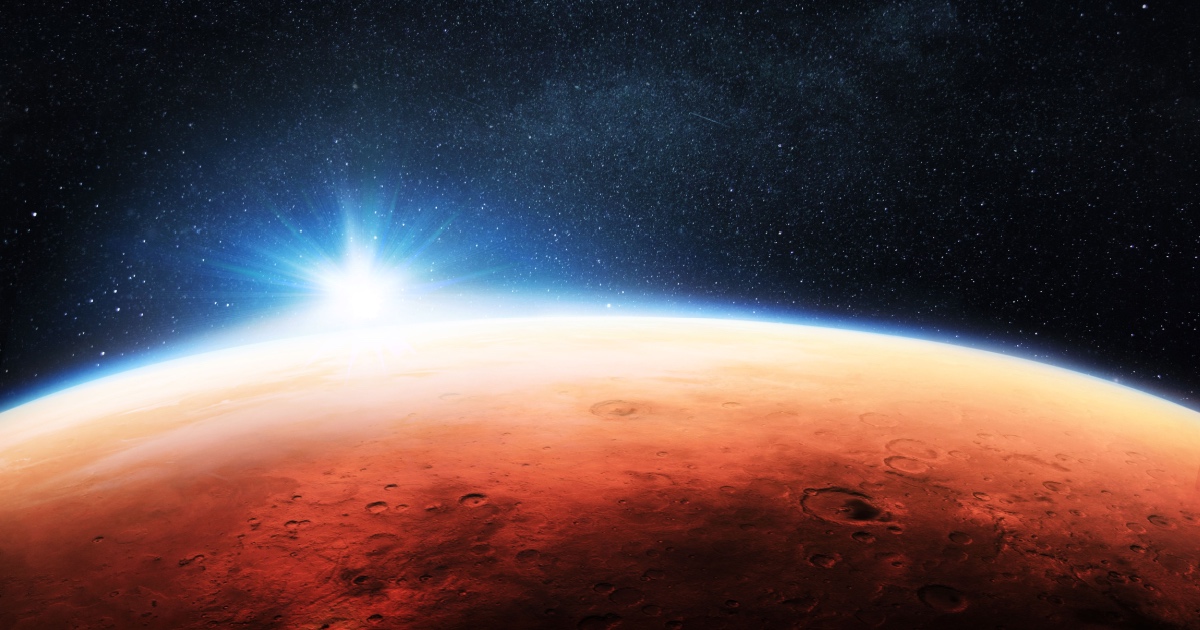

The sun goes down blue on Mars. That single fact, confirmed by multiple NASA rovers over five decades of photography, inverts everything intuitive about looking at the sky on another world. On Earth, sunsets blaze orange and red. On Mars, the horizon fades to a cool, pale blue as the sun dips below the rim. The planet famous for its rust-colored dust produces an evening sky that looks closer to an overcast Arctic afternoon than a desert dusk.
The first humans to see this were not astronauts. They were engineers and scientists watching image data arrive from a machine sitting 140 million miles away.
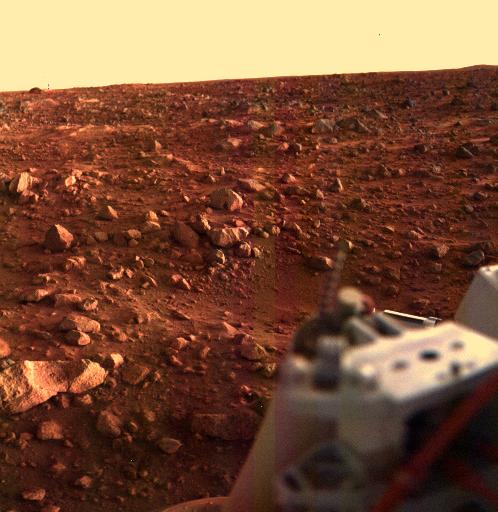
NASA’s Viking 1 lander was the first to show humans what a sunset looked like on Mars, capturing that view on August 21, 1976. That single frame, grainy by modern standards, marked the first time any person had seen the end of a day on another planet. Nothing before it in human history had come close. The image was real, taken by a machine resting on actual Martian soil, and it showed a sun smaller than the one we know, sinking over a cold, nearly airless plain.
The Mars Sunset Photographs That Changed Everything
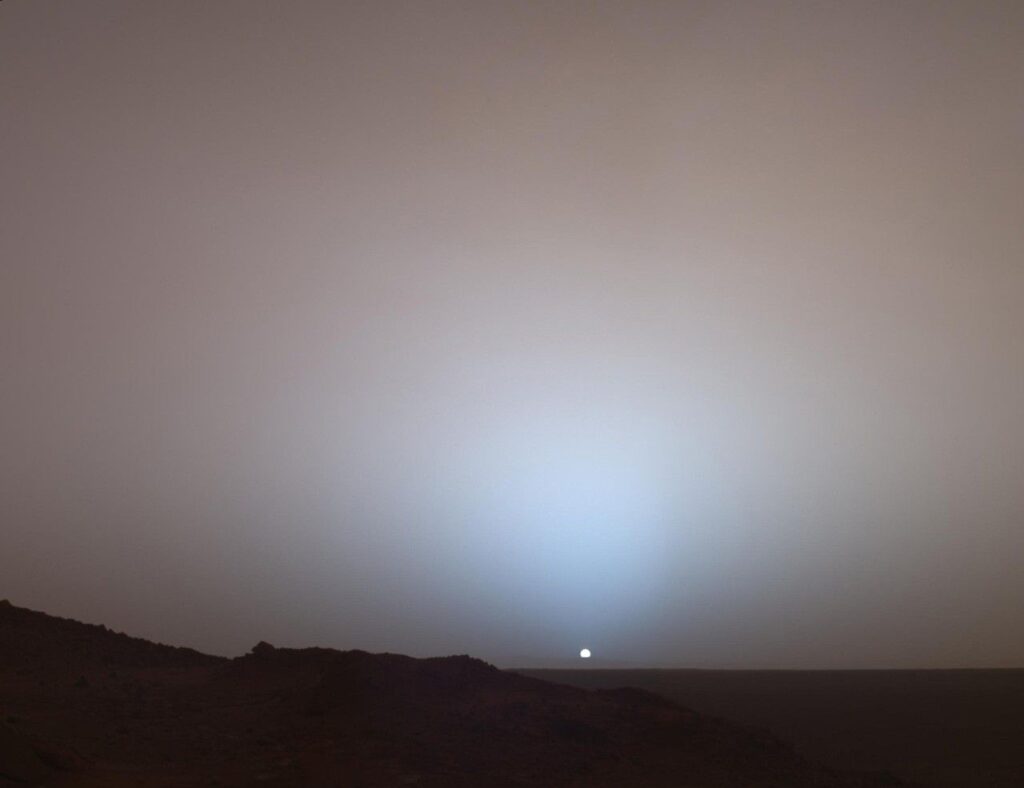
On May 19, 2005, NASA’s Mars Exploration Rover Spirit captured a sweeping view as the sun sank below the rim of Gusev Crater on Mars. The image mosaic was taken around 6:07 in the evening of the rover’s 489th Martian day, or sol. These mars sunset photographs weren’t taken for drama. Sunset and twilight images are occasionally acquired by the science team to determine how high into the atmosphere Martian dust extends, and to look for dust or ice clouds. The beauty was, in a sense, a byproduct of measurement.
Because Mars is farther from the Sun than Earth, the Sun appears only about two-thirds the size we see when we watch sunsets here on Earth. In Spirit’s panorama, that smaller disc hangs above the low crater wall, surrounded by a blue haze that most viewers find genuinely surprising on first encounter. The bluish glow in the sky above the Sun would be visible to us if we were there – it’s not a camera artifact or a color-processing trick. The physics behind it is real, and it’s the opposite of what happens on Earth.
The filter combination used to take Spirit’s image allows false color images to be generated that are similar to what the human eye would see, but with the colors slightly exaggerated. The Spirit team used its Panoramic Camera with filters at 750, 530, and 430 nanometers – covering near-infrared, green, and blue wavelengths – to produce a composite that gives the most faithful approximation of human vision that the hardware allows. The long Martian twilight, compared to Earth’s, is caused by sunlight scattered around to the night side of the planet by abundant high-altitude dust. That same dust is what makes the sky glow for so long after the sun disappears: the twilight glow remains visible, but increasingly fainter, for up to two hours before sunrise or after sunset.
Why the Sky Turns Blue, Not Red
On Earth, sunsets are red because of a process called Rayleigh scattering. The molecules that make up our atmosphere – mostly nitrogen and oxygen – are far smaller than the wavelengths of visible light. Those tiny molecules scatter short-wavelength blue light in all directions across the sky throughout the day, which is why the daytime sky looks blue. At sunset, when light travels a longer path through the atmosphere, so much blue has scattered away that only the longer red and orange wavelengths reach your eyes directly.
Mars runs this process nearly in reverse. As Mark Lemmon of Texas A&M University, a science team member of the Curiosity rover mission, explained: “The colors come from the fact that the very fine dust is the right size so that blue light penetrates the atmosphere slightly more efficiently. When the blue light scatters off the dust, it stays closer to the direction of the Sun than light of other colors does. The rest of the sky is yellow to orange, as yellow and red light scatter all over the sky instead of being absorbed or staying close to the Sun.”
The dust particles responsible for this are remarkably small. Martian dust suspended in the atmosphere has an effective radius of roughly 1.5 micrometers. At that size, the particles produce what physicists call Mie scattering – a process that preferentially directs blue wavelengths forward, toward the observer’s eye, rather than scattering them sideways across the whole sky. The result is a blue corona around the setting sun and a sky that glows amber and rust everywhere else – the daytime rust color doing exactly what Earth’s blue does at noon, while the sunset inverts the familiar palette entirely.
Ten Years Later: Curiosity Adds Color and Clouds
NASA’s Curiosity rover captured its first Mars sunset in color on April 15, 2015, confirming what the black-and-white Spirit images had suggested: the sky near the setting sun is genuinely blue. Curiosity assembled a four-image sequence across nearly seven minutes, creating the first moving record of evening falling over Gale Crater. The camera system used for this – Mastcam – sees color in a way that closely mirrors human vision. Fine dust in the atmosphere permits blue light to penetrate the atmosphere more efficiently than colors with longer wavelengths, and Curiosity’s color sensors picked this up faithfully.
The rover kept watching the sky. On February 2, 2023, NASA’s Curiosity Mars rover captured sun rays shining through clouds at sunset – the 3,730th Martian day, or sol, of the mission. It was the first time sun rays, also known as crepuscular rays, had been viewed so clearly on Mars. Crepuscular rays are the shafts of sunlight that appear to fan out from the sun when clouds partially block the light – the same effect visible on Earth through breaks in storm clouds over a field or ocean. On Mars, most clouds are made of frozen water ice and float about 37 miles (60 kilometers) above the ground. But Curiosity spotted clouds that reach a higher altitude, leading researchers to believe they are made of frozen carbon dioxide ice – or dry ice.
That same month, just a few days earlier, Curiosity also captured a set of colorful clouds shaped like a feather on January 27. When illuminated by sunlight, certain types of clouds can create a rainbow-like display called iridescence. Scientists study the color gradients in these iridescent clouds to track how cloud particles change in size and density as they form and disperse. Each sunset image, in other words, doubles as an atmospheric measurement.
You can explore more of what NASA’s rovers have uncovered about the Martian surface in this piece on Perseverance’s clearest Mars panorama.
A New Rover, a New Vantage Point
Perseverance captured its first Mastcam-Z sunset on November 9, 2021, on sol 257 of the mission, from Jezero Crater. Jezero is a 28-mile-wide ancient lakebed that NASA chose specifically for its potential to preserve signs of past microbial life. The rover landed there on February 18, 2021, and has been ascending the crater’s western rim ever since, climbing to elevations that offer sweeping views of the crater floor below.
Martian sunsets typically stand out for their distinctive blue color, because fine dust in the atmosphere permits blue light to penetrate more efficiently than colors with longer wavelengths. But Perseverance’s November 2021 sunset looks different: less dust in the atmosphere resulted in a more muted color than average. That variation matters scientifically. Comparing dust-rich and dust-poor sunsets lets researchers track seasonal changes in atmospheric dust loading – a key variable in Martian weather modeling and in planning any future human surface operations.
The Mastcam-Z camera system on Perseverance is a stereoscopic instrument capable of zooming across a wide focal range, producing sharper color images than any previous rover camera. Some images have been color-corrected to show what human explorers might one day see while relaxing after a hard day’s work on Mars. Those corrected images are as close as anyone alive today can come to standing on another planet and watching the sky change color.
What Scientists Are Actually Learning
The science packed into each sunset frame extends well beyond atmospheric dust. Clouds captured during Curiosity’s twilight surveys were studied as part of a follow-on imaging campaign to study noctilucent, or night-shining, clouds. While most Martian clouds hover no more than 60 kilometers above the ground and are composed of water ice, the clouds appearing in these twilight images appear to be higher in elevation, where it’s very cold – suggesting they are made of carbon dioxide, or dry ice. Carbon dioxide clouds high in the Martian atmosphere would affect how heat escapes from the planet’s surface, and understanding their formation helps scientists model Martian climate with greater precision.
Sunset images also help measure dust column height – how deep the atmospheric dust layer is from ground to sky. That measurement feeds directly into models used to predict dust storms, which can cover enormous areas of Mars for weeks and have already forced mission teams to make critical decisions. It was a dust storm that ended the Opportunity rover’s mission in 2018 by blocking sunlight from its solar panels. Knowing when and where dust accumulates in the atmosphere is, for any future crewed mission, a matter of survival.
What This Means for You
None of this requires a telescope or a physics degree to appreciate. As Justin Maki, InSight science team co-investigator and imaging lead at NASA’s Jet Propulsion Laboratory, put it: “It’s been a tradition for Mars missions to capture sunrises and sunsets.” Every rover sent to the surface has eventually turned its cameras toward the western horizon at the end of a Martian day. The images are among the most widely shared NASA has ever released, and for good reason: they show something any person understands instinctively – a day ending – happening somewhere no human has ever stood.
The full arc of these photographs runs from Viking 1’s first grainy frame in August 1976 to Curiosity’s iridescent feather clouds and crepuscular rays in early 2023. Each image adds a detail to a picture that is becoming, slowly, familiar. A blue sun-glow, a two-hour twilight, clouds of dry ice catching light 37 miles overhead. Mars is a cold, irradiated world with air too thin to breathe, but it has evenings. And for the first time in history, we’ve been able to see them.
AI Disclaimer: This article was created with the assistance of AI tools and reviewed by a human editor.
Read More: A Researcher Accidentally Found a Shortcut to Mars – and It Could Change Everything