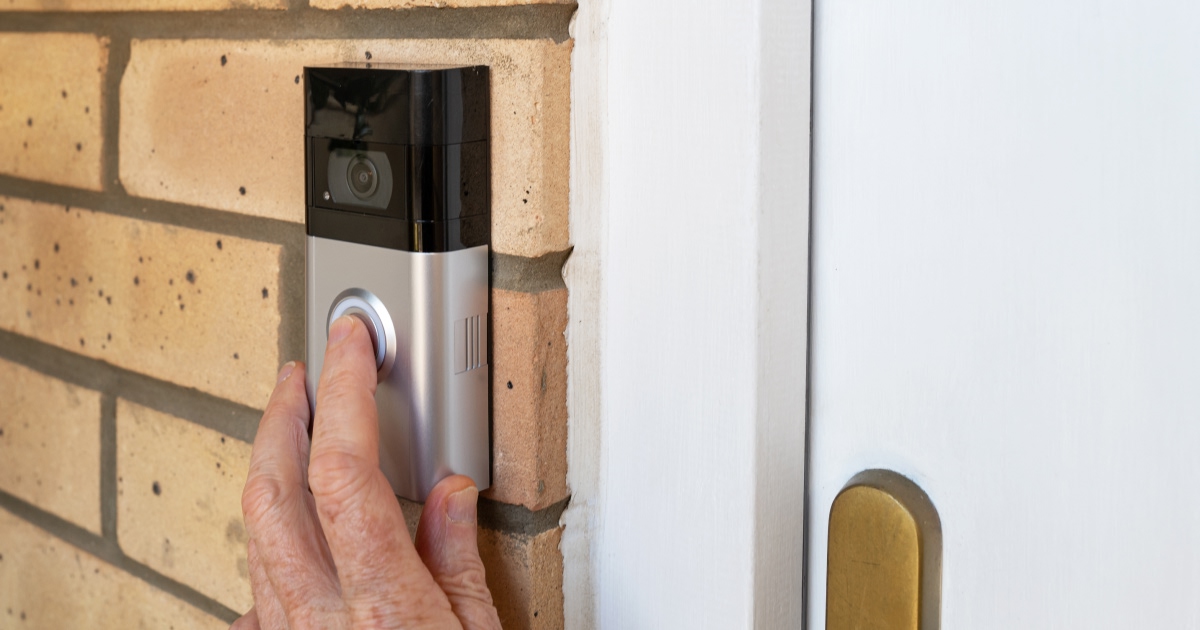

Most people assume the camera mounted outside their front door is watching out for them. The more unsettling reality is that the same device may be watching on behalf of people they’ve never met – employees, law enforcement, advertisers, or hackers with a reused password and a few spare minutes.
Video doorbells have become one of the fastest-growing smart home devices in the US, and the appeal is obvious. Being able to see who’s at the door from anywhere in the world, on your phone, feels like a reasonable trade for a hundred-dollar gadget. But the video doorbell disadvantages run deeper than most buyers realize before they install one, and they don’t get simpler with time. They tend to compound.
Before you mount one at your front door, here’s what the fine print, the federal regulators, and the security researchers have found.
The Hacking Risk Is More Serious Than “Use a Strong Password”
Video doorbells make it easy to see who’s at your front door, but like any internet-connected device, they’re susceptible to hacking. The standard advice is to choose a strong, unique password and keep your firmware updated. That’s sound guidance, but it only covers part of the exposure.
Security testing by Consumer Reports found critical vulnerabilities in five models from four brands – Eufy, GoControl, LaView, and Netvue – that can expose user data including email addresses and account passwords. Most video doorbells also lack two-factor authentication – a security feature that sends a one-time passcode via text or app to prevent account access even when a password is compromised – and barely a quarter of the brands Consumer Reports tested have it. Only five of the 16 doorbell brands tested offered the feature at all: Arlo, August, Google Nest, Ring, and SimpliSafe.
The consequences of a successful hack go well beyond someone watching your doorstep. A compromised doorbell camera can serve as an entry point for hackers to access other connected devices on the home network, potentially enabling data theft or further attacks. Devices that run outdated software face an especially steep risk: according to a 2024 Federal Trade Commission staff paper, nearly 89% of smart products fail to disclose how long they’ll receive software updates, and once manufacturers stop providing those updates, devices may lose their security protections entirely or stop working.
Your Footage Lives on Someone Else’s Servers
When you install a video doorbell, you place a camera and microphone at your front door and route that footage through corporate servers. Your private video is now in the hands of a third party.
In 2023, the Federal Trade Commission forced Ring to pay more than $5.6 million in a settlement after finding the company allowed employees and contractors to access customers’ video feeds. The FTC found that Ring’s poor privacy and lax security let employees spy on customers through their cameras, including those in bedrooms and bathrooms, and hackers exploited those vulnerabilities to harass, insult, and proposition children and teens through their Ring cameras – with some hackers even live-streaming customers’ footage.
Beyond that settlement, most popular video doorbells automatically upload footage to remote servers owned by the manufacturer, including products from Amazon, Google, and other large technology vendors. This effectively turns a personal security device into part of a wider digital surveillance infrastructure, and one of the biggest concerns surrounding the modern video doorbell is law enforcement access.
Amazon-owned Ring launched a feature on its Neighbors app called Community Requests, which allows police officers to request camera footage directly from users. The company pulled back from direct police requests in 2024, then reversed course: in 2025, Amazon reintroduced tools for police to request videos and images without a warrant. Law enforcement access is an ongoing concern – these companies must comply with legally binding warrants for footage, and they also reserve the right to share footage without a warrant in vaguely defined “emergency” situations. The FBI has separately warned that hackers use stolen email passwords to log into smart home devices and hijack features, including live-stream cameras, to watch the results of so-called “swatting” attacks on victims’ homes, according to an FBI public service announcement covered by Tom’s Guide.
The Data Sharing Goes Wider Than the Privacy Policy Admits
Few buyers read the privacy policy before purchasing a video doorbell, and those who do may not get the full picture. According to survey data from The Zebra, only 13% of Americans know how smart doorbell companies actually use their personal data, while 93% say they wouldn’t buy a doorbell camera if they knew it collected and sold data about their family.
An investigation by the Electronic Frontier Foundation of the Ring doorbell app for Android found it packed with third-party trackers sending out customers’ personally identifiable information, with four main analytics and marketing companies receiving data including names, private IP addresses, mobile network carriers, persistent identifiers, and sensor data. The EFF noted that only one of the trackers it found was mentioned in Ring’s own privacy policy.
The data picture got considerably more complicated in 2025. Amazon’s decision that year to incorporate facial recognition technology into Ring doorbells raised privacy concerns about potential abuse by Amazon or law enforcement. Facial recognition adds a layer of data collection that goes far beyond knowing someone rang your doorbell – it can, in principle, build profiles on everyone who walks past your home.
Reliability Depends on WiFi, and WiFi Isn’t Always Reliable
A video doorbell is only as good as the internet connection it runs on. Weak WiFi signals cause video doorbells to lose connection, resulting in slower notifications, buffering, and live view sessions that freeze or fail entirely. This is a particular problem for homes where the router is located far from the front door, or where thick walls weaken the signal.
During internet outages, video doorbells lose crucial features like live video feeds and remote alerts, and stored footage can be overwritten or lost during prolonged outages. For anyone who relies on the device as a primary security measure, a power or internet disruption means a complete gap in coverage, with no offline fallback in most systems.
Battery Life Falls Short of Marketing Claims
Battery-powered video doorbells are popular because they don’t require hardwiring. The convenience comes with a real trade-off. Ring Video Doorbell batteries often need recharging every three to six months in practice, despite manufacturer claims of longer battery life. That’s under average conditions.
In busier neighborhoods, some Ring batteries drain in just a few weeks when the doorbell keeps detecting passing cars on the street. Cold weather compounds the problem further. When temperatures drop below 40°F, lithium-ion battery efficiency drops substantially – in freezing conditions, battery life can decrease by 50% or more. PIR sensors – the heat-detecting sensors video doorbells use for motion detection – also struggle in cold weather, because they rely on a temperature differential to detect movement, and that differential shrinks significantly in freezing conditions.
For homeowners in northern climates, this means both more frequent recharging and less reliable motion detection during the months when security is arguably most important.
False Alerts Create Notification Fatigue
Motion detection on video doorbells frequently generates false alarms triggered by environmental factors like moving trees, pets, or passing cars when motion sensitivity is set too high. This isn’t a minor inconvenience. Constant false notifications train people to ignore them, which defeats the purpose of having an alert system. Most users end up either lowering sensitivity to the point where real events go undetected, or turning notifications off altogether.
The Costs Add Up Faster Than Expected
The total cost to install a smart video doorbell ranges from $150 to $650, depending on features and whether professional installation is needed. But the upfront price is only part of the expense. Subscriptions for basic cloud video storage average $3 to $10 per month, and professional 24/7 monitoring services run $20 to $40 per month. Without a subscription on most platforms, recorded footage either isn’t stored or is deleted after a very short window – meaning without ongoing payment, the device largely functions as a live viewer rather than a true security record.
Your Camera May Be Recording Your Neighbors
Video doorbells recording onto a neighbor’s property can raise genuine privacy concerns, particularly when cameras capture windows, fenced yards, or other private spaces. Most cameras have a wide field of view by design, and it’s entirely possible to capture a neighbor’s porch, driveway, or front window without intending to. This raises legal and ethical concerns, especially in states with stricter expectations around consent and reasonable surveillance.
Amazon does offer privacy zone settings that let users block out areas of the frame, but not all doorbells offer this feature, and Ring’s privacy zone tool doesn’t apply universally across all of their models. If your camera does capture a neighbor’s property and a dispute arises, the legal exposure is real – several UK courts have ruled against homeowners whose doorbell footage captured neighboring properties without consent.
What to Do Now
Video doorbells aren’t universally bad purchases, but the decision deserves more scrutiny than most buyers give it. The video doorbell disadvantages outlined above aren’t edge cases – hacking exposure, third-party data sharing, law enforcement access, subscription lock-in, and false alerts are structural features of how most of these products currently work.
If you do install one, the most important protective steps are: use a unique password not shared with any other account, enable two-factor authentication if the device supports it, check whether your device’s firmware updates automatically, and read the privacy policy carefully before accepting default settings. On the cost side, calculate the total three-year ownership cost including subscription fees before comparing devices by sticker price. And if battery life matters to you, consider a hardwired model rather than relying on batteries that degrade significantly in cold weather.
The core question isn’t whether a video doorbell is better than nothing. For many households, it is. The question is whether you understand what you’re handing over in exchange for the convenience – and whether you’re comfortable with that trade.
AI Disclaimer: This article was created with the assistance of AI tools and reviewed by a human editor.
Read More: Think You’re Alone? How to Detect Hidden Cameras in Airbnb and Hotel Rooms