
Think about the last time you went to get your tires changed. You sat in a waiting room that smelled of burnt coffee and rubber, watched a technician wrestle a wheel off your car with a rattle gun and muscle memory built over years, and waited. And waited. If the shop was short-staffed that day, you waited even longer. It’s one of those maintenance rituals most people accept as a minor inconvenience and forget about by the next morning.
But that familiar scene is about to look very different. Not because tire service has gotten more glamorous – it hasn’t – but because a Boston-based startup thinks the whole process has been stuck in the same decade for far too long. And the fix it has in mind doesn’t involve hiring more technicians.
It involves replacing most of what they do with a robot that never calls in sick, never drops a lug nut, and can handle three bays at once.
What SmartBay Actually Does
Automated Tire, Inc. (ATI), a physical AI and robotics company, has publicly unveiled SmartBay, its AI-powered robotic platform designed to execute automotive services starting with tire changes, wheel balancing, and vehicle inspections. The announcement, made in May 2026, ends what the company describes as a period of stealth development.
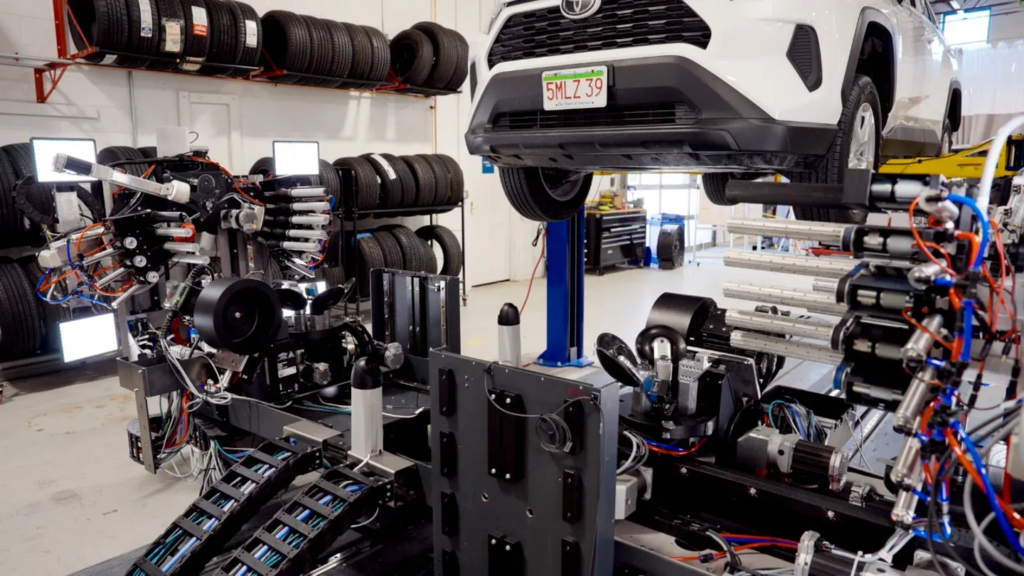
SmartBay uses computer vision and machine learning to generate the proper execution for each vehicle, rather than relying on pre-programmed routines that require manual intervention when real-world variables arise. That distinction matters. Most industrial robots are told exactly what to do in what sequence. SmartBay reads the vehicle in front of it and figures out its own approach.
Once a vehicle is positioned, the system automatically initiates an inspection, identifying tire and wheel conditions while capturing diagnostic data. Throughout the process, it continuously collects and analyzes that data, generating real-time insights and customer-facing reports while optimizing each step.
The part that surprises most people is what SmartBay does not do. It does not remove the wheel from the car. According to ATI CEO Andy Chalofsky, SmartBay is “the first patented system in the world that changes tires without removing the wheel from the vehicle.” The car is lifted as it would be on a conventional lift, but instead of taking off the lug nuts and pulling the wheel, SmartBay dismounts the tire directly from the rim while the rim stays on the car.
That’s a meaningful engineering departure from every service bay in operation today. Removing a wheel to change a tire has always been the assumed first step. SmartBay skips it entirely.
The Balancing Act No One Talks About
Wheel balancing is the part of tire service that customers rarely think about but almost always pay for. Traditional balancing involves spinning the tire on a standalone machine and adding small metal weights to counteract any unevenness. It’s been done this way for decades.
After mounting the new tire, SmartBay performs ATI’s trademarked Real Force Balance, which balances “the entire wheel-end assembly, including all of the rotating components in the wheel well,” rather than only balancing the tire by itself. That includes parts like brake rotors and hub assemblies, which spin with the wheel every time the car moves but are never accounted for in a conventional balance.
The system also uses a precision wheel-weight tool that dispenses the exact amount of weight composite needed to achieve an accurate balance. No eyeballing, no rounding up. The logic is that if anything in the wheel well is even slightly unbalanced, a tire-only approach will never fully fix the shimmy a driver feels at highway speeds.
The current generation of SmartBay still requires an operator to connect the air line to inflate the tire. Chalofsky has said a future version may completely automate that step, but the first generation is ready to deploy into the field. Where a manual tire change typically takes one operator an hour to replace and balance four tires, SmartBay reduces that total time to 30 minutes with one operator. That single operator can also manage three bays at a time, which is where the business case becomes hard to argue with.
The Staffing Crisis Driving Demand
SmartBay isn’t arriving into a healthy industry that simply wants to get more efficient. It’s arriving into one that is genuinely struggling.
According to NADA’s service technician data, the industry needs to replace nearly 76,000 technicians each year to keep up with retirements and new job demand, leaving an annual shortfall of about 37,000 trained techs. These figures come from NADA’s ongoing workforce tracking, which is observational in nature and based on labor market estimates rather than a controlled study. That gap hasn’t been closing. A separate analysis from the nonprofit TechForce Foundation predicts a shortfall of hundreds of thousands of auto techs through 2026, with a principal cause being an aging workforce whose average age is 40.
In a 2025 observational survey of shop owners and managers conducted by PartsTech, 514 respondents found that 46% reported the shortage of skilled technicians has a moderate to highly significant impact on their shop. That’s nearly half of all service business operators saying they can’t properly staff a service bay on any given day. Because this is a self-reported survey rather than a randomized study, it reflects shop owners’ perceptions, though the scale of the response makes it a meaningful data point.
The situation is only compounding. This shortage leaves shop owners trapped in a cycle of understaffing and expensive retraining, with high turnover leading to inconsistent service quality and longer wait times that frustrate customers and compress profit margins.
For many shop owners, the issue isn’t just finding warm bodies. It’s the time and cost of training them, the risk that they leave for somewhere else, and what happens to the service bay on the days they don’t show up. Chalofsky points out that SmartBay can work across different vehicle classes because “a Tesla, an F-150, and a Chevy Silverado all run through the same system.”
The EV Factor
There’s a second force pressing down on tire shops at the same time, and it comes from the growing number of electric vehicles on American roads.
Compared with similar gas cars, tire makers and industry observers report that many electric vehicles wear through tires faster, primarily because of their greater weight and the instant torque electric motors deliver from a standstill. Estimates vary depending on driving style and vehicle type. According to J.D. Power’s 2024 U.S. Original Equipment Tire Customer Satisfaction Study, 39% of battery electric vehicle owners replaced their tires at least once in the last 12 months, compared to just 20% of gas car owners. The study is observational, based on owner-reported satisfaction data, rather than a controlled wear test, so it captures behavior rather than precisely measuring tire degradation rates.
J.D. Power’s findings show that EV owners have similar expectations of tire wear as owners of gas-powered vehicles, despite EV tires naturally wearing faster due to greater vehicle weight and higher torque. In other words, EV owners are routinely being surprised by how quickly they need new rubber.
As Chalofsky noted, electric vehicles wear through tires significantly faster, and “the proliferation of EVs creates significantly more tire service opportunities.” For any service business that is already stretched thin on staffing, more tire volume without more qualified hands is a recipe for backlogs and lost revenue. SmartBay’s pitch is essentially that it removes the bottleneck before it gets worse.
Will Technicians Lose Their Jobs?
This is the question that sits underneath every story about AI moving into a skilled trade, and it deserves a direct answer. The short version: probably fewer of some roles, and a different kind of work for others.
When asked directly whether SmartBay replaces technicians or changes the work they do, Chalofsky said “both, but mostly the latter.” He explained that SmartBay can take over repetitive tire tasks where robotics works more efficiently, but also argued that it makes existing workers more valuable. “In many cases, it allows a shop to take a lower-skilled operator and get three to four times the throughput out of them, which means shops can actually pay those operators more because the work is more valuable,” he said.
That framing, automation as amplifier rather than eliminator, is consistent with how researchers increasingly describe the dynamics of physical AI entering labor markets. The question of whether AI replaces jobs or reshapes them is one researchers are still working through, as explored in a 2026 Johns Hopkins analysis on whether AI will make human workers obsolete. The broader pattern, as seen across industries from warehouse logistics to fast food, tends to look the same in the early stages: repetitive, physically demanding tasks go to machines first, and human roles shift toward oversight, exception-handling, and higher-complexity work.
Tire changes fit that profile almost perfectly. They’re physically taxing, and among the most injury-prone aspects of routine automotive service, deeply repetitive. A technician who has swapped thousands of tires isn’t deploying much creative skill on the job. What SmartBay offers is not replacing that person but taking the punishing core of their work and handing it to a machine.
The harder question is what happens to entry-level jobs. If a lower-skilled operator can now do the work of three or four using SmartBay, shops may not need to hire three or four people in the first place. Axios reported in early 2026 that it remains genuinely unclear how many blue-collar jobs could be rendered irrelevant, or over what timeframe, as AI expands from the virtual to the physical. For now, the optimistic version, that technology creates new roles as it displaces others, is plausible but not guaranteed.
Not the First to Try This
ATI isn’t entering entirely uncharted territory. It has been more than two years since a similar company, RoboTire, went bankrupt. RoboTire had raised $7.5 million in Series A funding in 2022 and was a recognized industry award winner in 2023. Its failure is a reminder that a compelling product concept and investor backing don’t guarantee survival. Other robotics companies in adjacent spaces have had more success, with firms like Boston Dynamics and Symbotic building sustainable businesses by targeting large-scale industrial deployments where volume and contract stability reduce risk. ATI is entering a more fragmented market – individual service bays rather than centralized warehouses – which brings its own distinct challenges.
Chalofsky is aware of RoboTire’s failure but says he is confident that SmartBay is designed to solve the real labor issues facing the automotive repair industry, a business his family has been in for four generations. He says SmartBay provides a measurable return on investment and delivers a platform that can grow in functionality.
The leadership team brings credibility beyond just automotive experience. Eran Frenkel, ATI’s President and COO, brings deep robotics operations experience, including leadership roles at Kiva Systems (now Amazon Robotics), 6 River Systems, and Third Wave Automation. That’s a resume built on deploying physical robots at scale inside complex, real-world operations, which is a meaningfully different background from most automotive startups.
SmartBay fits entirely within a standard 12-foot service bay and is designed to maintain full bay functionality and flexibility across other services when needed. That matters for a shop owner making a capital investment: the system doesn’t require a purpose-built facility or a major renovation.
Read More: Which jobs AI is most likely to affect
What This Means for You
If you own a car, this matters more practically than it might seem at first. The technician shortage isn’t abstract. It already shows up as longer wait times, inconsistent service quality at understaffed shops, and the creeping frustration of a two-hour appointment that bleeds into three. As the EV fleet grows and tire demand increases, that pressure doesn’t ease without either more technicians or smarter tools.
SmartBay addresses both the labor gap and the service-time problem in one system. Whether it rolls out widely depends on pricing, reliability in real-world conditions, and whether shop owners trust a robot to handle something as safety-critical as tires. Those are legitimate questions that only field deployment will answer.
What’s already clear is the direction of travel. The most physically punishing jobs in the service bay have always been the ones most ripe for automation. Tire work, heavy, repetitive, and injury-prone, checks every box. The question was never if AI-driven robotics would come for it, only when a system was capable enough to do it well. If ATI has built that system, tire shops as most Americans know them are going to look very different within the decade. For car owners, that could mean faster service, lower wait times, and more consistent results. For workers already in the trade, the transition may be gradual enough to adapt, with roles shifting rather than vanishing overnight. For those considering automotive service as a career, the job will almost certainly involve more oversight of machines and less hands-on tire swapping. That’s not necessarily worse. But it is different, and it’s closer than most people realize.
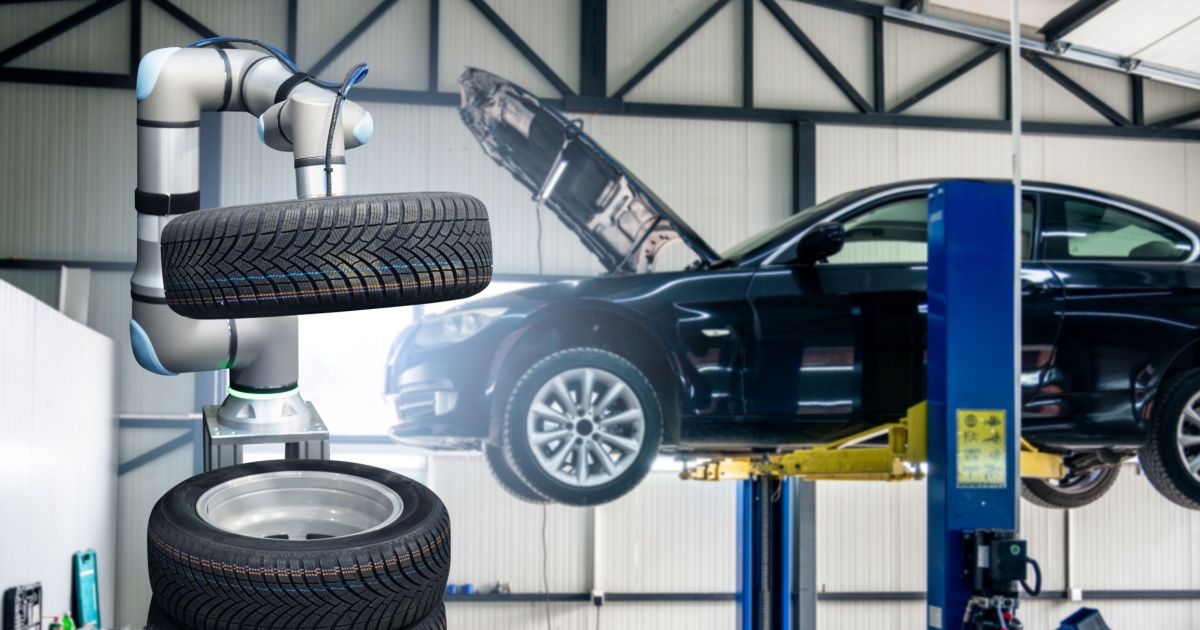
Editor’s Note: Lead image for representational purposes only. The lead image is not a depiction of any product or service from Automated Tire, Inc.
AI Disclaimer: This article was created with the assistance of AI tools and reviewed by a human editor.
Read More: Analysis Finds AI Could Impact Over Half of U.S. Jobs