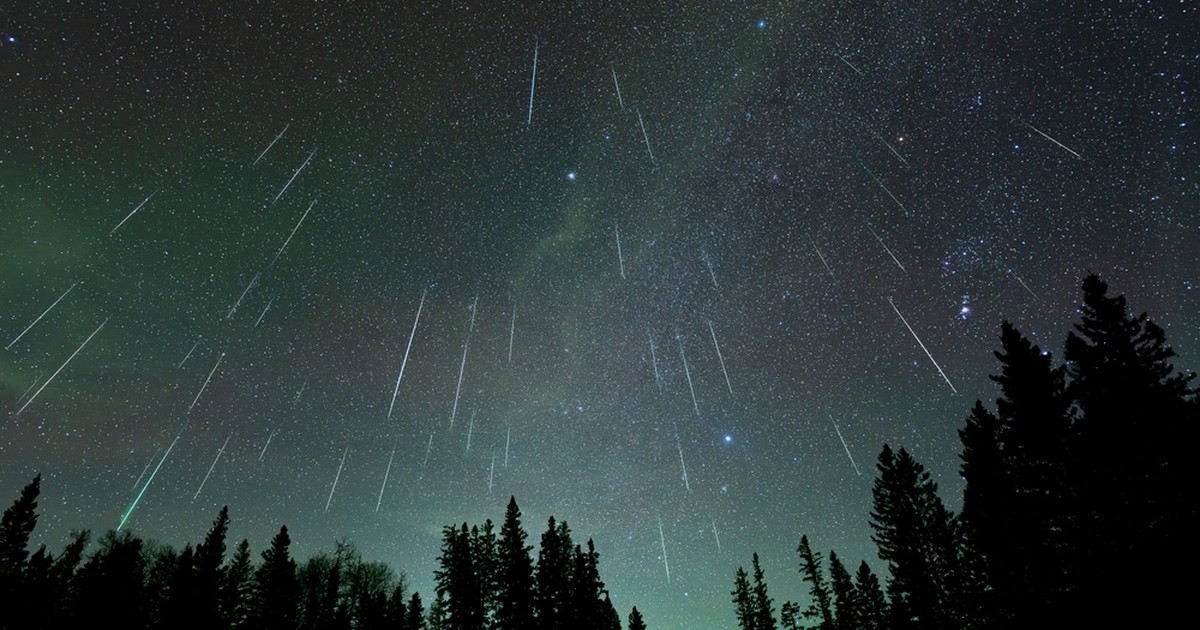

The Leonid meteor shower peaks tonight, Tuesday, Nov. 17, into the early hours of Wednesday, Nov. 18, 2026. Under very dark skies, you could see up to about 15 shooting stars an hour, according to the International Meteor Organization. NASA gives a more cautious guess of fewer than three an hour. If you can stay up past midnight and get away from city lights, this is one of the better skywatching nights of the fall. The moon sets around midnight, and the forecast is clear across a large part of the country.
The shower runs from Nov. 6 to Nov. 30, and the most activity comes around tonight’s peak. Missing tonight doesn’t close the door, because while rates drop off after the peak, but the shower stays active until the end of the month, and a few meteors are still possible on the nights after.
The best viewing tonight looks to be across the South and East, from Arizona to Tennessee, Kentucky, Virginia and the Carolinas, based on a forecast from Ryan Hall, Y’all. Clouds could get in the way in the Northwest, the northern Plains, Georgia and Florida.
1. What the Leonid meteor shower will look like tonight
The International Meteor Organization puts the peak at 23:45 Universal Time on Nov. 17. That is 6:45 p.m. Eastern, which comes before the best part of the night. The best viewing comes later, in the hours before dawn on Wednesday, Nov. 18, according to Space.com. The moon reaches its first quarter phase on Nov. 17 and sets around midnight, so the sky will be dark for those hours.
The meteors seem to fly out from one spot in the constellation Leo. This spot is called the radiant, and to find Leo, look for a group of stars that forms a backward question mark. This pattern is known as the Sickle, according to EarthSky. This year there is extra help, since the planets Jupiter and Mars sit just a few degrees apart in Leo on peak night. Both planets are bright, so they point you to the right patch of sky.
Leonids can show up anywhere in the sky. The best plan is to find a dark spot with a wide view, lie back, and take in as much sky as you can. You don’t need to stare right at Leo, because meteors close to the radiant come at you almost head-on, so their trails look short. Look a little away from Leo, where the meteors leave longer, more striking trails.
2. The moon sets just in time
One lucky break for tonight’s show is the moon’s timing. The first quarter moon is about half lit, and it sets close to midnight in most of the US, about 11:56 p.m. in New York and 12:07 a.m. in Los Angeles, based on the Ryan Hall, Y’all forecast.
That timing helps a lot, because moonlight washes out the fainter streaks until the moon drops below the horizon. By 1 a.m., the moon is down in most places and no longer gets in the way.
The best time to look up is between midnight and dawn, when skies will be darkest. Give your eyes 20 to 30 minutes to adjust to the dark before you start counting.
Read More: Catch Halley’s Comet Debris During the Stunning Eta Aquarid Meteor Shower
3. These are some of the fastest meteors you’ll see all year
Speed is what sets a Leonid apart. Leonid meteors hit the air at about 44 miles (71 kilometers) per second, according to NASA. That makes them some of the fastest meteors seen from Earth. At that speed, the bits of space dust burn up high in the atmosphere, creating the bright streaks that look like falling stars from the ground.
The Leonids are among the year’s fastest meteor showers. They are also known for fireballs, which are larger, brighter meteors that last longer than a normal shooting star, NASA says. Some Leonids leave glowing trails that hang in the sky after the meteor itself is gone. These are called persistent trains, and they can last for seconds, and now and then much longer. One trail photographed in 2023 stayed visible for about 5 minutes, EarthSky reported.
Leonids are also known for Earth-grazers. These meteors skim the top of the air at a low angle near the horizon, and they leave long, colorful tails. Some Leonids also glow blue or green, according to Scientific American.
4. The comet behind it all
Leonid meteors come from comet 55P/Tempel-Tuttle. Each year, Earth passes through the trail of dust and rock this comet has left behind, and those bits of rock burn up in our atmosphere as meteors.
The shower is active from Nov. 6 through Nov. 30, with peak activity on the night of Nov. 17 to 18. The best meteors show up after midnight on Wednesday morning, Nov. 18. That is when the radiant in Leo climbs high in the southeastern sky.
The comet itself has a long history. According to EarthSky, Wilhelm Tempel of Marseille Observatory in France first spotted the comet on Dec. 19, 1865. Horace Tuttle of Harvard College Observatory found it on his own 17 days later, on Jan. 5, 1866. Scientists later worked out that it takes about 33 years to go around the sun. The comet is small, since its core is only about 2.2 miles (3.6 kilometers) wide, NASA says. Its next close pass by the sun is due in 2031.
5. The legendary storm history of the Leonids
Tonight’s show is a normal yearly display, not a storm. Scientists do not expect a Leonid meteor storm in 2026, EarthSky reports. But the Leonids are famous for nights that were truly amazing.
Big Leonid storms happened in 1833, 1866, 1966, 1999, 2001 and 2002, according to the International Meteor Organization. A meteor storm means at least 1,000 meteors an hour, according to NASA. The 1966 storm was on a scale that is hard to picture. From Kitt Peak in southern Arizona, a group of 13 skywatchers saw Leonids falling at about 40 per second. That works out to about 144,000 an hour, Space.com reports.
This November marks 60 years since that 1966 storm. Storms tend to come about every 33 years, when Earth passes through a thick, fresh trail of comet dust. That is not the case in 2026. The Planetary Society says another storm could come as early as 2031, and a study released in August 2026 points to possible big displays in 2033 and 2034, Space.com reports.
6. Where you’ll have the best view in the US tonight
Skies look clear tonight across Arizona, Tennessee, Kentucky, Arkansas, Virginia, North Carolina and South Carolina, based on the Ryan Hall, Y’all forecast. West Virginia, Maryland, Delaware, New Jersey, Rhode Island, Alabama, Illinois and Indiana also look clear.
Skies look cloudy or mixed in the Northwest, Idaho, Montana, the northern Plains, Kansas City, Georgia and Florida. A Flood Watch covers much of east central Florida, so rain will likely spoil the view there. Seattle could see more clouds move in tonight, KIRO 7 forecasts.
Wherever you live, you can improve your chances. Get as far as you can from city lights, let your eyes adjust for 20 to 30 minutes, and face east. If you live in a cloudy area, check your local forecast for breaks in the clouds after midnight.
7. How to watch without making common mistakes
The biggest mistake people make at a meteor shower is reaching for binoculars or a telescope. You don’t need them, since using binoculars or a telescope will only limit your view, according to Live Science. Your eyes alone are the right tool, because meteors streak across big parts of the sky in a split second. Binoculars shrink your view to a tiny patch, so you will likely miss them.
NASA suggests lying flat on your back with your feet pointed east. Then look up and try to take in as much of the dark sky as you can. A sleeping bag, a blanket or a lawn chair all work well. Come ready for winter temperatures, NASA says. In less than 30 minutes in the dark, your eyes will adjust and you will start to see meteors.
The morning of Nov. 18 is the best bet, but the shower doesn’t end there. The hours before dawn are the best time to look on any night the shower is active. If clouds block your view tonight, try again on a clear night later this week. You may still catch a few meteors after the peak.
What to do tonight
Step outside after midnight, get away from city lights, lie on your back facing east, and give yourself at least an hour. The Leonids can bring up to 15 meteors an hour at the peak under ideal skies. How many you actually see depends on how dark your sky is, how much cloud there is, and how high Leo has climbed.
If tonight is cloudy where you are, the next big shower is not far off. The Geminids peak on the night of Dec. 13 to 14 and can bring up to 120 meteors an hour, Live Science reports. That is a little less than four weeks away. For now, the moon sets early and the forecast is clear over much of the country. Set an alarm for 1 a.m., dress warmly, and lie back to watch.
Disclaimer: The author is not a licensed medical professional. The information provided is for general informational and educational purposes only and is based on research from publicly available, reputable sources. It is not intended to constitute, and should not be relied upon as, medical advice, diagnosis, or treatment. Always consult a licensed physician or other qualified healthcare provider regarding any medical condition, symptoms, or medications. Do not disregard, avoid, or delay seeking professional medical advice or treatment because of information contained herein.
AI Disclaimer: This article was created with the assistance of AI tools and reviewed by a human editor.