Mysterious “Golden Orb” Found Off The Coast Of Alaska Finally Identified
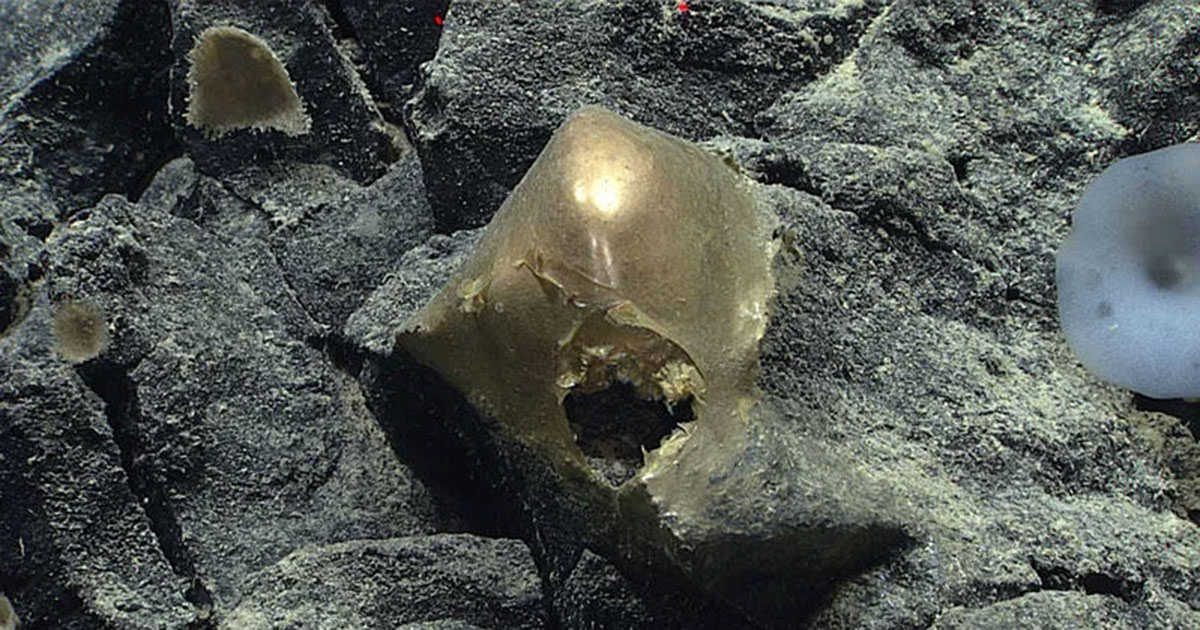
Something strange surfaced out of the Alaskan darkness in the summer of 2023, and it stopped scientists cold. Footage from a robotic camera more than two miles beneath the Gulf of Alaska suddenly filled with a soft, shimmering, golden shape — dome-like, maybe four inches across, pressed flat against a rock like it had been glued there by something deliberate. Nobody on the ship could identify it. It didn’t look like anything in the textbooks. It had a small hole in one side, which made it both more mysterious and, judging by the comments from the research team live-streaming the dive, slightly unnerving.
For nearly two and a half years, the object — which the internet promptly nicknamed the “golden orb” — remained unclassified. Online theories ranged from alien eggs to sea monster remnants. Even scientists with decades of deep-sea experience weren’t sure what they were looking at. That ambiguity is what made the story stick.
Now, in 2026, the answer has finally arrived — and it turns out to be stranger and more biologically interesting than most people guessed.
What Did NOAA’s Deep Discoverer Find?
In August 2023, during NOAA’s Seascape Alaska 5 expedition, scientists encountered a golden-colored structure adhered to a rocky outcropping at a depth of 3,250 meters — roughly two miles down. The remotely operated vehicle (ROV) responsible for the find was Deep Discoverer, a sophisticated underwater robot capable of transmitting live high-definition video back to researchers aboard the ship and to scientists watching from shore. The object measured about 10 centimeters across with a distinctive hole in one side, and it had the research team simultaneously baffled and delighted.
The live-stream reaction said it all. “I don’t know what to make of that,” one researcher said. Another speculated that “something either tried to get in or tried to get out.” Someone else compared the situation to the opening scene of a horror movie. The team collected the object using a suction sampler and shipped it to the Smithsonian National Museum of Natural History, where it sat waiting for scientists to crack its identity. What followed was one of the more methodical and multi-disciplinary detective efforts in recent deep-sea science — and it took the full weight of morphological analysis, advanced genomics, and taxonomy expertise to get there.
Why Identification Took Nearly Three Years
To understand why this discovery took so long to identify, it helps to appreciate just how hostile the environment is at this depth. At 3,250 meters, the ocean is very cold, very dark, and the ambient pressure is crushing. According to NOAA Ocean Exploration, only about 20% of the global seafloor has been mapped with modern technology, and an even smaller fraction has been biologically explored. Every expedition that sends an ROV down to those depths is venturing into territory as unknown as the far side of the moon.
The orb itself posed a specific identification challenge. Initial DNA barcoding was inconclusive, likely because the specimen was so thoroughly colonized by other microscopic life — bacteria, fungi, and other organisms feeding on the decaying tissue — that the signal was too noisy to produce a reliable match. Researchers had to move to whole-genome sequencing, a far more comprehensive analysis that looks at the entire genetic blueprint rather than a short identifying snippet.
This is also why NOAA ocean exploration missions matter to people beyond the scientific community. The agency’s deep-ocean research routinely shows that the sea is still producing discoveries that challenge everything we think we know about life on Earth.
What the Golden Orb Actually Is
A 2026 preprint study on bioRxiv by researchers at NOAA Fisheries and the Smithsonian Institution confirmed the answer: the mysterious golden mass is a remnant of the dead cells that formed at the base of a giant deep-sea anemone, Relicanthus daphneae. It was the part of the anemone that attached to the rock substrate — the biological equivalent of a footprint left behind after the animal moved on or died.
Anemones grip the seafloor by secreting a sticky material from their underside. Because this part of the animal is always hidden beneath the body, researchers have rarely had a chance to study it in isolation. The golden orb gave them exactly that opportunity — without anyone initially realizing what they were looking at.
The research team identified the presence of cnidocytes (stinging cells) of the spirocyst type — a type found exclusively within the class Hexacorallia, the group that includes sea anemones, true corals, and black corals. Their presence immediately told scientists they were dealing with something in that family. Sequencing the mitochondrial genomes of the specimens confirmed they were genetically almost identical to a known Relicanthus daphneae reference genome.
What Is Relicanthus daphneae?
Relicanthus daphneae is a deep-sea cnidarian (pronounced nih-DAIR-ee-un) — a group of aquatic invertebrates that includes jellyfish, corals, and sea anemones — with tentacles that can grow more than two meters (6.6 feet) long. It is a giant among giants even within this group, with a body that can reach up to one meter across and some of the largest spirocysts of any known cnidarian species.
First described scientifically in 2006, the species lives around the periphery of deep-sea hydrothermal vents — essentially underwater hot springs where superheated, mineral-rich water escapes through cracks in the Earth’s crust. Life clusters around these vents in the otherwise food-scarce deep ocean, and R. daphneae appears to use its extraordinary tentacles to snag whatever mobile prey passes through the vent field’s edges. Science Alert’s coverage of the identification notes the species has a complicated taxonomic history — originally described in 2006, it was later reclassified into a new genus after molecular analysis showed it occupied its own distinct suborder within the sea anemone family tree.
How Scientists Cracked the Case
The identification process was unusually complex, and it illustrates both how difficult deep-sea taxonomy is and how far the tools have come. As Allen Collins, zoologist and director of NOAA Fisheries’ National Systematics Laboratory, explained to NOAA: “This was a complex mystery that required morphological, genetic, deep-sea and bioinformatics expertise to solve.”
After initial DNA barcoding failed, the team moved to whole-genome sequencing, which confirmed animal DNA and contained a large amount of genetic material matching R. daphneae. They also had a second specimen for comparison — a similar cuticle collected from a specimen in the Southern Ocean — along with photographic evidence of similar cuticles beneath living individuals of the species. This confirmed that what they were looking at wasn’t a one-off — it was a biological structure the species regularly produces, just one that had never been collected and studied in isolation before.
The team then used an integrative taxonomic approach: morphological analysis of the fibrous material and stinging cells, combined with complete mitochondrial genome sequencing, to definitively place the orb within R. daphneae. According to Newsweek’s reporting on the identification, the team’s next step is preparing the Okeanos Explorer for new deep-sea mapping work in the south Pacific in the 2026 field season.
What the Orb Was Actually Doing Down There
The formal scientific question of what the orb is has been answered. The biological question — what was it for, and what happened to the animal that left it — remains more open. Researchers have put forward a compelling hypothesis.
Some sea anemones are capable of a reproductive process called pedal laceration (PEE-dal luh-SAIR-ay-shun): the animal abandons the base of its body and moves away, leaving a stub behind that can regenerate into a new individual. Whether this is the case for R. daphneae is still unknown. What has been confirmed is that the orb doesn’t sit there passively. The sheer volume of microorganisms found on the cuticle suggests it may act as a microscale hotspot of microbial activity — where microbes feed on and break down the decaying tissue as part of the nitrogen cycle, the set of biological and chemical processes by which nitrogen is converted between its various forms and recycled through ecosystems. Deep-ocean environments are nutrient-poor, so anything that concentrates microbial activity has outsized ecological significance.
What This Means for Deep-Sea Exploration
The pace of ocean mapping is accelerating, but the gaps remain enormous. According to NOAA’s 2026 Unmapped U.S. Waters report, the ocean and coastal mapping community added 70,700 square nautical miles of new bathymetric data coverage in 2025, bringing the total unmapped share of U.S. waters down to 44%. The goal is full mapping by 2040. That progress is real — but it also makes clear how much terrain remains invisible, and how much of the biology within it has never been seen.
The golden orb’s identification points to something broader. Whole-genome sequencing, once prohibitively expensive and slow, is now fast enough to be used on routine specimens. That changes what’s possible. The same toolkit that cracked the orb’s identity can now be applied to the hundreds of unidentified specimens that come back from every deep-sea expedition. As CAPT William Mowitt, acting director of NOAA Ocean Exploration, put it: “So often in deep ocean exploration, we find these captivating mysteries, like the ‘golden orb.’ With advanced techniques like DNA sequencing, we are able to solve more and more of them.”Read More:Lost City Discovered Deep in the Atlantic
What This Means for You
You don’t need to be a marine biologist to take something meaningful from this story. The golden orb’s identification is a reminder that the most extraordinary discoveries sometimes come from the most mundane-looking objects. A four-inch blob on a rock turned out to hold clues about a giant anemone’s reproductive biology, its forgotten anatomy, and the microbial life that depends on it.
For anyone interested in science and health, this matters because the deep ocean is increasingly recognized as a source of compounds with potential medical value. Organisms like R. daphneae, with stinging cells among the largest of any known cnidarian, produce biological structures and chemicals that scientists haven’t begun to fully characterize. Every species properly identified at depth is another entry point into that pharmacological and biological library.
More immediately, this story is a case study in how scientific persistence pays off. It took morphological analysis, two rounds of genomics, multiple independent specimens, and expertise spanning four different scientific disciplines — all applied to a four-inch piece of biological material that most people would walk past without a second glance. The ocean still has millions of those puzzles waiting. Scientists now have better methods than ever to solve them.
A.I. Disclaimer: This article was created with AI assistance and edited by a human for accuracy and clarity.