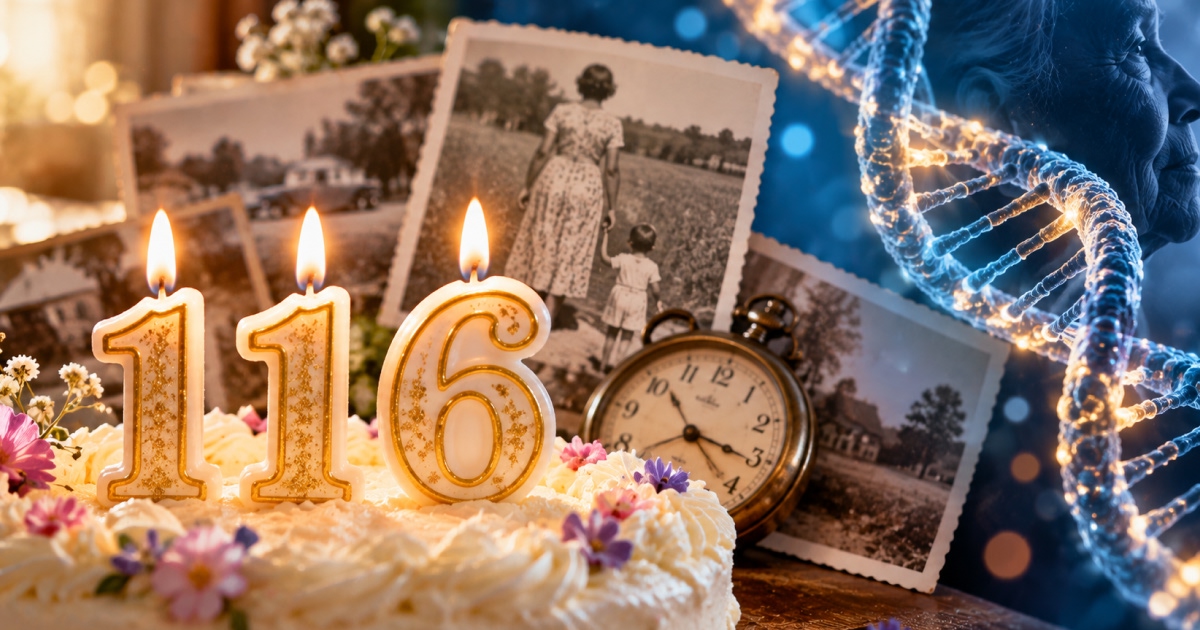

Naomi Whitehead was born in 1910, when the average American could expect to live only about 50 years. She grew up on a farm in Georgia, picking cotton and tobacco, married in 1930, raised three sons, and eventually settled in Greenville, Pennsylvania.
On September 26, 2026, she celebrated her 116th birthday.
Whitehead is now the oldest living person in the United States and the second-oldest verified living person in the world. Reaching 116 puts her in an extraordinarily small group of people known as supercentenarians, those who survive to at least 110.
People who reach these ages inevitably get asked for their secret. Was it what they ate? How active they were? Their outlook on life? Something they avoided?
Science increasingly points toward a less satisfying but fascinating answer: part of extreme longevity may simply be something you’re born with.
A major 2026 study suggested genetics could account for considerably more of the variation in human lifespan than researchers previously estimated. Other scientists are studying supercentenarians and their families to identify biological advantages that may help some people remain remarkably healthy while others develop age-related disease decades earlier.
That doesn’t mean lifestyle doesn’t matter, nor does having long-lived parents guarantee you’ll follow them into your 90s or beyond. Instead, people like Whitehead are helping researchers untangle one of aging science’s biggest questions: how much of a long life is inherited, and how much can the rest of us actually influence?
Genes play a bigger role than we thought
For decades, scientists believed that genetics contributed roughly 20 to 25 percent of the variation in how long humans live – specifically, differences in survival to the mid-80s. A 2026 study published in Science presents an entirely different picture: when external causes of death such as accidents, infections, and violence are accounted for, genetics may explain as much as 50 percent of the variability in human lifespan.
The researchers used data from three large Scandinavian twin cohorts to show that earlier heritability estimates were distorted by high rates of external mortality. Strip those out, and the genetic signal nearly doubles. Some researchers have contested the findings, arguing that deaths from infections can themselves carry a genetic component – meaning the correction may overstate the purely intrinsic genetic contribution. But the broader direction of evidence is consistent: genes become increasingly decisive the older a person gets.
What supercentenarians’ DNA actually looks like
A study published in 2025 on Maria Branyas – verified as the oldest living person in the world before her death in 2024 – found that she possessed an exceptionally young genome for her age, along with rare genetic variants linked to longevity, immune function, and a healthy heart and brain.
Before her death, Branyas volunteered blood, saliva, urine, and stool samples for research. Despite her age, she had excellent cardiovascular health and low inflammation levels. Her immune system and gut microbiome resembled those of people decades younger.
Researchers cautioned that findings from a single person cannot be generalized into a universal formula. Still, Branyas offers one of the clearest biological portraits yet of what an extraordinarily resilient human body actually looks like at extreme age.
The same genetic advantages appear to extend across longevity groups. Those who live past 110 show greater genetic protection against Alzheimer’s disease than those who live past 100 – suggesting that as longevity becomes more extreme, the genetic buffers become more powerful, not less. You can explore what these biological markers mean for everyday health decisions in this breakdown of longevity differences in blood biomarkers.
If your parent hits 100, your odds shift dramatically
Research from Albert Einstein College of Medicine, published in August 2026, found that adults with at least one parent who reached age 100 lived longer and had substantially lower risks of cardiovascular disease and hypertension. The findings suggest inherited biological factors, not just shared lifestyle habits, explain much of the advantage.
Compared with people whose parents had shorter lifespans, centenarians’ offspring at any given age had a 42 percent lower risk of death, a 33 percent lower risk of cardiovascular disease, and a 32 percent lower risk of hypertension.
The health advantages held even after the researchers accounted for lifestyle differences including smoking, alcohol use, exercise, diet, education, and socioeconomic status. Cancer risk was not clearly reduced, and stroke protection was inconsistent across the cohorts studied.
The research team concluded that centenarians offer crucial insights into what it looks like to age well, and that studying the families of people who reach 100 may be one of the most direct routes to understanding the biological mechanisms behind healthy aging.
The limits of inheritance
Whitehead’s family tree illustrates both the promise and the complexity of inherited longevity. As of her 110th birthday, she was the matriarch of a family that included 12 grandchildren, 28 great-grandchildren, 49 great-great-grandchildren, and 3 great-great-great-grandchildren. Her grandchildren, on average, would carry about a quarter of her DNA. By the time it reaches her great-great-great-grandchildren, that fraction falls to just over 3 percent.
Inheritance is not a guarantee. Each generation inherits a different random shuffle of a grandparent’s or great-grandparent’s genome. A descendant might inherit the beneficial variants – or might not. Population-level statistics about longevity describe probabilities across thousands of people, not certainties for any individual.
What blood tests reveal about extreme longevity
Research into the blood chemistry of people who reach 100 has identified consistent differences compared to those who don’t. People who live to 100 tend to have lower levels of fatty acids, fatty alcohols, and other key metabolites in their blood. Whether that difference reflects genetic programming, decades of dietary choices, or both remains an open question.
The metabolite findings point toward a pattern that keeps appearing in centenarian research: less systemic inflammation, a more efficient metabolism, and a cardiovascular system that holds up over time. Several of these markers can be nudged in better directions through consistent lifestyle choices – particularly around diet, physical activity, and avoiding tobacco and alcohol.
Branyas didn’t drink or smoke. Neither does Whitehead. Both abstinence from tobacco and abstinence from alcohol are among the most well-documented ways to slow accelerated biological aging.
Read More: 15 Signs You Might Live to 100
What Can the Rest of Us Learn From People Who Live to 100?
Naomi Whitehead’s 116 years are extraordinary precisely because there probably isn’t a simple formula for reproducing them.
The emerging genetics research suggests that inherited biology may explain a substantial portion of why lifespans differ between people. But a population-level estimate of genetic influence doesn’t mean that half of your lifespan is predetermined, nor does it establish a fixed genetic ceiling on how long any individual can live.
Even exceptional genes aren’t a guarantee.
Centenarians and supercentenarians still experience different diets, environments, healthcare, infections, stress, physical activity, social circumstances, and simple chance across extraordinarily long lives. Researchers studying Maria Branyas reached a similar conclusion: extreme longevity appears to emerge from a complicated interaction between genetics, lifestyle, environment, and luck.
Where these unusual families may prove especially valuable is in revealing the biology that protects some people from diseases that become increasingly common with age. If scientists can understand why certain people maintain healthier cardiovascular systems, immune function, metabolism, or cognitive health into their 90s, 100s, and beyond, some of those discoveries could eventually benefit people who didn’t inherit the same advantages.
For now, the familiar things people can influence still matter. Not smoking, staying physically active, eating a nutritious diet, managing blood pressure and other cardiovascular risk factors, and maintaining social connection are associated with healthier aging, even if none can promise an exceptionally long life.
And that’s perhaps the most useful lesson from someone turning 116.
Science may eventually explain why Naomi Whitehead was able to live far beyond almost everyone born alongside her. But living longer and living healthier aren’t exactly the same question, and we have considerably more control over the second.
Disclaimer: This information is not intended to be a substitute for professional medical advice, diagnosis, or treatment and is for information only. Always seek the advice of your physician or another qualified health provider with any questions about your medical condition and/or current medication. Do not disregard professional medical advice or delay seeking advice or treatment because of something you have read here.
AI Disclaimer: This article was created with the assistance of AI tools and reviewed by a human editor.
Read More: Why Biohacks Are a False Promise — and What Actually Works for Longevity