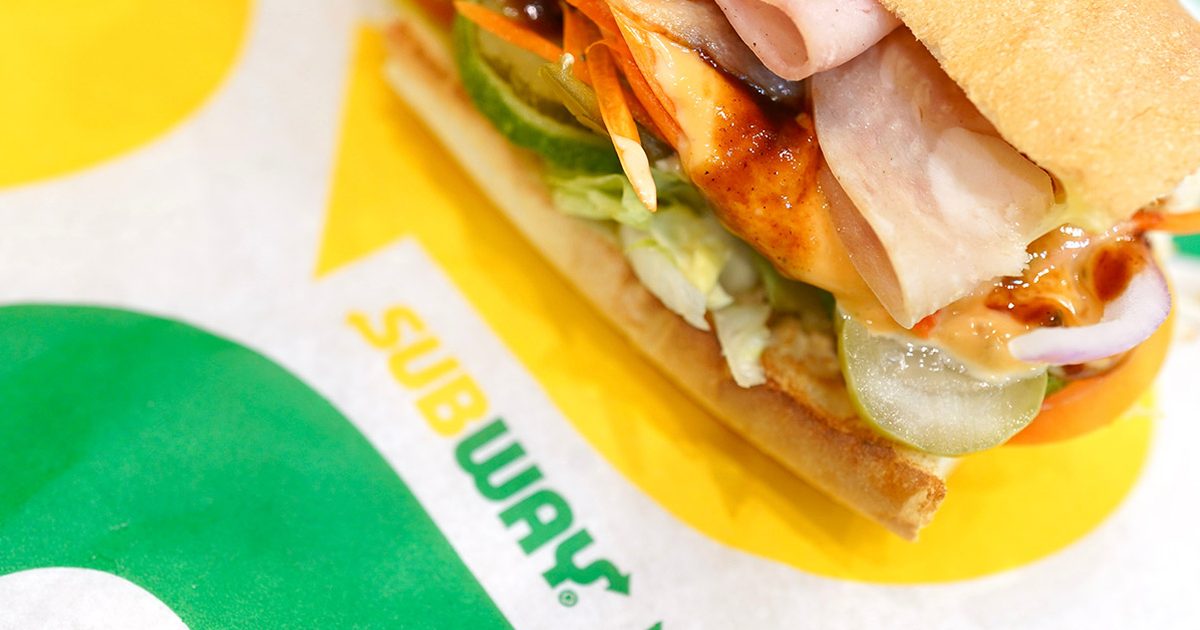

A 2020 court ruling found that Subway’s sandwich rolls contain sugar at 10% of the flour weight. That is five times the legal limit that qualifies a product as bread under Irish tax law. The case wasn’t about taste or texture. It was a tax dispute, and Ireland’s Supreme Court sided with the revenue authority. The rolls belonged in the same legal category as cakes and confectionery, not staple foods.
That sugar finding is just one item on a long list of food-quality controversies. The chain built its brand on the promise of eating fresh. For years, Subway positioned itself as the antidote to greasy fast food. Customize your sub, load up on vegetables, get something wholesome for not much money. The evidence of Subway’s quality problems didn’t arrive all at once. It stacked up case by case, lawsuit by lawsuit, lab test by lab test.
The chain now has more than 37,000 locations worldwide, more than McDonald’s at its peak. Those aren’t the numbers of a struggling brand. They make the pattern of product controversies harder to ignore, not easier.
Editor’s note: The headline is a strong judgment. The Irish bread ruling was a tax decision, not a food-safety finding. The tuna lawsuit was dismissed without a court finding that the product was mislabeled. The chicken DNA dispute was never settled in court. The points below are documented controversies and customer complaints, not a claim that every Subway sandwich is unsafe.
1. The bread that legally isn’t bread
Some Subway footlongs can cost as much as $14 in certain cities. But before you get to the price, there’s a more basic question about what, exactly, you’re paying for. In 2020, Ireland’s Supreme Court ruled that Subway’s bread does not legally qualify as bread for tax purposes.
The case began when an Irish Subway franchisee argued its sandwich rolls should be exempt from value-added tax (VAT). Bread is classified as a staple food under Irish law and taxed at zero percent. The court disagreed. Under Ireland’s VAT Act, the sugar content in bread cannot exceed 2% of the flour weight. Subway’s rolls came in at 10%, five times that limit, for both white and wholegrain varieties. That sugar level pushed the product into a different tax category entirely, one that includes cakes and confectionery. Following the ruling, Subway’s rolls became subject to a higher VAT rate.
Subway pushed back, with a spokesperson stating: “Subway’s bread is, of course, bread. We have been baking fresh bread in our stores for more than three decades.” That response addressed the product’s identity, not the sugar content itself. The finding wasn’t a matter of opinion. It was a measurement. If the bread you’re wrapping your turkey and vegetables in contains five times the sugar that qualifies it legally as bread in Ireland, that’s worth knowing before you order. It does not mean the rolls are illegal to sell as sandwiches. It does mean the sugar level failed a tax test used to define staple bread in that country.
2. The chicken that was mostly something else
In 2017, a CBC Marketplace investigation tested chicken products from five fast-food chains. The DNA analysis was conducted at Trent University. The results for Subway were striking. The oven-roasted chicken averaged 53.6% chicken DNA. The chicken strips came in even lower, at 42.8%. For context, the other four chains tested were McDonald’s, Wendy’s, A&W, and Tim Hortons. All came in between 80% and 90% chicken DNA. Subway was the only chain that failed to reach even 80%.
The filler making up the remainder was primarily soy protein, according to that investigation. Subway called the story “absolutely false and misleading” and demanded a retraction. The chain conducted its own independent testing and reported that soy protein came in below 10 parts per million, less than 1%, in its Canadian chicken products. That was Subway’s figure, not CBC’s. CBC Marketplace stood by its methods and results, which had been run and re-run across multiple samples from multiple locations.
The legal fallout was notable. Subway filed a $210 million defamation lawsuit against CBC. The Ontario Superior Court dismissed it. Whatever the truth of the specific DNA figures, the gap between Subway’s results and CBC’s remained unexplained. The court found no basis to hold CBC liable for publishing them. Customers who ordered chicken expecting mostly chicken had a reasonable basis for their confusion. The court did not decide which lab result was right.
Read More: 16 Worst Fast Food Chains to Avoid
3. The tuna controversy that couldn’t be resolved
Few food stories in recent memory generated as much confusion as Subway’s tuna. In 2021, a lawsuit alleged that lab testing of 20 Subway tuna samples found no detectable tuna DNA in 19 of them. Chicken and pork DNA were detected instead, the suit claimed. The New York Times commissioned its own independent lab test and reported finding “no amplifiable tuna DNA” in its samples. Inside Edition tested the product as well and found the opposite. It did contain real tuna, with a Florida lab confirming tuna presence in all three samples it examined.
The legal proceedings added more complexity rather than clarity. U.S. District Judge Jon Tigar presided over the case in the Northern District of California. He dismissed co-plaintiff Karen Dhanowa’s claims because she had never actually purchased a Subway tuna sandwich. Subway called the suit “meritless” and sought sanctions against the plaintiffs and their attorneys, arguing it caused damage to the brand. On July 27, 2023, the lawsuit was formally dismissed with prejudice, meaning it cannot be refiled. The court made no finding that the tuna was misrepresented.
What the case left behind is an unresolved question. Why did some independent lab tests fail to detect tuna DNA in samples purchased from Subway locations? Subway maintains its tuna is 100% wild-caught tuna. DNA testing for processed seafood is technically complicated. Heavy processing can degrade DNA to the point where it becomes undetectable even in authentic fish products. The court made no finding either way. But for a chain that asks customers to trust its ingredients, that long inability to produce a clean, independent resolution did real damage to that trust.
4. The Footlong that came up short, twice
Subway’s size problems predate smartphones. In 2007, a local Arizona television station, working with the Arizona Department of Weights and Measures, tested the chain’s three-foot party subs. They found the subs did not meet legal requirements to be advertised as 36 inches. Arizona rules allow only a 3% variance, meaning the minimum acceptable length would be 34.92 inches. Subway’s party subs didn’t reach it. Worse, investigators found the boxes Subway used to package those subs were too small to hold a correctly sized sandwich. That raised questions about whether the full-size product was ever the actual goal.
Six years later, the same problem surfaced with the standard Footlong. An Australian teenager posted a photo to Facebook in January 2013 showing his Subway Footlong measuring only 11 inches. The image went viral and triggered a wave of class-action lawsuits in the United States. The case settled in 2016. Subway agreed to put measuring tools in stores and to ensure sandwiches consistently reach 12 inches. Plaintiffs who had bought a Footlong since 2003 were entitled to a share of the settlement. Lead plaintiffs received $500 each.
The gap between the brand’s core identity, the Footlong, and the actual product delivered is hard to explain away as a rounding error. It happened under two entirely different formats, in two different decades, across multiple markets.
5. The $5 Footlong that disappeared and didn’t come back
The $5 Footlong, launched in 2008, became one of the most effective fast-food promotions in history. It drove traffic, created cultural shorthand for value, and kept Subway relevant during the financial crisis. It was discontinued in 2012 amid franchisee complaints that the price point was eating into profits. An attempt to revive it in 2017 collapsed when franchise owners revolted. By then, the economics simply didn’t work.
By 2024, some Subway footlongs were running as high as $14 in major cities before add-ons. That is a 180% markup from the original deal. That August, the chain launched a temporary promotion offering any footlong for $6.99 through its app. It was framed as a response to customers pushing back on fast food pricing across the industry. Since 2020, the cost of food and labor in the restaurant industry has risen over 35%. That explains some of the increase. But paired with ongoing complaints about portion sizes and ingredient quality, the value equation has shifted away from Subway’s favor.
6. The “Eat Fresh” claim vs. the supply chain reality
Subway built its brand on two words: “Eat Fresh.” The gap between that slogan and what actually arrives at stores has been a recurring source of consumer frustration. Some ingredients are prepared fresh in-store, like tomatoes, onions, and certain vegetables. Other items, including turkey, cold-cut meats, and some proteins, arrive pre-packaged. Bread dough and cookie dough arrive pre-made.
Proteins tell a more complicated story. Ham, turkey, roast beef, pepperoni, and tuna arrive refrigerated and pre-packaged. Steak, chicken, and chicken strips come fresh-frozen. Starting in 2023, Subway began rolling out in-store meat slicers to some locations large enough to hold the machinery. Those sites could offer fresh-sliced turkey, ham, and roast beef. That’s a genuine improvement. But it’s a selective one, dependent on franchise size and investment. It doesn’t cover rotisserie chicken or steak, which remain pre-packaged.
The practical result is a chain whose freshness claims depend heavily on which location you visit. They also depend on what protein you order, and what day the last produce delivery arrived. For a brand whose entire identity rests on the word “fresh,” that variability is a problem the slogan was never designed to acknowledge.
7. The value proposition no longer holds up
Subway technically maintains some of the lower starting prices in fast food. The full picture is harder to square. The chain is long past the days of $5 footlongs and is unlikely to return to them. Even if the price increases are partly explainable by food and labor inflation, the value you get for the cost of a sandwich may not hold up anymore.
The controversies, legal, culinary, and logistical, compound that calculation. Customers now have to weigh a purchase against questions about whether the chicken is mostly chicken, whether the bread is legally bread, and whether the sandwich will be the size it’s advertised. The low sticker price stops doing the work it used to do. Other options have filled the space Subway once occupied. Competitor chains with higher customer satisfaction scores, grocery store deli counters, and homemade alternatives all offer more certainty. The cost is comparable, or only slightly higher.
Food is what the body runs on. Spending money on it isn’t the problem. Spending it on something that leaves you uncertain about what you actually ate is. Cheap isn’t a deal if the food behind it can’t hold up to basic scrutiny.
What this means for you
The tuna lawsuit was dismissed without any court finding that Subway’s products were mislabeled or unsafe. The chicken DNA dispute was never resolved in court. That legal detail matters. Across ingredients, sizing, and pricing, though, Subway has repeatedly had to defend itself. The claims are that its products don’t match what customers were led to expect. That pattern spans nearly two decades.
If you still enjoy Subway, the most practical approach is to treat it like any franchise. Results vary by location. Fresh-sliced meat locations genuinely offer a better product than pre-packaged ones. Vegetable-heavy orders sidestep most of the protein quality questions. Checking the app for promotions remains the only way to get pricing that resembles the value the brand still advertises. Going in clear-eyed is a reasonable adjustment. Don’t assume that “Eat Fresh” is a guarantee rather than a marketing line. The last decade of Subway’s history has earned that caution.
Disclaimer: The author is not a licensed medical professional. The information provided is for general informational and educational purposes only and is based on research from publicly available, reputable sources. It is not intended to constitute, and should not be relied upon as, medical advice, diagnosis, or treatment. Always consult a licensed physician or other qualified healthcare provider regarding any medical condition, symptoms, or medications. Do not disregard, avoid, or delay seeking professional medical advice or treatment because of information contained herein.
AI Disclaimer: This article was created with the assistance of AI tools and reviewed by a human editor.