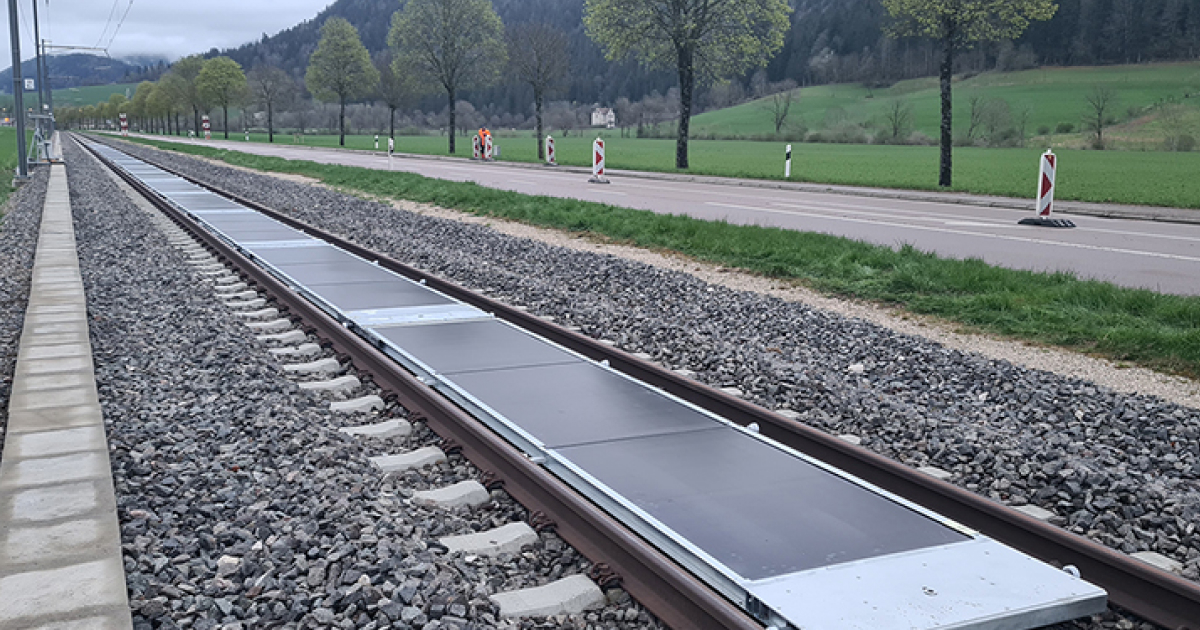

Forty-eight solar panels are sitting on the ground between active railway tracks in western Switzerland, and every day regional trains roll directly over them at roughly 70 kilometers per hour. After more than 11,000 of those passes, not one panel has shifted out of place.
The installation belongs to Swiss startup Sun-Ways, and it sits on a 100-meter stretch of track near the village of Buttes, in the canton of Neuchâtel. The engineering challenge is straightforward to state and difficult to solve: put photovoltaic modules on a working rail line and see if they survive. The pilot has a total capacity of 18 kilowatts and is expected to generate approximately 16,000 kilowatt-hours of electricity annually.
Railways cut through open countryside, fenced off from other land uses and exposed to sunlight for hours each day. Sun-Ways places photovoltaic panels in the unused strip between the rails, generating electricity from infrastructure that already exists without converting any new land. The execution presents significant engineering challenges.
How solar panels and trains can coexist
The railway environment is harsh. Panels placed between the rails face vibration, dust, metal particles, snow, ballast movement, and repeated pressure waves from passing trains. They must not distract drivers or interfere with signaling systems, inspection equipment, or emergency work.
Sun-Ways developed a system of interconnected photovoltaic panels patented specifically for installation between standard-gauge railway tracks. A machine from Swiss rail maintenance specialist Scheuchzer AG can lay 300 meters of panels per hour, equivalent to over 500 panels per day. Installation speed matters because every hour a maintenance machine occupies a live track disrupts normal rail operations.
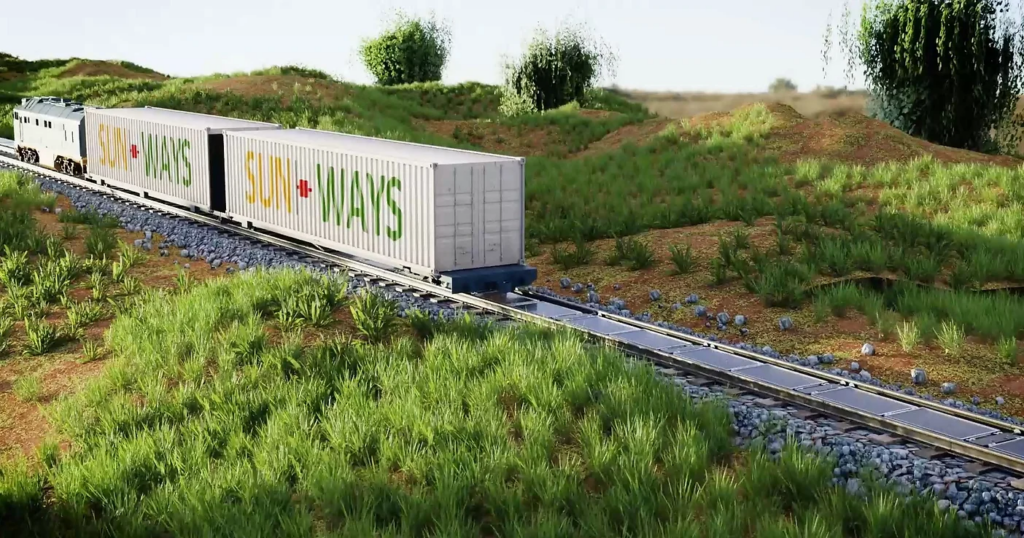
The 48 panels at Buttes are placed on railroad sleepers and held in place by a patented locking mechanism designed to stay fixed while trains pass inches above. Glare was an early concern flagged by railway safety reviewers, and Sun-Ways fitted the panels with an anti-reflective coating to address it. Sun-Ways CEO Joseph Scuderi has described the panels’ hook system and removability as the project’s core engineering innovations, speaking to Professional Engineering, the Institution of Mechanical Engineers’ publication, and to ESG News.
Early results noted by Swissinfo show that airflow from passing trains naturally sweeps dust off the panel surfaces, eliminating the need for manual cleaning. TransN, the public transport company of canton Neuchâtel that operates the Buttes section, confirms the solar system has not interfered with daily railway operations.
Individual modules can be detached from the tracks and disconnected from the power grid in approximately ten minutes using dedicated tools, allowing track crews to access the line for maintenance and reinstall the panels afterward.
The regulatory path that made it possible
Switzerland’s Federal Office of Transport approved a three-year pilot project to install removable solar panels on a working rail line in western Switzerland. That approval came in October 2024, after a ten-month technical review, according to PV Magazine’s 2025 coverage of the project’s inauguration.
Sun-Ways needed to prove the panels were safe and establish a process for removing and reinstalling them around routine track maintenance schedules, so that railway operators wouldn’t face a choice between generating power and maintaining infrastructure.
During the three-year test, scheduled to run through April 2028, Sun-Ways will study installation and removal, glare, track inspections, compatibility with railway equipment, maintenance impacts, dirt accumulation, and energy performance.
What the numbers actually mean
The Buttes installation comprises 48 panels with a total rated capacity of 18 kilowatts and a projected annual output of 16,000 kilowatt-hours. Switzerland’s national railway operator, SBB, already runs on 100% renewable energy. The Sun-Ways electricity would feed into the grid, potentially powering stations, signaling infrastructure, or nearby communities rather than directly powering trains.
Sun-Ways’ between-rail placement eliminates land-use conflict, but introduces unresolved questions about debris accumulation, snow clearance in Alpine conditions, and long-term vibration fatigue. Switzerland’s relatively cloudy climate is also a real constraint – Buttes receives less direct sunlight annually than most of southern Europe or Asia, meaning the same system in sunnier geographies could generate substantially more electricity per meter of track.
The system is currently designed to support trains traveling up to 150 kilometers per hour, which could limit its use in countries where high-speed trains exceed that threshold, including France, Italy, and South Korea. More than 11,000 trains have crossed the installation at around 70 kilometers per hour without incident.
If deployed across Switzerland’s full 5,320-kilometer rail network, BGR noted in 2026 that the technology could produce approximately 1 terawatt-hour of electricity annually, enough to supply around 300,000 households.
International interest is already lining up
France’s SNCF announced in February 2026 a partnership with Sun-Ways to study the technology. SNCF operates around 28,000 km of railway lines and is one of the largest industrial consumers of electricity in France. Its teams will study the Swiss pilot results, including installation, glare, track inspection, maintenance impacts, energy output, and dirt buildup.
South Korea approved a similar pilot project near Osong station in September 2025. Sun-Ways also names China, India, Singapore, and the Netherlands as interested parties, with Belgium, Canada, Mexico, and the US among others that have expressed interest.
Using existing railway corridors avoids the land acquisition, planning permission, and community opposition that ground-mounted solar farms typically require. The infrastructure corridor and its fencing already exist; the open question is whether panels can occupy that corridor without disrupting the railway operations it was built for.
Open engineering challenges
Rooftop solar arrays are typically tilted toward the sun to maximize output. Panels installed flat between rails capture less energy per panel than the same panels mounted on a roof. Sun-Ways and partner institutions are working on solutions to improve energy capture in this configuration, though it remains an active engineering challenge.
Snow and ice present a separate problem in colder climates. Sun-Ways is developing a system to melt frozen precipitation and keep the panels generating through Alpine winters, but that system is still in development. The Buttes pilot went offline briefly during the winter period, which accounts for part of the gap between projected and actual annual output figures.
The three-year pilot ends in April 2028, when Switzerland’s Federal Office of Transport will decide whether the space between the rails becomes a permanent part of the country’s energy infrastructure. For the countries monitoring the results, that decision may shape their own regulatory timelines.
AI Disclaimer: This article was created with the assistance of AI tools and reviewed by a human editor.
Lead image credit: Sun-Ways
Read More: New Solar Windows Generate Electricity Even on Cloudy Days, Researchers Say