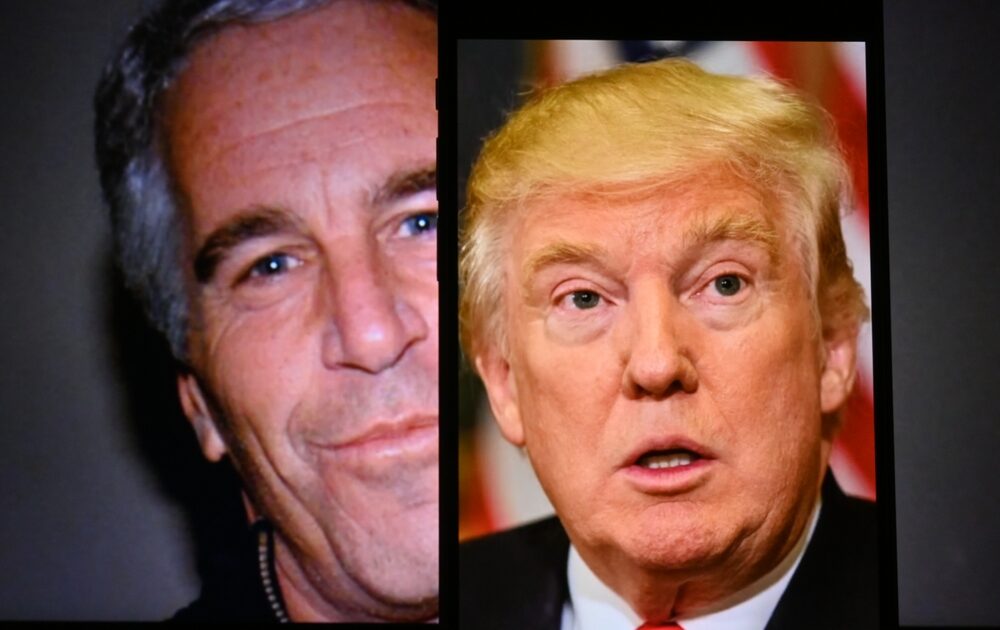

Three storylines are gripping American political life simultaneously in 2026, each volatile on its own. One involves a dead convicted sex offender and millions of pages of government documents that many Americans believe are still being hidden from them. Another is a full-scale military war in the Middle East that the United States entered on February 28, 2026, striking Iran alongside Israel in one of the most consequential military decisions in a generation. The third is a president whose approval numbers are in freefall and whose relationship with that dead sex offender stretches back across four decades.
These three storylines did not develop in isolation. They have collided, cross-contaminated, and accelerated each other in ways that are reshaping both domestic politics and international affairs. And their intersection has produced one of the most charged political questions of the year: did the war on Iran serve, at least in part, to bury the Epstein files?
Answering that question honestly requires pulling the threads apart first – understanding each storyline on its own terms before asking how they connect. The timeline matters. So does the evidence. So does what it does not show.
A Quick Overview:
The Epstein files saga and the 2026 Iran war are two of the dominant political events of Trump’s second term. The Epstein disclosure process – set in motion by Trump’s ambiguous pre-election statements, then delayed, redacted, and contested throughout 2025 – reached a political breaking point in early 2026 just weeks before the United States launched strikes on Iran on February 28. The temporal overlap has driven widespread public speculation that the war was designed, in part, to redirect attention from a scandal that directly implicated the president. Independent analysts, data from Google Trends, and congressional voices across party lines have documented a measurable collapse in public interest in the Epstein files following the start of military operations. Whether that outcome was the product of political calculation or geopolitical coincidence remains unproven. What is not in dispute is the timing, the measurable effect on public attention, and the political context of record-low presidential approval ratings in which both crises have unfolded.
The Epstein Promise: What Trump Actually Said – and When
The claim that Trump “campaigned on releasing the Epstein files” has been frequently repeated, but the record is more complicated. Trump never mentioned the issue in any major campaign speech, rally, or policy announcement before the 2024 election.
What actually happened was considerably more qualified. Trump mentioned the subject just twice during the campaign, both times only when asked. In a June 2024 interview on Fox & Friends, co-host Rachel Campos-Duffy asked Trump whether he would declassify various files – including those related to 9/11 and the JFK assassination – before asking about the Epstein files. His on-air answer was edited to a simple “yeah, I would,” but his full response, which aired the following day, showed him hedging: “I guess I would… you don’t want to affect people’s lives if it’s phony stuff in there.” Then, on a September 2024 episode of the Lex Fridman podcast, Trump again addressed the Epstein documents, saying he’d “certainly take a look at it” and that he’d be “inclined” to release them.
Those two moments – hedged, interview-prompted, and far removed from formal campaign commitments – nonetheless became the basis of a widely held public expectation. Trump had long resisted the release of additional files from the Justice Department’s investigation into Epstein and his associate Ghislaine Maxwell, despite those on-record statements. That unfulfilled promise became the center of growing public controversy, conspiracy theories, and pressure from Congress in the months since he took office.
The gap between expectation and reality produced a political crisis that the administration never fully resolved.
The Timeline of Delay: From “Sitting on My Desk” to Stonewalling
The Epstein file rollout under Trump’s second term followed a pattern of raised expectations followed by retreating deliverables.
In February 2025, Attorney General Pam Bondi stated in a Fox News interview that the Epstein client list was “sitting on my desk right now to review.” Later that month, the White House gave binders to several prominent conservative and right-wing figures reading “Epstein Files: Phase 1” and “Declassified.” Critics noted the binders contained little new information.
The turning point came in July 2025. The Justice Department posted a memo that said there is no evidence Epstein was murdered or that he kept anything amounting to a much-anticipated “client list.” The department stated it did not plan to release any new documents on the matter. The Justice Department and FBI said in the memo that files related to Epstein’s sex trafficking case do not contain an incriminating “client list,” contradicting conspiracy theories some Trump administration officials and supporters had backed.
The July memo was devastating for the administration’s credibility. Many of Trump’s close advisers, both inside and outside the White House, grew increasingly frustrated with Bondi’s handling of the files, following days of intense criticism from some of the president’s most devoted supporters. A recently released Justice Department memo finding no evidence that Epstein was murdered became a target of deepening scrutiny from the MAGA-aligned right.
According to a bombshell report from The Wall Street Journal, Bondi had informed Trump in May that his name appeared multiple times in files related to Epstein. Bondi and her deputy told the president that Justice Department officials reviewed what she described as a “truckload” of documents and discovered the president’s name appeared multiple times.
In June 2025, Trump associate Elon Musk also claimed that the reason for not releasing the Epstein files was because Trump’s name was in the documents, a claim the Department of Justice denied.
Congressional pressure eventually forced the issue. In November 2025, the U.S. House of Representatives passed the Epstein Files Transparency Act, and the U.S. Senate unanimously approved it, with President Trump signing the bill into law the next day. The House voted 427 to 1 to pass the act, with Republican Representative Clay Higgins of Louisiana casting the lone nay vote. The Senate passed the bill via unanimous consent, and Trump signed it into law.
On December 19, the Department of Justice released the first batch of Epstein files, violating U.S. law by failing to release all the files by that day. The failure received bipartisan criticism. Many documents contained extensive redactions, with hundreds of pages entirely blacked out.
On January 30, 2026, the Justice Department released some three million more documents, saying that would be the last significant disclosure. While the Department of Justice acknowledged that a total of 6 million pages might qualify as files required to be released, it stated that the January 30 release would be the final one, and that it had met its legal obligations.
For regular readers following how the Epstein files have ensnared some of the world’s most powerful figures, our earlier coverage of the Epstein files and high-profile names provides detailed context on who has appeared in the documents and what their appearances actually mean.
What the Files Revealed About Trump
Donald Trump developed a social and professional relationship with Jeffrey Epstein that began in the late 1980s. During Trump’s prior career as a businessman and media personality, he and Epstein visited each other’s real estate properties regularly. Trump and Epstein socialized frequently throughout the 1990s and early 2000s, including attending parties at Trump’s Mar-a-Lago resort in Florida and Epstein’s residence.
Trump had a falling out with Epstein around 2004 and ceased contact. No criminal wrongdoing has ever been established against Trump in connection with Epstein’s crimes.
But the released documents complicated the clean break narrative. In a 2018 email thread, Epstein wrote of Trump, “I know how dirty Donald is.” In a 2019 email, Epstein told author Michael Wolff that his ex-friend Trump “knew about the girls.” In a 2011 email to Ghislaine Maxwell, Epstein wrote “I want you to realize that the dog that hasn’t barked is trump,” adding that a person identified as a trafficking victim “spent hours at my house with” Trump.
Among the Trump associates in the latest Epstein tranche were former adviser Steve Bannon, former DOGE head Elon Musk, and Commerce Secretary Howard Lutnick, who each exchanged friendly emails with Epstein for years after his initial arrest and conviction. No direct evidence of Trump, Musk, or Lutnick participating in sex trafficking or sexual abuse emerged from the files, and inclusion in the documents does not directly prove any sort of illegal activity.
On January 30, 2026, the DOJ released an email from August 2025 containing a report from the FBI’s National Threat Operations Center describing sexual allegations made against Trump, including some involving Epstein. The email was sent from the Child Exploitation and Human Trafficking Task Force in the FBI New York Field Office. The allegations originated from unverified tips. The New York Times said they weren’t able to corroborate any of the allegations. Other files also revealed that the FBI had secretly investigated Epstein-related allegations against Trump, with some described as “not credible.”
Public Sentiment: Anger Across the Political Spectrum
The polling on the Epstein file handling has been damning. An Economist/YouGov poll from July 2025 found that 56% of respondents disapproved of Trump’s handling of the Epstein investigation, while only 22% approved. The vast majority of Americans, including 89% of Democrats and 73% of Republicans, said the federal government should release all documents it possesses related to the Epstein case.
A February 2026 Economist/YouGov poll found that 53% of Americans believed Trump was “trying to cover up Epstein’s crimes,” while 29% did not. Both questions showed a stark party-line split, with 91% of Democrats saying Trump was trying to cover up Epstein’s crimes, compared to 13% of Republicans.
A CNN poll from early 2026 showed that Republican satisfaction with the administration’s handling of the files had shifted over time, but broader public confidence in the government’s transparency remained low. Nearly half of Republicans, three-quarters of independents, and nine in ten Democrats said the government was withholding information.
The Iran War: Origins and Outbreak
The military conflict that began on February 28, 2026, did not emerge from a vacuum. Its roots reach back years through a chain of escalations, failed diplomacy, and deliberate strategic pressure.
After the Middle Eastern crisis began in 2023, Iran and Israel exchanged missile strikes in 2024, and again during the Twelve-Day War in June 2025. Tensions escalated following the October 7 attacks on Israel and the start of the Gaza war. Israel fought Iran-backed militias across the Middle East, including Hamas, Hezbollah, and the Houthis.
On June 13, 2025, Israel conducted a major operation against Iran. The strikes targeted nuclear facilities, military sites, and regime infrastructure, following nearly two years of war between Israel and Iran-backed militant groups that also saw two direct confrontations between Israel and Iran in 2024. The United States got involved, targeting the most critical and fortified sites in Iran’s nuclear program. A ceasefire was announced on June 24, bringing the 12-Day War to an end.
The peace did not last. In the aftermath of the 12-Day War, Iran’s currency entered a freefall, exacerbated by the imposition in September of new international sanctions. The economic spiral led to the outbreak of protests on December 28, 2025, which, at the encouragement of the United States, spread across Iran in January 2026.
The United States and Iran began indirect negotiations in February in Oman and, by late February 2026, Iran made a surprising offer on its nuclear program and the sides agreed to meet again in Vienna to work out technical issues. But the diplomatic track collapsed. The attacks followed the failure of indirect negotiations in February 2026 on a new agreement to curtail Iran’s nuclear program. The mediating Omani foreign minister had stated significant progress, with Iran willing to make concessions, but President Trump said he was “not thrilled” with the talks.
The conflict began when the United States and Israel launched airstrikes on Iran, targeting military and government sites and assassinating several Iranian officials, including Supreme Leader Ali Khamenei. The surprise attacks were launched during negotiations between Iran and the United States regarding Iran’s nuclear program.
Iran responded with missile and drone strikes on Israel, United States bases, and U.S.-allied Arab countries in West Asia, and closed the Strait of Hormuz, disrupting global trade.
Iranian attacks targeted oil infrastructure in the region, including vessels in the Strait of Hormuz, through which 20 percent of the world’s oil passes.
The Authorization and Its Justifications
In early 2026, Israeli Prime Minister Benjamin Netanyahu lobbied President Trump for a joint military strike on Iran, specifically targeting its leadership. Following high-level meetings in February, Trump authorized “Operation Epic Fury,” with reports citing Israeli intelligence provided by Netanyahu as a decisive factor in the decision.
Trump and administration officials including Vice President JD Vance, Secretary of State Marco Rubio, and Special Envoy Steve Witkoff all accused Iran of bad faith in negotiations. The administration offered multiple justifications for the strikes, including forestalling Iranian retaliation, destroying Iran’s missile capabilities, preventing nuclear weapons development, and pursuing regime change.
On April 7, 2026, Iran and the United States announced a temporary two-week ceasefire. A conditional ceasefire was declared on April 8.
The Intersection: When the Two Crises Collide
This is where the political calculus becomes genuinely difficult to parse.
The second batch of Epstein-related documents, released in early March 2026, could have been one of the year’s biggest political stories. Containing purported FBI interview materials that some interpreted as alleging sexual misconduct involving a sitting U.S. president, they seemed poised to dominate headlines for weeks. Instead, the story faded after roughly 48 hours, just as the United States and Israel launched attacks on Iran, seizing global attention.
The drop in public attention is measurable. Google Trends data tracking worldwide searches for “Epstein files” over the three months prior showed a sustained rise through the end of January and February, peaking around the major disclosure moments. Searches on Google for the Epstein files plummeted after the war started. At least temporarily, the shift was succeeding. It was taking up Congress’ time and the media’s time.
That observation came from a political analyst speaking to Al Jazeera shortly after the war began. The same report noted that Trump’s approval numbers were among the worst of his career, some of the worst this early in any term in recent memory, and that with signs the economy was going to get worse, he “really needs a distraction from that in the form of a war.”
The political optics were difficult to ignore. Some critics sarcastically renamed “Operation Epic Fury” as “Operation Epstein Distraction.” A recent poll from Drop Site News found that a majority – 52% – of Americans believed Trump attacked Iran to distract people from the Epstein files.
Congressional voices from both parties registered the overlap. Republican Congressman Thomas Massie and Democratic Senator Jeff Merkley both made comments suggesting the Iran war was meant to distract people from the Epstein files. Massie wrote on X: “PSA: Bombing a country on the other side of the globe won’t make the Epstein files go away.”
Separately, accounts were drawing millions of views for pro-Tehran posts by tapping into the conspiracy theory that the president attacked Iran to distract the public from the Epstein files. The Washington Post reported that Iranian state-aligned propaganda was actively exploiting the narrative to spread disinformation, a sign of how quickly the theory had crossed from domestic political discourse into international information warfare.
What the Evidence Does and Does Not Show
There is widespread public and media speculation that the U.S.-Israel strikes on Iran were timed or framed to divert attention from the fallout of newly released Epstein files, but the available reporting shows this is primarily a narrative advanced by commentators, entertainers, and some politicians rather than a conclusion supported by concrete evidence of intent from decision-makers.
No reporting has produced direct evidence – internal memos, decision notes, or whistleblower testimony – showing policymakers explicitly planned the strikes to bury Epstein coverage. The documented evidence covers timing and public attention patterns.
Independent analysts and several news outlets also argue that launching a large military operation that risks American lives, economic disruption, and congressional blowback is an extraordinarily costly and risky method to “distract,” undermining the plausibility that distraction was the primary motive.
The geopolitical case for the Iran strikes was not fabricated. Iran’s posture was in a weakened state after years of sanctions, recent destabilizing protests, damage inflicted during the 12-Day War with Israel in June 2025, and the diminished position of Iran’s allies. Given Iran’s weakened position, the United States and Israel calculated that they had greater opportunity to advance their objectives through military means than by diplomatic means.
The more substantiated takeaway in the reporting is not that the war was definitively a diversion, but that its timing and consequences materially altered public focus and political accountability surrounding the Epstein files.
Approval Ratings in Freefall
The political backdrop against which both crises have played out is an administration under historic pressure.
Americans’ assessments of President Trump have declined steadily over the last several months. His job approval rating now stands at 34%, the lowest mark of his second term, according to a Pew Research Center survey of 5,103 U.S. adults conducted in April 2026.
One of the steepest declines has been in the share of Americans who say Trump “keeps his promises.” Today, 38% say this describes Trump very or fairly well, down from 43% last August and 51% shortly after his reelection in November 2024.
Economic discontent drove Trump’s re-election, but his failure to temper inflation and the fallout of the Iran war have turned voters against him. About 37% of voters approve of Trump’s job performance in a New York Times/Siena poll released in May 2026, down 3% from the last poll conducted in January. While Republicans still broadly back the president, 69% of independents disapprove of Trump.
The Silver Bulletin approval tracker, updated on May 18, 2026, shows Trump’s net approval rating hitting a new second-term low of -20.1. Trump’s decline in the polls shows no signs of slowing down.
Trump entered his second term with a historically modest approval rating of 47%, and that number has declined steadily, driven primarily by economic dissatisfaction and opposition to the Iran conflict, to record lows in the 34 to 37% range depending on the polling organization.
Read More: Trump’s Second-Term Approval Rating: What The Polls Show
Where Three Crises Leave the Country
The triangle connecting Trump, the Epstein case, and the Iran war is real in the sense that all three stories are active simultaneously, that they share political actors, and that each has shaped public perception of the others. But their connection is not identical across all three corners.
The Epstein file handling represents a documented case of an administration failing to deliver on publicly stated commitments, then doing so in a manner that drew bipartisan criticism and drove record disapproval across the political spectrum. Politically, the Epstein saga caps off a rocky first year for an administration facing record-low favorability ratings. Trump spent most of 2025 downplaying the significance of the files, at times lashing out against Republicans who demanded the release of information about other potential perpetrators.
The Iran war is a genuine military conflict with its own strategic logic, years of escalating tensions, and real-world consequences including closed shipping lanes, regional casualties, and a global energy crisis. The decision to strike was shaped by decades of U.S.-Iran confrontation, Israeli lobbying, and nuclear proliferation concerns that predate any Epstein scandal.
What is documented with precision is the effect on public attention. The March 2026 Epstein files were, by nearly every measure, more politically damaging than previous ones. However, the new batch released on March 5, which included documents the Department of Justice had previously and improperly withheld, received only a fraction of the coverage that welcomed the January 30 release.
The convergence of these crises has not resolved any of them. The Epstein files remain contested, the war is ongoing, and Trump’s approval ratings continue to fall. A majority of Americans, 56% according to polling, say the overall level of ethics and honesty in the federal government has fallen over the course of Trump’s term. That number sits as the broader context for everything the triangle represents: an administration being judged simultaneously on its transparency, its military judgment, and its honesty with the American public.
Right now, all three verdicts are coming back negative. For ordinary Americans watching from the outside, the question is no longer whether trust has eroded. The question is whether there is a floor – and no one in Washington, on either side of the aisle, seems to know the answer.
AI Disclaimer: This article was created with the assistance of AI tools and reviewed by a human editor.
Read More: Donald Trump Misses Major Faith Rally for Golf Trip