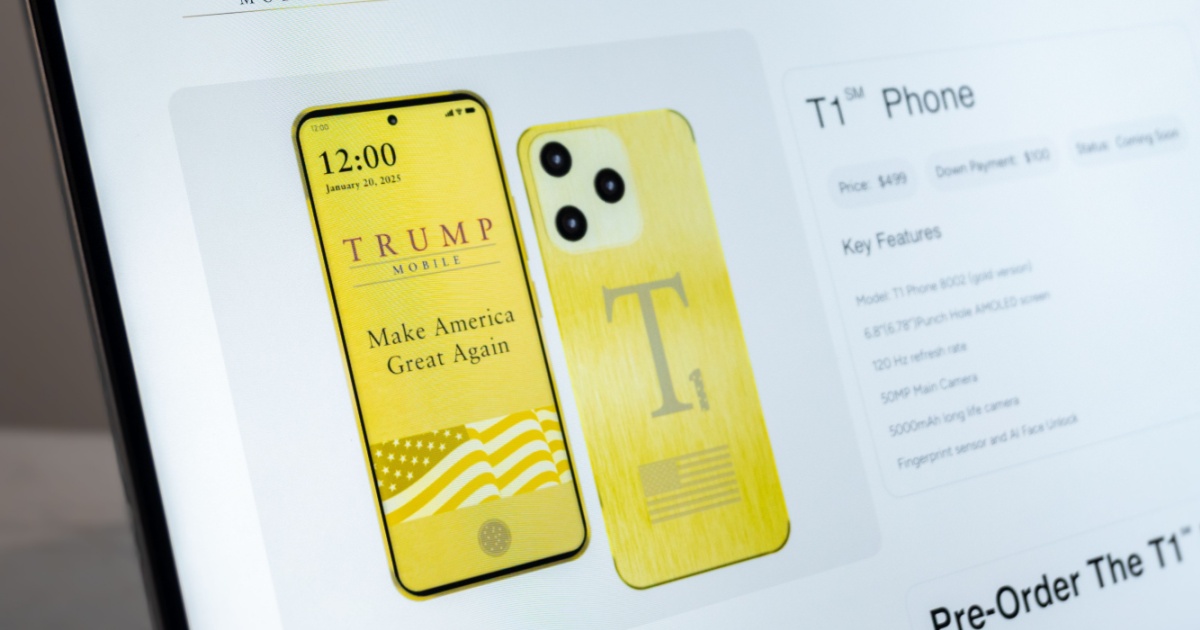

Nearly 600,000 people handed over $100 apiece to pre-order a gold-colored Android smartphone bearing the Trump name, an American flag on its back, and a promise that it was built right here in the United States. Almost a year later, not a single one of them has received a phone. What many of them have received instead is a quietly updated email, one that buried in the fine print tells them their money may be gone for good.
The story of the Trump Mobile T1 has been unraveling in slow motion since June 2025. What started as a splashy product launch at Trump Tower, headlined by Donald Trump Jr. and Eric Trump, has since become something considerably less triumphant. Deadlines passed, manufacturing claims evaporated, and now a freshly rewritten terms-of-service document has confirmed what many buyers already feared. For some customers, reading those updated terms felt less like legal housekeeping and more like a goodbye note.
But this is not a standalone story. The T1 fits into a long record of Trump-branded ventures that critics, regulators, and in several cases courts have described in strikingly similar terms. Understanding the phone controversy fully means looking at the broader pattern, from a for-profit university that settled fraud allegations for $25 million to a presidential memecoin that launched three days before an inauguration and left retail investors with steep losses.
The Trump Mobile T1: A Timeline of Broken Promises
Trump Mobile launched on June 16, 2025, at Trump Tower, headlined by Donald Trump Jr. and Eric Trump, timed to coincide with the tenth anniversary of Donald Trump’s 2016 campaign launch. The device was marketed as a gold-colored Android handset bearing an American flag on its back, retailing at $499 and bundled with a monthly service plan at $47.45 per month, a figure chosen as a nod to Trump being the 45th and 47th president.
An estimated 590,000 consumers paid $100 each to Trump Mobile to pre-order the T1, meaning $59 million was paid for a product that may or may not exist. As of May 2026, not a single confirmed customer has received the device.
The delivery timeline collapsed almost immediately. Initial delivery was promised for late summer 2025, then slipped to November, then December, then the first quarter of 2026. A mid-March 2026 T-Mobile carrier certification deadline also passed without resolution, and by April 2026, Trump Mobile quietly redesigned its website, removing the release date entirely rather than replacing it with a new one.
The Customer Service Chaos
NBC News placed a $100 deposit in August 2025 to track the phone’s development. That date passed without an update, and when NBC News followed up with the call center, an operator said the delivery would now be in the “beginning of December,” with no specific date, citing the government shutdown as a reason for the delay. In a call in January 2026, an operator said the phone was “in the final stages of certification and field testing” and targeting a ship date “sometime in Q1 2026.” That quarter has now passed. Analysts quickly dismissed the government shutdown explanation as irrelevant to a private-sector hardware company.
The experience for independent journalists was no better. Investigative reporter Joseph Cox of 404 Media, who also placed a deposit, found that Trump Mobile charged his card the wrong amount, never collected his shipping address, and sent a confirmation email promising delivery notifications that never came. Cox described it as “the worst experience I’ve ever faced buying a consumer electronic product” and subsequently reported unauthorized recurring charges being levied against customers’ cards.
The ‘Made in America’ Claim That Wasn’t
The T1 was sold from day one on the strength of a politically loaded promise: it would be built in America. Within days of the June 2025 launch, that language vanished from the Trump Mobile website. “MADE IN THE USA” became “American-proud design,” then “Brought to life right here in the USA,” language that supply chain experts noted was legally and commercially meaningless.
By February 2026, company executives confirmed to reporters that the T1 would not be manufactured in the United States. Final assembly of roughly the last ten components would take place in Miami, while bulk production would happen overseas. The phone itself is widely believed to be a reskinned version of the Chinese-made Wingtech Revvl 7 Pro 5G, a device already sold by T-Mobile in the United States.
While customers waited for the T1, the company began selling refurbished iPhones, which are primarily produced in China, and Samsung devices under the same branding umbrella.
The Terms of Service That Changed Everything
The clearest signal that deposits may never be returned came on April 6, 2026. A revised terms of service published that day stated explicitly that paying a deposit “does not constitute a completed purchase and does not create a binding legal contract.” The payment is described as “a conditional opportunity to buy the device if Trump Mobile eventually chooses to sell it,” with the company retaining all control over whether a phone is produced at all.
The fine print removes any binding contract, limits liability for delays, and stipulates that deposits have no independent cash value and are non-transferable. The headline on the website promised buyers were locking in promotional pricing, while the legal document sitting behind it said pricing could change at any time, no inventory was guaranteed, no delivery date was binding, and the company had no obligation to produce the phone.
If Trump Mobile decides to cancel the T1 entirely, it states it will issue refunds of the original deposit amount. The fine print adds, however, that the company bears no liability for delays caused by “parts shortages or hold-ups with regulators,” and that buyers waive any right to pursue claims beyond the original deposit figure.
The Political and Regulatory Response
Sen. Elizabeth Warren and 10 other Democratic members of the House and Senate asked regulators to investigate Trump Mobile’s “T1” phone, specifically asking the agency to investigate whether consumers were cheated by paying $100 deposits for phones that have yet to materialize. The letter also asked the FTC to determine whether Trump Mobile used “false advertising” in claiming that its T1 phone would be made in the USA.
California Governor Gavin Newsom’s office also weighed in publicly, describing the T1 phone project as appearing to be fraud. Phone case manufacturer Spigen separately threatened legal action after a promotional image appeared to feature a doctored image of a Samsung placed inside one of its branded cases, marketed as the T1.
As of May 2026, the FTC has not confirmed the existence of an investigation, nor whether one will ever be opened.
Not the First Time: The Broader Pattern of Trump-Branded Controversies
The T1 phone is not an isolated incident. It fits into a documented history of Trump-branded consumer and investment ventures that generated large sums of money and significant controversy, often leaving participants worse off than when they started.
Trump University: The $25 Million Settlement
The most thoroughly litigated example is Trump University, a for-profit real estate seminar program that operated from 2005 to 2010. The program, which was unaccredited, attracted criticism and legal scrutiny for allegedly misleading students about its educational offerings and the success of its real estate strategies, prompting the New York Attorney General to file a civil suit accusing Trump University of violating consumer protection laws.
Former students filed two class-action suits alleging that Trump was guilty of defrauding students, and New York Attorney General Eric Schneiderman filed a third lawsuit in 2013 accusing Trump and Trump University of violating consumer protection laws. The $25 million settlement recovered about 90 percent of the costs of those who attended Trump University, which, as part of the deal, did not admit to any wrongdoing.
The parallels to the T1 situation are not subtle. In both cases, a Trump-branded venture marketed heavily to loyal supporters using aspirational language. In both cases, critics alleged the actual product fell well short of what was promised. In both cases, regulatory and legal scrutiny followed.
Trump NFTs and the $TRUMP Memecoin
More recently, Trump’s entry into digital assets has generated fresh controversy. Trump has a documented history of using crypto to make money, having started selling NFT trading cards in 2022 and made millions from them, according to financial disclosure documents.
Then came the memecoin. The $TRUMP meme coin was launched on January 17, 2025, three days before Trump was inaugurated as president of the United States. After its launch, its price soared dramatically overnight. Less than a day later, the aggregate market value of all coins was more than $27 billion, valuing Trump’s holdings at more than $20 billion.
The gains, however, were concentrated. The New York Times reported that Trump affiliates controlled an additional 800 million tokens that, hypothetically, could be worth over $56 billion, potentially making Trump one of the richest people in the world. A March 2025 Financial Times analysis found that the crypto project netted at least $350 million through sales of tokens and fees.
Retail investors fared very differently. The $TRUMP token’s market capitalization peaked at over $27 billion shortly after launch but has since experienced a dramatic decline, dropping by over 90% to around $1.9 billion. Some analysts noted its similarity to a “rug pull,” a scheme in which a coin is launched and quickly abandoned, leaving early investors with steep losses.
Forbes reported that crypto now accounts for the majority of Donald Trump’s net worth, thanks largely to the cash generated by World Liberty Financial token sales and the $TRUMP coin fees. Legal experts quoted by PolitiFact raised concerns that the anonymous nature of cryptocurrency transactions meant anyone in the world could buy Trump’s tokens while concealing their identity, creating potential conflicts of interest and circumventing campaign finance restrictions.
In April 2025, the top 220 holders of the coin were offered dinner with the president, and the very top 25 holders would receive a special VIP White House tour. Following the announcement, the coin jumped more than 50%. Analysis found that leaked information about the promotion allowed certain traders to make bets on the coin before it was publicly announced.
In addition to the $TRUMP and $MELANIA meme coins, the Trump family leads a decentralized finance exchange called World Liberty Financial. A Trump business entity owns 60 percent of World Liberty and is entitled to 75 percent of all revenue from coin sales, with Eric Trump and Donald Trump Jr. actively involved in the management of the company. The venture has raised corruption concerns because it offers a direct financial channel to the Trumps. The company has been the subject of extensive reporting on conflicts of interest stemming from Donald Trump’s involvement, including dealings with foreign entities and individuals who had previously been under criminal investigation or convicted.
Read More: 15 Invisible Everyday Scams We Accept as Normal
What This Means for You
The T1 phone saga and the broader pattern of Trump-branded controversies share a common structural thread. In each case, a politically resonant marketing pitch attracted large numbers of loyal buyers or investors. In each case, the gap between what was promised and what was delivered proved vast. And in each case, the legal fine print, whether in a terms-of-service update, a settlement agreement, or a coin disclaimer, ultimately protected the brand far more than it protected the consumer.
For the nearly 600,000 Americans who put down $100 on the promise of a gold Trump phone, the most practical step available right now is clear: submit a formal cancellation request in writing through Trump Mobile’s customer support before any “final sale” is processed. The revised terms state that deposits are refundable on request prior to that point. Waiting to see whether the phone ever materializes means accepting a contract that, by its own language, guarantees you nothing. When a product is sold on political loyalty rather than verified specifications and enforceable delivery terms, those who act quickly on the fine print tend to fare considerably better than those who don’t.
AI Disclaimer: This article was created with the assistance of AI tools and reviewed by a human editor.
Read More: People are Furious After Finding Out About All The Things Trump Named After Himself