
Somewhere between buying organic, reading nutrition labels, and swapping chips for something that sounds virtuous, a sneaky pattern emerges. You’re eating foods that feel genuinely healthy. You track your steps, you skip dessert, you reach for the granola bar instead of the cookie. And yet the scale creeps in a direction you didn’t plan for.
Here’s what most people don’t realize: food marketing is extraordinarily good at dressing up calorie-dense, sugar-loaded products in the language of wellness. Words like “natural,” “wholesome,” and “made with real fruit” trigger a mental green light that bypasses the actual nutrition label. The result is that millions of people are eating with the best intentions and still working against their own goals.
That’s not a willpower problem. It’s an information problem. Several widely trusted “healthy” staples are far more complicated than their packaging suggests, and knowing what to look for changes everything.
1. Granola Bars
Granola bars occupy prime real estate in the wellness imagination. They sit next to trail mixes and protein snacks at the checkout counter, they come in earthy packaging with pictures of mountains and oats, and they carry an almost automatic association with clean eating. The actual nutrition label, however, often tells a different story.
Some granola bars contain as much sugar, carbs, and calories as candy bars. Check the nutrition label and you may see as many as 200-plus calories in a tiny one-third-cup serving, along with lots of added sugars and saturated fat. A review of a dozen granola and oat bars by Consumer Reports found that only a few met their suggested limit for added sugar, which was no more than 5 grams per serving. Nature Valley Oats ‘n Honey Crunchy Granola Bars, for instance, had more than double that amount.
The hidden cost is how quickly those numbers stack up. Many granola bars are highly processed and include added sugars, vegetable oils, preservatives, and artificial flavors, and studies indicate that high consumption of processed and sugary foods can increase the risk of metabolic syndrome, a cluster of conditions linked to diabetes, stroke, and heart disease. The fix is straightforward: flip the bar over and check the ingredients list. As a general rule, steer clear of granola bars that list sugar or other sweeteners within the first three ingredients. Look for bars with at least 3 grams of fiber, 3 or more grams of protein, and fewer than 8 grams of added sugar per serving. Better yet, make your own with oats, nuts, seeds, and a small amount of honey or dates.
2. Flavored Yogurt
Plain yogurt genuinely deserves its reputation. It’s high in protein, rich in probiotics, and consistently associated with better weight management in observational research. The problem isn’t yogurt – it’s what food manufacturers do to it before it hits the shelf.
The most significant factor that transforms yogurt into a potential source of weight gain is added sugar. Many commercial yogurts contain excessive sweeteners to improve palatability, often to counteract tartness or the removal of milk fat. Many milk and yogurt products, particularly flavored varieties, may contain large amounts of free sugar. This matters because sugar calories in yogurt don’t carry the same compensatory satiety signals that the protein and fat in plain yogurt do. You can eat a flavored yogurt cup and feel hungry again surprisingly fast.
According to some dietitians, a useful rule of thumb when examining a nutrition label is to aim for yogurt with less than 8 grams of added sugar per serving, but, if possible, avoiding added sugars is best for weight loss. Research suggests that low-fat yogurts do not have more beneficial effects on weight than regular whole-fat products, partly because of the higher sugar content of low-fat varieties. So reaching for full-fat, plain Greek yogurt and adding your own fresh fruit is almost always the smarter move than buying a pre-flavored low-fat option.
3. Fruit Juice
Few foods feel as inherently healthy as a glass of orange juice in the morning. It comes from fruit, it’s cold-pressed and “100% natural,” and for decades it sat beside eggs and toast as the model of a good breakfast. Recent research has substantially complicated that picture.
Drinking just one glass of 100% fruit juice every day leads to gaining close to half a pound over three years, according to research published in the journal Preventive Medicine. In a study of nearly 50,000 postmenopausal women, researchers found that weight gain among fruit juice drinkers was on par with those who regularly consumed sugary drinks like soda. Each 6-ounce serving of 100% fruit juice contains about 15 to 30 grams of sugar, 60 to 120 calories, and very little fiber.
The mechanism is worth understanding. As researchers at Harvard T.H. Chan School of Public Health explained, a glass of orange juice is about three oranges that can be consumed in a minute or two. You could easily go back for another, adding many calories and causing a spike in blood glucose – something that almost never happens when you eat three oranges whole. The high sugar and low fiber content of juice means it can spike blood sugar levels and increase appetite, and over time, that combination can lead to weight gain. Whole fruit works differently. Increasing whole fruit intake by one serving per day was associated with about one pound of weight loss over three years in the same research. Swap the juice for the real thing, and you get the fiber, the water content, and the satiety that processing removes.
4. Store-Bought Smoothies
A homemade smoothie with leafy greens, frozen berries, and a spoonful of nut butter is a genuinely nutritious meal. A store-bought or café smoothie – or even a home version loaded with too many calorie-dense add-ins – can easily become something closer to a dessert, with the calories to match.
Smoothies can be a great way to pack in nutrients, but they’re also an easy place to rack up extra calories. Too much nut butter, chia or flaxseeds, added sugar, or a high-fat base can turn a healthy smoothie into a calorie bomb. The body doesn’t register liquid calories the same as solid foods. That last point is the key issue: research consistently shows that liquid calories tend to be less satiating than the equivalent calories from solid food, which means a 500-calorie smoothie often doesn’t reduce how much you eat later in the day the way a 500-calorie meal would.
The calorie gap in commercial options can be startling. Some protein powders, a common smoothie add-in, contain as much as 23 grams of sugar per scoop. Some can turn a glass of milk into a drink with more than 1,200 calories, and the risk is weight gain and an unhealthy spike in blood sugar, according to Harvard Health. When building a smoothie at home, keep it to one piece of fruit, a handful of vegetables, a protein source like plain Greek yogurt, and water or unsweetened plant milk as the base. Skip the flavored syrups, fruit juice bases, and sweetened powders entirely.
5. Avocados (in Larger-Than-Usual Portions)
Let’s be clear: avocados are genuinely excellent food. They’re loaded with heart-healthy monounsaturated fats, fiber, potassium, and a range of vitamins. Regular avocado consumption has been associated with better diet quality in multiple studies, and they’re among the most nutrient-dense whole foods available. The portion size, though, is something most people never pay attention to.
A whole medium avocado contains about 240 calories, 22 grams of fat, and 10 grams of fiber, according to Harvard’s Nutrition Source. That’s a meaningful nutritional package – but it’s also a significant calorie contribution if you’re treating a whole avocado as a casual garnish on top of an already substantial meal. Because avocados are relatively high in fat, they are also high in calories, and those calories add up quickly when you’re spreading them generously on toast, adding them to smoothies, and spooning guacamole throughout the day.
There’s no reason to be concerned that avocados are fattening if you eat them in moderation as part of a nutrient-dense, whole food diet, according to Healthline. The research supports eating them regularly. The practical issue is one of portion awareness: a serving of fresh avocados is one-third of an avocado, or 50 grams, according to the USDA. A quarter of an avocado contains 60 calories, while the official serving size of one-third has 80 calories – figures that rise fast when portions double. Use half an avocado as a generous portion, and enjoy the rest the next day with a squeeze of lime to keep it fresh.
6. Low-Fat Salad Dressings
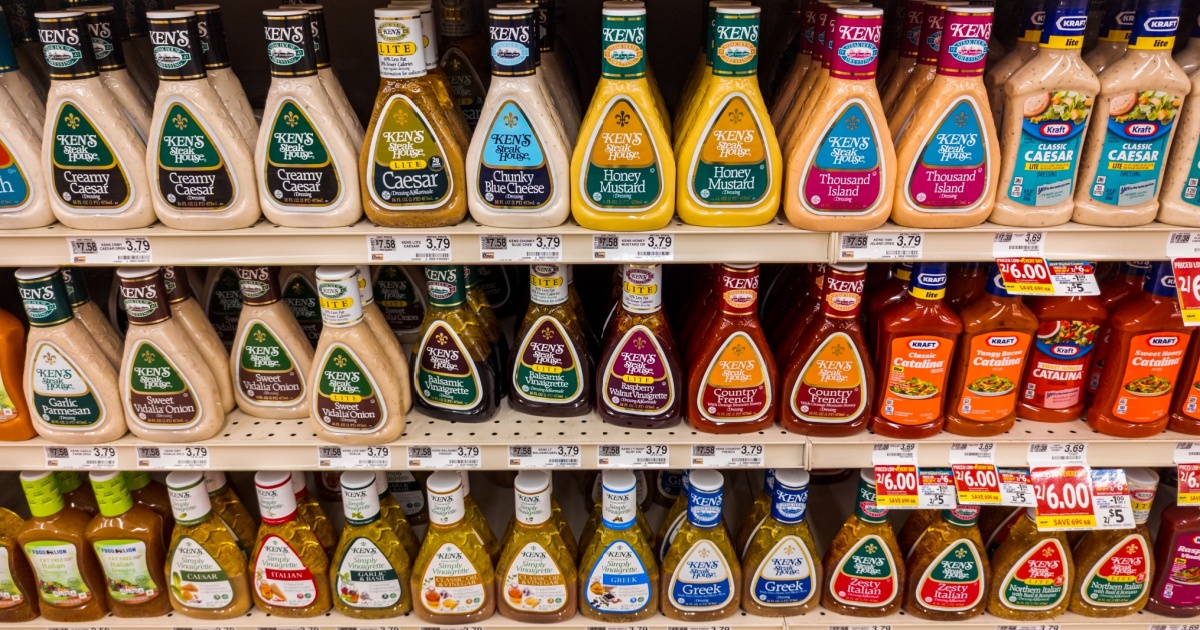
Reaching for the “light” or “fat-free” salad dressing feels like the responsible choice. It’s a small, daily decision that seems to align perfectly with any effort to eat well. The problem is that low-fat versions of salad dressings almost always compensate for removed fat with something worse: added sugar, refined starches, and sodium, in quantities that rival many processed snack foods.
A 2025 study suggests that the nature of ultra-processed foods, not just the consumption of extra calories from them, is what contributes to their association with excess weight gain and greater risk for obesity, according to Harvard Health. Many commercial low-fat dressings fall squarely into the ultra-processed category, built from thickeners, artificial flavors, and sugar to mimic the mouthfeel that fat naturally provides. Research has consistently shown that eating ultra-processed foods raises the risk of obesity, and a study in the October 2025 issue of Cell Metabolism suggests the nature of the food itself is the problem, not just the calorie count.
There’s also an irony embedded in low-fat dressings that most people don’t know about: the fat in full-fat dressings actually helps your body absorb fat-soluble vitamins and antioxidants from the vegetables beneath them. Remove that fat, and you reduce the nutritional value of the whole salad. A simple olive oil and vinegar dressing gives you healthy monounsaturated fats, genuine flavor, and none of the processing. One tablespoon of olive oil has just over 100 calories, so a measured drizzle works well without overdoing it. Check the label on any bottled dressing and look for products with fewer than 3 grams of sugar per 2-tablespoon serving and a short ingredients list you can actually read.
Read More: 16 filling foods that have almost zero calories and are perfect for weight loss
What to Do Now
None of these six foods needs to disappear from your diet. The goal isn’t elimination – it’s accuracy. When a granola bar has 19 grams of added sugar, it’s a treat, not a health food. When a smoothie tops 700 calories, it’s a meal, not a snack. When you’re pouring flavored yogurt that lists “sugar” as the third ingredient, you’re eating dessert with a wellness label on it.
The single most useful habit you can build is reading the nutrition label before the front of the package. Ingredients are listed by weight in descending order – so if sugar appears in the first three, it’s the dominant feature of that product, whatever the marketing says. Choose whole fruit over juice. Make your dressing. Portion your avocado. And when a food genuinely delivers on its healthy-sounding promises – the way plain Greek yogurt, whole avocados in reasonable amounts, and home-built smoothies do – keep it in your routine with confidence. The difference between a food that supports your goals and one that quietly works against them is usually right there on the label. You just have to look.
Disclaimer: This information is not intended to be a substitute for professional medical advice, diagnosis or treatment and is for information only. Always seek the advice of your physician or another qualified health provider with any questions about your medical condition and/or current medication. Do not disregard professional medical advice or delay seeking advice or treatment because of something you have read here.
AI Disclaimer: This article was created with the assistance of AI tools and reviewed by a human editor.
Read More: 3 Reasons Your Belly is Enlarged That May Not Be Related to Weight Gain