
Most Americans can name a few things about Canada. Hockey. Cold winters. Tim Hortons. Politeness bordering on mythology. It’s the country right next door, sharing nearly 5,525 miles of border and decades of pop culture, trade deals, and friendly ribbing. And yet, for all that proximity, the mental map a lot of Americans carry of their northern neighbor is riddled with gaps, guesses, and flat-out myths.
None of this is malicious. It’s more a product of familiarity breeding assumptions. Canada tends to feel so close, so similar, that most Americans never feel the need to look any deeper. That’s where things get interesting, because the closer you look, the more the differences stack up – and the more the stereotypes start to fall apart.
Some of the things Americans believe about Canada are harmless enough: a harmless joke about an accent, a vague sense of the weather. Others are more consequential misunderstandings about healthcare, language, culture, and size. Here’s where the record needs setting straight.
1. Canada Is Always Freezing
The cold-country stereotype is perhaps the most reflexive assumption Americans make. Ask someone to picture Canada and they’ll picture blizzards, parkas, and frozen tundra. The reality is far more varied than that.
Canadian weather varies dramatically by region and season. Cities like Vancouver experience mild winters with little snow, while Toronto’s summer temperatures regularly reach above 30°C (86°F). That’s around 86 degrees Fahrenheit – hardly the arctic wasteland the stereotype suggests. The Maritime provinces enjoy beautiful fall colors and moderate temperatures, and southern Ontario’s climate closely resembles that of many northern U.S. states.
Average winter and summer high temperatures across Canada range from Arctic conditions in the north to genuinely hot summers in the southern regions, with four distinct seasons. The north is cold. Parts of British Columbia are rainy and temperate. The prairies get extreme heat in the summer. Canada is not a climate – it’s a continent’s worth of climates, compressed into one country Americans tend to imagine as one big snowfield.
So if you’ve been picturing Canada as perpetually frozen, you’ve essentially been picturing one corner of a country that covers 9,984,670 square kilometres and spans seven major geoclimatic regions. The range is enormous, and it’s worth knowing before you pack for a trip to Vancouver in July.
2. Healthcare Is Completely Free
This one is common and understandable. Canada has universal healthcare, so the assumption is that Canadians pay nothing for medical treatment. The truth is more layered.
Canada does have a universal health care system funded through taxes, meaning any Canadian citizen or permanent resident can apply for public health insurance, but each province and territory has a different health plan that covers different services and products. Funded through taxes isn’t the same as free – Canadians pay for the system, just not through individual bills at the point of care.
More importantly, the system has real coverage gaps. Canadian Medicare provides coverage for approximately 70 percent of Canadians’ healthcare needs, with the remaining 30 percent paid for through the private sector. That 30 percent typically covers services like prescription drugs, eye care, dental treatment, medical devices, and psychotherapy. Canada is the only country with a universal healthcare system that does not include prescription drugs, which means Canadians still pay for approximately 30% of their healthcare directly or via private insurance.
Wait times are also a real and acknowledged trade-off. Available data indicate much longer waits in Canada than in the U.S. to consult a specialist and to have non-emergency surgery like knee replacements. The incidence of unmet medical needs is slightly lower in Canada than in the U.S., but the difference is notable: waiting time is cited as the reason by over half of Canadians with unmet needs, while cost is cited by over half of Americans in the same situation. Different trade-offs, different system – but neither is simply “free.”
3. Everyone Speaks Both English and French
Americans often picture Canada as a bilingual country where citizens seamlessly switch between English and French. That picture doesn’t match the day-to-day reality for most Canadians.
French-English bilingualism isn’t as widespread as many Americans think. Only about 18% of Canadians speak both official languages fluently, with French speakers concentrated mainly in Quebec and parts of New Brunswick. Most Canadians outside these regions primarily speak English in their daily lives.
Canada has two official languages, and bilingual labeling appears on products across the country – but that’s federal policy, not a reflection of what’s happening in living rooms from Alberta to Newfoundland. The requirement for bilingual packaging and signs doesn’t reflect the average Canadian’s language abilities. A Calgarian going about their daily life may never need to use French, just as someone in rural Quebec may rarely use English. The country is officially bilingual. Its population, for the most part, is not.
4. Canada Is Just America’s Hat
The notion that Canada is essentially a quieter, politer version of the United States – “America’s hat,” as the joke goes – is one of the more condescending assumptions around. Canadians notice it, and they don’t love it.
Although Canada shares many similarities with its southern neighbor, and popular culture in the two countries is in many respects indistinguishable, the differences are profound. As the 20th-century literary critic Northrop Frye wrote in his essay collection The Bush Garden, the distinctive Canadian attitude “may go back to the central fact of Canadian history: the rejection of the American Revolution.” Contemporary Canadians are more inclined to favor orderly central government and a sense of community over individualism.
This shows up in foreign policy decisions that would surprise Americans who assume the two countries always move in lockstep. Canada refused to join the United States in the Iraq War in 2003, has taken stronger stances on climate policy, and regularly differs from American foreign policy positions at the United Nations. Canada also became a destination for American draft dodgers during the Vietnam War.
Canada also has its own distinct cultural institutions, literature, and identity that thrive independently of American influence. Canada has developed a vast music infrastructure including conservatories, record companies, and performing arts centers, supported by programs like the Canada Music Fund, and the Canadian music industry is one of the largest in the world, producing internationally renowned composers and ensembles. The country with its own culture, its own foreign policy instincts, and its own national identity deserves more than to be called a hat.
5. Hockey Is Canada’s Only Sport
Hockey is massive in Canada. No one disputes that. But equating Canada with hockey so completely that other sports don’t exist is an oversimplification Canadians tend to find a bit tired.
Lacrosse is actually Canada’s official national summer sport, a fact that surprises many people who assume hockey holds both titles. In 1994, Parliament passed the National Sports of Canada Act, which declared lacrosse to be Canada’s National Summer Sport, with ice hockey as Canada’s National Winter Sport. Lacrosse originated as a sacred sport played by First Nations people for spiritual, ceremonial, and diplomatic purposes, known as Baggataway or Tewaarathon, and held deep cultural meaning across many Indigenous nations.
Beyond lacrosse, hockey is without question a massive part of Canadian culture and holds a special emotional place for millions. That said, Canada is also passionate about football through the CFL, basketball, thanks in large part to the Toronto Raptors’ 2019 NBA championship, and increasingly soccer. Not everyone in Canada plays hockey. Not everyone in Canada skates, either. Canadians are sports fans in the fullest sense of the phrase – not just fans of one particular sport.
6. Canada Is Small
This one is perhaps the most factually wrong assumption on the list, and yet it persists. Canada is not a small country wedged somewhere above the northern U.S. states. It is one of the largest places on Earth.
By total area including its waters, Canada is the second-largest country in the world, after Russia. Canada covers 9,984,670 square kilometers and also has the world’s longest coastline, stretching 243,042 kilometers. To put that in perspective, you could fit the entire continental United States inside Canada’s borders with room to spare.
The vast majority of Canada’s territory is sparsely populated wilderness, with a population density of just 3.5 people per square kilometer – among the lowest in the world. Despite this, nearly 80% of Canada’s population lives in urban areas. The overwhelming majority of Canadians live within 185 miles of the U.S. border. So while the country is enormous, most of its people cluster near the south, which gives visitors the impression of a compact, manageable place. Venture north, and that illusion disappears fast.
The practical implication: Americans sometimes try to pack multiple Canadian cities into a single trip the way they’d plan a road trip through several states, without grasping the actual distances involved. Toronto to Vancouver is roughly the same distance as New York to Los Angeles.
7. Maple Syrup Is Casual Pantry Stuff Up There
Americans know Canada makes maple syrup. What they don’t fully grasp is the sheer scale – and how central to the global supply chain Canada actually is.
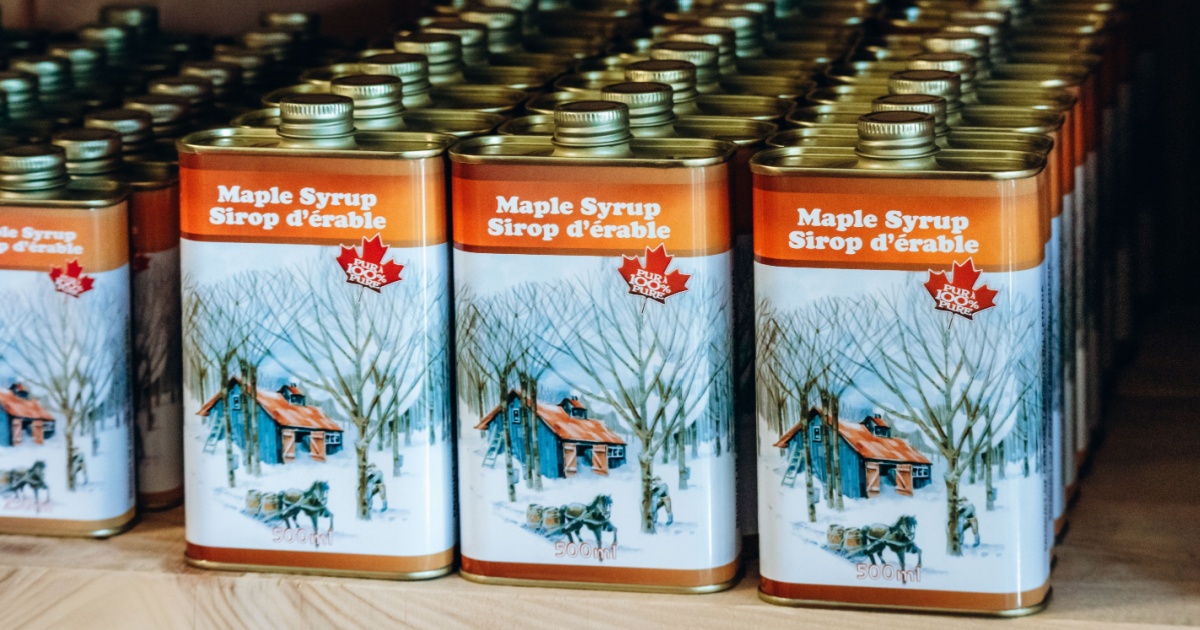
According to Quebec Maple Syrup Producers, the Canadian maple syrup industry accounts for an average 72% of the world’s maple syrup supply, with 90% of Canadian production originating from Quebec. That’s not just a lot of syrup – it makes Canada the dominant force in a global commodity market. Quebec’s maple industry contributes $1.1 billion to Canada’s GDP and creates the equivalent of 12,600 full-time jobs.
There’s even a strategic reserve. The Global Strategic Maple Syrup Reserve, managed by Quebec Maple Syrup Producers, helps stabilize the market and has a total capacity of 133 million pounds stored across three warehouses, allowing for supply regulation and price stabilization. The idea of a strategic reserve for syrup sounds whimsical, but it makes total sense when you realize how much of the world depends on Quebec’s harvest. A bad maple season in Canada affects supply globally – the same way a poor olive harvest in Spain can affect olive oil prices in American kitchens.
Read More: Countries Where Americans Aren’t Always Welcome
8. Canadians Actually Say “Aboot”
Few things amuse Canadians less than the “aboot” impression. It’s a phonetic caricature that outsiders love to repeat, and Canadians find it baffling because, to their own ears, they’re saying no such thing.
Any Canadian will say they do not say “aboot.” The Canadian accent can sound different to American ears, but seldom – if ever – do people actually pronounce the word as “oot” or “aboot.” What’s responsible for the misconception is a phonetic quirk called “Canadian raising,” which tends to be exaggerated by outsiders. Canadian raising is a real linguistic feature – it refers to how the vowels in words like “about” and “house” are pronounced slightly differently before certain consonants – but it’s a subtle shift, not the comedy accent that gets trotted out in impressions.
Canadian spelling is another area where Americans sometimes feel confused or assume Canadians are just using British spellings inconsistently. In fact, according to Oxford’s Guide to Canadian English Usage, “Canadian English is a variety of English in its own right,” with its own political, cultural, historical, and geographical realities that require its own words and conventions. Canadians generally put a “u” in words like “colour” and “favour” where Americans leave it out, and spell “theatre” and “centre” with an “re” at the end. It’s not an error. It’s not British. It’s distinctly Canadian.
What to Do With All of This
The overarching theme here isn’t that Americans are uniquely uninformed – it’s that proximity can breed a false sense of understanding. Canada and the United States share a border, a language (mostly), and enormous amounts of trade, culture, and history. That closeness makes it easy to assume you already know the full picture.
But Canada is a genuinely distinct country with its own healthcare architecture, its own linguistic realities, its own Indigenous history and national sport, its own foreign policy positions, and enough square kilometers to dwarf almost every other nation on Earth. It also controls most of the world’s maple syrup, which is not a small thing when you think about it.
Getting Canada right isn’t just a matter of trivia. For anyone crossing the border – whether to visit, work, or live – understanding how the country actually functions, what drives its people, and where it genuinely differs from the U.S. makes for a richer, more respectful experience. And Canadians, for their part, are unlikely to correct you too aggressively if you get something wrong. But they’ll definitely notice.
AI Disclaimer: This article was created with the assistance of AI tools and reviewed by a human editor.
Read More: Canada is Home to World’s Longest Hiking Trail Stretching From Coast to Coast