Metal Detector Hobbyist Unearths Ancient Celtic Gold Coin
A curved gold coin, smaller than a modern cent, has pushed Saxony’s coin record deeper into the Iron Age. In July 2025, a certified volunteer metal detectorist found the piece on farmland near Gundorf, northwest of Leipzig. Saxony’s State Office for Archaeology later identified it as a Celtic gold quarter stater, dated to the 3rd century BCE. The office also classed it as a Regenbogenschüsselchen, often rendered in English as “rainbow cup.” The coin weighs 2 grams and was made from nearly pure gold. Because the surface looks almost die-fresh, archaeologists suspect it did not pass through everyday trade. Instead, the office links it to stored wealth and elite contacts with Celtic communities to the south. One object cannot map a whole economy, yet it can prove that exchange routes reached farther than assumed. Equally important, the finding highlights how modern reporting rules can protect fragile evidence during hobby searches.
The day Saxony introduced its oldest coin
On 27 October 2025, Saxony’s archaeology office presented the coin to the press in Dresden. The state minister for culture and tourism attended the event. The announcement used direct language about shared heritage and public responsibility. Barbara Klepsch said of the find, “The gold coin is a tangible piece of our history.” She also thanked the finder for reporting it with care.
Officials stressed cooperation between volunteers and archaeologists. That cooperation protects sites that staff cannot watch each day. A prompt report preserves location data and nearby traces before ploughing or weather disturbs them. The press note called the discovery an example of “vorbildliche Zusammenarbeit (exemplary cooperation).” It also said, “Correct reporting behavior is crucial” for legal searching. That message aims to turn curiosity into documented evidence. The media release also explains why the coin shifts Saxony’s timeline.
Until this discovery, the oldest known coin from Saxony was a silver Büschelquinar. Finders recovered that coin near Zauschwitz in 2007. The office dates that silver type to the early 1st century BCE. It links the minting region to southern Germany. The Gundorf gold coin predates it by more than 100 years. So the office now treats the Regenbogenschüsselchen as Saxony’s oldest coin find so far. This does not prove Celtic settlement in Saxony. However, it confirms that coin-using networks touched the region earlier than previous finds suggested. The statement also notes that only 2 Celtic coin finds were known in Saxony until recently. Intensive field surveys added 9 more coins in recent years. Among those, the office reports only 1 other gold specimen, and it was undecorated. That wider context helps explain why the Gundorf coin drew attention in a press setting.
A quarter stater in 2 grams of gold
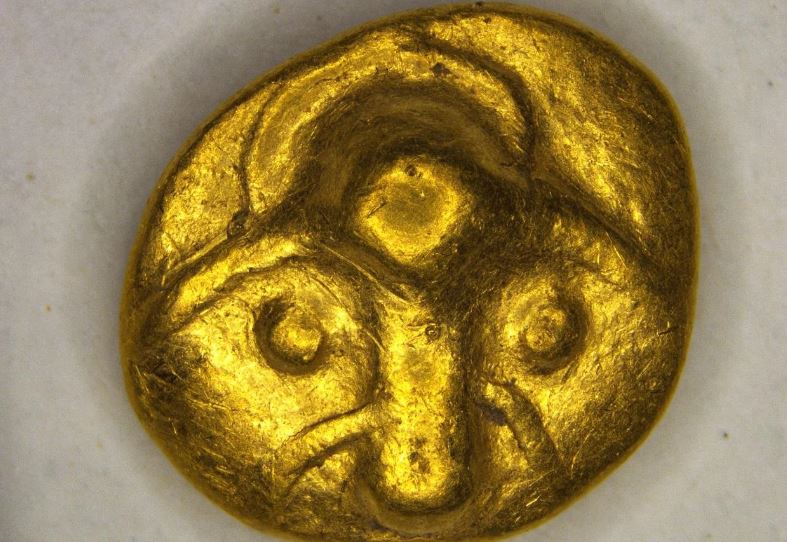
Obverse of the 2,200-year-old Celtic gold quarter stater featuring a stylized animal head. Credit: Saxony State Office for Archaeology
The office description begins with measurable facts, because those facts guide later comparison. It states, “The piece, weighing 2 grams, is a quarter stater.” It also describes the coin as made from “nearly pure gold.” Numismatists use a quarter stater for a quarter unit within a stater-based standard. A 2-gram gold piece concentrates value into a very small object. That makes it easy to carry and easy to hide. It also makes it easy to store, since gold resists corrosion in soil. The coin’s gentle curve supports the “rainbow cup” label. A curved flange can stiffen a thin piece of metal. That shape also protects the design when the coin moves in a pouch or pocket. It can also make the piece easier to spot after rain, because light catches the curve.
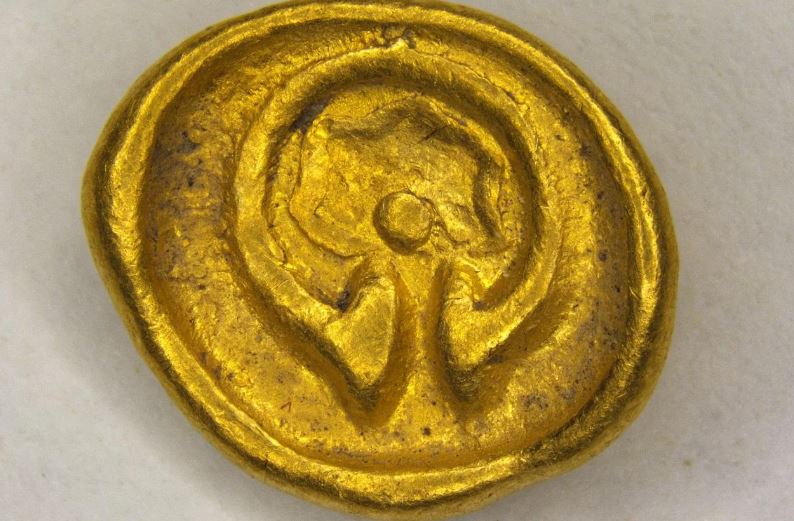
Imagery provides a second set of identifiers. The office describes a stylised head on the obverse, likely an animal, possibly a deer. On the reverse, it describes an open-neck ring with thickened ends. It also notes a star with rounded points and a small sphere. Such motifs can signal identity and prestige without any writing. Regina Smolnik cautioned against picturing everyday change. She said the almost-die-fresh coin was unlikely “in the sense of a coin-based monetary economy” in circulation. She then added that it probably served “as a status symbol or as a store of value.” That reading fits the condition described by the office. It also explains why the coin could travel far while staying sharp. A stored piece can move between hands without heavy wear.
Why “rainbow cup” stuck as a name
“Rainbow cup” sounds like folklore, and the Saxon office explains that folklore in official language. It ties the nickname Regenbogenschüsselchen to an old superstition. It quotes “the superstition that a treasure can be found where the rainbow touches the earth.” It also records the older claim that bowl-shaped gold pieces fell from the sky. Such stories helped rural communities talk about sudden wealth in fields. They also turned isolated finds into shared memory, passed along in families and local sayings. Even today, the name remains useful because it signals a specific curved form at once. English writers translate it as “rainbow cup,” but the German word keeps the original tone. It is a label with cultural history built into it, for researchers too.
The statement also offers a practical reason for the superstition. It explains that similar coins were often found after heavy rain, when water washed them from the soil. The office even suggests this washing-out effect likely sparked the superstition in the first place. Ploughed land brings objects closer to the surface, then rain does the rest. That process can separate a coin from any surrounding traces, which is why findspot notes become important. The coin’s concave profile can catch light and stand out against wet earth. So weather, farming, and folklore reinforce one another. Numismatists still use the nickname, but they treat it as a typological term, not a claim about miracles. In museum displays, the same name can hook attention and then lead visitors toward an evidence-based explanation.
A Bohemian trail, not a Saxon mint
The strongest comparative clue in the Saxon statement points toward northern Bohemia. The office writes, “Comparable pieces are found mainly in the northern Bohemian settlement area of the Celts.” It also dates those parallels to the 3rd century BCE. That comparison narrows the likely origin without claiming a single workshop. For Saxony, it means the closest matches sit south of Leipzig across modern borders. Coin types often cluster around minting regions, so regional comparison is basic detective work. In this case, the office treats a Bohemian origin as the best fit for the style and shape. It also calls the object, unequivocally, a Celtic coin issue, based on the evidence. That helps separate local use from local production in Saxony.
Smolnik framed the find as evidence of contact, even though Saxony lies outside the Celtic settlement zone. She said, “The valuable new find is further evidence that there were regular contacts and connections.” That language stays within what a single object can support. It does not claim migration or conquest. It points to exchange, including the movement of valuables and knowledge. A gold coin could reach Saxony with a travelling trader. It could also arrive as a gift between elites who maintained distant partnerships. Because the find came from a field, its original setting is unknown. So researchers avoid grand stories and focus on plausible movement. The coin’s near-fresh surface suggests careful storage, not constant handling. Either way, the find adds a solid data point to discussions of pre-Roman interaction zones.
A torc on a coin, and what it signals
The reverse shows an open-neck ring, or torc, which many researchers link to rank and display. Museums communicate that link in plain language for visitors. The British Museum states, “Gold torcs may have been a symbol of high status.” It adds that Cassius Dio described Boudicca wearing a gold necklace, yet he wrote long after the events. The same museum record notes that some Iron Age deities appear in sculpture wearing torcs. Together, these points show why the torc carries meaning beyond decoration. When a torc appears on a coin, it can signal elite identity and prestige to those who recognise it. Saxony’s statement calls the motif a “geöffneter Halsring,” which fits the torc form. Smolnik also described the Gundorf piece as a status symbol or wealth store. A torc image supports that reading, because it points directly to the rank.
The torc image also matches how torcs were built and worn. A British Museum blog describes a common form as “open at the front, with a flexible neck-ring.” That detail helps readers interpret the Gundorf coin’s open ring with thickened ends. Celtic coin imagery often uses stylisation and abstraction, so recognisable objects become anchors. The torc provides that anchor, and it gives the design a clear centre of gravity. The nearby star and small sphere can then work as secondary marks, guiding classification. In small coins, engravers often compress complex ideas into a few strong shapes. That compression suits a world where value must be readable at a glance, but also easy to carry.
How Celtic coinage learned the “stater” idea
The reverse shows Celtic motifs. Credit: Saxony State Office for Archaeology
The word “stater” did not begin in Celtic Europe, and its origin is easy to trace. The Open University writes, “‘Stater’ is from Greek.” It also links early coin minting in the western world to Greek trade around 600 BCE. That background matters because Celtic coinage developed in a continent already shaped by Mediterranean money. Through exchange contacts, Celtic communities encountered the idea of standardised weight plus official stamping. Coinage did not replace every older value system at once. However, it offered a portable standard when people needed quick agreement on value. Gold was especially useful for that role, because small weights could represent large worth. They could then adapt that idea to local needs, including gifts, payments, and elite display. Once a unit becomes familiar, fractional pieces can follow, including the quarter stater named in Saxony’s statement.
Coin evidence also shows imitation across cultures. The British Museum records some pieces as “Contemporary Celtic imitation.” These imitations include coins modelled on famous Macedonian issues. Copying can carry practical benefits, since it borrows trust from a known standard. Yet imitation also changes in the act of copying, because engravers simplify lines and adapt symbols. That is where distinctly Celtic styles emerge, including abstraction and compressed motifs. In that context, a quarter stater can be both money and a message. It can function in exchange among people who accept the standard. It can also act as proof of access to wider networks and to mint knowledge. It can store value, yet it can also communicate who controls that value.
Trade networks that move small gold far
A Bohemian gold coin turning up near Leipzig makes sense when you consider Iron Age exchange corridors. Amber is one major tracer because it travels widely and survives well in archaeology. A project at Friedrich-Alexander University Erlangen-Nürnberg links amber to long-distance trade. It states, “Amber indicates the existence of a supra-regional distribution network during the Hallstatt and Early La Tène Periods.” The project adds that this network moved amber from north to south. It also notes movement in western and eastern directions. Such corridors can carry more than amber. They can move knowledge about weights, metal quality, and trusted exchange partners. Gold coins fit into that flow because they compress value into a durable object. A traveller can carry significant wealth without hauling bulky goods.
Movement, however, depends on who controls access. Not every household handled gold, and not every exchange used coins. Elites often managed long-distance contacts, since they could guarantee safety through reputation. In that context, a gold coin can act as portable wealth inside a trusted circle. Stored wealth can move without constant handling, which helps explain the nearly die-fresh look described by the office. That helps explain why the coin stayed pristine during long storage periods. It can also signal membership in an upper layer of society, where distant contacts were part of status. Therefore, the coin sits at the intersection of economy and identity, not only at the cash point.
Detecting is done with permission and paperwork
The Gundorf findings also highlight the modern rules that can make public discoveries useful for research. Saxony’s archaeology office states, “Searching for archaeological monuments in the Free State of Saxony is permitted only with prior authorization.” The same guidance explains that this applies with a metal detector and without one. It also says the office offers free information talks and training courses. Those sessions explain heritage law and field practice, so hobby activity becomes documented work. When trained searchers report quickly, archaeologists can record coordinates and circumstances. That turns a loose object into a useful data point in a regional survey map. It also reduces accidental damage to sites that sit under modern fields. Even a small scoop can destroy fragile layers, so training reduces risk. In Saxony’s system, certification signals that the finder understands these limits.
Saxony’s detectorist leaflet explains what goes wrong without that structure. It warns that unsystematic digging can “destroy the contextual associations irretrievably” and make finds scientifically worthless. Context includes soil layers, nearby traces, and exact position. Once someone disturbs those links, specialists cannot rebuild them from the object alone. The leaflet also emphasises reporting duties under Saxon heritage law, including a section titled “Meldepflicht (Reporting obligation).” It notes that finds can be legally important even when they are not ancient. The leaflet also warns that detector searches without permission can face criminal prosecution. These details are not background noise. They explain why the Gundorf coin arrived with official documentation and public presentation, not with secrecy.
After the press event, the coin enters a slower phase of analysis and record-building. Specialists will photograph it, measure it, and compare it with known groups from northern Bohemia. They can also test the metal to confirm purity and identify trace elements, while avoiding damage. In Britain, the Portable Antiquities Scheme explains how experts often examine metal finds. It refers to “a non-destructive test using X-ray fluorescence (XRF).” XRF can confirm surface composition, which supports comparison between coin groups and time periods. However, researchers still need context data, because chemistry alone cannot show who owned the coin or why they carried it. Non-destructive methods also keep the object available for display and future study. It supports public transparency, too.
The Saxon office also places the Gundorf coin within a growing dataset from regional fieldwork. It reports that intensive surveys added 9 Celtic coins to Saxony’s record in recent years. Among those, the office notes only 1 other gold specimen, and it was undecorated. Smolnik summed up the situation with a crisp line: “Celtic coins are a rarity in Saxony.” Each documented example, therefore, has extra value for mapping contacts and exchange zones. Over time, careful comparison can show whether finds cluster along certain river corridors or soil regions. It can also show whether elite objects appear near known settlements or appear alone in open fields. For now, the Gundorf coin stands as a rare, well-reported object that invites patient, evidence-led work.
A.I. Disclaimer: This article was created with AI assistance and edited by a human for accuracy and clarity.