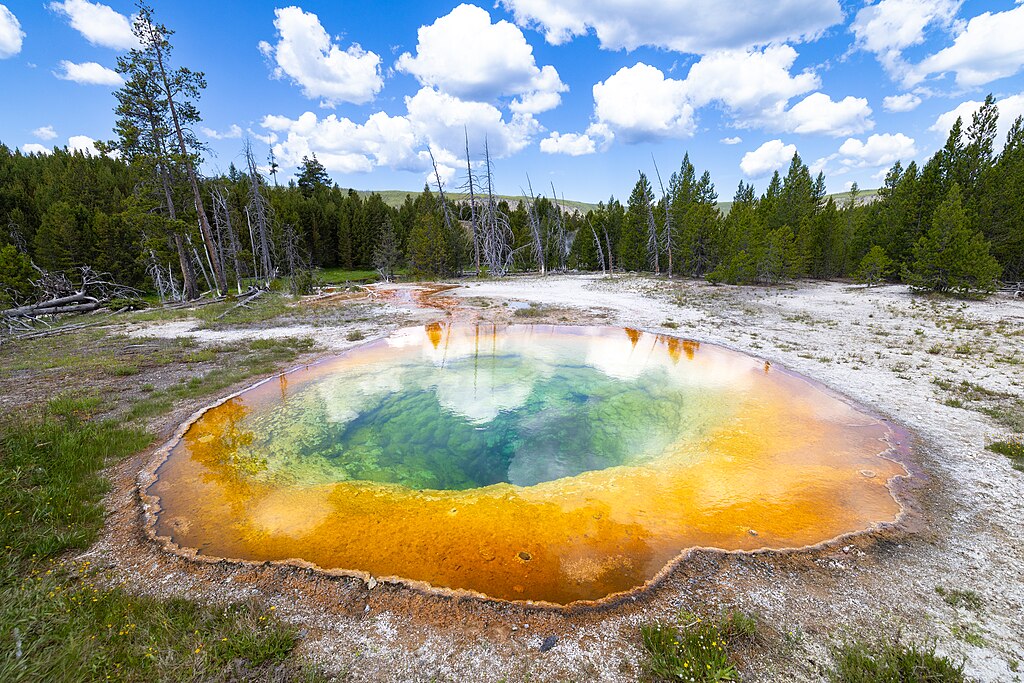

Beneath a national park famous for its geysers and bison herds sits one of the most powerful volcanic systems on Earth. Most visitors to Yellowstone walk the boardwalks above superheated springs without giving much thought to what lies below. But scientists who study the ground they’re standing on think about little else. The Yellowstone caldera, a roughly 35-mile-wide crater formed by a catastrophic eruption some 640,000 years ago, sits over a magma system that has produced three of the largest volcanic explosions in North American history. The question scientists keep returning to isn’t really whether Yellowstone will erupt again. It’s what happens to the planet when it does, and whether we’d recognize the warning signs in time to prepare.
This is also a story that reaches far beyond Wyoming. Yellowstone is extraordinary, but it isn’t the only geological system capable of reshaping civilizations. From the slopes above Naples to the volcanic zones of New Zealand and Indonesia, a handful of geological giants share the ability to alter global climate, trigger agricultural collapse, and destabilize the world as we know it.
Understanding what that actually looks like, what the science shows and what it doesn’t, matters more than most disaster coverage lets on.
What the USGS and Recent Science Actually Say About Yellowstone Supervolcano Climate Impact
To understand the Yellowstone supervolcano climate impact, start with a much smaller comparison. The 1991 eruption of Mount Pinatubo in the Philippines was about 1,000 times smaller than Yellowstone’s largest known eruption. That comparatively modest event still caused the sulfur dioxide it released to interact with the atmosphere, cooling Earth’s surface for three years. At the height of that impact, global temperatures dropped by 1.3°F (0.7°C).
Scale that up by a factor of 1,000, and you begin to appreciate the scope of what USGS scientists are discussing when they model a Yellowstone eruption. If another catastrophic, caldera-forming Yellowstone eruption were to occur, the USGS states it would probably alter global weather patterns and have enormous impacts on human activity, especially agricultural production, for many years. Scientists currently lack the ability to predict specific consequences or durations of those global impacts.
That last caveat is important. The uncertainty isn’t a sign that scientists are unconcerned. It’s a sign that the scale of the event is genuinely beyond what modern climate modeling has been tested against. What researchers do have is a growing body of data on how the system works underground, and the picture from January 2025 is more detailed than anything that existed before.
A study published in Nature by Bennington et al. used magnetotelluric imaging, a technique that maps electrical conductivity underground, at over 100 measurement locations around Yellowstone. Researchers found each magma reservoir measured between 9 and 15 percent liquid melt, well below the proportion required for eruption. The northeast Yellowstone reservoir is the largest, containing approximately 440 cubic kilometers of melt. For comparison, the most recent catastrophic caldera-forming eruption 640,000 years ago erupted about 1,000 cubic kilometers.
So right now, Yellowstone isn’t close. But “not close” by geological standards and “not dangerous in our lifetimes” are not the same statement. The system is very much alive.
How Would a Yellowstone Eruption Affect Global Temperatures?
This is the question at the heart of most Yellowstone supervolcano climate change discussions, and a landmark 2024 study offers one of the most definitive answers yet. A study published in the Journal of Climate by a team from NASA’s Goddard Institute for Space Studies and Columbia University found that post-eruption cooling from a volcanic super-eruption would probably not exceed 2.7°F (1.5°C) even for the most powerful blasts. Lead author Zachary McGraw noted that the relatively modest temperature changes found are compatible with the absence of firm evidence of global-scale catastrophe from any single super-eruption in the historical or fossil record.
That might sound reassuring. It shouldn’t be, entirely. A 1.5°C global average temperature drop doesn’t sound dramatic until you consider what that means at the ground level. Researchers at the MIT Climate Portal note that some researchers believe the cooling effect from a supervolcano could last for decades, with the possible effect reaching up to about 7°F (4°C) in the most extreme estimates, though the NASA-led study frames the lower end of that range as more scientifically supported.
What’s not in dispute is the mechanism. When volcanoes erupt explosively, they shoot gases including sulfur dioxide into the stratosphere. Sulfur dioxide is the most significant of these, because it reacts with water vapor to create sulfate aerosols. Those aerosols increase the reflection of radiation from the sun back into space, reducing the warming that reaches Earth’s surface.
The historical analogy scientists keep returning to is the 1815 eruption of Mount Tambora in Indonesia. Widely considered the largest eruption in recorded human history, it claimed tens of thousands of lives and plunged Earth into the “Year Without Summer,” a prolonged period of low temperatures that ravaged crops and caused widespread famine and disease epidemics around the world. Tambora was roughly a VEI-7 event. Yellowstone’s three historical eruptions were VEI-8, meaning they released at least ten times more material.
For context on the scale required to qualify: to be classified as a super-eruption, a volcano must release more than 240 cubic miles (1,000 cubic kilometers) of magma. The most recent such super-eruption occurred more than 22,000 years ago in New Zealand.
Which U.S. States Would Be Most Affected?
The answer differs depending on proximity to the eruption, and the two categories of threat are very different in character.
The surrounding states of Wyoming, Idaho, and Montana would be directly in the path of pyroclastic flows, hot avalanches of volcanic ash, pumice, gases, and rocks that can reach 400 to 500°C, move at more than 300 kilometers per hour, and travel for more than 100 kilometers. You can’t outrun a pyroclastic flow. It picks up and destroys everything in its path.
Those flows destroy and bury everything within about 60 miles of the vent, turning every living thing into charcoal. Parts of Montana, Idaho, and Wyoming closest to the park would face near-total destruction in the immediate hours of the eruption. This is the zone where survival without advance evacuation would be essentially impossible.
The ash threat is the one that affects everyone else. Scientists at the Yellowstone Volcano Observatory predict that a supereruption would drop thousands of feet of ash within the park radius, and coat communities stretching from Missoula, Montana, to Albuquerque, New Mexico. That’s a diagonal stretch covering portions of Montana, Wyoming, Idaho, Colorado, Utah, Arizona, and New Mexico in meaningful accumulation.
But the effects extend much further. A Yellowstone supereruption would drop at least a few millimeters of ash over much of the U.S. and parts of Canada, devastating agriculture, water supplies, and electrical grids. Huge amounts of ash and gas launched into the stratosphere would block sunlight and plunge the Earth into a prolonged period of cold and dark.
Previous eruptions from the same system left geological fingerprints that scientists can trace today. The most recent eruption, roughly 640,000 years ago, created an ash bed stretching east-southeast from Yellowstone, scattering material primarily across Colorado, Nebraska, Kansas, and South Dakota, with its furthest extents reaching New Mexico, Texas, and Oklahoma. The largest eruption in the system’s history, 2.1 million years ago, left ash across more than 15 states, from California east to Texas, north through Missouri into Minnesota. The so-called Lava Creek ash bed covers all or part of 21 states, along with slivers of Canada and Mexico.
Much of the rest of the country could be blanketed in falling volcanic ash, in some places more than three feet deep. While the effects of heavy and extensive ash fall would devastate agriculture across much of North America, this isn’t even the worst of it. Electrical grids would fail as wet ash coats transmission equipment. Water supplies across the central and western US would be contaminated. The US grows a significant portion of the world’s grain in the states that would receive the heaviest ash fall. A multi-year agricultural collapse in those regions would not stay an American problem.
If you live in a volcanic hazard zone near Yellowstone, understanding which category of threat you face matters enormously for any personal planning.
The Other Volcanic Systems Capable of Global Climate Collapse
Yellowstone captures most of the attention, but scientists who study global catastrophic risk have a broader list they monitor. The most studied and potentially still-active supervolcanic systems on Earth include Yellowstone (United States), Toba (Indonesia), Taupo (New Zealand), Campi Flegrei (Italy), Aira (Japan), Long Valley (United States), and Valles (United States).
Campi Flegrei, Italy
This is arguably the most immediately concerning system on the planet, and it’s been receiving increasing attention from volcanologists. The volcano near Naples is shaking the ground in a way scientists say it hasn’t for centuries, posing risks for hundreds of thousands of people living in the 8-mile-wide crater left by past eruptions. By late 2024, cumulative ground uplift at the center of the caldera exceeded 1.2 meters since the 1980s, accompanied by increasing earthquake frequency. An estimated 1.5 million people live within the caldera, and roughly 3 million live within its broader hazard zone, making it arguably the most dangerous volcanic system on Earth in terms of population exposure.
What we know from the geological record is that 40,000 years ago, this caldera produced the most powerful and destructive eruption that Europe has seen in the last 200,000 years, blanketing the continent in ash and imposing a volcanic winter. Global temperatures plummeted during that event, and the entirety of what is now Europe, as well as parts of Russia, were covered in volcanic ash. Experts say any future eruption would almost certainly be smaller than that event, but it could still be large enough to halt air travel across Europe and beyond.
Toba, Indonesia
The Toba super-eruption was the largest volcanic event in the last 2 million years, ejecting an estimated 2,800 cubic kilometers of material. Some researchers have proposed it triggered a volcanic winter lasting years and may have reduced the global human population to as few as 10,000 individuals, a genetic bottleneck theory that remains debated but underscores the potential severity of such events.
Troublingly, research from Curtin University indicates that Toba may be capable of erupting without the presence of liquid magma, the conventional gold-standard sign of eruption potential. That means Toba could erupt again without the clear geological prelude scientists typically rely on as warning.
Taupo, New Zealand
Lake Taupo in New Zealand fills a multi-collapse caldera created by repeated eruptions over the past 300,000 years. The Oruanui eruption ejected over 1,170 cubic kilometers of material, making it the largest eruption on Earth in the last 70,000 years. Taupo remains within one of the most volcanically active regions in the world.
Long Valley Caldera, California
Less discussed than Yellowstone but geographically closer to major US population centers, the Long Valley caldera in eastern California formed in a colossal eruption 750,000 years ago and has been restless since 1980. It sits within driving distance of Los Angeles, and its monitoring has revealed details relevant to eruption forecasting across all caldera systems.
Beyond Supervolcanoes: The Deeper Threat of Large Igneous Provinces
A supervolcano eruption would be catastrophic. A Large Igneous Province (LIP) event would be in a different category entirely.
LIPs are not single explosive eruptions. They are prolonged episodes of massive volcanic outpouring, sometimes erupting tens of thousands of cubic kilometers of material over periods that stretch for hundreds of thousands of years. The most severe extinction event during complex life, the end-Permian mass extinction 252 million years ago, saw the loss of 90% of marine species and 70% of terrestrial species. Increasing evidence identifies massive eruptions associated with large igneous provinces as key drivers of these events.
That particular event is now traced directly to the Siberian Traps, a LIP whose remnants cover roughly 3 million square miles of modern Siberia. Around 252 million years ago, more than 96 percent of marine species and 70 percent of land species disappeared. Scientists have linked this to massive volcanic activity in the Siberian Traps, which raised air and sea temperatures while releasing toxic amounts of greenhouse gases into the atmosphere over a very short geological timeframe. One researcher described the Siberian Traps as making Yellowstone “look like the head of a pin.”
The mechanism is twofold and opposite in effect. Explosive eruptions of volcanic ash and sulfur into the upper atmosphere reflect solar radiation back into space, producing global cooling similar in some ways to a nuclear winter. Voluminous lava flows that characterize LIPs, on the other hand, release massive amounts of CO2, driving global temperatures sharply higher, amplifying the effect of any existing greenhouse conditions.
The Deccan Traps, another LIP, erupted around 66 million years ago, roughly coinciding with the asteroid impact that ended the age of dinosaurs. Scientists continue to debate how much the volcanic activity contributed to that extinction, versus the impact alone. Temporal associations between LIPs and perturbations to global climate and ecosystems occur throughout geological history, and they imply that greenhouse gases released directly by LIPs can initiate global change that persists for tens of thousands to hundreds of thousands of years.
LIP eruptions are vanishingly rare by human timescales, but they are not impossible.
What This Means for You
The honest answer to “should I be worried about Yellowstone?” is: not in any meaningful near-term sense. According to the USGS, the annual probability of a Yellowstone supereruption is around 0.001%, and notes that even that figure is probably an overestimate for the short term. The magmatic system beneath Yellowstone is currently mostly solid, and there are no signs of an impending eruption in the monitoring data.
Yellowstone is also not “overdue.” The three supereruptions in its history occurred at 2.08, 1.3, and 0.631 million years ago — averaging roughly 725,000 years apart. On that timeline, there is still about 100,000 years to go. But scientists are quick to add that volcanic systems do not operate on predictable schedules, and most volcanic systems that have produced a supereruption do not repeat it. The more relevant near-term hazards at Yellowstone are hydrothermal explosions and smaller lava flows — real, but far less dramatic than the doomsday scenarios that dominate online coverage.
What the science does support is continued monitoring. The Yellowstone Volcano Observatory tracks seismicity, ground deformation, and gas emissions around the clock. Scientists have decades of data on what normal behavior looks like, which means they are genuinely positioned to detect meaningful changes if they occur. The story of Yellowstone and climate is ultimately not about imminent catastrophe. It is about understanding a planetary system that operates on timescales far longer than human civilization — and making sure we have the monitoring infrastructure to recognize if something actually changes.
The Bottom Line
The viral claims about a new Yellowstone study predicting imminent eruption and catastrophic climate collapse do not reflect what volcanologists actually found. What the real science shows is a system being carefully monitored, a risk that is genuine but remote on any human timescale, and a broader understanding that the most consequential volcanic events in Earth’s climate history were not single eruptions but sustained lava provinces operating over hundreds of thousands of years.
If you follow Yellowstone in the news, the most useful filter is source. Claims from the USGS Yellowstone Volcano Observatory and peer-reviewed journals carry weight. Claims from websites without institutional authorship or primary source citations deserve skepticism. The volcano is worth understanding. The hype around it rarely is.
A.I. Disclaimer: This article was created with AI assistance and edited by a human for accuracy and clarity.
Read More: 700,000-Year-Old ‘Extinct’ Volcano Could Be Awakening, Experts Warn