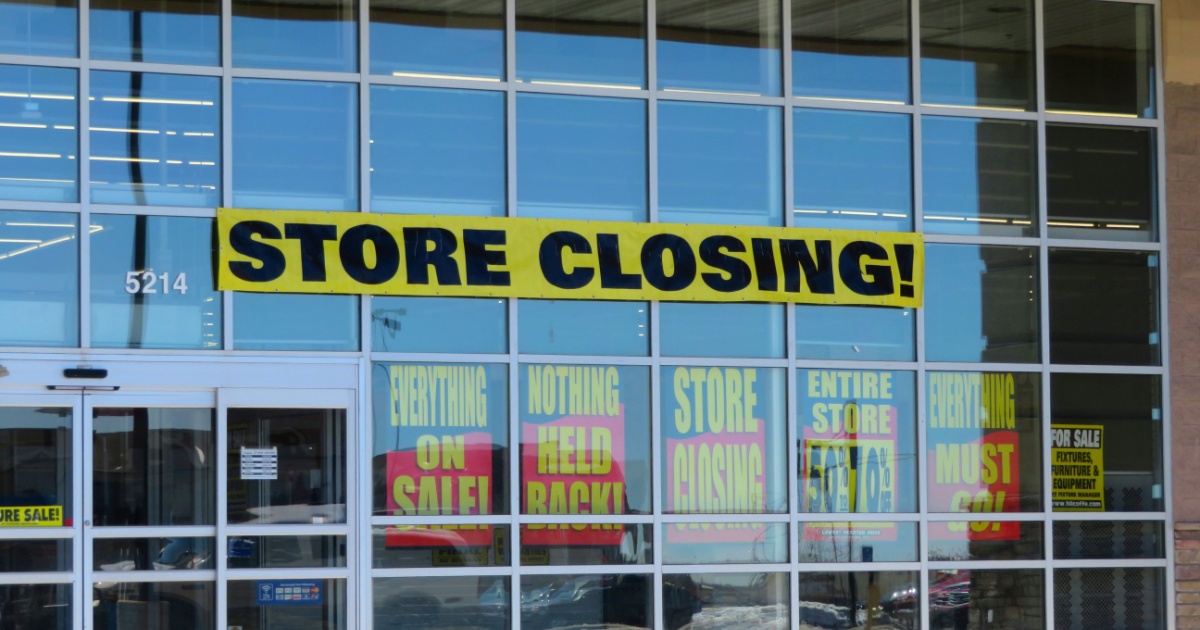

Something’s walking the American shopping mall you used to love, and it’s the sound of locks being changed. Stores that have been fixtures of everyday life for decades are going dark, sometimes with no warning and barely a goodbye. The mall anchor that owned your Saturday afternoons. The pharmacy where you picked up your prescriptions. The fast food spot where you ordered the same thing every Friday for 15 years. All closing.
So far in 2026, analysts have identified more than 2,000 planned store closures across the country, and that number keeps climbing as companies finalize lease decisions and restructure their operations. Some of these closures are strategic retreats. Others are full-scale liquidations. A handful are the final chapters in stories that began decades ago.
The factors driving this are not simple. Rising operating costs, shifting shopping habits, the relentless pull of e-commerce, and years of over-expansion have all converged at once. What you’re seeing on shuttered storefronts isn’t just business as usual – it’s an industry in the middle of a serious reckoning. Here’s a full breakdown of the major names, what happened to each of them, and what it means if one of those stores is in your town.
1. 7-Eleven (645 Stores)
7-Eleven is not just the most iconic convenience store chain in America – with its Slurpees, Big Gulps, and seemingly permanent corner presence – it’s one of the oldest. Founded in 1927 in Dallas, Texas, the brand has grown into a global operation spanning more than 86,000 locations across 19 countries.
The chain plans to close 645 stores in North America in fiscal year 2026, according to earnings filings from parent company Seven & i Holdings. That fiscal year runs from March 1, 2026 to February 28, 2027. Although 7-Eleven plans to open more than 200 new locations in the same period, fiscal 2026 will be the fifth consecutive year the company has closed more stores than it opened.
The closures are part of a broader effort to evolve the business toward food. Foodservice sales across the convenience store sector rose from 12% of in-store revenue in 2004 to nearly 30% by 2024, now accounting for 40% of gross margin in the category. 7-Eleven’s newer “food-forward” store format is designed to close the gap with rivals like Wawa and Sheetz. Seven & i reports that food-forward stores generate 18% higher average daily sales per store than its system average. The stores closing tend to be the older, smaller format locations that no longer fit the brand’s direction.
2. Francesca’s (approximately 400 Stores)
Francesca’s was founded in Houston in 1999 and grew into a national specialty retailer targeting trend-conscious customers with apparel, jewelry, and accessories at accessible price points, operating through a boutique-format model with small-footprint stores in malls and shopping centers. The store count peaked at approximately 700 boutiques around 2016 to 2017.
A shift in the competitive landscape due to e-commerce, underperforming investments in non-core brands, and a disruptive 2023 data breach were among the many reasons cited in the brand’s collapse. Court filings identify a cascade of events: a potential investor withdrew funding around December 30, 2025; two major suppliers lost their own lender financing, cutting off product delivery; and the company’s lenders issued a notice of default in January 2026.
Francesca’s bankruptcy includes the court-approved request to continue liquidation sales across its fleet of about 400 leased stores. The company said its inability to secure new financing made long-term viability impossible, and the closures will result in the elimination of approximately 3,400 jobs nationwide. The business model showed a critical weakness: only 13% of 2025 sales came from e-commerce, a dangerously low figure for a fashion retailer targeting trend-conscious shoppers, signaling fundamental problems as consumer behavior shifted online.
3. Walgreens (up to 1,200 Stores Over Three Years)
Walgreens is one of the most recognizable names in American pharmacy. For generations, it was the place you went for prescriptions, flu shots, greeting cards, and a midnight snack all in one trip. The chain once operated more than 8,500 stores across the US.
Walgreens announced plans to close 1,200 stores over the next three years in October 2024, with 500 closing during fiscal year 2025, as part of a cost-cutting strategy called the “Footprint Optimization Program.” As of early 2026, its new private equity owner has scaled back those plans somewhat, with Walgreens now expecting to close fewer than 100 stores in 2026, according to Bloomberg, a significant reduction from the pace originally announced.
Pharmacy chains have over-expanded to thousands of locations over the years, signing long-term leases for pricey corner spots. Many shoppers have complained about understaffing and items locked up to prevent theft. Pharmacies have also faced shrinking profits for filling prescriptions, driven by dramatic declines in reimbursement rates from pharmacy benefit managers (PBMs), the third-party companies that manage prescription drug benefits for health insurers. This wave of pharmacy closures has raised concerns that many Americans could be left without adequate access to nearby drugstores, with so-called “pharmacy deserts” growing across the country.
4. Wendy’s (approximately 300 Locations)
Wendy’s has been an American fast food staple since Dave Thomas founded it in Columbus, Ohio, in 1969. Known for its square burgers, Frosty shakes, and never-frozen beef, the chain built a loyal following over more than five decades. It’s currently the third-largest hamburger chain in the United States.
Ohio-based Wendy’s announced plans to close 5% to 6% of its US restaurants, or an estimated 298 to 358 stores out of its 5,969 US locations. The closures are part of a previously announced turnaround plan, with 28 stores already closed during the fourth quarter of 2025 as part of the process. Interim CEO Ken Cook has been direct about the rationale.
Wendy’s struggled badly with sales in 2025, reporting an 11.3% decrease in same-store sales and an 8.3% loss in global systemwide sales in Q4. According to Cook, one way the company is addressing the downward trend is through “system optimization,” which includes closing “consistently underperforming restaurants” to allow franchisee partners to focus on more profitable locations. No specific list of closing locations has been released, so customers will need to watch for local announcements or notices at their nearest restaurant.
5. Macy’s (150 Stores Total, Including 14 Confirmed in 2026)
The closures are part of Macy’s “Bold New Chapter” initiative, a turnaround plan announced in 2024 that includes closing about 150 underperforming stores by 2026. Macy’s has been an institution in American retail since 1858, growing from a small dry goods store in New York into a department store empire with hundreds of locations and the most famous Thanksgiving parade in the country.
The 14 stores scheduled to close in 2026 follow 66 closures in 2025 and 55 in 2024. Once this round is completed, Macy’s will be about 80% of the way toward its goal of closing 150 locations under the turnaround plan. Once all planned closures are complete, about 350 Macy’s stores are expected to remain.
Macy’s says early results from its store closures and reinvestment strategy are showing signs of progress. The company reports that its upgraded “Reimagine 125” locations are outperforming the broader chain, with comparable sales rising 2.7% in the third quarter. For shoppers near a closing Macy’s, clearance sales are typically a good window to stock up on bedding, kitchenware, and clothing at significant markdowns before the doors close for good.
6. Pizza Hut (250 Locations)
Pizza Hut has been delivering cheesy, saucy nostalgia since two brothers, Dan and Frank Carney, opened the first location in Wichita, Kansas, in 1958. Today the brand is owned by Yum! Brands and operates roughly 20,000 restaurants around the world.
Three months after announcing its intention to close 250 underperforming Pizza Hut restaurants during the first half of 2026, closures are already underway. Yum Brands CFO Ranjith Roy indicated on an earnings call in February that the “targeted closures” were expected to be completed by July 1, as part of the brand’s “Hut Forward” turnaround plan, which also includes marketing support and technological upgrades to some existing stores.
The company noted that the 250 targeted closures are a fraction of the 20,000 locations that Yum! Brands operate globally. The specific locations affected have not been publicly identified. Pizza Hut has also faced intense competition from Domino’s and a surge of independent pizzerias, especially as delivery app economics have rewired how Americans order pizza. The closures represent an effort to concentrate on stores that can realistically compete in that environment.
7. Kroger (60 Stores)
Kroger is one of the largest supermarket operators in the United States, running more than 2,700 stores under a collection of banners including Ralph’s, Fred Meyer, and Fry’s. When Kroger announces closures, it tends to matter to the communities affected, often significantly.
Grocery giant Kroger said in June 2025 that it planned to close 60 “unprofitable” stores across the US over the next 18 months, and by September the company had confirmed it had begun that process. Interim CEO Ron Sargent didn’t specify which locations would close, but said they were spread across the country. Media reports have identified closures in Illinois, Kentucky, and Texas, among other states.
The economic math here is challenging. Kroger operates in a brutal-margin business where the difference between a profitable and unprofitable store can come down to a few percentage points of labor or shrink (inventory loss through theft or spoilage). For shoppers in areas losing a Kroger, this often means a longer drive to find comparable grocery options, which is a genuine hardship in communities already underserved by food retail. Checking local news is your best source for closure information since the company has not released a full list. This isn’t an isolated trend – as we’ve covered before with retail chains closing locations, communities are bearing the real cost of these corporate decisions.
8. Saks Off 5th (57 Stores)
Saks Off 5th is the outlet arm of the Saks luxury retail family, offering discounted designer and premium-brand clothing, shoes, and accessories. It’s carved out a niche between true luxury and fast fashion, attracting shoppers who want aspirational brands at more realistic prices.
Saks Off 5th plans to close 57 store locations in early 2026, including five Last Call locations, as part of a broader restructuring effort after parent company Saks Global filed for Chapter 11 bankruptcy. Nine of those closures were announced in 2025, with the remaining locations revealed in January 2026. Cities including Austin, Chicago, Pittsburgh, Philadelphia, and Washington DC are among those losing locations.
Saks Global, the parent company that also owns Saks Fifth Avenue, Neiman Marcus, and Bergdorf Goodman, has been under severe financial pressure. Saks Fifth Avenue luxury apparel stores are set to shrink to just 13 as a result of the parent company’s bankruptcy filing in January 2026, with the company announcing eight store closures in January and then adding another 12 to the list in March. The entire luxury department store segment is being fundamentally restructured.
9. Carter’s (approximately 100 Stores by End of 2026)
Carter’s is the dominant name in baby and children’s clothing across North America. Walk into any baby shower and odds are good that something on the registry came from Carter’s. The brand has been dressing American children since 1865, making it one of the oldest children’s apparel companies still operating.
Carter’s said in October 2025 that it plans to close 150 stores across the region over the next three years as leases expire, including about 100 by the end of 2026. The seller of baby and children’s clothes cited the impact of tariffs on their business operations as one contributing factor in the decision. The remaining 50 or so closures are expected to phase out by 2028.
This is a strategic contraction rather than a sign of brand failure. Carter’s remains profitable and widely distributed through third-party retailers like Target and Amazon. The store closures reflect a rethinking of how much physical retail footprint the brand actually needs when so many of its customers already shop online. Parents who rely on Carter’s outlets for frequent children’s clothing purchases should check whether their local store is on the closure list before assuming it will be around next season.
10. REI (3 Stores)
REI is a consumer cooperative, a company owned by its members rather than outside shareholders, that has built a loyal following among outdoor enthusiasts since 1938. Known for quality gear, attentive staff, and a distinctive cooperative model that pays annual dividends to members, REI has long been considered one of the more values-driven retailers in America.
REI confirmed plans to close three locations in 2026, including its flagship store in SoHo, New York City, and stores in Boston and Paramus, New Jersey. The New York City and Boston stores will close in late 2026, while the Paramus, New Jersey location will close early in the year. REI told Business Insider that the Paramus, New Jersey closure would happen in the first quarter of 2026.
The closures come after REI laid off 400 employees in 2025 and ended its Experience classes and adventure tourism packages. A spokesperson framed the decision around long-term positioning, telling Nexstar’s WPIX that “as markets and customer needs evolve, we must adapt to position the co-op for long-term success.” Three stores is a small number in the context of this list, but the SoHo flagship was a high-profile location and its closure signals that even well-loved, mission-driven retailers are not immune to the pressures reshaping the market.
11. Yankee Candle (20 Stores)
Yankee Candle is a Massachusetts-born brand that became a mall institution, with fragrant stores doing brisk business in gifts, seasonal candles, and home scents. Founded in 1969 by a teenager who melted crayons to make a Christmas gift for his mother, the brand grew into a specialty retail powerhouse.
Newell Brands said in December 2025 that it would close 20 Yankee Candle stores in the US and Canada beginning in January 2026. The closures were announced alongside the reduction of its workforce by over 900 employees. The parent company described the closures as representing just 1% of the brand’s total sales and framed them as part of a global productivity plan. CEO Chris Peterson said the plan was about “taking the next, disciplined step to enhance efficiency, sharpen our strategic focus, and deliver stronger, more consistent performance.”
Like Carter’s, Yankee Candle remains a viable brand sold widely through other retail channels. Closing physical boutiques does remove a key part of what made the experience distinctive: the ability to smell every fragrance before buying, wander through seasonal displays, and pick up last-minute gift sets. Shoppers who rely on those stores for gifts will likely shift to department stores or direct online purchasing.
12. Grocery Outlet (36 Stores)
Grocery Outlet is a discount grocery chain that operates on a distinctive model: buying excess or overstocked inventory from suppliers and selling it at steep discounts through independently operated stores. It built a loyal following among bargain shoppers, particularly in the western US.
The chain has announced the closure of 36 underperforming stores, with about two-thirds of those located in the eastern US, where the business struggled to gain the same traction it built in its western home markets. CEO Jason Potter was candid about the reasoning, stating the closures involved stores where the company no longer saw a viable path to sustained profitability. The closures are a reminder that even value-focused grocery concepts are not insulated from the pressures of high operating costs, particularly as rents in many eastern markets proved more challenging than projected.
13. Apple (3 Mall Stores)
Apple isn’t struggling. Let’s be clear about that. The company is one of the most profitable businesses on Earth. But even Apple is making calculated moves away from struggling real estate. Apple announced on April 9 that it would close three stores in June 2026, including locations in Connecticut, California, and Maryland. All three stores are located in struggling shopping malls.
In a statement reported by MacRumors, Apple said: “Following the departure of several retailers and declining conditions at Trumbull Mall, the Shops at North County, and Towson Town Center, we’ve made the difficult decision to close our stores at these locations.” When Apple walks out of a mall, it’s often a signal that the mall itself is in serious trouble, because anchor tenants like Apple are usually among the last to leave. These three closures say less about Apple and more about the continued contraction of indoor mall retail across the country.
Read More: 5 Red Flags of Recession Everyone Should Watch Out For in 2026
What This Means for You
If a store on this list is one you use regularly, act now rather than waiting. Liquidation sales, especially at chains like Francesca’s, can offer real deals in the early weeks, but inventory thins out quickly and gift cards typically stop being honored once a liquidation is underway. Check your local news for specific closure dates in your area, since most national chains have not released full location lists.
The bigger picture is worth sitting with for a moment. Retail analyst Neil Saunders has noted that this trend is expected to continue, explaining that “against the backdrop of rising costs, a lot of retailers are looking to become more efficient,” and that “part of this involves closing underperforming stores that are not producing sales growth or contributing to profits.” Rising costs, cautious consumer spending, and the continued growth of online shopping are not going away, which means more closures are likely through the rest of 2026 and into 2027.
For communities, especially those in smaller cities or areas with limited retail options, these closures often mean more than inconvenience. Losing a pharmacy, a grocery store, or an anchor retailer can reshape where residents shop, how far they drive, and what access they have to goods and services. Keep an eye on what’s happening locally, support the independent businesses in your area where you can, and don’t take for granted that the store you’ve shopped at for decades will still be there next year.
AI Disclaimer: This article was created with the assistance of AI tools and reviewed by a human editor.
Read More: California Overtakes Japan, Ranks 4th in Global Economy, Says Newsom