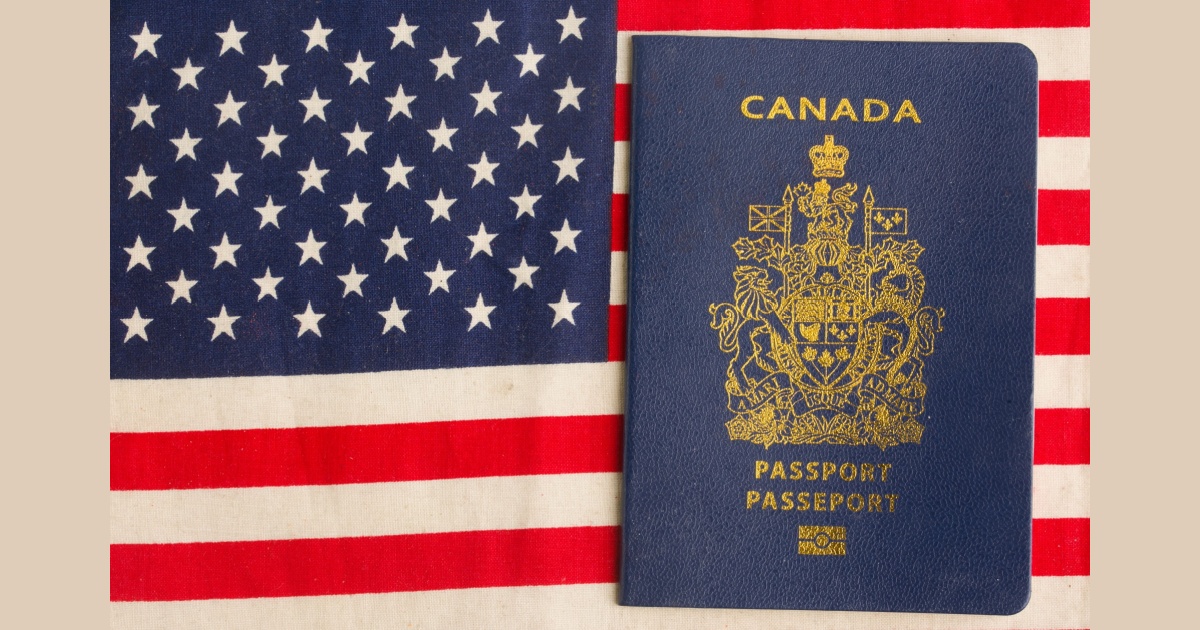

Somewhere in your family tree, there may be a name you’ve never looked up. A grandmother who crossed the border decades ago. A great-grandfather who worked in the mills. A line in a census record that nobody ever followed. For millions of Americans, that overlooked branch of the family could now have very real legal consequences – because Canada just changed the rules on who it considers a citizen.
This isn’t a naturalization program. Nobody is asking you to move, learn a new anthem, or wait in a years-long immigration queue. The change is more fundamental than that. Canada is now saying that for a large number of people, citizenship was already theirs by birthright – it just wasn’t being recognized. And since a new law took effect at the end of 2025, those people can formally claim it.
The response has been extraordinary. Immigration lawyers on both sides of the border are overwhelmed. Archives in Quebec are fielding requests at levels nobody anticipated. And ordinary Americans are pulling out old birth certificates, flipping through family Bibles, and calling relatives they haven’t spoken to in years.
What the New Law Actually Changed
Canada’s new citizenship law, Bill C-3, an Act to amend the Citizenship Act, has permanently removed the first-generation limit that previously prevented Canadian citizenship from passing beyond one generation born outside Canada.
To understand why that matters, it helps to know what the old rule looked like. Since 2009, Canadian law imposed what was known as the first-generation limit: only the first generation born outside Canada to a Canadian parent could inherit citizenship. If your parent was born in Canada, you were Canadian. But if your parent was also born outside Canada – even if their parent, your grandparent, was born in Canada – citizenship could not pass to you.
This rule created a class of people known as “Lost Canadians” – individuals who had Canadian ancestry and should have been citizens, but were excluded by the generational cutoff.
The legal trigger for change came in December 2023. The Ontario Superior Court of Justice declared the second-generation cutoff unconstitutional in Bjorkquist et al. v. Attorney General of Canada, with applicants arguing that the law discriminated on the basis of national origin by creating a lesser class of Canadian citizens. On January 22, 2024, the federal government announced it would not appeal. The then-Minister of Immigration publicly acknowledged the law had produced unacceptable consequences and committed to legislative reform. Bill C-3 is the result of that reform.
Canada enacted Bill C-3 after it received royal assent on October 1, 2024, and the law took effect December 15, 2025, permanently removing the first-generation limit on citizenship by descent for people born before that date.
Under the new rules, people born outside Canada in the second generation or later may be Canadian if their parent was also born outside Canada to a Canadian citizen – meaning the grandparent was Canadian – and that same parent spent at least 1,095 days in Canada before the birth. For people born before December 15, 2025, however, there is no generational cap at all. If your great-great-grandparent was born in Canada and Canadian citizenship descends unbrokenly to you, you may be a citizen. The law retroactively recognizes the entire chain, provided there is an original “anchor” who was a Canadian citizen, whether born in Canada or naturalized.
Why So Many Americans Qualify
The numbers are hard to comprehend at first. Immigration attorney Amandeep Hayer estimated that there are millions of Americans who are Canadian descendants. Part of the reason goes back well over a century.
Between 1840 and 1930, about 900,000 French-speaking Canadians left Quebec to work in New England’s factories, mills, potato fields, and logging camps. By 1930, nearly a million had crossed the border in search of work, arriving in extended family groups and establishing French-speaking enclaves throughout New England in small industrial cities like Lowell, Massachusetts; Manchester, New Hampshire; and Woonsocket, Rhode Island. Their descendants – now spread across multiple American generations – form one of the largest pools of potential applicants. Approximately 10 million Americans may qualify because of this historical migration from Quebec to New England in the late 1800s and early 1900s.
The migration wasn’t limited to Quebec. The historical ties between the two countries run deep: waves of Canadian emigration to the United States occurred throughout the 19th and 20th centuries, including large numbers of French Canadians who settled in New England, Maritimers who moved to the Boston area, and families from across the Canadian provinces who relocated for work in cities like Detroit, Buffalo, Seattle, and beyond.
The demand at Montreal’s National Archives points to how many families are now engaged in that search. Over 1,000 requests arrived in January 2026, compared with just 32 the prior year.
The Surge in Applications
Millions of Americans are pursuing Canadian citizenship after a law that took effect in December made the process significantly easier for people with Canadian ancestry, prompting immigration lawyers on both sides of the border to report a surge in applications.
Amandeep Hayer, whose Vancouver, British Columbia, area practice previously handled about 200 citizenship cases a year, said he is now fielding more than 20 consultations per day. Nicholas Berning, an immigration attorney at Boundary Bay Law in Bellingham, Washington, said his practice is “pretty much flooded with this,” adding that his firm had “shifted a lot of other work away in order to push these cases through.”
The uptick goes beyond legal professionals. Aaron Lowry, who created the fast-growing Facebook page “Canadian Citizenship by Descent,” was one of the first Americans to get his citizenship through a short-lived interim bill that preceded Bill C-3. Since becoming a Canadian citizen in 2024, the Ann Arbor, Michigan, resident has traveled extensively in Canada and taken a deep interest in Canadian politics and history.
The motivations are varied. Some applicants are driven by genuine heritage reconnection. Others are more directly motivated by the current political climate in the United States. This wave of interest has been markedly different from previous post-election surges. “There’s been a very steady increase in interest in moving to Canada since November 2024, which is unprecedented,” says one immigration professional with 17 years in the industry.
The numbers from Canada’s immigration agency back this up. The Immigration, Refugees and Citizenship Canada office says processing times for a certificate of citizenship are around 10 months, with more than 56,000 people currently awaiting a decision. From December 15 to January 31 alone, the agency confirmed citizenship by descent for 1,480 people, though not all were Americans. For context, 24,500 Americans gained dual U.S.-Canada citizenship in all of 2024.
What Motivates Americans to Apply
The personal stories behind the applications reveal something more nuanced than a simple political escape plan. For many Americans, the law has offered what feels like an unexpected connection to family history they’d long set aside.
For Zack Loud of Farmington, Minnesota, the discovery was completely unexpected. Learning that Canada already considered him and his siblings citizens because their grandmother is Canadian prompted him to reconsider his options. “My wife and I were already talking about potentially looking at jobs outside the country, but citizenship pushed Canada way up on our list,” he said.
Others describe a more deliberate calculation about security. Maureen Sullivan, of Naples, Florida, whose grandmother was Canadian, sees citizenship in Canada as a backup option. Sullivan was motivated in part by federal immigration enforcement near a high school in St. Paul where her nephew attends school. When she first heard about the bill, she said she “couldn’t believe it” – describing it as “this little gift that fell in my lap.”
Then there are those who have gone further and actually relocated. Michelle Cunha, of Bedford, Massachusetts, said she decided to move to Canada altogether after decades of political engagement left her feeling spent.
The change in Canadian law also restores status to “Lost Canadians,” people who lost or never obtained citizenship because of the outdated and unconstitutional rules. For some of these families, the legal recognition carries emotional weight that goes beyond any practical calculation. Whether or not they intend to move back to Canada, for many in the community, an official recognition by means of Canadian citizenship legitimizes a long-held sense of belonging. “I always have felt Canadian and this would make me just so happy,” said one applicant.
How to Know If You Qualify – and What to Do Next
The process of claiming citizenship under Bill C-3 is different from a standard immigration application. You do not “apply for citizenship” in the traditional sense. If you qualify under Bill C-3, you are already a citizen. What you apply for is a citizenship certificate, which is official proof that you are a Canadian citizen.
As immigration attorney Amandeep Hayer, who advocated for the law in the Parliament of Canada, puts it: “You are Canadian, and you’re considered to be one your whole life. That’s really what you’re applying for, the recognition of a right you already have vested.”
The core eligibility question comes down to your family tree. Bill C-3 allows anyone born before December 15, 2025, to claim citizenship if they can prove they have a direct Canadian ancestor – a grandparent, great-grandparent, or even more distant relative. The catch is that word “prove.” Immigration lawyers note that the biggest barrier for most American applicants is not eligibility but documentation: proving an unbroken chain of descent to a Canadian-born ancestor can require birth certificates, marriage certificates, and sometimes immigration records spanning generations.
There’s also one important caveat to know upfront. If an ancestor in the chain renounced citizenship, rights to Canadian citizenship end there. The chain must be unbroken.
For those with documents already organized, the cost of applying is surprisingly modest. The application fee is 75 Canadian dollars, roughly $55 USD. Costs increase for those hiring an attorney or genealogist. One Massachusetts applicant, Mary Mangan of Somerville, filed her application in January using advice from online forums, suggesting that many people may not need professional help at all – though more complex multi-generational cases or situations involving adoption may benefit from legal guidance.
Canada has an extensive historical record-keeping tradition dating back to the 1800s, including federal censuses, immigration arrival records, military service files, and provincial vital statistics. Many of these records are accessible through Library and Archives Canada and provincial archives, and can be invaluable in building a claim.
You can also access the official guidance on eligibility and how to apply directly through the Government of Canada, which maintains a dedicated page explaining the Bill C-3 changes.
If you’re exploring the mental and emotional dimensions of major life transitions like reconsidering citizenship, community, and belonging, this piece on managing stress and anxiety explores how external pressures can shape our well-being and decision-making.
Not Everyone Is Celebrating
The surge in American interest has prompted a more cautious conversation inside Canada itself. Fen Hampson, professor of international affairs at Carleton University in Ottawa, said Canadians are generally “welcoming people,” but some are concerned about people with thin ties to Canada becoming “Canadians of convenience.”
Hampson said some Canadians also worry that a surge of interest from Americans could delay efforts by refugees and asylum-seekers fleeing vulnerable situations. “Canadians don’t like queue jumpers,” he said.
It’s a legitimate concern. An applicant who has never set foot in Canada, who holds no cultural connection to the country, and who is seeking citizenship primarily as an insurance policy occupies a very different position from a refugee who has risked everything to reach safety. Both are now drawing from the same overloaded processing system – one that already has more than 56,000 applications in its queue.
At the same time, it’s worth noting that the law draws no such distinctions on its face. If the legal lineage is there and the documents are in order, eligibility exists regardless of motivation. The policy debate about whether that’s wise is ongoing – but for now, the legal door is open.
Read More: Canada is Home to World’s Longest Hiking Trail Stretching From Coast to Coast
What This Means for You
If you have any Canadian ancestry at all – a grandparent, a great-grandparent, a great-great-grandparent – it’s worth spending a few hours digging into your family history before dismissing this as something that doesn’t apply to you. If your parent, grandparent, or great-grandparent was born in Canada, you may already be a Canadian citizen. The first step is simply confirming whether that ancestor was, in fact, Canadian – and whether the chain of descent from them to you can be documented.
Start with what you already have: old birth certificates, marriage records, immigration documents, family letters, naturalization papers. Then use freely available tools like Library and Archives Canada, which holds federal census records, military files, and vital statistics going back to the 1800s. If you hit a wall, a genealogist who specializes in Canadian records can often locate documents you can’t find on your own – and many immigration attorneys offer a single consultation to assess whether a case is worth pursuing before you commit to anything.
The application fee itself is low enough that the financial risk of trying is minimal for most people. The bigger investment is time and paperwork. But for millions of Americans, the result could be a second passport, expanded rights to live and work in Canada, and a legal recognition of a heritage that was there all along – just waiting to be claimed.
AI Disclaimer: This article was created with the assistance of AI tools and reviewed by a human editor.
Read More: Canada Proposes Taxing University Graduates Up To $500,000 If They Want To Seek Jobs In The U.S.