

Somewhere in a storage room at the Ashmolean Museum in Oxford, England, sits a small perspex box containing what looks like a lump of orange wax. It smells faintly of honey. For decades, nobody could definitively say what it actually was. Dozens of researchers had taken their best shots at identifying it, and each time walked away empty-handed. The substance stubbornly refused to give up its secrets.
The material came from bronze jars unearthed in southern Italy in 1954, buried inside an underground shrine that had been sealed for roughly 2,500 years. When archaeologists first opened those jars, the assumption seemed obvious. Of course it was honey. Honey was everywhere in the ancient world, poured at altars, packed into tombs, offered to gods. But obvious assumptions and scientific proof are two very different things, and for 70 years, the proof wouldn’t come.
Then a team of chemists at the University of Oxford decided to try again – this time with tools the earlier researchers simply didn’t have. What they found didn’t just solve a long-standing archaeological puzzle. It opened a window into one of the oldest and most fascinating relationships between humans and the natural world.
A City, a Shrine, and Eight Bronze Jars
Paestum was an ancient settlement on the Tyrrhenian coast of southern Italy, founded by Greek colonists from Sybaris around 600 B.C. When Sybaris was destroyed in the sixth century B.C., its inhabitants fled and founded a city called Poseidonia, which the Romans later renamed Paestum when they took it over in the third century B.C. The site is home to some of the best-preserved Greek temples in the world, and its sacred precinct had long attracted archaeological attention.
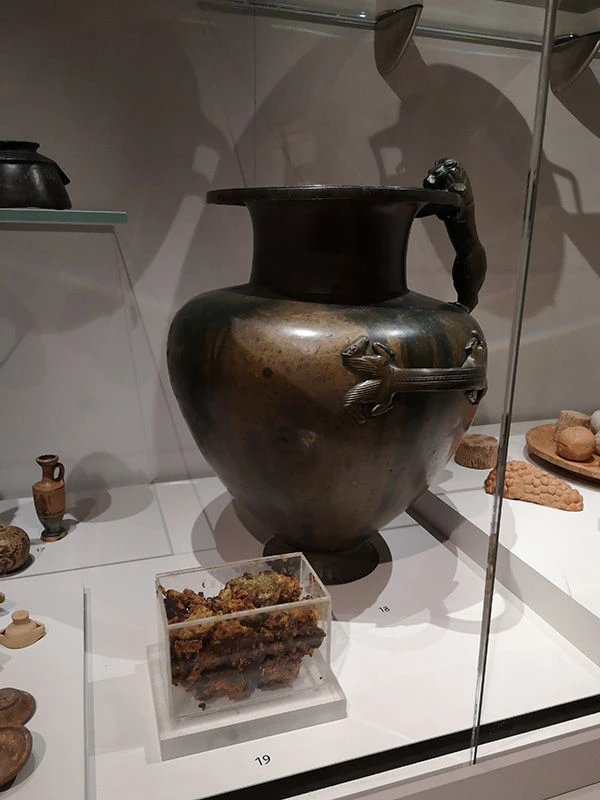
In 1954, archaeologists excavating in the ancient Greek settlement found an underground shrine containing bronze jars – six hydrae and two amphorae – surrounding an empty iron bed. The jars contained a paste-like residue with a strong wax aroma, and archaeologists reported the residue to have been originally a liquid or viscous liquid, since traces of it were found on the exterior of the vessels, which were originally sealed with cork disks.
The jars were found in what is known as a heroon – a sacred space dedicated to a hero rather than an Olympian god. The excavation report emphasized the sacredness of the shrine: the empty bed and the inaccessibility of the space signify that the deity was there. The archaeologists identified the original contents as having been honey, a “symbol of immortality,” originally offered as honeycombs but of which only beeswax remained as the main element.
That initial interpretation made perfect cultural sense. Honey and honeybees held a central place in Greek thought and daily life. It was used in medicine, cosmetics, and food, but it also carried profound symbolic meaning – associated with purity, preservation, and the afterlife, often offered to gods, heroes, and the dead. The problem was that when researchers actually tried to confirm the presence of honey through chemical analysis, they couldn’t.
Over the course of 30 years, three different teams analyzed the residue but failed to confirm the presence of honey, instead concluding that the jars contained some sort of animal or vegetable fat contaminated with pollen and insect parts. The mystery deepened, and eventually the jars faded into the background of museum collections – catalogued, photographed, and filed away.
The Breakthrough: Science Finally Catches Up
The story might have ended there, except that in 2019, the bronze jars traveled to Oxford. In preparation for the exhibition “Last Supper in Pompeii” at the Ashmolean Museum, colleagues at the Archaeological Park of Paestum and Velia made several high-profile loans, including a Greek bronze hydria from the Heroon and its organic contents, providing a unique opportunity to re-analyze those contents using modern instrumentation at the University.
The Oxford team, led by Professor James McCullagh, director of the Mass Spectrometry Research Facility in the Department of Chemistry, applied a combination of spectroscopic and mass spectrometry techniques to analyze the molecular composition of the residue. Mass spectrometry works by breaking molecules apart and measuring their mass, allowing chemists to identify exactly what a substance is made of at the molecular level – even when that substance is thousands of years old and has been chemically transformed by time.
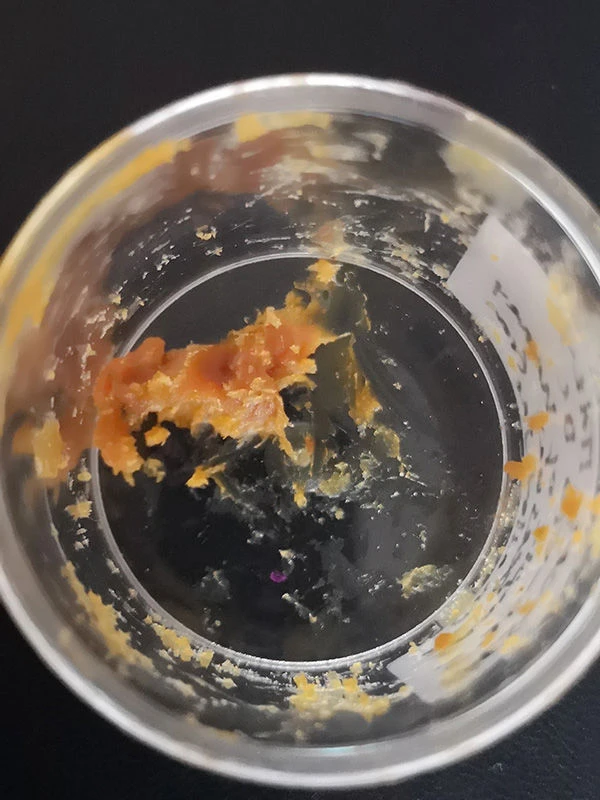
The researchers used a suite of modern analytical techniques, including mass spectrometry for proteins and small molecule compositional analysis, and this integrated approach enabled the identification of sugars, organic acids, and royal jelly proteins that would have remained undetected using a single method.
The results, published in a 2025 study in JACS – the Journal of the American Chemical Society – under the title “A Symbol of Immortality: Evidence of Honey in Bronze Jars Found in a Paestum Shrine Dating to 530-510 BCE,” provided the first direct molecular evidence that these jars once held honeycomb. For the first time, researchers detected intact hexose sugars – the dominant sugars in honey – as well as royal jelly, a nutrient-rich secretion made by worker bees, and peptides that are molecular markers unique to the European honeybee (Apis mellifera). Together, these findings provided conclusive evidence that the jars once held honeycomb rather than another organic substance.
Why Earlier Tests Failed – and What Changed
The failure of previous analyses wasn’t a sign of poor science. It was a sign that some questions have to wait for the right tools. The value of revisiting ancient artifacts with modern tools is clear here: earlier attempts to identify the substance failed simply because the science had not yet caught up with the question.
Professor McCullagh explained that applying multiple analytical techniques was key. By using several mass spectrometry and spectroscopic approaches, the team was able to reveal a comprehensive picture of the residue’s molecular composition – enabling them to distinguish between contaminants, degradation products, and original biomarkers.
One unexpected ally in the analysis was the bronze itself. The researchers identified copper ions in the honey mixture. Because these ions are biocidal – meaning they kill microorganisms – their presence would have contributed to the preservation of sugars on the surface of the residue, potentially explaining how the honey lasted thousands of years.
Fresh honey today contains about 79 percent hexose sugars, mostly fructose. The ancient sample had far lower sugar levels, consistent with degradation over time. Scientists believe that after the original cork seals disintegrated, oxygen and microbes entered the jars, and bacteria gradually consumed most of the sugar, leaving behind the acidic, waxy substance archaeologists first encountered in 1954. What was left was no longer recognizable as honey by conventional tests – but its molecular fingerprints were still there, waiting for the right instrument to read them.
For people interested in how ancient foods have shaped modern health practices, it’s worth knowing that honey’s reputation as a medicinal substance isn’t just mythology. A 2025 review in the journal Antibiotics confirmed that honey has gained increasing recognition for its potent antimicrobial properties, particularly against antibiotic-resistant pathogens, with its antibacterial action involving hydrogen peroxide production, phenolic compounds, high sugar concentrations, and the presence of bee defensin-1. The historical use of honey in ancient Egypt and Greece – where it was employed for treating wounds and gastrointestinal disorders – has long been documented. The Greeks at Paestum weren’t wrong to venerate it.
What Lived Inside the Residue
One of the more startling details from the research involves what else the team found alongside the honey. The residue wasn’t just degraded sugar and wax. It was, as the lead author described it, a whole chemical ecosystem.
The multianalytical approach detected lipids, saccharide decomposition products, hexose sugars, and major royal jelly proteins – all supporting the hypothesis that the jars once contained honey or honeycombs. Royal jelly is a milky protein secretion produced by worker bees, used to nourish bee larvae and queens. Finding its proteins intact after two and a half millennia is remarkable on its own.
The team also recovered peptides associated with a relative of Varroa destructor – a parasitic mite known to feed on honeybee larvae. This tiny detail reveals something about ancient beekeeping conditions. Bee parasites were apparently present in the hives that produced this honey, just as they are today in modern apiaries across the world. The honey in these ritual jars wasn’t gathered from pristine, curated colonies. It came from real hives, with all the biological complexity that entails.
In addition to identifying the honey, the analyses revealed other interesting facts about the objects: some had soot at the base, evidence of their use over firepits, while others showed thick layers of scale, indicating that they were used as boilers for heating water. These weren’t purely ceremonial vessels stored away untouched. They were objects that had been actively used in rituals before being sealed in the shrine.
If you enjoy discoveries that connect ancient wisdom to modern science, you might also find it fascinating how another ancient Greek artifact – once dismissed as too advanced to be real – gave up its secrets to modern researchers in a remarkably similar way.
The Bigger Picture: Museum Collections as Scientific Gold Mines
Perhaps the most practical takeaway from this research isn’t about honey at all. It’s about what’s still sitting in museum storage rooms, incompletely understood, waiting for better technology to come along.
The study was made possible through a close partnership between the University of Oxford’s Ashmolean Museum and the Archaeological Park of Pompeii. The research highlights the value of reinvestigating archaeological residues in museums with advanced biomolecular techniques and offers a more specific method for detecting bee products in ancient contexts.
Dr. Gabriel Zuchtriegel, Director of the Archaeological Park of Pompeii and a co-author on the study, noted that applying chemical and scientific analyses to existing artifacts allows researchers to adopt a more informed approach to understanding the lives and rituals of past societies – and that all of this can come from material already on museum shelves. The implication is significant: the answers to many long-standing historical questions may already be in our collections. They just need the right questions asked of them.
This research is a reminder that archaeological collections hold untapped scientific potential, and that new information can be revealed when modern analytical techniques and multidisciplinary collaborations are combined.
Read More: An Ancient Device Too Advanced to Be Real Gives Up Its Secrets at Last
What This Means for You
A jar of orange gunk in a museum basement might seem far removed from daily life in 2026. But this story carries a few ideas worth sitting with.
First, the science of ancient materials is still young. Researchers couldn’t identify honey in those jars for 70 years – not because the honey wasn’t there, but because the tools to find it hadn’t been invented yet. The same principle applies in modern medicine and nutrition. Some questions we’re asking today about food, health, and the body don’t yet have answers because we don’t yet have the instruments to find them. Patience and continued investment in analytical science matter more than most people realize.
Second, honey’s place in human culture as both a ritual and medicinal substance isn’t coincidental. Research has shown that honey can disrupt bacterial biofilms – a major factor in antibiotic resistance – and that its ability to improve wound healing, reduce inflammation, and promote tissue regeneration gives it a broad therapeutic profile. The ancient Greeks called it a symbol of immortality. Modern science is still confirming how right they were about its resilience and potency, 2,500 years later.
And third, the next time you pass through a natural history museum and glance at an unassuming jar in a glass case, it’s worth remembering: that unlabeled lump of something might still have a story to tell.
AI Disclaimer: This article was created with the assistance of AI tools and reviewed by a human editor.
Read More: Can Honey and Cinnamon Really Heal? Science vs. Hype