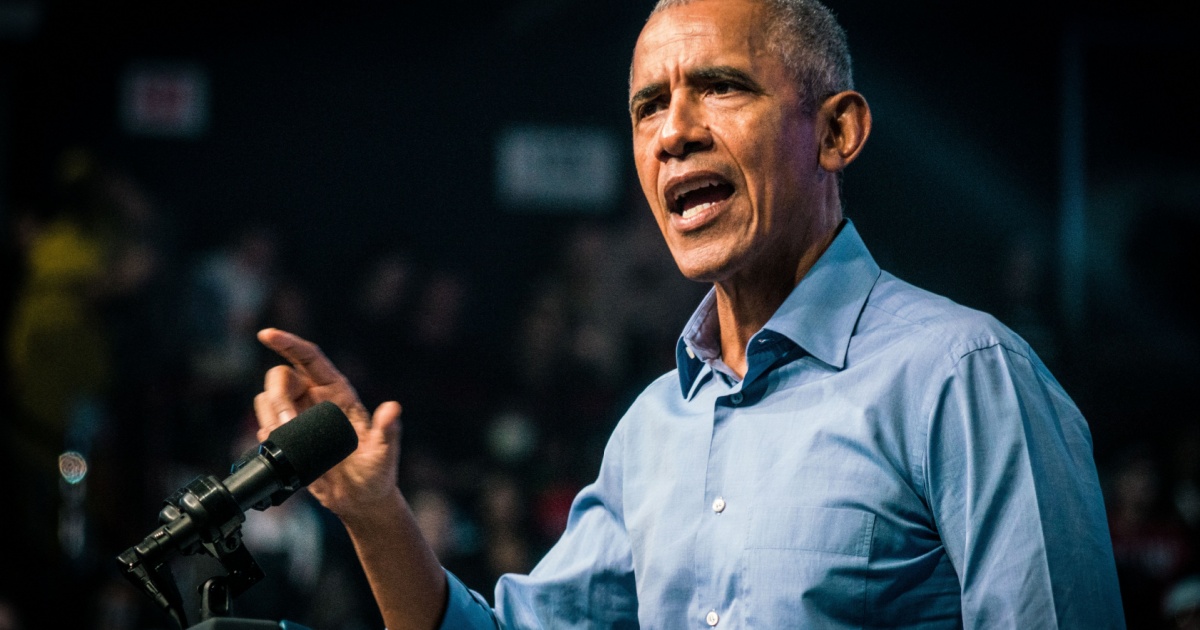

There are moments in American political life when the most consequential things get said not before committees or at press conferences, but on a late-night television stage. On a Tuesday evening in early May 2026, former President Barack Obama sat down with Stephen Colbert for one of the final broadcasts of a show that has, for eleven years, served as a barometer of the national mood. What followed was one of the most direct and sobering assessments of the American democratic system that Obama has offered since leaving office, and at its center was a single, unambiguous warning: there is one thing, above all others, that democracy cannot survive.
Obama did not arrive simply to reminisce. He came to the show at a moment of unusual weight: with Colbert counting down to his final broadcast, with the Obama Presidential Center in Chicago weeks away from opening its doors to the public, and with the American political system embroiled in controversies over prosecutorial independence, pardon power, and executive authority that have consumed Washington for over a year. The interview, carefully conversational in tone, grew increasingly pointed as it went on.
By the time it was over, Obama had offered a diagnosis of what he believes ails American democracy, and a prescription for how to fix it. Neither was gentle.
The Core Warning: Justice Cannot Be a Weapon
Speaking on CBS’s The Late Show, Obama argued that while the political system could withstand divisive elections and policy swings, it could not survive the use of prosecutorial power against political opponents.
Obama warned specifically against allowing the attorney general to become the president’s “consigliere,” an Italian term for a personal adviser, emphasizing the need for the nation’s top prosecutor to remain independent of political influence. He made the remarks as the Department of Justice under President Trump was pursuing a number of prosecutions of the president’s opponents, including former FBI Director James Comey.
His framing was precise: “The idea is that the attorney general is the people’s lawyer, it’s not the president’s consigliere.” The word choice was loaded. The term “consigliere” carries unmistakable connotations. It is the language of organized crime structures, not constitutional government.
Obama elaborated: “We can survive a lot – bad policy, funky elections, there’s a bunch of stuff that, you know, we can overcome. We can’t overcome the politicization of our justice system, the awesome power of the state. You can’t have a situation in which whoever is in charge of the government starts using that to go after their political enemies or reward their friends.”
The statement was pointed without being personal. Obama never named President Trump directly throughout the interview. But the context surrounding his remarks required no elaboration for anyone paying attention to what has unfolded at the Justice Department over the past year.
The Comey and James Prosecutions: A Case Study
The episode Obama was implicitly referencing has been one of the defining legal dramas of 2025. The Justice Department indicted former FBI director James Comey following a social media post from President Trump that demanded prosecution for more of the president’s political foes. Trump, in the view of many legal analysts, shattered norms around the Justice Department by installing loyalists at the top and inserting himself into prosecutions at an agency that has historically operated with some independence from the president.
A federal judge later dismissed the criminal charges against both Comey and New York Attorney General Letitia James, ruling that the U.S. attorney Trump handpicked to prosecute them was unlawfully appointed. The ruling threw out two cases Trump had publicly called for, as he pressured Justice Department leaders to move against high-profile figures who had criticized him and led investigations into his conduct.
The process by which those indictments were obtained drew particular scrutiny. Decisions about who to prosecute are normally made by career prosecutors, who have experience evaluating criminal investigations and are not directly appointed by the president. Prosecutors in the James case prepared a memo stating they did not believe the case could be proven beyond a reasonable doubt. Prosecutors in the Comey case concluded there was not probable cause to indict, meaning they did not believe it was more likely than not that he had broken the law.
Those concerns apparently resulted in the prior U.S. attorney’s resignation in September 2025. Trump then told reporters “I want him out,” and after the resignation claimed he had fired the official. His replacement, a former personal attorney to the president with no prior prosecutorial experience, then obtained both indictments within days of her appointment.
After the charges were dismissed, Comey responded: “I am grateful that the court ended the case against me, which was a prosecution based on malevolence and incompetence and a reflection of what the Justice Department has become under Donald Trump, which is heartbreaking.”
Former Attorney General Pam Bondi, who had overseen the prosecution efforts, resigned earlier in 2026 amid reported unhappiness from Trump over how the DOJ was performing.
The Call for Codification
Obama’s sharpest practical argument was not simply that these norms had been broken. It was that relying on norms alone was no longer sufficient.
When Colbert asked about the need to restrict executive powers, Obama said “there are a couple that I followed even though they weren’t law. I want us – we’re going to have to do some basic work to return to this basic norm, and now we probably have to codify it.”
He was unambiguous about where that codification should begin: “The White House shouldn’t be able to direct the attorney general to go around prosecuting whoever the president wants prosecuted.”
This argument has significant backing in legal and policy circles. The Center for American Progress, in a detailed 2021 analysis of Justice Department independence – still the most comprehensive policy framework on the subject – recommended that the DOJ codify stronger limits on contacts and communications with the White House, clearly articulating what kinds of communications are appropriate and prohibited, especially those that deal with prosecutions and criminal investigations. The center further argued that the DOJ should codify its policy in the Federal Register following notice-and-comment rule-making, noting that an attorney general can currently change the policy with the stroke of a pen, and that the policy has not always been readily and publicly available. Codifying it as a rule would ensure that it is public, that it is considered, and that it is that much harder for the next administration to undo or ignore.
The Pardon Problem
Obama also raised concerns about a second area where unwritten rules have given way to what he described as something more transactional: the use of presidential pardon power.
His comment during the interview was direct, if dry: he suggested that presidents probably should not pardon people who have given campaign contributions or invested in their businesses. The remark was, in context, a pointed one.
The Campaign Legal Center, in a March 2026 analysis, concluded that Trump had increasingly used pardons as a tool to reward those who had advanced his political or financial interests. In some cases, individuals convicted of serious crimes secured clemency after making sizable political donations or supporting Trump family business ventures.
Among those documented cases: Trevor Milton, a tech executive convicted of defrauding investors, was pardoned in March 2025 after pouring nearly $2 million into pro-Trump political committees during the 2024 presidential campaign. The Marshall Project reported that in late 2024, a Florida nursing home executive was sentenced to 18 months in prison for stealing employees’ tax payments. Just three weeks after his mother attended a $1 million-a-head fundraiser for Trump, the president pardoned him, wiping out the prison term and restitution.
In 2025, lobbying firms reported nearly $5.2 million in payments from clients seeking clemency from Trump, approximately eight times more than was disclosed in 2024 from people seeking clemency from President Biden.
NBC News analyzed Trump’s pardons for 88 individuals granted through January 20, 2026, and found that more than half went to wealthy criminals convicted of white-collar crimes such as money laundering and fraud.
The pattern that Obama gestured at without naming directly has been documented in substantial detail across multiple independent analyses.
The Military: A Third Front
The politicization of the Justice Department was not the only institutional concern Obama raised. He also expressed concern about the politicization of the military, noting that “there had been a whole series of norms that were in place to ensure that you weren’t trying to make the military loyal to you, as opposed to the Constitution, and the people of the United States.” He called for mechanisms to restore that standard.
The concern reflects a broader pattern in his argument: that American democratic institutions were designed to function on the assumption of good-faith adherence to norms that were never written into law, because doing so seemed unnecessary. That assumption, Obama suggested, has been proven wrong, and the response must be structural, not merely rhetorical.
The Presidential Center and the Journey It Represents
Obama spoke with Colbert ahead of the opening of the Obama Presidential Center in Chicago, which is set to open to the public on Juneteenth. He said he hopes it will help people think about “this extraordinary journey this country took to get to” his presidency.
Chicago will get its first full look at the Obama Presidential Center during a full slate of grand opening celebrations over Juneteenth weekend. A dedication ceremony will be held June 18 for the namesake museum and campus in Jackson Park, which will open to the public on June 19 after a decade of planning, fundraising, delays, and construction.
Obama announced plans in 2015 for the $800 million center and its 225-foot museum tower, which take up 19.3 acres of the National Register-listed Jackson Park. It was originally expected to open by 2021 before being held up by lawsuits and federal reviews.
More than a traditional presidential library, the Obama Presidential Center is the first fully digital library of its kind. Each aspect of the space is built to be immersive, community-focused, and accessible for all. The centerpiece of the 19-acre campus is the museum, with four floors of dynamic exhibits on Obama’s presidency, his signature initiatives, achievements and challenges, and an intimate look at the First Family’s White House years.
General admission tickets cost $30 for adults and $23 for children aged 3 to 11. Illinois residents can purchase adult tickets for $26 and child tickets for $15. The Obama Foundation warned that weekend and summer tickets are expected to sell out quickly.
Colbert’s Final Act and Obama’s Offhand Joke
The conversation also carried a bittersweet backdrop. The Late Show with Stephen Colbert concludes Thursday, May 21, on CBS after 11 groundbreaking seasons. Currently the most-watched late-night show, averaging more than 2.7 million viewers according to Nielsen ratings data, the network announced its decision to end the show last July after Colbert openly criticized its parent company, Paramount, for agreeing to pay a $16 million settlement over President Trump’s claims that 60 Minutes unfairly edited an interview with his opponent Kamala Harris during the 2024 campaign.
CBS said in a statement that canceling the show was “purely a financial decision” and “is not related in any way to the show’s performance, content or other matters happening at Paramount.” Not everyone accepted that framing. David Letterman, Colbert’s predecessor, criticized the network, saying: “I’m just going to go on record as saying: They’re lying. They’re lying weasels.” Other late-night hosts, including John Oliver, Jimmy Fallon, Seth Meyers, and Jon Stewart, appeared in the studio audience to express solidarity.
When Colbert asked Obama whether he should run for president after the show ended, Obama joked “I think it’s a stupid idea” but then added “the bar has changed,” saying, “I put it this way: I think that you could perform significantly better than some folks that we’ve seen.” The audience laughed. The dig, as with everything else Obama said that evening, landed without a named target.
Read More: Who’s Leading the 2028 Presidential Race? Full Polling Breakdown
Bigger Picture
Obama’s appearance on The Late Show was not a political rally speech or a formal policy address. It was a conversation, and precisely because of that format, it carried a clarity that more formal settings often obscure.
His central claim stands on its own: the politicization of the criminal justice system is the specific threat to democracy that cannot be absorbed, recovered from, or corrected after the fact in the way that bad policy or even contested elections can be. This is not a vague warning. Obama raised concrete concerns about the expansion of executive branch powers and the use of the Justice Department for political ends. The prosecutions of Comey and James, and the documented pattern in pardon decisions, give that warning a specific factual basis that goes beyond partisan framing.
His argument for codification matters too. The norms that governed executive-DOJ relations for decades were unwritten because they were assumed to be self-enforcing. Obama’s position, stated directly, is that those norms can no longer be assumed, and that the absence of written law has become a vulnerability. He said those norms may now need to be formally protected by law rather than relying on precedent and institutional restraint: “We’re going to have to do some work to return to this basic norm and we probably now have to codify it.”
And the tone. Obama was not performatively outraged. He was methodical, and that methodical quality gave his words their weight. The most striking thing about what he said is not that he said it, but how unsurprised he seemed to be. A former president, on a late-night stage in the final weeks of a storied show’s run, laying out with calm precision the mechanisms by which he believes democracy comes undone. It was not a warning shot. It was an assessment.
AI Disclaimer: This article was created with the assistance of AI tools and reviewed by a human editor.
Read More: If Trump Dies in Office: What Happens to Melania?