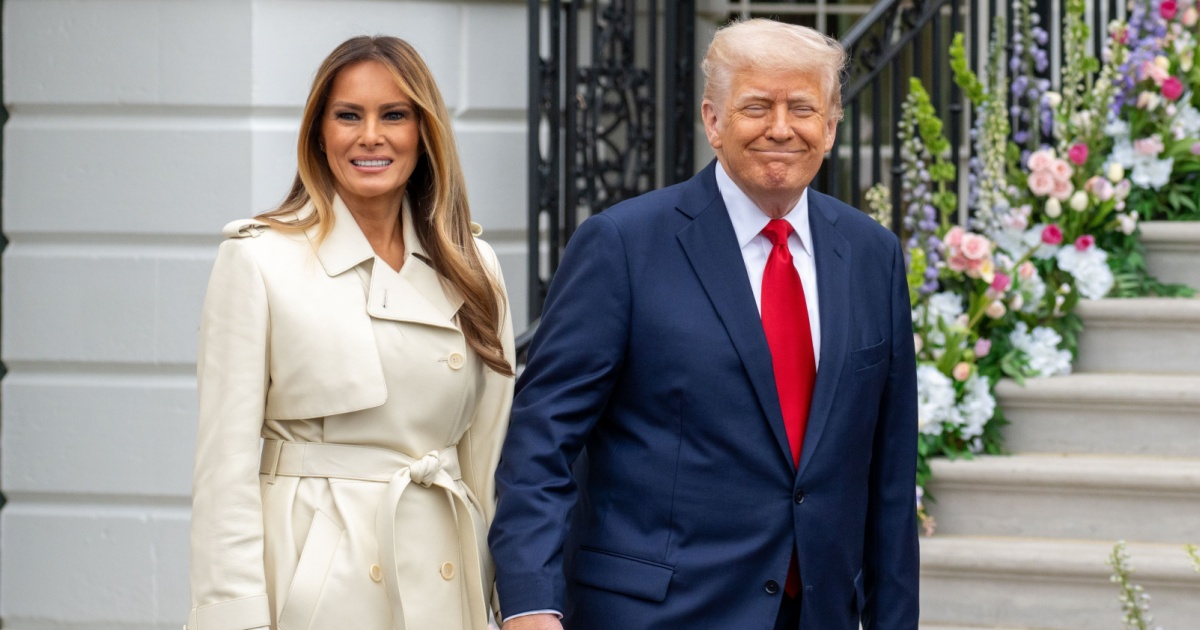

The question of what would happen to Melania Trump if the President died in office isn’t one most people want to think about out loud. But in 2026, with renewed scrutiny swirling around Donald Trump’s age, his physical appearance, and his health disclosures, it has become a question that millions of Americans are quietly asking. Not out of ill will, but out of curiosity about a scenario that no sitting First Lady’s team has ever had to prepare for, at least not for decades.
Trump is currently 79 years old, the oldest person in American history to hold the presidency upon his second inauguration in January 2025. If he completes his term, he would need to serve until at least August 15, 2028 to become the oldest sitting president in American history, and on January 20, 2029, the last day of his second term, he would be 82 years, seven months, and six days old. Those are not abstract numbers. They are a backdrop against which public concern has measurably grown.
YouGov polling before the 2024 election found that a majority of Americans believed Trump’s health and age would affect his ability to perform his duties if elected. Since the start of his second term, those concerns have increased, with nearly two-thirds of Americans now saying his health and age are affecting his ability to do the job. Against that backdrop, the constitutional question of what happens next, and what happens to Melania specifically, is not speculative tabloid fodder. It is a serious matter of constitutional law, federal statute, and presidential protocol.
The Constitutional Answer: The 25th Amendment
The legal answer to the question of succession is unambiguous. In case of the removal of the President from office, or of his death or resignation, the Vice President shall become President. That is the direct language of Section 1 of the 25th Amendment, ratified in 1967. There is no deliberation, no waiting period, and no congressional vote required for the basic transfer of power. It is automatic and immediate.
The amendment did not create this principle from scratch. The first section of the 25th Amendment codified the traditionally observed process of succession in the event of the death of the president, which is that the vice president would succeed to the office. What the amendment did was remove all legal ambiguity that had existed since the founding era. Before 1967, the Constitution’s original text was silent on whether a vice president who stepped in was becoming the president or merely an acting president, a distinction that had caused real confusion as far back as 1841.
It was ultimately the assassination of President John F. Kennedy in 1963 that finally pushed Congress to create a detailed, specific, and unambiguous outline of executive succession. The result was a constitutional amendment that now makes one thing crystal clear: if Donald Trump were to die in office today, JD Vance would not become an “acting” president. He would become the President of the United States, full stop.
What Happens to the Vice Presidency?
When Vance ascended to the presidency, the office of vice president would immediately become vacant. Whenever there is a vacancy in the office of the Vice President, the President shall nominate a Vice President who shall take office upon confirmation by a majority vote of both Houses of Congress. That is Section 2 of the same amendment. The new President Vance would be constitutionally required to name a nominee for the vice presidency, creating a political dynamic unlike any seen in modern American history.
The one precedent for this exact mechanism playing out in real time came in 1973 and 1974. The first use of this provision occurred in 1973 when President Richard Nixon nominated Congressman Gerald R. Ford of Michigan to fill the vacancy left by Vice President Spiro Agnew’s resignation. In less than a year, the 25th Amendment would be used again, this time when Vice President Ford became President after Richard Nixon resigned.
JD Vance: A Record-Setting President
Should Vance assume the presidency under these circumstances, he would enter the history books in multiple ways. Born on August 2, 1984, he is currently 41 years old. The youngest president to ever occupy the Oval Office was Theodore Roosevelt, who was 42 years and 322 days old when he ascended to the presidency following the death of William McKinley in 1901. Vance, at 41 in 2026, would beat that record, becoming the youngest person ever to hold the office of President of the United States.
The first Millennial to serve as vice president, Vance is the youngest person elected to the vice presidency since Richard Nixon in 1952, and the third-youngest vice president in U.S. history. His ascent to the presidency would represent a generational shift of historic proportions, moving from the oldest president in American history to one of the youngest in a single moment.
Usha Vance, his wife, would simultaneously become First Lady. There is no election for that title, no confirmation hearing. The role transfers with the presidency itself. She would assume all the ceremonial and public responsibilities that currently belong to Melania, and the White House transition protocols would begin immediately.
What Happens to Melania?
For Melania Trump, the immediate consequence would be the end of her formal role. The title of First Lady is not a constitutional office, a paid position, or a legal designation. It is an informal honorific granted entirely by the fact of marriage to a sitting president. The moment Donald Trump’s presidency ended, whether by death or any other cause, the title would pass to the next president’s spouse. Melania would leave the White House, most likely returning to Mar-a-Lago in Palm Beach, Florida, or the Trump residence in New York.
This would not, however, mean the end of her federal protections. In 1965, Congress authorized the Secret Service, under Public Law 89-186, to protect a former president and his or her spouse during their lifetime, unless they decline protection. That protection does not depend on whether the former president is alive. Federal law states that former presidents and their spouses are entitled to protection for their lifetimes, except that protection of a spouse shall terminate in the event of remarriage, and that children of a former president who are under 16 years of age are also covered. Melania’s Secret Service detail would continue, and would only be removed if she chose to decline it or if she remarried.
This statutory protection has evolved significantly over the decades. In 1994, the coverage was amended to reduce the protection period to 10 years after a former president left office. However, President Barack Obama signed the Former Presidents Protection Act of 2012, ensuring that all living former presidents and their spouses receive lifetime protection.
The Question of Finances
Beyond security, Melania’s financial position would be determined primarily by the terms of her prenuptial agreement with Trump and the inheritance laws of whatever state governs the estate, not by any federal statute. The federal government does provide a pension and benefits to former presidents’ surviving spouses. A former president’s spouse may be paid a lifetime annual pension of $20,000 if they relinquish any other statutory pension. That figure is a formality compared to the private wealth involved, but it illustrates that the federal government does maintain ongoing obligations to presidential widows.
Trump’s personal fortune, estimated by various outlets at multiple billions of dollars, would be subject to inheritance and estate tax rules. What Melania would actually receive would depend on the terms of their marriage agreement and his will, private documents that the public has no current access to. What is not in dispute is that any estate of that scale would face a significant federal tax obligation before any distribution to heirs.
The State Funeral: Protocol and Precedent
If a sitting president were to die in office, the nation would enter a formal period of mourning governed by long-established military and congressional protocol. The process is not improvised. Traditionally five days in length, presidential state funerals are meticulously choreographed. Coordination for the events is conducted by the army’s Military District of Washington and begins early in each presidential term, when a new president is asked to attend to the strange task of imagining his own funeral service.
In the United States, state funerals are the official funerary rites conducted by the federal government, offered to a sitting or former president, a president-elect, high government officials, and other civilians who have rendered distinguished service to the nation. Administered by the Military District of Washington, state funerals are greatly influenced by protocol and steeped in tradition. The overall planning, as well as the decision to hold a state funeral, is largely determined by the family of the honoree.
The standard sequence of events for a president who dies in office would include an initial period of lying in repose at the White House, followed by lying in state at the U.S. Capitol Rotunda, and concluding with a national funeral service at the Washington National Cathedral. Presidents who die while in office may lie in repose in the East Room of the White House, as was the case for both Franklin D. Roosevelt and John F. Kennedy, who first lay in state in the East Room, where trim black drapery dimmed the festive sparkle of the chandeliers. Protocol also dictates that flags will be flown at half-staff for a period of 30 days after the passing of a U.S. president.
Melania, as the president’s widow, would be central to every stage of these observances. She would sit in the front row at the Capitol Rotunda ceremony and at the National Cathedral service alongside immediate family members. The family retains significant input into the specific arrangements, including who delivers eulogies and where burial occurs, though the military district coordinates the logistics. The family has authority over whether the president will lie in state; when Harry Truman died, his body did not lie in state in the Capitol. Out of respect for Bess Truman, the family opted for a smaller, more private funeral service instead.
The most recent presidential state funeral provides the clearest modern template. Jimmy Carter, after several years dealing with various health issues and declining physical ability, entered hospice care in February 2023. He died on December 29, 2024, at the age of 100. His funeral schedule ran from January 4 to January 9, 2025, and included ceremonies in Georgia and Washington, a funeral procession, a service at the U.S. Capitol, a National Funeral Service at Washington National Cathedral, and a private service and interment in Plains. He lay in state in the Capitol Rotunda on the Lincoln catafalque from January 7 to 9, and Washington National Cathedral hosted the state funeral service on January 9, 2025.
The Political Reality: An Age-Defined Moment
The broader context for all of this is impossible to ignore. Since taking office for a second term in January 2025, Trump has been recorded appearing to nod off during public appearances, and close-up images of his hands show thick patches of makeup. About one-quarter of Americans now think Trump’s current overall health is poor, and about half believe he is suffering some level of cognitive decline.
The most recent YouGov polling from April 2026 found that 48% of Americans say Trump is too old to be president, with 35% saying he is suffering significant cognitive decline and 29% saying he is suffering significant physical decline. The White House has consistently pushed back against any suggestion of decline. Trump himself dismissed concerns about his health in a Wall Street Journal interview, declaring, “My health is perfect.”
The constitutional machinery does not care about any of that. It exists precisely because the nation cannot afford to be unprepared. The United States presidential line of succession is the order in which the vice president and other officers of the U.S. federal government assume the powers and duties of the presidency upon an elected president’s death, resignation, removal from office, or incapacity. Every element of what would happen, to the office, to Vance, and to Melania, is governed by law, precedent, and protocol that has been in place and tested over more than two centuries. The system is designed to be invisible until it is suddenly needed, and then to operate without delay.
Read More: People Furious After New US Passport Design for 250th Anniversary Revealed
What This Means in Practice
The scenario in question is not outside the bounds of reasonable concern. The United States has lost eight presidents to death in office, and the constitutional and statutory framework for what follows has been refined through each of those experiences. If President Trump were to die while serving his second term, the transfer of power would be immediate and legally unambiguous: JD Vance becomes President of the United States the moment Trump’s death is confirmed, and Usha Vance becomes First Lady at the same moment.
Melania Trump’s formal role as First Lady ends instantly, but her federal protections do not. Congress authorized permanent Secret Service protection for former presidents and their spouses back in 1965, and that protection was made explicitly lifetime in scope when Obama signed the Former Presidents Protection Act of 2012. She would retain her Secret Service detail for life, provided she does not remarry. She would also remain the subject of public attention as the widow of a former president, a role that carries no official duties but carries enormous cultural weight.
The state funeral, the period of national mourning, the transition of the White House: all of it is governed by procedures far older than any current administration. Funeral plans are already in place, coordinated with the Military District of Washington at the start of every presidential term. The constitutional machinery has been built, tested, and refined for precisely this kind of moment. Whether it is ever needed depends on factors no one can predict. But the answer to every question about what would happen next is already written down, and has been for a very long time.
AI Disclaimer: This article was created with the assistance of AI tools and reviewed by a human editor.
Read More: Poll Reveals How Popular Melania Trump Is Compared To Other First Ladies