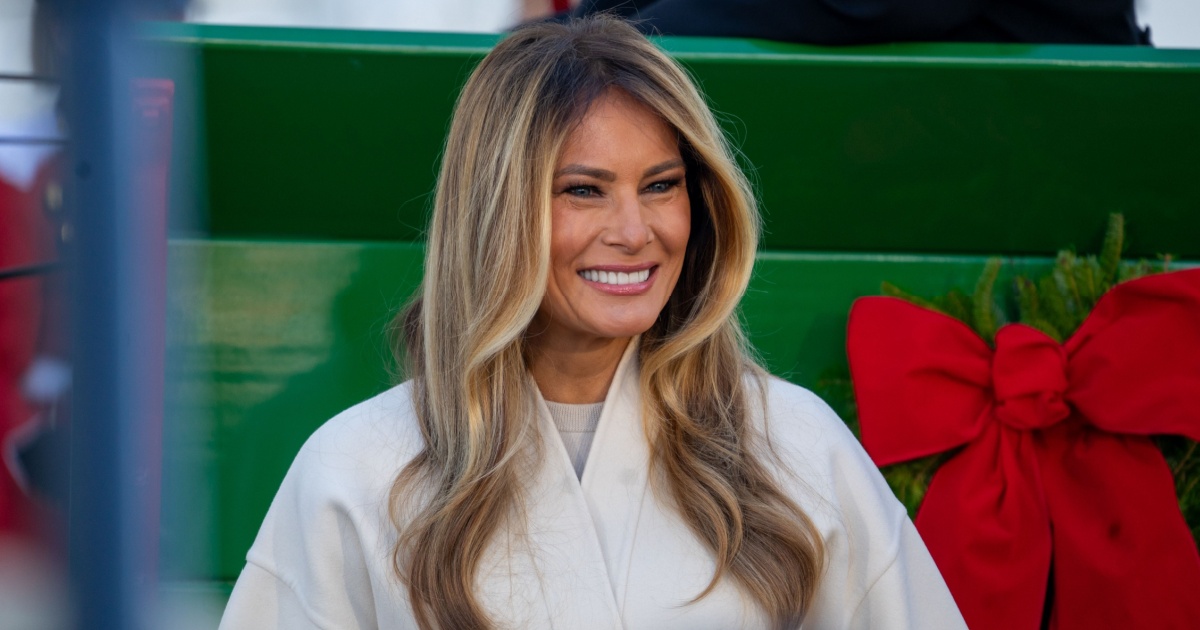

The first lady of the United States has traditionally occupied one of the safer perches in American political life. The role is unelected, largely ceremonial, and historically insulated from partisan crossfire. Americans, regardless of their politics, have tended to extend a degree of goodwill to the president’s spouse that their husbands rarely enjoyed on their own. That pattern has now broken, decisively, in the case of Melania Trump.
Polling data analyzed in early April 2026 tells a story that veteran survey analysts are calling unprecedented. Not since systematic favorability tracking of first ladies began has a sitting presidential spouse recorded numbers this far into negative territory at a comparable point in a presidency. The scale of the collapse – and the speed at which it has occurred – has prompted public comment from some of the country’s most prominent data analysts. The numbers, in the words of CNN’s chief data analyst, are “historically awful.”
What drove Melania Trump to this point is not a single event. It is an accumulation: a high-profile documentary that divided critics and audiences along strict partisan lines, a presidency that has grown increasingly unpopular, an ongoing military conflict in the Middle East, and a role that the first lady has long defined by studied absence from public view. Together, these forces have produced a polling result that rewrites the record books – in the wrong direction.
The Poll That Set the Record
A CNN/SSRS survey conducted between March 26 and March 30, 2026, places Melania Trump’s net favorability rating at -12, meaning unfavorable views of the first lady outpace favorable ones by twelve full points. The survey was highlighted by CNN senior data analyst Harry Enten, who described the numbers as the worst ever recorded for a modern first lady at this stage of a presidency.
According to the CNN/SSRS historical data cited by Enten, Nancy Reagan stood at +50 at a comparable point in her husband’s presidency, Hillary Clinton at +25, Laura Bush at +46, and Michelle Obama at +42. Enten’s conclusion was direct: “If we look at this historically, the worst ever, the worst ever at this point in term number two.”
Enten added that even former first lady Jill Biden, measured during a first term rather than a second, still outperformed Melania’s current numbers – she was above water as well – making Melania’s rating the worst at this point in any modern presidency, not merely second terms.
The Trajectory of a Decline
The collapse in Melania Trump’s standing has not been sudden. It reflects a sustained slide across multiple years. Enten pointed to a dramatic arc: she stood at +30 in May 2018, fell to +3 in January 2025, and has now plunged to -12 in the latest survey. Both figures are a significant departure from her first term, when her favorability ratings were as high as +30 in May 2018.
First ladies historically benefit from higher favorability than their husbands. The position is unelected, less visible, and normally uncontroversial, meaning those who hold it are typically well-liked by the American people. Melania Trump has now broken that pattern more decisively than any of her predecessors. CNN senior data analyst Enten described the data as suggesting Trump has broken the traditional pattern, noting that the numbers “could reflect larger American frustration with her husband’s administration.”
Poll Methodology
The CNN/SSRS survey uses a probability-based panel methodology, drawing a random national sample. CNN polls conducted by SSRS are typically carried out among random national samples drawn from a probability-based panel, conducted online or by telephone with live interviewers, with a margin of sampling error of plus or minus 3.2 percentage points for the full sample. The March 26 – 30 wave falls within standard methodological parameters for national public opinion surveys and is consistent with CNN’s long-running tracking series on first lady favorability, which provides the historical baseline against which Melania Trump’s numbers are being compared.
Presidential Approval: A Collapsing Baseline
Melania Trump’s numbers do not exist in isolation. They sit alongside a pronounced deterioration in approval for President Trump himself, documented by multiple independent polling organizations across the same period.
The Issues & Insights/TIPP Poll, conducted between March 31 and April 2, 2026, found that 39 percent of respondents viewed Trump favorably, while 53 percent had an unfavorable opinion and 8 percent were not sure. Issues & Insights/TIPP, which published the April 7 findings, has been ranked among the most accurate pollsters by third-party polling analysts based on how closely its results have matched final election outcomes.
Compared with March’s survey, in which Trump had garnered 42 percent favorable and 49 percent unfavorable ratings, his net overall favorability fell from -7 percent to -14 percent, a significant swing in sentiment. The sharpest erosion came from non-Republican voting blocs: Democrats registered 9 percent favorable and 85 percent unfavorable, while independents and third-party members came in at 62 percent unfavorable and 28 percent favorable.
The Issues & Insights/TIPP survey was the first to be conducted since the war in Iran began, after joint U.S. and Israeli strikes that killed the country’s supreme leader and prompted Iranian retaliatory attacks across the Middle East.
Pew and the Broader Landscape
The most comprehensive recent measurement comes from Pew Research Center, which surveyed 5,103 U.S. adults between April 20 and April 26, 2026. Trump’s job approval rating in the Pew survey now stands at 34 percent – the lowest mark of his second term – and he has lost ground across a variety of personal attributes and issue areas.
Trend data from Pew shows approval falling from 47 percent in late January 2025 to the mid-30s by late April 2026, while disapproval climbed from the low-50s to 64 percent over the same period. Trump’s net approval rating deteriorated steadily, moving from -4 at the start of 2025 to -30 in the latest survey.
One of the steepest declines in the Pew data has been the share of Americans who say Trump “keeps his promises” – today 38 percent say this, down from 43 percent last August and 51 percent shortly after his reelection in November 2024.
While most Trump voters still approve of the way he is handling his job, that share is shrinking: 78 percent of the president’s 2024 voters currently approve, down from 83 percent in January and 95 percent in the early days of his term. Trump’s younger voters are now substantially less likely than his older supporters to approve of his job performance: 57 percent of Trump voters under 35 and 70 percent of those ages 35 to 49 now approve, compared with 87 percent of his voters ages 50 and older.
Reuters/Ipsos findings align closely with Pew. The Reuters/Ipsos poll released in late April showed Trump’s approval dropped to 34 percent, 2 points below his approval in mid-April, while his disapproval rating increased to 64 percent from March’s 62 percent. The president’s handling of the overall economy reached its lowest point in that poll at 27 percent, with increasing costs – including a 40 percent rise in gas prices tied to the Iran conflict – having soured American views.
Polling Aggregates and the Big Picture
Cross-referencing major polling aggregates confirms the breadth of the trend. According to Nate Silver’s national approval tracker, Trump stood in late April at 39 percent approval and 57.8 percent disapproval, yielding a net approval rating of -18.8, the lowest of his second term. The Silver Bulletin average placed Trump’s net approval rating at -18.4, with his numbers on the cost of living even worse, at net -41.5.
Trump began his second term with a 47 percent approval rating – the second lowest approval rating at the start of a presidential term in polling history, second only to his first term – and throughout 2025 to 2026, his approval rating has steadily declined to an average of 37 to 40 percent.
The Documentary Factor
Any analysis of Melania Trump’s favorability collapse must account for the self-titled documentary that preceded the CNN/SSRS survey by several weeks. Released on January 30, 2026, by Amazon MGM Studios, the film was the most expensive documentary acquisition in Hollywood history. Amazon’s offer of $40 million was the highest price ever paid for a commissioned documentary, and also included a theatrical release and a follow-up to be filmed in a proposed docuseries format.
The marketing outlay was equally extraordinary. Amazon paid $40 million for the rights to the film and committed another $35 million for marketing – eye-poppingly high sums for a documentary. The Hollywood Reporter called it the “most expensive” such film in history.
The documentary outperformed opening weekend box office expectations, bringing in about $7 million domestically, with audiences that were largely white, female, and 55 or over. But the critical response was devastating. The film received a dismal 6 percent critics’ score on Rotten Tomatoes. In contrast, it earned a 99 percent audience score on the same platform, reflecting an almost complete partisan split in how the film was received – the biggest critics-versus-audience gap in Rotten Tomatoes history, according to a spokesperson for the site.
After the opening weekend, the film plummeted quickly: in its third weekend, it saw a 62.3 percent drop in attendance, and by its fourth week, the documentary had disappeared from the box office entirely, not appearing in IMDb’s top 38 films. The film grossed $16.4 million in the United States and Canada, and $303,986 in other territories, for a worldwide total of $16.7 million.
By financial standards, the film is not a winner. The company that financed it, Amazon MGM Studios, still has a long way to go to break even. Theater owners keep roughly half of ticket sales, meaning in the best-case scenario, the studio is walking away with just $10 million against a combined $75 million outlay.
CNN’s analysis directly linked the documentary’s reception to Melania Trump’s broader public image problem. CNN correspondents concluded that the documentary’s box office and critical failure “correlates with the historic lack of appeal that she has for a first lady.
The Historical Context of First Lady Favorability
To understand the magnitude of what the CNN/SSRS data is showing, it is worth examining what the historical baseline actually looks like. First ladies have, since systematic polling began, occupied a unique and generally protected position in American public life. The role of presidential spouse is a unique job and while styles have varied over time, Americans are theoretically supportive of the first lady having influence – and work as a spokesperson to bring attention to a non-controversial issue generally wins public approval, which is usually the driving force behind first ladies having a higher approval rating than their presidents.
The one notable exception to this pattern prior to Melania Trump was Hillary Clinton, whose deep involvement in policy – particularly the push for health care reform in the early 1990s – made her a more polarizing figure. Her job rating slowly declined over her husband’s first term to around 50 percent, and in early 1996 she received the only-ever overall disapproval rating for a first lady before Melania Trump’s current numbers, at 42 percent approval and 47 percent disapproval. Yet even Clinton’s lowest moments produced net favorability figures that sat well above Melania Trump’s current -12. Hillary Clinton was previously the lowest-rated second-term first lady at this stage of a presidency, polling at +25 during the height of the Lewinsky scandal.
Historical data also shows that previous presidential spouses of deeply unpopular presidents were often able to walk away with their public reputations largely unaffected: despite President Carter having a 32 percent approval rating in August 1979, Rosalynn Carter held a positive rating from 59 percent of the country. That traditional firewall has not held for Melania Trump.
The Roper Center for Public Opinion Research at Cornell University maintains comprehensive historical data on first lady favorability stretching back decades, and the pattern it documents is consistent: the role has historically conferred near-automatic goodwill regardless of the political environment around it. Melania Trump’s current numbers represent a departure from that pattern that has no precedent in the modern polling era.
Structural Drivers: Economy, Iran, and Political Polarization
Polling analysts have pointed to several structural factors underlying both the president’s and first lady’s falling numbers. The most prominent is economic anxiety tied to the U.S. conflict with Iran. In the March Reuters/Ipsos poll, 63 percent of Americans described the economy as “somewhat weak” or “very weak,” including 40 percent of Republicans, 66 percent of independents, and 84 percent of Democrats.
An ABC News/Washington Post/Ipsos poll found that 72 percent of Americans disapproved of how Trump is handling inflation – a 7-point increase from two months ago – while 76 percent disapproved of his handling of the cost of living. Core inflation hit a two-year high of 3.5 percent in March, and more than half of respondents – 66 percent – disapproved of how Trump is handling the Iran war, with 33 percent approving.
The partisan structure of the collapse is also revealing. Declines in Trump’s standing have come at least as much from Republicans as from Democrats, though Republicans still offer generally positive views of the president: 68 percent of Republicans and Republican-leaning independents approve of Trump’s job performance, down from 73 percent in January. GOP confidence in Trump on foreign policy in general has declined 7 points.
For Melania Trump specifically, the erosion of the first lady’s traditional political insulation appears tied to deepening polarization in how Americans view the executive branch as a whole. As the nation has grown increasingly polarized, so too have opinions about the first lady, with the traditional goodwill that the role carried appearing to diminish alongside broader partisan sorting.
The Roper Center research also notes that a first lady’s fortunes tend to rise when she champions clearly non-controversial causes, and fall when she is seen as linked to divisive policy battles or to a president under significant political strain. Both of those negative conditions apply in Melania Trump’s current situation.
Midterm Implications
The converging poll data carries significant implications beyond the immediate question of White House popularity. As the United States approaches the midterm elections, low approval ratings for both the president and first lady could reflect obstacles ahead for the GOP as it fights to maintain seats in Congress.
From February 2025 through April 2026, Democrats have typically held a 2- to 7-point advantage on the generic congressional ballot, including 45 percent to 40 percent in the most recent April 20 wave. While generic ballots fluctuate, sustained leads of this size historically place the president’s party at risk – particularly when paired with declining approval.
Ebbing support within a president’s own party can potentially depress turnout, complicate legislative agendas, and endanger down-ballot candidates. Previous surveys have also found that Trump’s job approval ratings have fallen on the economy, potentially hurting the Republican Party’s chances of keeping both congressional chambers in the upcoming midterms.
Read More: Reasons Why Pope Leo XIV Won’t Visit the US Under Trump
What This Means for the Record Books
The April 2026 polling data does not exist in a vacuum – it reflects the accumulated weight of more than a year of political turbulence, an active military conflict, and a documentary that widened rather than narrowed the partisan divide around Melania Trump. For historians and political scientists who track public opinion, the numbers set a new floor for first lady favorability that no predecessor has come close to reaching.
Several clear conclusions emerge. Melania Trump’s -12 net favorability, measured by CNN/SSRS in the March 26 – 30 survey, is the lowest ever recorded for a modern first lady at this stage of any presidency, first or second term. Every comparable historical data point, from Nancy Reagan at +50 to Hillary Clinton at +25, sits far above her current standing. The descent from +30 in May 2018 to +3 in January 2025 to -12 in March 2026 describes a trend line, not a single shock. And the structural conditions driving that trend – an active military conflict, rising prices, and intensifying political polarization – show no signs of rapid reversal.
For anyone paying attention to the broader political environment heading into the November 2026 midterms, the data offers a concrete preview of the headwinds facing the Republican Party. A majority of Americans – 56 percent – say the overall level of ethics and honesty in the federal government has fallen over the course of Trump’s term, while only 19 percent say it has risen. When a first lady who has historically stood apart from her husband’s political battles is polling 12 points underwater, it signals something deeper than ordinary partisan disapproval. It signals that the White House’s difficulties have become impossible to compartmentalize – and that the midterm electorate is watching closely.
AI Disclaimer: This article was created with the assistance of AI tools and reviewed by a human editor.
Read More: People are Furious After Finding Out About All The Things Trump Named After Himself