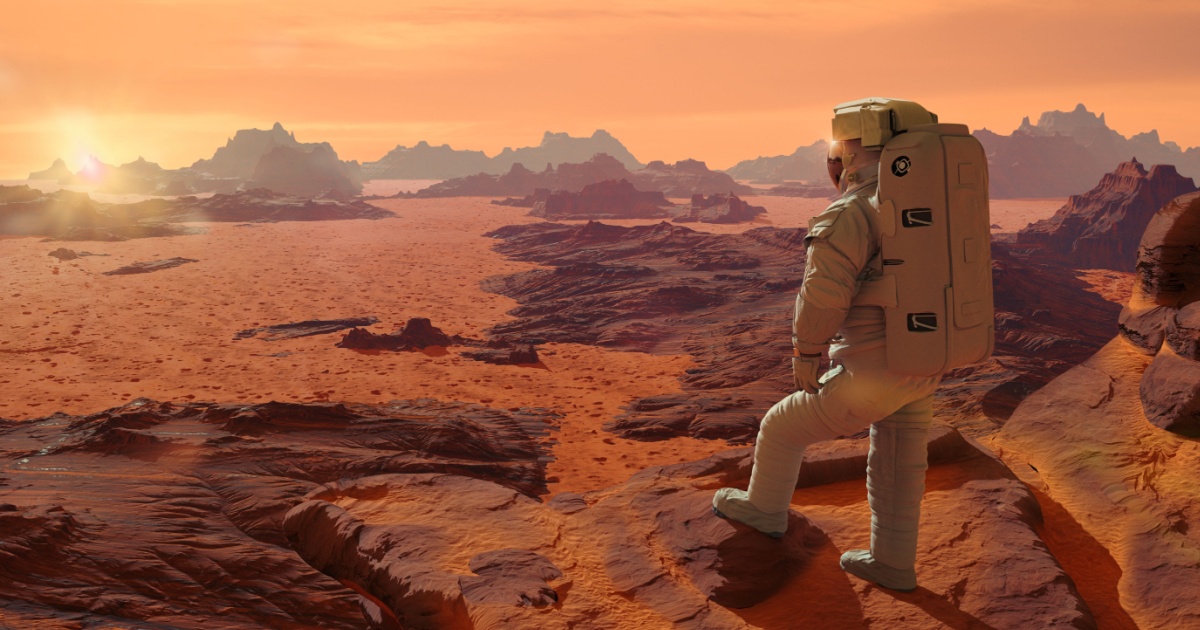

Every time the Earth and Mars slow down enough to face each other from the same side of the sun, mission planners get a brief window – a window that comes around only once every 26 months – to dispatch a spacecraft toward the Red Planet. For most of human spaceflight history, that window has been treated as a rigid constraint. You launch during it, you travel for seven to ten months to get there, you wait on the surface for the planets to realign, and then you travel seven to ten months back. The full round trip, under that framework, stretches to nearly three years.
That assumption may no longer be the only option. A researcher in Brazil, while tracking the early trajectory of a near-Earth asteroid, stumbled onto something he was not looking for. Using the geometric clues buried in that asteroid’s initial orbital data, he identified what he describes as a potential shortcut between Earth and Mars. The findings, published in April 2026 in the peer-reviewed journal Acta Astronautica, suggest that a full round trip to the Red Planet could potentially be completed in as few as 153 days. That is roughly five months. One-way flights to Mars currently take that long on their own.
The discovery was, by the researcher’s own admission, an accident. But the mathematics behind it are generating serious attention in the aerospace community, and raising a question that nobody in the space exploration world wants to take lightly: are we thinking about Mars travel all wrong?
Why Getting to Mars Takes So Long
To understand why this finding matters, it helps to understand the trap that mission planners are currently stuck in.
The trip to Mars takes about seven months and covers roughly 300 million miles. That estimate applies when spacecraft use what engineers call a Hohmann-style transfer orbit – essentially the most fuel-efficient curved arc between two planets. As Earth and Mars orbit the sun at different speeds and distances, about once every 26 months they align in a way that allows the most energy-efficient trip to Mars. Miss that window, and you are burning exponentially more fuel to chase a planet that has moved out of position.
Historically, spacecraft have followed trajectories that took between six and nine months to reach Mars, using traditional chemical propulsion on roughly Hohmann transfers. The problem is that the return journey demands another long wait. A one-way trip to the Red Planet would take nine months, but a return journey would be around three years. That duration is not just a logistical problem. It is a health crisis waiting to happen.
Space radiation poses one of the most significant health risks for long-duration space missions, with cancer, cognitive decline, and cardiovascular issues among the primary concerns. The longer astronauts spend in deep space, the worse the exposure. Faster trajectories are within NASA career radiation limits, while 180-day one-way trajectories are not, and the key challenge for human missions to Mars is precisely this lengthy transit time of six to nine months using low-energy trajectories. A faster route, in other words, is not just a convenience. It is a medical necessity for anyone who expects to return home healthy.
The Asteroid That Changed the Equation
Marcelo de Oliveira Souza, a cosmologist at the State University of Northern Rio de Janeiro in Brazil, first stumbled on the idea in 2015, when he was studying near-Earth asteroids. He was not looking for a shortcut to Mars. He was cataloging trajectories.
When astronomers first spot a near-Earth asteroid, they quickly track its motion across the sky to calculate a preliminary orbit. These initial approximations often reveal highly eccentric, sweeping trajectories with a distinct tilt relative to the plane containing Earth’s orbit around the Sun. Scientists eventually refine these paths with further observations, often tossing the early orbital data aside. Souza, however, saw potential in that discarded data.
In his new study, Souza followed the predicted route of asteroid 2001 CA21 to look for a new path to reach Mars. He examined the flight path of the asteroid, which crossed the orbits of both Earth and Mars at a steady five-degree tilt. The early orbital estimates for 2001 CA21 showed it carving a path through space that intersected both planets’ orbital zones. Those early estimates were later revised as better data came in – but at the moment Souza was looking, the geometry was still intact.
Although later measurements refined the asteroid’s true trajectory, its initial geometry during the October 2020 opposition – when Earth and Mars were aligned on the same side of the sun and closest together in their orbits – hinted at the possibility of “ultra-short” routes between the two planets. “This was a surprise for me – I was not looking for this,” Souza told Live Science. He added, “Maybe I was in the right place at the right time.”
How the Shortcut Works: Lambert Analysis and Orbital Planes
Souza’s method relies on a long-established mathematical tool in orbital mechanics called Lambert’s problem. In celestial mechanics, Lambert’s problem is concerned with the determination of an orbit from two position vectors and the time of flight, posed in the 18th century by Johann Heinrich Lambert and formally solved with mathematical proof by Joseph-Louis Lagrange. The most typical use of this algorithm is for the design of interplanetary missions – a spacecraft traveling from Earth to Mars can be considered, in a first approximation, to follow a heliocentric elliptic Kepler orbit from the position of Earth at launch to the position of Mars at arrival.
What Souza added was a constraint. Rather than searching for all possible paths between Earth and Mars, he restricted his search to trajectories that stayed within roughly five degrees of the orbital tilt defined by asteroid 2001 CA21’s early path. He looked for trajectories to Mars that remained within five degrees of the tilt identified in that asteroid data. Staying close to this specific angle allows a spacecraft to take a more direct path through space, rather than following the wider, more curved arcs typically used in Hohmann transfer orbits.
The research examined several upcoming Mars oppositions, specifically those in 2027, 2029, and 2031, to determine when such a shortcut might be viable. Mars opposition, when Earth sits directly between the Sun and Mars, is already a key launch window due to the reduced distance between the planets. Yet only one of these alignments stood out.
The analysis found that 2031 was the only year when the Earth-Mars geometry lined up favorably with the asteroid’s orbital plane. Souza wrote that “the 2031 Mars opposition supports two complete sub-year round-trip missions consistent with the CA21-anchored plane, illustrating how early small-body orbital data may contribute to the early identification of rapid interplanetary transfer opportunities.”
The Two Mission Profiles: Fast and Faster
Souza discovered two complete, dynamically sound round-trip profiles for a spacecraft. The first option is an ultra-rapid, high-energy flight completing the entire mission in roughly 153 days. This includes a blistering 33-day outbound flight, a 30-day stay on the Martian surface, and a 90-day return journey.
The precision of the proposed schedule is striking. In that scenario, a spacecraft would depart Earth on April 20, 2031, at about 27 kilometers per second, arrive at Mars by May 23 after a 33-day journey, spend about 30 days on the surface, depart June 22, and return to Earth by September 20, with the return leg taking roughly 90 days.
The second option offers a more feasible, lower-energy path, taking 226 days. A crew would spend 56 days flying out, 35 days on the ground, and 135 days coming home. This lower-energy alternative would require a launch at about 16.5 kilometers per second for a mission lasting about 226 days, or about 7.5 months – still significantly shorter than current mission timelines.
Both profiles represent a dramatic compression compared to the status quo. For context, NASA’s Perseverance rover took approximately seven months just to reach Mars in 2021 – and that was a robotic probe with no human cargo, no life support, and no need to return.
The Propulsion Gap: Where Theory Meets Reality
Here is where the research runs into its most significant obstacle. The high-energy trajectory would require departure speeds of around 32.5 kilometers per second, well beyond current rocket capabilities, and a spacecraft would arrive at Mars traveling around 64,800 mph (108,000 km/h) – too fast for existing landing systems to handle safely, Souza noted in the paper.
For reference, NASA’s New Horizons probe, when launched in January 2006, left Earth at a speed of about 16.26 km/s – at the time, the fastest spacecraft ever launched from Earth. The minimum-energy version of Souza’s shortcut would require roughly the same departure speed. The maximum-energy version would demand double that. No rocket currently in service or under active development has been confirmed to achieve 32.5 km/s from Earth’s surface.
The required velocities are comparable to those achieved by missions such as New Horizons. Such high-speed trajectories could be within the reach of next-generation rockets such as SpaceX’s Starship or Blue Origin’s New Glenn, Souza told Live Science. That remains a forward-looking claim. Both vehicles are still undergoing development and testing, and neither has yet demonstrated the performance margins that this kind of mission would demand.
The landing problem is equally consequential. The concept remains largely theoretical and would depend heavily on mission specifics – including spacecraft design, payload mass, and propulsion capabilities – all of which would shape whether such fast transfers are feasible in practice. Arriving at Mars at 64,800 mph means shedding enormous amounts of velocity during entry. Current heat shields and retropropulsion systems are not designed for that scenario.
It is commonly believed that advances in propulsion technology, such as nuclear thermal or VASIMR engines, are necessary to reduce transit time significantly. A separate 2025 study published in Scientific Reports found that a 90-day Mars transit is technically feasible using chemical propulsion – specifically, SpaceX Starship with anticipated orbital refueling and aerocapture capabilities. Souza’s work exists alongside that research rather than replacing it. Both point toward the same conclusion: faster Mars travel is geometrically possible, even if the hardware has not caught up yet.
Rethinking Asteroid Data as a Navigation Tool
Perhaps the most consequential implication of this research is not the specific 2031 window it identifies, but the method it introduces. The significance of this study goes beyond a single asteroid or a specific year. Souza emphasizes that future missions do not necessarily need to follow 2001 CA21 itself. Instead, the asteroid serves as a proof of concept for a new way of thinking about navigation. The preliminary orbits of small bodies can be used as a “methodological screening tool” to help mission planners identify rapid transfer opportunities that traditional planetary-only models might miss.
Astronomers constantly monitor the skies for space rocks, primarily to protect our planet from catastrophic impacts. Now, that same surveillance data can double as a deep space navigation tool.
The asteroid 2001 CA21 was never a physical target for the mission. Souza used its old orbital plane the way a cartographer uses a contour line – to reveal structure that flat optimization runs can overlook. The method anchors a search to a geometric rule and lets the rule surface corridors that energy-only approaches might miss.
Souza concludes in the paper that “early small-body orbital solutions may encode natural heliocentric geometries that help structure and highlight rapid interplanetary pathways within conventional trajectory search spaces.” He adds that “the plane-anchoring approach developed here provides an innovative and generalizable framework for exploring whether similar geometric templates exist within other near-Earth object orbital configurations.”
In other words, 2001 CA21 may be one of many asteroids whose early orbital sketches contain hidden geometric value. The question now is whether other early-epoch asteroid solutions encode similar templates. The paper leaves that population survey for future work.
Read More: NASA Captures Its Clearest Panorama Image of Mars to Date, and It’s Astounding
The Health Argument for Speed
One dimension of this research that deserves more attention than it typically receives is the direct link between travel time and crew health. The argument for faster Mars travel is not just about efficiency. It is about survivability.
Exposure to space radiation increases the risks of astronauts developing cancer, experiencing central nervous system decrements, exhibiting degenerative tissue effects, or developing acute radiation syndrome. Outside of Earth’s protective magnetosphere, crews are exposed to pervasive, low dose-rate galactic cosmic rays and to intermittent solar particle events. These are not manageable nuisances. They are mission-limiting threats.
NASA’s Human Research Program identifies space radiation health effects – including cancer, cardiovascular disease, and cognitive decrements – as the highest-priority health risk for exploration missions. A 153-day round trip changes the radiation exposure calculation profoundly. Three years in deep space and five months in deep space are not comparable propositions from a biological standpoint, and the 153-day profile would keep total mission dose well within safer boundaries.
What This Means for Mars Planning
Souza’s research will not put a human on Mars in 2031. There are too many engineering barriers standing between the geometric solution he has identified and a flyable spacecraft capable of achieving it. The propulsion requirement for the fastest profile far exceeds anything currently operational, and landing at the arrival velocities involved would require heat shield and deceleration technology that does not yet exist.
What the study does accomplish is substantial. It introduces a new method for finding fast interplanetary routes – one rooted in data that space agencies already collect and have historically discarded. The 2031 Mars opposition may be the only window in the near term where this specific geometry works, but the broader method could be applied systematically to the entire catalog of near-Earth asteroids, searching each one’s early orbital estimates for similar geometric templates. That is a data-mining exercise that costs nothing beyond computation time.
The 226-day lower-energy profile deserves serious study as a near-term benchmark. At a departure speed comparable to New Horizons, it sits within the plausible performance envelope of advanced chemical propulsion systems. It cuts the current round-trip timeline by more than half, keeps radiation exposure within manageable limits, and requires a surface stay of just 35 days – a sharp contrast to the 500-day surface stays built into conventional mission architectures. For mission planners willing to think differently about what existing data can tell them, that is a starting point worth taking seriously.
As Souza told Live Science: “Maybe this can change the idea that we need more than two years to go to Mars and return.” For engineers and planners who have long taken that two-year figure as a given, that challenge is worth examining carefully. The geometry exists. The data that revealed it was already sitting in astronomy archives, filed away as obsolete. Souza simply looked at it differently – and what he found may reshape how the next generation of Mars mission designers think about the routes between worlds.
AI Disclaimer: This article was created with the assistance of AI tools and reviewed by a human editor.
Read More: Artemis II Crew Captures First Earth Images from Orion Spacecraft – NASA