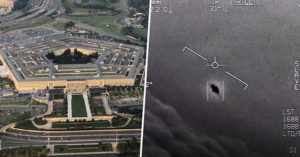

Something about the phrase “have fun” lands differently when it comes from the most powerful office on earth and it’s attached to decades of government secrets about objects nobody can explain. That’s exactly what happened on May 8, 2026, when the Pentagon put 162 classified files online for anyone to read, with President Trump’s blessing carrying roughly the weight of a shrug and a grin.
For people who have spent years asking whether the government actually knows more than it lets on about strange things in the sky, this was a moment worth pausing on. Not because the files handed anyone a smoking gun. But because what was released, what was withheld, and what the administration chose to say about it all raises questions that are worth taking seriously.
This isn’t really a story about aliens. It’s a story about how a government shares difficult information with the public, and what that process looks like when it’s filtered through a social media post telling you to “enjoy.”
What Was Actually Released
The files, referred to as the United States UAP files or the UFO files, are a collection of declassified U.S. government records concerning unidentified anomalous phenomena (UAPs) released by the Trump administration beginning on May 8, 2026, and announced to continue as repeated, ongoing, expanding releases of UFO materials.
The release, posted on a new Pentagon “UFO” website, included 162 files drawn from the FBI, Department of Defense, NASA, and State Department. The documents contain eyewitness testimony, photos, and reports of sightings of unexplained objects, covering incidents dating back decades from around the globe. To be specific about what “162 files” actually means: Friday’s release included 120 PDFs, 28 videos, and 14 image files.
The 162 documents range from 1942 to 2025 and include audio clips and photographs. The Pentagon now uses the term Unidentified Anomalous Phenomena, or UAPs, for such objects, although “UFO” remains in the web address and is used throughout the website. The files are publicly available at war.gov/UFO, a newly launched government portal built to house the material on a rolling basis.
The files were published through the Presidential Unsealing and Reporting System for UAP Encounters (PURSUE), a government website created to release reviewed UAP-related material to the public. The acronym alone suggests a level of interagency coordination that contrasts sharply with the casual tone of Trump’s public comments about it.
What the Files Actually Show
The honest answer is: not much that settles anything. The first tranche of records did not confirm the existence of extraterrestrial life. The Pentagon described the released materials as unresolved cases for which the government could not make a definitive determination based on available evidence, while some scientists and skeptics said many of the files were ambiguous, previously public, or potentially explainable as camera artifacts, balloons, debris, or unreliable eyewitness accounts.
Some of the individual files are genuinely striking on their face. One document includes a transcript of a conversation between Mission Control and astronauts James “Jim” Lovell and Frank Borman during 1965’s Gemini 7 mission. The transcript opens with Borman’s report of a “bogey,” a term for an unknown aircraft, as well as a debris field consisting of “very, very many…hundreds of little particles.” The record is accompanied by handwritten annotations documenting the encounter, including a note reading “UFO Sighting by Borman.”
More recent files are equally puzzling. The roughly two dozen videos, which run for a total of 41 minutes, show reported encounters around the world between 2020 and 2026. Most show footage from an infrared camera tracking a white object that appears as a speck on the screen moving through the air. A report accompanying a video taken in Greece in 2023 said the object was making multiple “90-degree turns” at approximately 80 miles per hour. One of the videos shows an object described as resembling a football in the Indo-Pacific, and another from Syria shows two semi-transparent, irregularly shaped orange areas that each appear for two seconds.
The State Department’s files include diplomatic cables from countries including Papua New Guinea, Kazakhstan, Turkmenistan, Georgia, and Mexico, detailing various UAP incidents. The dates range from 1985 to late 2025. A cable from the U.S. Embassy in Tajikistan in 1994 relayed the experience of a commercial air pilot and crew who reported seeing a strange object at 41,000 feet.
None of this explains what any of these objects are. The Defense Department described the scope of its review as covering “tens of millions” of records, acknowledging it would release new materials “on a rolling basis as they are discovered and declassified.” Defense officials justified the lack of explanation as due to a “variety of reasons,” including a lack of sufficient data.
The Redaction Problem
Before anyone celebrates full transparency, there’s a significant caveat buried in the details. Out of the 162 files, 108 contain redactions. The Pentagon said information was withheld to “protect the identity of eyewitnesses, the location of government facilities, or potentially sensitive information about military sites not related to UAP.”
That means fewer than a third of the released files are fully unredacted. The administration offered a narrowly worded reassurance: “No redactions have been made to any files released under President Trump’s directive concerning information about the nature or existence of any encounter reported as a UAP or related phenomena.” In other words, the government says it didn’t black out anything about what the objects actually were, only surrounding contextual details.
Whether you find that reassuring depends largely on how much trust you already extend to the institutions making that claim, and right now that trust is in short supply across the political spectrum. A year-end 2025 poll found that public trust in government dropped and is near the lowest point in the nearly 70 years the survey has been conducted. Just 17 percent of Americans trust the government to do what is right “just about always” or “most of the time,” according to the Pew Research Center, five points lower than the prior year’s poll.
“Have Fun and Enjoy”
The tone of the White House’s official response to the release deserves its own look. The Pentagon unsealed what it described as “new, never-before-seen” files related to otherworldly encounters, months after Trump directed the government to begin disclosing intelligence related to alien and extraterrestrial life, unidentified aerial phenomena, and unidentified flying objects. Trump, in a Truth Social post, characterized the dissemination of the archives as an effort to achieve “complete and maximum transparency,” writing “the people can decide for themselves, ‘WHAT THE HELL IS GOING ON?'” and adding, “Have Fun and Enjoy!”
There’s something genuinely unusual about a sitting president publicly handing off the task of interpreting potentially sensitive national security material to the general public with roughly the energy of someone sharing a viral video. Whether that reads as refreshing candor or casual deflection likely depends on where you started.
Some Republican lawmakers, including Representatives Anna Paulina Luna of Florida and Tim Burchett of Tennessee, had pushed for months for the Pentagon to increase its transparency by declassifying documents related to UFOs. Congress had created an office in 2022 specifically to declassify this material. Burchett called the initial release “a great start.”
The response crossed party lines in unexpected ways. The administration’s decision to declassify the batch of files drew unexpected praise from Democratic Senator Kirsten Gillibrand of New York, who cheered the release, stating, “Transparency is the only path to truth.” Gillibrand wrote that she was “encouraged that the administration has finally heard my call and the call of millions of Americans to begin unsealing these files,” adding she has long advocated for the declassification and release of UAP files.
What Sparked This in the First Place
The release didn’t come out of nowhere. The chain of events traces back to a viral moment in February 2026, when former President Barack Obama appeared on “The Late Show with Stephen Colbert.” His comments followed an earlier interview on a podcast, where he said of aliens, “They’re real, but I haven’t seen them,” sparking widespread online speculation.
Obama later clarified his remarks on Instagram, writing that “the odds are good there’s life out there” but that “the distances between solar systems are so great that the chances we’ve been visited by aliens is low,” adding, “I saw no evidence during my presidency that extraterrestrials have made contact with us.”
Trump seized on Obama’s original comments publicly, calling them “a big mistake” for potentially releasing classified information, while simultaneously pledging to release whatever the government had. Speaking with Colbert, Obama dismissed ongoing UFO speculation as “conspiracy theories,” arguing the federal government wouldn’t be able to maintain such a massive cover-up. “One of the things you learn as president is the government is terrible at keeping secrets,” Obama said.
More Still to Come
This is not the end of the file release. According to Reuters, there are plans for releasing another tranche 30 days after the first one, with a release date set for June 7, 2026. The administration has also framed the scope of what still exists as vast. The files represent the first tranche released under PURSUE, the interagency program Trump ordered in February. They draw from the FBI, the State Department, NASA, the Office of the Director of National Intelligence, and the Department of Energy, among other agencies.
The Sol Foundation, a research group focused on UAPs, used Friday’s release to push for legislation that would force a “thorough” review of classified UAP records “with the aim of providing Americans with the full truth about longstanding government knowledge and programs concerning technologies and vehicles not of human origin.”
The Pentagon described the released materials as unresolved cases for which it could not make a definitive determination based on available evidence, while some scientists and skeptics said many of the files were ambiguous, previously public, or potentially explainable as camera artifacts, balloons, debris, or unreliable eyewitness accounts. That’s a wide gap between what many people hoped to find and what the files actually delivered.
Read More: Scientists Tied to UFOs and Nuclear Programs Are Dying – Here’s Every Case
What to Make of All This
If you went looking for proof of alien life in these files, you didn’t find it. That’s not spin – that’s what the data shows. The Pentagon’s dedicated All-domain Anomaly Resolution Office, whose first report in 2024 revealed hundreds of new UAP incidents, found no evidence that the U.S. government had ever confirmed a sighting of alien technology. The newly released files don’t change that conclusion.
What the release does offer is something different and arguably more significant: a window into how much the U.S. military and intelligence apparatus still doesn’t understand about things its own pilots, diplomats, and astronauts have been reporting for decades. Objects making 90-degree turns at high speed, orbs that split into multiple craft, anomalies over active military zones with no resolution. These aren’t explained away by this release; they’re formally acknowledged as open questions.
For anyone who has been paying attention to the broader pattern of government secrecy, the more meaningful signal here isn’t what was revealed but what was promised next. The Pentagon’s UFO site said new documents will be released on a rolling basis “as they are discovered and declassified, with tranches posted every few weeks.” How much actually surfaces, how redacted it remains, and whether it ever goes beyond what a curious public can verify independently will tell us far more than any single “have fun” post ever could.
AI Disclaimer: This article was created with the assistance of AI tools and reviewed by a human editor.
Read More: ‘Alien Technology’? Scientists Investigate Unusual Spherical UFO