
Something strange is happening at the heart of the National Mall. Walk toward the Lincoln Memorial on any given morning in May 2026, and you’ll find the long stretch of water that has defined that sightline for over a century entirely drained. Black fencing lines the paths. Workers in hard hats move across a dry concrete basin. The view that millions of visitors have photographed, grieved beside, and gathered at is simply gone.
That alone would be newsworthy. But what’s happening behind those fences is far more complicated than a routine repair.
The Lincoln Memorial Reflecting Pool is being painted. Not restored to its original appearance. Not maintained. Painted a vivid shade that President Trump has described as “American flag blue.” For a structure whose entire purpose was to disappear into its own reflection, that choice has triggered a legal battle, a cost controversy, and a fundamental question: who gets to decide what an American landmark looks like?
A Mirror, Not a Feature
Architect Henry Bacon designed the Lincoln Memorial Reflecting Pool as part of his final project before his death in 1924. His intention for the pool was to create a mirror, not a surface you were supposed to look at. The pool opened in 1923 with a plain asphalt and tile bottom, and when the National Park Service – the federal agency that manages national parks, monuments, and historical properties – rebuilt it in 2012, the new floor was tinted a neutral gray to maximize reflectivity.
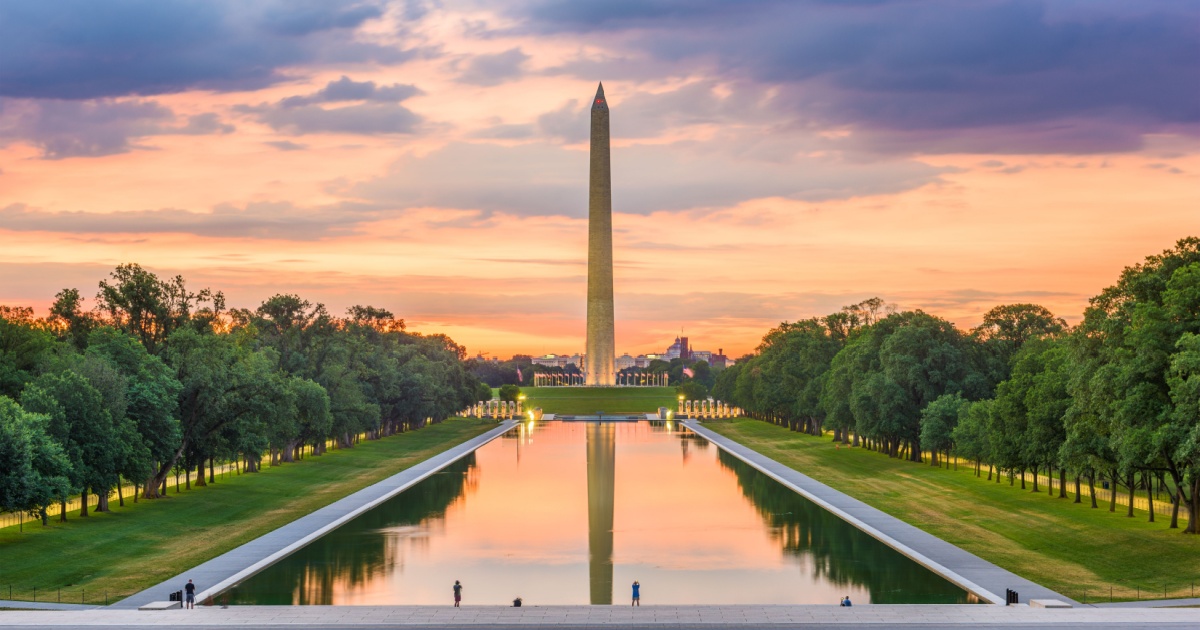
The Reflecting Pool mirrors the sky, the Washington Monument, and the Lincoln Memorial itself, extending the Memorial’s formal design and contemplative character. The pool runs approximately 2,029 linear feet. Its shallow depth, roughly 18 inches along the edges and up to 30 inches at the center, creates a mirror-calm surface when the wind is still. Bacon’s intention was simple yet powerful: to reflect the surrounding monuments and sky, connecting earth, water, and stone into a unified panorama.
The design philosophy behind that dark bottom was not accidental. The 1999 National Park Service Cultural Landscape Report for the Lincoln Memorial Grounds specifically identifies the dark-tiled basin as a character-defining feature of the historic landscape, noting that “the dark color of the tile created the illusion of greater depth and a more profound reflection.” The floor was supposed to vanish. The reflection was the point.
On Easter Sunday April 9, 1939, Marian Anderson sang from the steps of the Lincoln Memorial before a crowd of 75,000, after being denied access by the Daughters of the American Revolution to Constitution Hall. The March on Washington was held in Washington, D.C., on August 28, 1963, and the most notable speech came from the final speaker, Rev. Martin Luther King Jr., standing in front of the Lincoln Memorial, as he delivered his historic “I Have a Dream” speech. And in 2021, lights traced the pool’s rim to mark lives lost during the COVID-19 pandemic.
What’s Actually Happening Now
In early April, the Department of the Interior awarded a no-bid contract to the Virginia firm Atlantic Industrial Coatings to waterproof and paint the pool. The reflecting pool, which has long been plagued by leaks, algae, and structural problems, will be cleaned, repaired, and coated with an industrial-grade waterproof coating. During the announcement, Trump announced the project on April 23, saying, “In another couple of weeks, we’re going to have the most beautiful reflective pool between the Washington Monument and the Lincoln Memorial that you’ve ever seen,” calling the work necessary because the pool “was filthy, dirty, and it leaked like a sieve for many years.”
Details of the broader plan emerged at an Oval Office event about healthcare, during which President Trump claimed to have spearheaded the overhaul by asking contractors he knew for “a good price.” Trump also said he had chosen the shade of blue himself, after being dissuaded from a Caribbean turquoise.
An Interior Department official said that the pool leaks 16 million gallons a year and that the coating material being used is leak-proof. The administration framed the project as necessary maintenance, fast-tracked to be completed before America’s 250th anniversary celebrations on July 4, 2026. The Interior Department stated in contracting documents that delaying the award long enough to conduct a competitive procurement would prevent the National Park Service from completing the work in time and that such a delay “would result in serious injury to the Government.”
That urgency argument sits at the center of the controversy. The pool is not a swimming pool. It stretches roughly 2,000 feet long, has been around since the 1920s, and carries complicated problems tied to both its age and its scale. The New York Times, citing federal records, reported that the government is paying $13.1 million for the project through a no-bid contract awarded to Atlantic Industrial Coatings, which previously performed work at Trump’s property in Sterling, Virginia. The company had never previously held a federal contract, and its work history centers on lining pipes, culverts, and fuel tanks – a very different kind of project.
The Cost That Keeps Growing
When President Trump first announced the project publicly, he described its cost as roughly $1.5 million. The actual figure tells a different story.
According to ABC News, citing federal contract records, the cost of the ongoing renovation is nearing $13.1 million through a no-bid contract – NBC News noted it could not independently verify the exact figure. The Interior Department added $6.2 million to the existing contract, valued at $6.9 million. The money is coming from national park entrance fees – a fund collected from visitors to federal parks and directed toward park maintenance and renovations.
Context from a prior administration is worth noting here. During former President Barack Obama’s first term, his administration spent $34 million making substantial repairs to the pool. Those repairs went through standard federal review processes. The current project, according to critics, did not.
The Trump administration’s approach to remaking Washington’s landmarks extends well beyond the Reflecting Pool. A similar pattern of disputed paint jobs, surging price tags, and federal preservation lawsuits has played out at the Eisenhower Executive Office Building, a structure that has stood for more than 150 years and is now at the center of its own legal fight.
A Lawsuit, a Judge, and an Urgent Request
A nonprofit dedicated to promoting informed stewardship of historic landscapes asked a federal judge to halt the Trump administration’s painting of the reflecting pool. In its complaint, The Cultural Landscape Foundation argues that the original color of the pool’s tiling is a fundamental element of its historic character. “The dark grey, achromatic basin was not incidental to the design,” the group writes. The complaint cites the 1999 National Park Service Cultural Landscape Report, adding that because the Reflecting Pool is listed on the National Register of Historic Places, the suit argues the Trump administration unlawfully bypassed Section 106 of the National Historic Preservation Act of 1966, which would have required the National Park Service to consult with interested parties before moving ahead with any redesign.
The foundation also argues the project runs afoul of the National Environmental Policy Act, the federal law requiring an assessment of how such changes would impact the environment.
The foundation’s argument goes beyond procedure. “The new coloration will cause the pool to resemble a large swimming pool rather than the reflective civic landscape it was designed to be, distorting the experience of the site for the millions of visitors who come to it each year.”
The foundation’s president and CEO, Charles A. Birnbaum, who is also a plaintiff in the case, said in a statement that the Reflecting Pool’s design “is fundamental to the solemn and hallowed visual and spatial connection between the Washington Monument and the Lincoln Memorial.” “A blue-tinted basin is more appropriate to a resort or theme park,” he said.
“No consulting parties have been notified, engaged, or given an opportunity to participate,” the complaint states, adding that the “latest desecration of the reflecting pool is part of a pattern … in which this Administration willfully disregards legal limits established by Congress.”
The case was assigned to Judge Carl Nichols, a Trump appointee who has previously presided over challenges to the president’s efforts to remake the federal workforce. Nichols asked both sides to tell him whether he should hold a hearing over the foundation’s request for an emergency court order halting work on the Reflecting Pool. Trump has said he wants the project finished within two weeks, which makes the emergency hearing request time-sensitive.
Will Blue Actually Make It Better?
The Interior Department insists it will. A spokesperson for the agency said in a statement that the new color “will enhance the visitor experience by making the pool reflect the grand Lincoln Memorial and Washington Monument.”
Preservation experts and reporters who have spoken with engineers on the ground are less certain. From the standpoint of reflectivity, the change may not make much visual difference when viewed from a low angle, such as standing on the steps of the Lincoln Memorial or at the World War II Monument at the other end. Any difference would more likely appear from a higher vantage point, like an airplane or the top of the Washington Monument.
The space is meant to be invisible. It’s supposed to reflect back gray stone and surrounding trees. If what visitors see instead is an artificial blue, the pool could look jarring and out of place on the National Mall.
The practical concern for anyone hoping the issue might be reversed later is straightforward. Once blue paint goes on, reversing it becomes significantly more complicated and expensive. That’s exactly why the foundation asked for an emergency halt rather than waiting for a full hearing.
Workers are also installing a “state-of-the-art ozone nanobubbler filtration system,” which the Interior Department cites as an improvement to the pool’s long-term maintenance.
Read More: Trump’s D.C. Landmark Paint Controversy
What Happens Next
If you’re planning a visit to the National Mall this summer, the Reflecting Pool is still closed to visitors as of mid-May 2026. The changes are set to be completed before the America 250 celebration on July Fourth of this year. Whether a court order halts that timeline remains an open question.
For people who care about public spaces, historic landmarks, or simply where their tax dollars go, this story has real stakes. One of the biggest concerns is the no-bid contracting process. The government is supposed to allow multiple vendors to compete on jobs like this so taxpayers get their money’s worth. That process was bypassed here in the name of speed.
The deeper issue is about who has authority over shared public spaces. The Lincoln Memorial Reflecting Pool doesn’t belong to any administration. It belongs to everyone who has ever stood at its edge, and to everyone who will in the future. As the lawsuit’s complaint states, the dark gray basin was not incidental to the design – it was the design. That isn’t an aesthetic preference. It’s a matter of recorded history, backed by the National Park Service’s own documents.
Whether the courts agree, and whether the blue paint stays or gets reversed, the result of this renovation will be visible to millions of visitors for years to come. The fences will come down. The water will return. And when it does, the pool beneath it will look different from anything Henry Bacon ever imagined.
AI Disclaimer: This article was created with the assistance of AI tools and reviewed by a human editor.
Read More: Trump’s “Personal Casino”? What to Know About Truth Predict and Prediction Markets