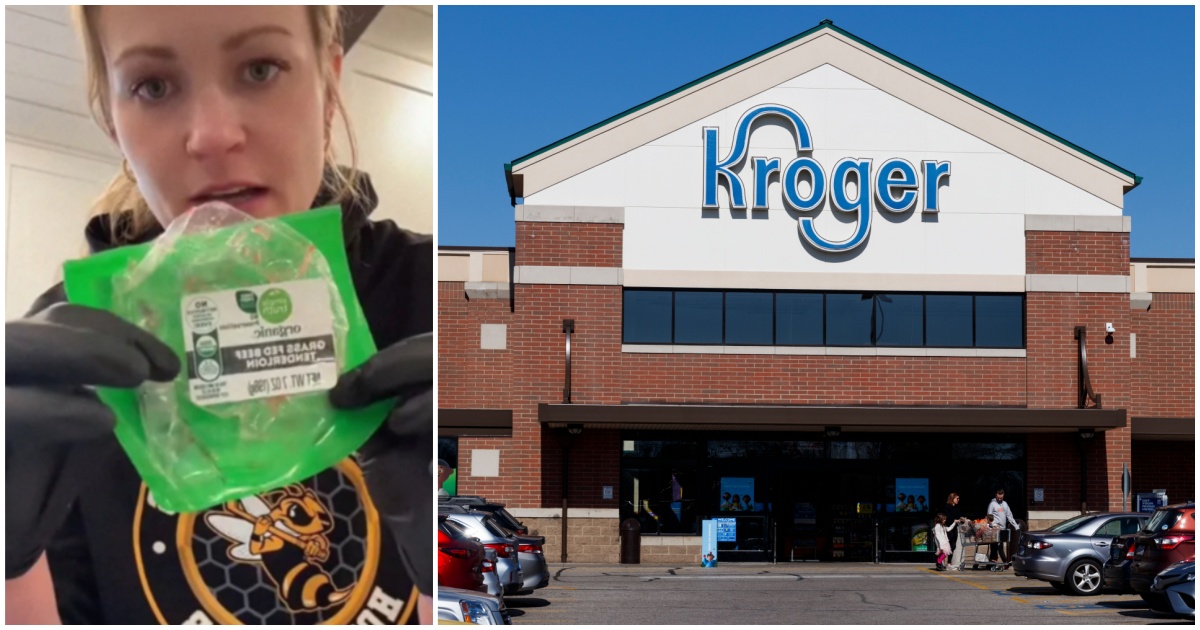

Most people trust that what’s on the label is what’s in the package. You pick up a cut of beef that says “organic,” “grass-fed,” and “filet mignon,” and you assume you know what you’re buying. A premium cut. A whole piece of muscle. A fair trade for a near-$20 price tag.
That assumption is exactly what one Kroger shopper challenged when she opened her package of Simple Truth organic grass-fed filet mignon and found something she couldn’t explain. The meat didn’t look right. It didn’t behave right. And when she stretched it in her hands, it moved more like Play-Doh than beef. The TikTok she posted went viral fast, and the explanation that came from a responding farmer sparked a much bigger question that most shoppers have never thought to ask: is that “steak” actually a steak at all?
The short answer, in some cases, is no. And the substance involved has been hiding in plain sight on grocery store shelves for decades.
What “Meat Glue” Actually Is
The substance at the center of this controversy is called transglutaminase, more commonly known by the blunt nickname “meat glue.” Transglutaminase is a protein-bonding enzyme that can make separate cuts of meat behave as if they were always one piece. Think of it as a biological fastener for proteins. When applied to two surfaces of meat and left to set, it creates a bond strong enough to pass visual inspection by even an experienced cook.
Though the name sounds alarming, transglutaminase is an enzyme found naturally in humans, animals, and plants, where it helps link proteins together by forming what are known as covalent bonds. In the human body, transglutaminase plays a role in various biological processes, including blood clotting. The version used in food manufacturing, however, is not extracted from your own body. The most common commercial method creates the enzyme through fermentation using Streptoverticillium mobaraense bacteria, with the finished powder typically blended with ingredients such as maltodextrin, gelatin, or milk proteins to make it easier to handle.
The food industry has been using meat glue since the 1990s. Its rise accelerated when researchers discovered how to produce the enzyme at scale through bacterial fermentation, and commercial versions quickly entered professional kitchens. Over time, its applications moved well beyond restaurants. Today, transglutaminase appears in restructured seafood, dairy products, and some baked goods.
The TikTok That Kicked Off the Conversation
The Kroger incident is a vivid example of consumer discovery happening in real time. In the viral clip, a shopper identifying herself as @nellifer21 opened a package of Simple Truth organic grass-fed filet mignon she had purchased at Kroger. She found the meat oddly pliable, stretching between her fingers in a way whole-muscle beef simply does not. When she stretched it, she described it as being “literally like Play-Doh.” A farmer and TikToker using the handle @blackbirdcoop responded with a detailed breakdown.
The responding TikToker pointed to a “strange seam” running down the middle of the meat as a “tell-tale sign” of transglutaminase. He explained that the Play-Doh texture typically happens when muscle fibers break down, which can be due to improper ageing, repeated freezing and thawing, or both. His broader point was direct: “Meat glue will often be used on cheaper cuts like these to assemble them into something that’s more acceptable as a steak, though it’s unusual and pretty ballsy to try to pass it off as crème de la crème, like filet.”
The price point added to the concern. The shopper paid $18.99 for the cut, while the commenter noted that even USDA Choice center cut filet, which he considers the “bottom of the barrel” for filet mignon, averages $25 to $35 per pound. That gap is significant. Genuine filet mignon does not sell cheaply. When it does, a closer look at what you’re actually holding is warranted.
@blackbirdcoop @Nellifer ♬ original sound – Farming While Beige
Is It Legal? What the FDA and USDA Actually Say
The practice of using transglutaminase in meat products is entirely legal in the United States. The FDA classifies transglutaminase as GRAS, short for “Generally Recognized As Safe,” which means it can be used in food production without pre-market approval. It was first recognized as GRAS by the FDA in 1998.
Meat glue is legal in all fifty U.S. states and has been approved for use by both the USDA and FDA. However, legality does not mean the practice goes unregulated or unlabeled, at least in theory. Under USDA rules, products made from pieces of whole muscle meat, or that have been reformed from a single cut, must disclose this fact on their label as part of the product name, for example “Formed Beef Tenderloin” or “Formed Turkey Thigh Roast.”
Under FSIS regulations, meat manufacturers must reveal the use of transglutaminase in a given product by adding the TG enzyme to the list of ingredients on the label, where it may appear as “TG enzyme,” “enzyme,” “TGP enzyme,” or the trade name Activa, and must label the product as “formed” or “reformed” meat.
The problem is that the gap between what the rules require and what consumers actually notice is enormous. Most people do not scan an ingredient list for “enzyme” before dropping a steak in their cart. The word alone tells them nothing. And if the front of the package says “organic” and “grass-fed,” few shoppers have reason to suspect the cut is anything other than what it appears.
The regulatory picture gets murkier at restaurants. If a consumer wants to know whether a restaurant steak is a formed or reformed product, the USDA recommends asking the wait staff directly. In practice, very few diners do this, and fewer still would expect to need to.
The international picture is also telling. Transglutaminase has been banned for use in food production in Russia since 2020, as well as by the European Union in 2010. Specifically, the EU’s 2010 ruling banned meat glues derived from a substance known as thrombin. In the U.S., the FDA’s GRAS classification remains intact, and there is currently no federal push to change it. If you want a fuller picture of how food labeling can be used to obscure rather than inform, reading food labels carefully is a practical place to start.
The Food Safety Problem Hiding Inside Glued Meat
Beyond the question of deception, there is a legitimate food safety argument against restructured meat, and it comes down to the basic physics of bacterial contamination.
When you cook a whole-muscle steak, bacteria on the exterior of the meat are killed by the heat of the cooking surface. The interior remains relatively protected. This is why health authorities permit eating a rare steak when it comes from a single intact cut. The risk to the center is low.
Glued meat changes this equation entirely. When multiple sections of meat are joined together to form one piece, it increases the chances of bacteria being introduced into the food’s interior. The small pieces of meat used in binding often carry a much larger surface area than a single cut and have typically spent more time exposed to air during processing. Both conditions significantly increase the possibility of bacterial contamination.
The Center for Science in the Public Interest stated that transglutaminase is “used to deceive consumers.” The organization explained that binding two pieces of food together puts into the protected center of meat any bacteria that were on the outside and thus easily killed in cooking. “It is for that reason that we consider this ingredient, which on its own is safe, as a potential safety risk.”
The various pieces of meat may also come from multiple sources, which makes it difficult to trace the source of an outbreak if one occurs. That traceability gap is not a minor technical footnote. It is the kind of detail that matters a great deal when a foodborne illness investigation is underway.
What the Science Says About Transglutaminase and Health
The food safety concern around bacteria is fairly well established. The health concerns around transglutaminase itself are more contested, but they deserve careful attention, particularly for people with specific conditions.
Published studies on transglutaminase generally conclude that it is safe for the general population when used as directed. The enzyme is deactivated during cooking, and the human body naturally produces its own transglutaminase for various biological processes. An FDA spokesperson, speaking to Newsweek, confirmed that “like most enzymes, transglutaminase will be inactivated or denatured by heat during food processing or cooking at the consumer level.”
Where the picture becomes more complicated is for people with celiac disease or gluten sensitivity. Celiac disease is an autoimmune condition in which the immune system attacks the small intestine in response to gluten, a protein found in wheat, barley, and rye. Transglutaminase 2, an enzyme involved in tissue repair, can trigger harmful immune reactions in diseases such as celiac disease, where it can accidentally accelerate the immune system’s damaging response.
Research raises the concern that the immune system might confuse microbial transglutaminase from food with the body’s own tissue transglutaminase, the enzyme targeted in celiac disease. This reaction could potentially contribute to an autoimmune response. While this research is still emerging and not conclusive, it is considered enough to warrant caution for people with diagnosed celiac disease.
This is not a fringe concern. A 2024 study published in Nature Immunology examined a transglutaminase 2 inhibitor as a potential treatment for celiac disease, finding that orally administered ZED1227 effectively prevented gluten-induced intestinal damage and inflammation, providing molecular-level evidence that TG2 inhibition is an effective strategy for treating celiac disease. Scientists are actively developing drugs to block this same enzyme because of the role it plays in autoimmune damage. The fact that a version of it is simultaneously being added to food products without clear disclosure is, at minimum, a question that deserves a direct answer.
Transglutaminase is linked to a higher risk of bacterial contamination and may also worsen celiac disease or gluten sensitivity symptoms. People with autoimmune disorders should take this information to their doctor and make decisions accordingly.
Read More: Why Eating More Processed Meat Increases Your Risk for Serious Health Problems
Why “Organic” and “Grass-Fed” Labels Don’t Protect You Here
One of the most important takeaways from the Kroger filet mignon story is this: certified organic, grass-fed labeling says nothing about whether transglutaminase was used. These certifications address how the animal was raised and what it was fed. They do not govern how the final cut was processed or assembled.
A product can carry USDA Organic certification while still being a restructured piece of meat held together with a binding enzyme. The two categories of labeling do not overlap. Health-conscious shoppers who rely on “organic” and “grass-fed” as proxies for “minimally processed” and “whole cut” are operating on an assumption that the food system does not back up.
This is why knowing what to look for on the ingredient panel matters. Under FSIS regulations, manufacturers must add the TG enzyme to the list of ingredients, where it may appear as “TG enzyme,” “enzyme,” “TGP enzyme,” or the trade name Activa, and must label the product as “formed” or “reformed” meat. If you see any of those words on a package of steak, you are holding a restructured product, not a solid cut.
The challenge is that this labeling requirement applies primarily to packaged retail products under USDA jurisdiction. The FDA has not required specific labeling for products containing meat glue in all categories, which is why many consumers have no idea when they are eating it.
What to Do Now
The goal here is not to create alarm over every steak in the supermarket. Less than 0.02 percent of the meat consumed each year contains transglutaminase. For the vast majority of shoppers eating minimally processed whole cuts from the butcher counter, none of this applies directly. The concern is specific: restructured products sold as premium whole cuts, particularly at price points that make the whole thing financially implausible on its face.
For the general population, the most practical steps are straightforward. Look at the ingredient panel, not just the front of the package. Any steak that contains the word “enzyme” or “formed” in either the product name or the ingredient list is not a whole-muscle cut. Price can also serve as a rough signal. Genuine filet mignon costs what it costs. If a price seems too low for the cut being offered, the cut may not be what it seems.
For people with celiac disease, gluten sensitivity, or autoimmune conditions, the precaution is more direct. Avoid all restructured meat products and ask specific questions at restaurants and food service settings. The USDA’s own guidance confirms that a consumer should ask restaurant staff to find out if a menu item is a formed or reformed product. It is an awkward question to ask at a steakhouse, but it is a reasonable one.
The broader issue is one of transparency. The rules are designed to protect consumers through disclosure. That protection only works if the disclosure is legible, prominent, and written in language that an ordinary shopper can act on. “Enzyme” on line four of an ingredient list does not meet that standard in practice, even if it meets it on paper.
The Bottom Line
Until labeling requirements change, the most effective protection a shopper has is free and takes about thirty seconds: read the full label before anything else goes in the cart. Look past the “organic” and “grass-fed” badges on the front. Turn the package over and check the ingredient panel and the product name. A whole-muscle steak has no reason to contain an enzyme. A restructured one will tell you, if you know where to look.
The Kroger filet mignon story is ultimately about a consumer who looked closer and asked a question that most people never think to ask. That question turns out to have a real answer, and the answer matters. Premium label or not, the gap between what a package implies and what it actually contains can be significant enough to affect your health, your wallet, and your ability to make an informed choice. Read the whole label. When a premium cut sells at a discount price, ask why.
AI Disclaimer: This article was created with the assistance of AI tools and reviewed by a human editor.
Lead image credit: @nellifer21 TikTok / Shutterstock
Read More: The Surprising Reason Aldi Charges You to Use Their Shopping Carts