
The morning of February 15, 2013 started like any other in the Russian city of Chelyabinsk. People were driving to work, kids were heading to school, and nobody gave a second thought to the sky. Then, without warning, something utterly extraordinary happened – and in the moments that followed, the world got a very uncomfortable reminder of just how exposed we really are.
No alarm had been raised. No scientists had issued a public alert. No government had issued an evacuation order. The object that split the sky that morning had been completely invisible to every telescope on Earth, and the reason why says as much about the limits of our planetary defenses as the explosion itself.
The Chelyabinsk meteor event, as it came to be known, is now one of the most studied space incidents in modern history. But understanding what actually happened, how large the threat was, and what still hasn’t been fixed more than a decade later, gives the story a weight that goes well beyond a dramatic viral video from a Russian dashcam.
What the Chelyabinsk Meteor Event Actually Was
At approximately 9:20 a.m. local time, according to NASA’s Jet Propulsion Laboratory, a space rock traveling at over eleven miles per second tore through the atmosphere above Russia’s southern Ural region. According to a NASA report on the five-year anniversary of the event, the explosion released the energy equivalent of around 440,000 tons of TNT, generating a shock wave that blew out windows over 200 square miles and damaged buildings. Over 1,600 people were injured in the blast, mostly due to broken glass.
The vapor trail left behind was captured on camera from as far as 125 miles away, according to the same NASA report. That detail alone tells you something about the scale of what had just occurred. The object was an asteroid approximately 17 to 20 meters in size, as confirmed by NASA JPL, that struck the atmosphere over the Ural Mountains in the middle of the day.
To put the force of the impact in perspective: according to Space.com, the explosion was pegged as 30 to 40 times stronger than the atomic bomb the United States dropped on Hiroshima during World War II. And yet, because it detonated high in the atmosphere rather than on the ground, the damage it caused was, in the most literal sense, the minimum possible outcome. Due to the asteroid’s approach from the daytime sky, it was not detected prior to impact, serving as a reminder that while there are no known asteroid threats to Earth for the next century, an Earth impact by an unknown asteroid could occur at any time.
The Blind Spot That Let It Through
Here’s the part that most people don’t realize when they watch the famous dashcam footage: the asteroid wasn’t just missed because someone failed to look hard enough. It was structurally undetectable with the tools available at the time.
As NASA JPL confirmed, the object was not detected sooner because it approached Earth from the day side of the planet, from a region of the sky hidden by the bright light of the Sun. Asteroid detection telescopes simply cannot scan regions of the sky that close to the Sun.
Ground-based observatories rely on scanning the night sky. Any asteroid approaching from the direction of the Sun is, quite simply, washed out by solar glare. At any moment, the Sun hides countless asteroids from view, including a constantly rotating cast of Apollo asteroids – Earth-crossing rocks with orbits wider than Earth’s – as well as a class called Atens, which have orbits smaller than Earth’s and spend much of their time on the planet’s dayside.
The Chelyabinsk event wasn’t a unique piece of bad luck. From asteroid surveys, impacts on the scale of the Chelyabinsk meteor event are estimated by NASA to occur roughly once every 50 years. That’s an uncomfortably short window, especially given that the population of near-Earth asteroids with diameters less than 100 meters remains largely undiscovered, meaning the next event of consequence will likely arrive as an airburst with little to no warning.
The Chelyabinsk event was also not as large as the Tunguska meteor, another object that exploded over Siberia in 1908. According to Space.com, the Tunguska explosion flattened 825 square miles of forest. Both events arrived unannounced.
The Science Left Behind
The destruction was one part of the story. The other was the opportunity.
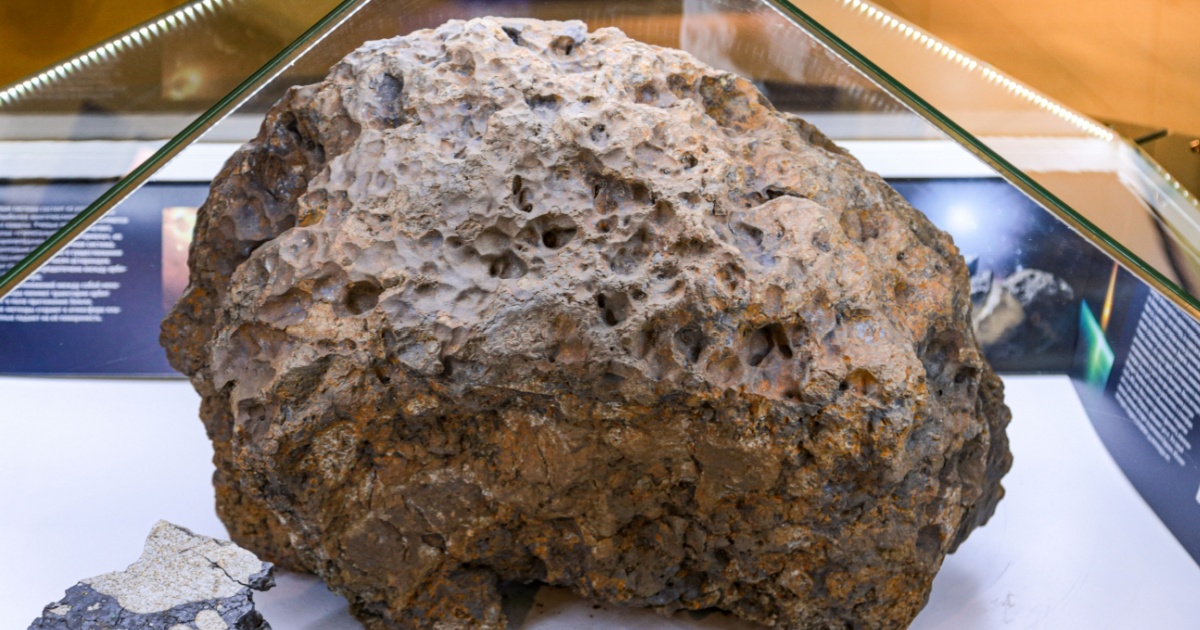
Some of the pieces inside the meteorite were formed in the first 4 million years of solar system history. That makes every fragment a time capsule, older than any rock on Earth. In October 2013, scientists raised a coffee-table-size piece of the object from the lake in which it crashed. That fragment, recovered from Lake Chebarkul, weighed 540 kilograms and became one of the most studied meteorite samples in recent decades.
The rock itself was classified as an ordinary chondrite, the most common type of meteorite found on Earth, representing primitive material from the early solar system. Scientists at Lawrence Livermore National Laboratory became the first to simulate the Chelyabinsk meteor in full three-dimensional detail, modeling exactly how the rock broke apart as it plunged through the atmosphere. Understanding that breakup sequence matters enormously for predicting how much energy a future impactor would transfer to the ground.
Dashcam culture in Russia, widespread at the time due to insurance fraud concerns, meant the event was captured from dozens of angles simultaneously. That gave researchers an unusually rich dataset: multiple synchronized video records of the entry angle, brightness curve, and fragmentation sequence of a real asteroid strike. Nothing like it had been available before.
For readers curious about how other objects in our solar neighborhood have been tracked over the years, this look at the Apophis asteroid offers another striking case study in how planetary defense works when telescopes do get advance warning.
How the World Responded
The Chelyabinsk meteor event arrived at a remarkable moment in history. According to NASA, coincidentally, negotiations sponsored by the United Nations were finalizing formal recommendations for the establishment of planetary defense-related international collaborations, including the International Asteroid Warning Network (IAWN) and the Space Missions Planning Advisory Group (SMPAG), when the Chelyabinsk impact occurred. The timing lit a fire under discussions that had been moving slowly for years.
Since then, NASA established the agency’s Planetary Defense Coordination Office (PDCO) in 2016 to oversee and coordinate the agency’s ongoing mission of planetary defense. Before Chelyabinsk, planetary defense was treated largely as an academic exercise. After it, governments started writing checks.
According to Space.com, officials from the Federal Emergency Management Agency attended a planetary defense conference for the first time, and the Obama administration asked Congress for $40 million in asteroid-seeking funds for NASA, double what the agency had previously.
Then came the most significant practical test in history. NASA’s Double Asteroid Redirection Test (DART) successfully impacted the asteroid Dimorphos on September 26, 2022, becoming the first mission to demonstrate asteroid deflection. It knocked Dimorphos enough that its orbital period around its companion asteroid shortened from 11 hours and 55 minutes to 11 hours and 23 minutes. The aim had been to reduce the period by a minimum of just 73 seconds, meaning the mission far exceeded expectations.
As NASA’s Planetary Defense Officer Lindley Johnson has put it, “A collision of a NEO with Earth is the only natural disaster we now know how humanity could completely prevent.”
The Blind Spot Is Still There
Despite the progress, the fundamental problem that allowed the Chelyabinsk event to go undetected remains largely unsolved. Ground telescopes still cannot look toward the Sun. Any asteroid approaching from the dayside can still arrive without warning.
This was illustrated again in early 2025, when asteroid 2024 YR4 briefly made headlines. According to NASA’s Center for Near-Earth Object Studies, the asteroid was first reported to the Minor Planet Center on December 27, 2024, two days after it had already passed its closest point to Earth. It was not detected sooner because it approached from the dayside, from a region of sky hidden by the Sun’s light.
The fix, at least in concept, is a space telescope operating beyond Earth’s atmosphere, positioned where it can look in toward the Sun without being blinded. NASA’s Near-Earth Object (NEO) Surveyor, the agency’s first infrared space telescope purposely designed to discover potentially hazardous asteroids and comets, is currently undergoing integration and testing, with launch set for no earlier than September 2027. NEO Surveyor will be able to find asteroids that approach Earth from the direction of the Sun, as well as ones both leading and trailing our planet’s orbit, where they are typically obscured by the glare of sunlight.
The European Space Agency is pursuing a complementary mission. ESA’s NEOMIR, hunting asteroids in the infrared, is designed to detect impact hazards similar to the Chelyabinsk event in advance for the first time, and is targeted for launch in the mid-2030s to close the blind spot on the dayside hemisphere of Earth.
As of November 2025, astronomers had discovered the 40,000th near-Earth asteroid, according to the European Space Agency. These space rocks range from a few meters to a few kilometers in size and are on orbits that bring them relatively close to Earth. That tally sounds reassuring until you account for how many are still out there, unseen, in the part of the sky our telescopes can’t reach.
Read More: God of Chaos Asteroid Live Feed
What This Means for You
The Chelyabinsk meteor event was, by any measure, a lucky escape. A slightly larger rock, a slightly steeper entry angle, or an airburst closer to a city center, and the conversation today would be very different. The injuries were real, the structural damage was extensive, and the warning time was exactly zero. What’s worth sitting with is not the fear of that, but the practical reality: this is a solvable problem.
The DART mission showed that humanity can physically move an asteroid if given enough lead time. The NEO Surveyor telescope, on track for a 2027 launch, is designed to find the threats we currently can’t see. What’s still missing is time, specifically the years or decades of advance notice that make deflection possible. That notice can only come from better detection.
The Chelyabinsk event made planetary defense a policy priority rather than just a scientific curiosity. The next step is making it a fully funded one. In the meantime, the blind spot in our sky remains open. The Sun keeps its secrets, and somewhere out there, something is moving through it.
AI Disclaimer: This article was created with the assistance of AI tools and reviewed by a human editor.
Read More: Apophis, The ‘God of Chaos’ Asteroid Could Hit Earth in 2068