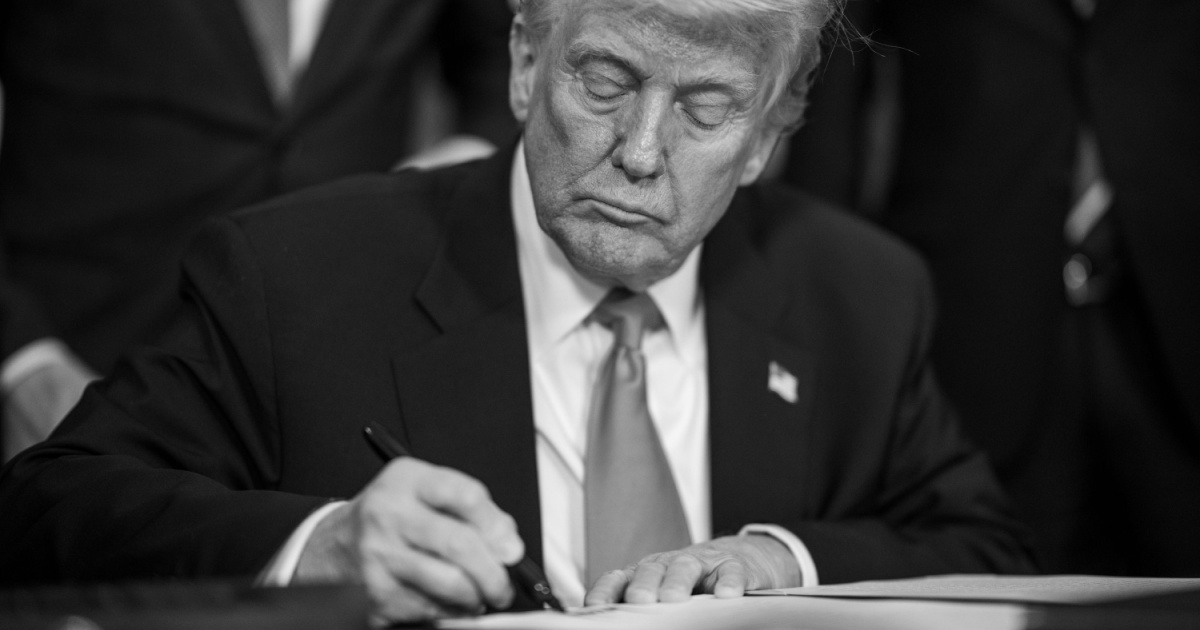

Repetitive sub-threshold cash withdrawals that line up with payroll cycles. Shell companies cycling money through real estate. Individual taxpayer ID numbers opening accounts without any verified legal status. These are among the specific red flags named in the executive order President Trump signed on May 19, 2026, titled “Restoring Integrity to America’s Financial System.” The order doesn’t freeze accounts immediately. What it does is set regulatory deadlines that will reshape how American banks screen customers over the next six to twelve months – and the financial crimes it targets have already cost hundreds of billions of dollars.
Trump took to Truth Social on June 2, announcing the order as one of the administration’s most powerful tools yet against illegal immigration, cartel activity, and financial fraud. He stated that access to the nation’s financial systems “must be limited to those who have a Legal Right to be here,” and that bank accounts used to enable illegal immigration or hold welfare received by undocumented immigrants “will be shut down, and funds will ultimately face Impoundment and Seizure.”
The order is both narrower and broader than its headline suggests. It doesn’t immediately freeze anyone’s account. What it does is set off a chain of regulatory deadlines that will reshape how American banks screen customers over the next six to twelve months, and it uses the machinery of the Bank Secrecy Act, a 1970 law already requiring banks to report suspicious financial activity, as the mechanism.
What the Trump Immigration Executive Order Actually Directs
The order directs Treasury Secretary Scott Bessent to issue guidance identifying suspicious financial patterns tied to payroll-tax evasion, labor trafficking, shell-company activity, off-the-books wage payments, and the use of Individual Taxpayer Identification Numbers to obtain financial services without verified legal presence.
Within 90 days, the Secretary of the Treasury must, in consultation with appropriate federal financial regulators, propose changes to Bank Secrecy Act regulations to strengthen risk-based customer due diligence requirements for covered financial institutions. Those changes should ensure that institutions collect and verify sufficient customer identity information to reasonably identify the nominal and beneficial owners of accounts.
Institutions should also maintain authority, where warranted by risk indicators or supervisory concerns, to obtain additional information, including information relevant to whether account holders possess lawful immigration status and employment authorization, as part of a risk-based due diligence program. A second, 180-day deadline requires Treasury and regulators to consider changes to customer identification program requirements, with specific attention to how foreign consular identification cards are used to open accounts.
Within 60 days, the Consumer Financial Protection Bureau is directed to consider clarifying that potential deportation and loss of wages are factors that could adversely affect a non-work authorized borrower’s ability to repay credit under existing ability-to-repay standards, and that lenders may consider such factors as part of a reasonable and good-faith underwriting determination. The order frames this directive in safety-and-soundness terms, noting that lending to individuals without legal work authorization or who face substantial loss-of-wage risk creates a structural “ability to repay” deficiency that undermines the safety and soundness of the national banking system.
The $312 Billion Problem
The administration’s case for the order rests heavily on documented financial crimes that have moved through U.S. banks for years. Chinese money laundering networks have used U.S.-based accounts to launder hundreds of billions of dollars for criminal organizations, including to finance human trafficking.
According to a FinCEN advisory published by the Treasury Department’s Financial Crimes Enforcement Network, FinCEN analyzed 137,153 Bank Secrecy Act reports filed between January 2020 and December 2024 associated with suspected Chinese money laundering network activity, totaling approximately $312 billion in suspicious transactions. These networks play a significant role in laundering proceeds from drug trafficking and are also involved in facilitating fraud, human trafficking, and human smuggling.
Financial institutions also filed 17,389 Bank Secrecy Act reports in the dataset associated with more than $53.7 billion in suspicious activity involving the real estate sector. That’s not abstract money flowing through shell accounts in foreign banks. That’s money that moved through American financial institutions, often in plain sight, while meeting the technical requirements banks apply to routine customers.
The Bank Secrecy Act already requires financial institutions to report cash transactions exceeding $10,000 and file suspicious activity reports when patterns suggest laundering or fraud. The new executive order is designed to extend that scrutiny specifically to financial activity connected to immigration violations and labor trafficking, adding immigration status as an explicit risk factor alongside existing red flags.
Cartels, Cryptocurrency, and Fentanyl Proceeds
The order arrived the same day as a significant Treasury Department enforcement action that put the financial mechanics of drug trafficking into sharp relief. On May 20, 2026, Treasury sanctioned a Sinaloa Cartel-affiliated money laundering network, alleging that traffickers converted fentanyl proceeds into cryptocurrency before routing the funds to cartel operators.
According to Treasury’s Office of Foreign Assets Control, one sanctioned network coordinated the collection of bulk quantities of cash in the United States – the proceeds of fentanyl and other illicit drug sales – and then facilitated the conversion of this bulk cash into cryptocurrency for ultimate transfer to the Sinaloa Cartel in Mexico. That’s the playbook: collect street-level drug money in cash, convert it digitally to obscure the origin, then route it back to cartel leadership. The U.S. banking system is a critical transit point in that chain.
The stakes are substantial. According to the CDC, 79,384 drug overdose deaths occurred in 2024, with an age-adjusted rate of 23.1 deaths per 100,000, and fentanyl remains the primary cause. U.S. Customs and Border Protection seized more than 27,000 pounds of fentanyl making its way into the U.S. in the prior year, according to CBP’s fentanyl data page. Synthetic opioid overdoses are the leading cause of U.S. deaths in people ages 18 to 45. Data from the U.S. Sentencing Commission shows fentanyl now accounts for 22% of federal drug trafficking cases, up 135% since fiscal year 2021.
Treasury Secretary Scott Bessent stated in a May 2026 press release accompanying the sanctions: “As President Trump has made clear, this Administration will not allow narco-terrorists to flood our borders with poison. Treasury will continue to target terrorist cartels and their fentanyl trafficking networks to protect our communities and Keep America Safe.”
The Ohio Case: $126 Million, 40 Shell Companies
The administration has also pointed to a domestic case that illustrates how labor trafficking and financial fraud intersect inside the United States, far from the border. In April 2025, U.S. Immigration and Customs Enforcement seized assets linked to a suspected $126 million illegal staffing and laundering operation in Ohio. According to ICE, the network used roughly 40 shell companies to employ and house undocumented workers, many of them smuggled in through Mexico, while moving millions through bank accounts, real estate, and luxury goods.
That operation worked because the financial system didn’t flag it in time. Multiple companies, each below the threshold of suspicious scrutiny on its own, collectively moved over $100 million in illicit labor revenue. The executive order describes “red flags and typologies” associated with suspicious activity. Among these are repetitive cash withdrawals, the use of shell companies to conceal true account ownership, and the use of certain platforms for “off-the-books” wage payments – patterns that describe exactly the kind of scheme Ohio’s network used to avoid triggering Bank Secrecy Act thresholds.
The order specifically flags “patterns of repetitive, sub-threshold cash withdrawals or deposits that correlate with payroll cycles conducted outside of regulated payroll processing systems” as suspicious activity requiring enhanced due diligence.
Read More: 7 Ways Trump Is Reshaping Social Security Right Now
The ITIN Question and the Banking Industry Pushback
The most contested provision involves Individual Taxpayer Identification Numbers, or ITINs. An ITIN is a tax ID issued by the IRS to anyone who needs to file U.S. taxes but doesn’t qualify for a Social Security number. ITINs are used primarily to file taxes and comply with U.S. tax law, and millions of immigrants use them to open bank accounts, apply for credit, and pay taxes.
The executive order identifies the use of an ITIN to obtain credit products or open depository accounts where the applicant lacks verified lawful immigration status as a potential red flag. Although an ITIN facilitates tax compliance, its use in lieu of a Social Security number or valid work-authorized visa “may be identified as a risk factor requiring enhanced due diligence.” That language matters because it doesn’t close ITIN-based accounts outright. It requires banks to take a closer look, and what they find during that review could lead to account restrictions or closures.
The Trump administration had earlier considered a stricter proposal that would have required banks to collect new and existing customers’ citizenship information. Finance leaders had largely opposed the proposal, warning that requiring the collection of customer data would be an onerous and extremely costly process. Critics said the proposal risked “debanking” millions of Americans, because many citizens don’t readily possess passports or other citizenship documents that banks might require, disproportionately affecting elderly Americans, low-income households, and rural residents.
The banking industry had been aggressively lobbying for months to stop the White House from issuing an order that would have made collecting customers’ citizenship status mandatory, arguing it would be expensive and require vast amounts of paperwork. The final order, as signed, is more narrowly scoped, using risk-based guidance rather than a universal mandate.
What This Means
Financial institutions should begin assessing their current customer identification, due diligence, and BSA/AML compliance programs in anticipation of the Treasury advisory and forthcoming regulatory changes. Lenders should evaluate the potential impact on their underwriting standards and credit risk management practices, particularly with respect to the CFPB’s anticipated ability-to-repay guidance. For most Americans with standard documentation, day-to-day banking is unlikely to change. The order’s red flags target specific patterns: repetitive sub-threshold cash transactions, off-the-books payroll, ITIN use without verified legal status, and foreign consular ID cards presented as the sole form of identification.
The order does not automatically close any existing bank account or affect existing financial services. What it does is direct regulators to develop new guidance, and that guidance has not yet been issued. Banks are not currently required to ask for anyone’s immigration status or take action against existing customers. The 60-day Treasury advisory deadline lands in mid-July 2026. That’s when the practical rules for financial institutions will become clearer. If you hold an ITIN-based account or use a foreign consular ID as your primary banking document, speaking with your bank now, before guidance is formally issued, gives you time to understand what documentation they may request and what options you have.
Disclaimer: This information is not intended to be a substitute for professional financial advice, investment advice, tax advice, or legal advice, and is provided for informational purposes only. Always seek the guidance of a qualified financial advisor, accountant, or other licensed professional regarding your personal financial situation or investment decisions. Do not make financial, investment, or tax decisions based solely on information presented here. Past performance is not indicative of future results, and all investments carry risk, including the potential loss of principal.
AI Disclaimer: This article was created with the assistance of AI tools and reviewed by a human editor.
Read More: Most Americans Now Support Removing Trump — Here’s What That Actually Takes