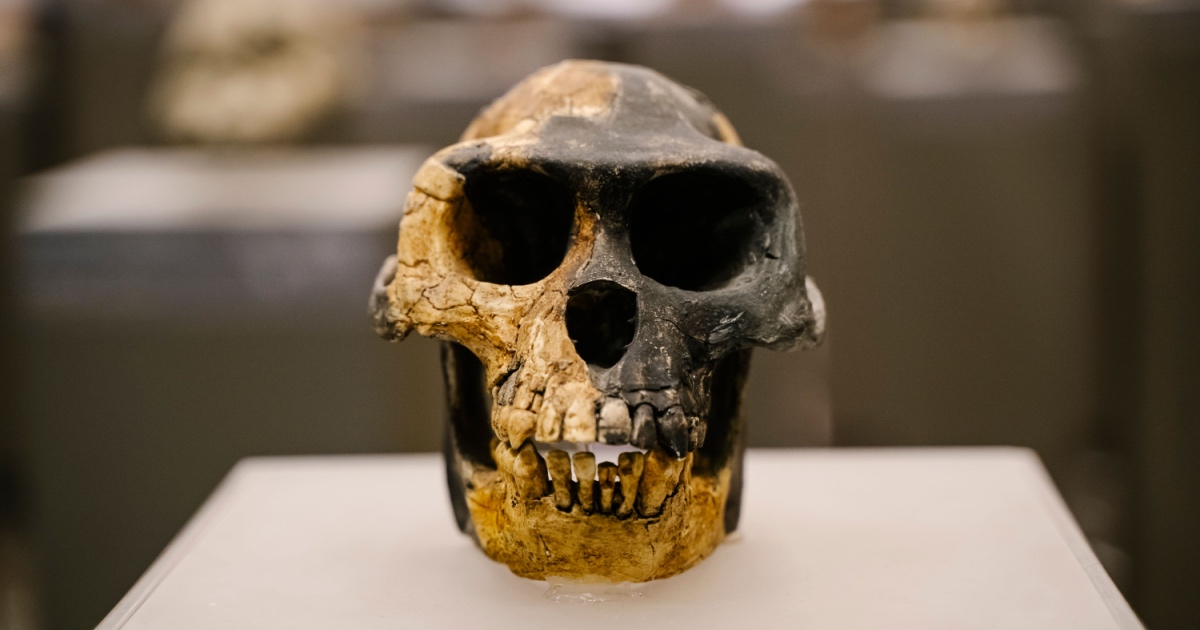

A 4.4-million-year-old skeleton sat in a lab drawer for fifteen years before scientists could agree on what she was. She had the grasping toe of a tree-dweller and the pelvis of something edging toward upright. She walked on two feet, at least some of the time, but her ankle looked more like a chimpanzee’s than a modern human’s. Her name was Ardi, and she may be the clearest window we have into the moment human evolution genetics first began pulling our ancestors away from the apes.
Ardi was unearthed in Ethiopia in 1994 and is the oldest known partial hominin skeleton. She belongs to the species Ardipithecus ramidus, and for decades after her discovery, researchers debated exactly how she moved. A new analysis published in late 2025 is now settling some of that argument – and the answer changes how scientists understand the very origins of our lineage.
The debate matters beyond academic paleontology. How and why our ancestors first stood up is one of the foundational questions in biology. Every time a fossil like Ardi gets reanalyzed with new methods, the picture of where we came from either sharpens or complicates. This time, it did both.
What Made Ardi So Hard to Classify
Approximately 1 million years older than Lucy, the well-known early human ancestor skeleton, Ardi represents an earlier stage of human evolution. Lucy (Australopithecus afarensis) lived around 3.2 million years ago. Ardi predates her by more than a million years – and her anatomy looks correspondingly more primitive.
“One of the surprises in this discovery was that Ardi walked upright, yet retained a lot of ape-like characteristics, including a grasping foot,” said Thomas Prang, assistant professor of biological anthropology at Washington University in St. Louis. That grasping foot, a mosaic of traits straddling the divide between ape-like climbers and upright walkers, posed questions about the exact nature of locomotion that preceded modern human walking.
Morphometric analyses of Ardi’s ankle bones, published in Communications Biology in 2025 by Prang and colleagues, provide evidence that humans evolved from an ancestor with vertical climbing adaptations like those of chimpanzees and gorillas. The study used 3D measurements and statistical comparisons across dozens of primate species to place Ardi’s ankle in context – not just against modern humans, but against the full range of ape and monkey locomotion.
The team focused on the talus, a bone in the ankle that transfers body weight between the lower leg and foot and helps African apes to climb. The talus enables dorsiflexion – the backwards flexing of the foot – and inversion, the sideways turning of the foot. In climbing primates, both movements position the body’s center of mass closer to the support point, which prevents the animal from toppling backward on a vertical surface.
What the Ankle Bone Revealed
Prang’s results demonstrate that Ardi’s ankle bears similarities to the tali of chimpanzees and gorillas, who are adapted to vertical climbing and terrestrial plantigrade quadrupedalism. Plantigrade quadrupedalism means walking on all fours with the full sole of the foot flat on the ground – the same way bears walk, and the way African apes move when they’re not in the trees.
One key measurement – the talar angle, essentially how the ankle joint tilts – was 14.5 degrees in Ardi, the highest of any fossil hominin studied and squarely in the range of non-human primates like gorillas and bonobos. That single number tells researchers a great deal about how the foot was habitually loaded. A high talar angle is the signature of an animal that spends real time in vertical postures, pushing off against tree trunks rather than the flat ground.
The researchers also identified derived features in Ardi’s ankle consistent with an enhanced push-off mechanism in the foot – a trait that would later become fundamental to efficient upright walking in later hominins. The total pattern across the ankle, plus other skeletal clues, points strongly toward vertical climbing paired with early forms of upright walking.
The team used detailed 3D measurements and statistical tests to sort ankle shapes and estimate how different traits evolved. They acknowledge some overlap – different animals can share similar ankle shapes – so no single measurement proves one behavior. The convergence of multiple lines of evidence, though, tells a consistent story.
Rewriting What Came Before Us
The deeper implication of the study isn’t just about Ardi. It’s about what her features suggest regarding the creature that came even before her – the last common ancestor of humans and chimpanzees. According to Nature Scitable, humans shared a common ancestor with chimpanzees and bonobos around 6 million years ago.
Thomas Prang stated that “our observations of the human and ape fossil record are inconsistent with recently proposed models of human origins, which envision the last common ancestor of humans and chimpanzees as a generalized arboreal ape,” in his 2025 study published in Communications Biology.
That challenges a competing hypothesis, which has gained traction in recent years: that the shared ancestor was a more generalized, monkey-like tree-dweller, and that the African ape anatomy we see in chimpanzees and gorillas evolved independently after humans split off. Prang’s data argues against that. The research does not imply that humans evolved from chimpanzees. However, it adds more evidence to the hypothesis that the common ancestor humans share with chimpanzees was probably quite similar to the chimpanzees living today.
Prang acknowledged that “the finding is both controversial and also aligned with what people thought originally. Nobody disputes the importance of the discovery of Ardi, of course, but many people in the field would say the initial interpretation was probably flawed. And so, this paper is a correction of that initial idea that distanced Ardi from chimpanzees and gorillas.”
Ardi’s Other Clues: Teeth, Posture, and Social Life
The ankle wasn’t the only part of Ardi’s anatomy telling a story. Ardipithecus had a small face and a reduced canine-premolar complex, indicative of minimal social aggression, according to findings from the original 2009 Science publication. In living great apes like chimpanzees and gorillas, males use large, prominent canine teeth to compete aggressively for mates. Ardi’s males had canines that were nearly the same size as the females’ – a pattern far more similar to humans than to modern apes. A good sample of canine teeth of this species indicates very little difference in size between males and females – a finding that the Smithsonian’s Human Origins Program describes as reflecting reduced social competition.
Ardipithecus was a facultative biped, meaning she stood upright on the ground but could move on all four limbs in the trees, according to the Australian Museum. She stood roughly 120 cm tall and weighed around 50 kg, based on measurements from the original skeleton. Her brain was no larger than a chimpanzee’s. Yet her pelvis and lower limb geometry show an animal that had already committed, at least partially, to life on the ground.
Ardi’s fossils were found alongside faunal remains indicating she lived in a wooded environment – not the open savanna. This directly contradicts one long-held theory of bipedalism that proposed our ancestors stood up because they had to cross wide, treeless grasslands. Ardi’s woodland habitat suggests something more subtle: that upright walking may have evolved first as a way to move through trees, not across plains.
For readers interested in more recent fossil evidence of how our evolutionary cousins developed, a 2-million-year-old skull found in South Africa adds another layer to the story of early human relatives adapting in radically different ways.
Why It Took So Long to Read the Evidence
A study published in Communications Biology on October 15, 2025, by a team from Washington University in St. Louis led by biological anthropologist Thomas Prang reexamines the locomotor abilities of Ardipithecus ramidus, challenging longstanding interpretations about our evolutionary heritage. The delay between Ardi’s 1994 discovery and this re-analysis wasn’t laziness – it reflected the genuine difficulty of working with fossil material this old and fragmented.
The original 2009 analysis of Ardi by 47 international scientists, published as 11 papers in Science, concluded that she was more humanlike than ape-like in key respects. That interpretation shaped a decade of textbook explanations about early human evolution genetics. Prang’s new 3D morphometric approach, with broader primate comparison groups than were used before, yields a different reading of the same bones. The study also notes there may have been normal variation within Ardipithecus populations that natural selection could later shape into more efficient bipedalism.
Research into how bipedalism evolved has broad implications: according to a 2026 piece in Harvard Magazine, around 8 million years ago some of our ancestors began the long evolutionary journey from walking on all fours to walking upright. Ardi, living 4.4 million years ago, sits near the middle of that transition – not at its start, not at its finish, but in the messy, compromised middle where evolution does most of its work.
Read More: Research Says Humans Share One Common Ancestor, and It’s Not Who You Think
What This Means for You
The picture of human evolution genetics that emerges from Ardi is less linear than we were taught. Our ancestors didn’t simply abandon the trees and stand up. They spent millions of years in between – climbing at night, walking during the day, their bodies carrying features from both worlds at once.
What Prang’s 2025 analysis makes clear is that the skeleton that eventually produced you didn’t spring from some vague, generalized primate. It came from a creature with genuine African ape-like anatomy – a vertical climber with an ankle built for trees – who was simultaneously, haltingly, learning to put both feet on the ground. The bones that held that story sat unread for over thirty years. Reading them correctly turns out to matter enormously for understanding not just where we came from, but what forces shaped us into the only primate that can run a marathon.
AI Disclaimer: This article was created with the assistance of AI tools and reviewed by a human editor.