
The United States’ democracy score on the V-Dem Institute’s Liberal Democracy Index – which runs from 0 to 1 – dropped to 0.57 in 2025, placing it outside the world’s top 50 democracies for the first time. That number puts America at roughly the same democratic level it occupied in 1965, the year most political scientists consider the country to have first achieved genuine universal democracy. How a nation travels sixty years backward in a single presidential term is the story that political scientists have been warning about for decades, drawing on historical leadership lessons they feared were going unheeded.
The trajectory matters because it isn’t random. Countries don’t stumble into authoritarianism the way they stumble into recessions. The patterns are consistent, the warning signs are recognizable, and history has recorded them clearly enough that researchers now have a name for the sequence. The question being asked by scholars across the political spectrum in 2026 is not whether the warning signs are present. It’s whether enough people are paying attention to what those signs have historically meant.
What makes the current moment particularly striking to researchers is the speed. Democratic erosion is usually slow. Institutions weaken over years, norms fray gradually, and the public rarely notices the accumulated damage until it’s significant. The United States appears to be moving on a different timeline entirely.
Historical Leadership Lessons That Democracies Keep Ignoring
More often than not, democracies die slowly, in plain sight, at the hands of elected officials, through the gradual erosion of political norms and institutions. That’s the central argument of Harvard political scientists Steven Levitsky and Daniel Ziblatt in their book How Democracies Die, which analyzed democratic breakdowns across Europe and Latin America to build a framework for identifying authoritarian behavior before it reaches the point of no return.
Levitsky and Ziblatt identify four indicators of authoritarian behavior: rejection of (or weak commitment to) democratic rules of the game; denial of legitimacy to political opponents; toleration or encouragement of violence; and a readiness to curtail civil liberties of opponents, including the media. These aren’t abstract academic categories. They’re a checklist developed from studying what happened in Germany in the 1930s, Venezuela in the 2000s, Turkey in the 2010s, and Hungary across the past decade.
When How Democracies Die was published in 2018, Levitsky and Ziblatt argued that Donald Trump was the only U.S. major-party presidential candidate in history who met all four of their criteria – even before he became president. Now, with Trump in his second term, the data from multiple independent research institutions has caught up with those warnings.
One of the consistent patterns Levitsky and Ziblatt identified is that the very defense of democracy is often used as a pretext for its subversion – elected leaders use economic crises, wars, or security threats to justify antidemocratic measures. Historical examples range from Adolf Hitler in Germany to Alberto Fujimori in Peru and Hugo Chávez in Venezuela. The rhetorical sleight of hand is remarkably durable: frame the erosion of rights as necessary protection, and a large portion of the public will accept it.
What the Numbers Show Right Now
Democratic backsliding is now happening in well-established democracies. Democracy in the USA is deteriorating at unprecedented speed, and media and journalists are increasingly targeted across the world, according to the 2026 Democracy Report from the V-Dem Institute at the University of Gothenburg. Nearly a quarter of the world’s nations are going through democratic backsliding in 2025, and six out of the ten newly identified autocratizing countries are in Europe and North America.
In terms of the speed of autocratization, Trump’s second term “outpaces not only Trump 1.0 but also the most prominent autocrats of the last 25 years,” including Russia’s Vladimir Putin, Turkey’s Recep Erdogan, and Hungary’s Viktor Orbán, according to the same V-Dem report.
From the 1990s through the start of the first Trump administration, the United States typically rated 0.8 or above on V-Dem’s Liberal Democracy Index, placing it among the top 20 countries in the world. Last year that score plummeted to 0.57, knocking the country out of the top 50.
The V-Dem report summarizes Trump’s second term as a rapid concentration of powers in the presidency. Professor Staffan I. Lindberg – a professor of political science and Founding Director of the V-Dem Institute at the University of Gothenburg – led the research team and stated that “the current U.S. administration has been undercutting institutionalized checks and balances, politicizing civil service and oversight bodies, and intimidating the judiciary, alongside attacks on the press, academia, civil liberties, and dissenting voices.”
Freedom of expression, a core aspect of democracy, shows the most drastic global decline, and is the most common target among autocratizing leaders over the past 25 years, according to the same V-Dem data.
Freedom House, which tracks global political rights and civil liberties independently, tells a parallel story. Global freedom declined for the 20th consecutive year in 2025, with 54 countries experiencing deterioration in political rights and civil liberties. Among all 88 countries rated “Free,” the United States experienced the sharpest single-year decline, dropping 3 points to a score of 81 on Freedom House’s 100-point scale.
Today just 21 percent of the world’s people live in countries rated Free, down from 46 percent two decades ago.
The Press Is a Leading Indicator
Historically, one of the earliest and most reliable indicators of democratic backsliding is the targeting of the press. According to Reporters Without Borders, press freedom globally fell to a 25-year low in 2026, with the Index’s legal indicator deteriorating in more than 60% of states – 110 out of 180 countries – between 2025 and 2026.
Reporters Without Borders found that Donald Trump “has turned his repeated attacks on the press and journalists into a systematic policy,” pushing the US down to 64th place, a drop of seven places. That comparison carries particular weight given the historical record. Leaders in countries that completed a slide into competitive authoritarianism – the political science term for systems that still hold elections but have weakened them to the point of unfairness – almost invariably targeted press freedom early in their consolidation of power.
Since 2001, the expansion of increasingly restrictive legal frameworks – particularly those linked to national security policies – has been steadily eroding the right to information, even in democratic countries. The pattern of using national security framing to suppress journalism is one of the most consistent features across historical and contemporary cases of democratic backsliding.
Across two decades of global freedom decline, freedom of expression and the liberal aspects of democracy – including rule of law and checks and balances – have registered the sharpest downgrades of any tracked freedoms, according to the V-Dem Institute’s findings.
The Weimar Lesson and the Gradual Trap
The historical leadership lessons from Weimar Germany remain the most-cited and most misunderstood in public debate about democratic erosion. People tend to think of Hitler’s rise as sudden – a violent seizure of power by an obvious extremist. According to the United States Holocaust Memorial Museum, Hitler and the Nazi leadership were prepared to take advantage of every opportunity and legal loophole to transform Germany’s democratic institutions. The collapse of Weimar democracy was methodical, incremental, and legally dressed at almost every stage.
Authoritarianism is gradual. It rarely announces itself outright. Instead, it creeps through incremental legal changes and exploits the tendency of both institutions and the public to normalize each individual step before the next one arrives. That normalization gap – the time between a precedent being set and the public understanding its implications – is where democracies lose the most ground.
Authoritarian leaders capitalize on fear, play on institutions, and sow division to reduce opposition. The fear is usually tied to an external threat, real or exaggerated. That pattern holds for leaders who dismantled democratic systems across the twentieth century and remains consistent in the current era.
On immigration specifically – one of the most frequently deployed fear arguments in American political discourse – the evidence runs counter to the framing. According to a 2025 Cato Institute analysis of 2024 American Community Survey data, available evidence shows that undocumented immigrants are less crime-prone than native-born Americans. The 2024 native-born American incarceration rate was 1,195 per 100,000 – the highest of the three groups analyzed – while illegal immigrants had an incarceration rate of 674 per 100,000 and legal immigrants just 303 per 100,000. The gap between that evidence and the political narrative built around it is itself a historical leadership lesson – not just about Trump, but about how every demagogue in the record books has used threat inflation to justify the removal of rights.
Read More: A Chilling Warning: Trump Turns to a Centuries-Old Law That Could Shake the Nation
What Turns the Tide
The V-Dem data isn’t uniformly bleak. Authoritarian turns can reverse themselves, and the V-Dem report finds that 10 nations – including Bolivia, Brazil, and Poland – are turning back toward democracy after a period of decline. Some observers are looking to those countries for lessons on how to rebuild democratic systems after authoritarian pressure.
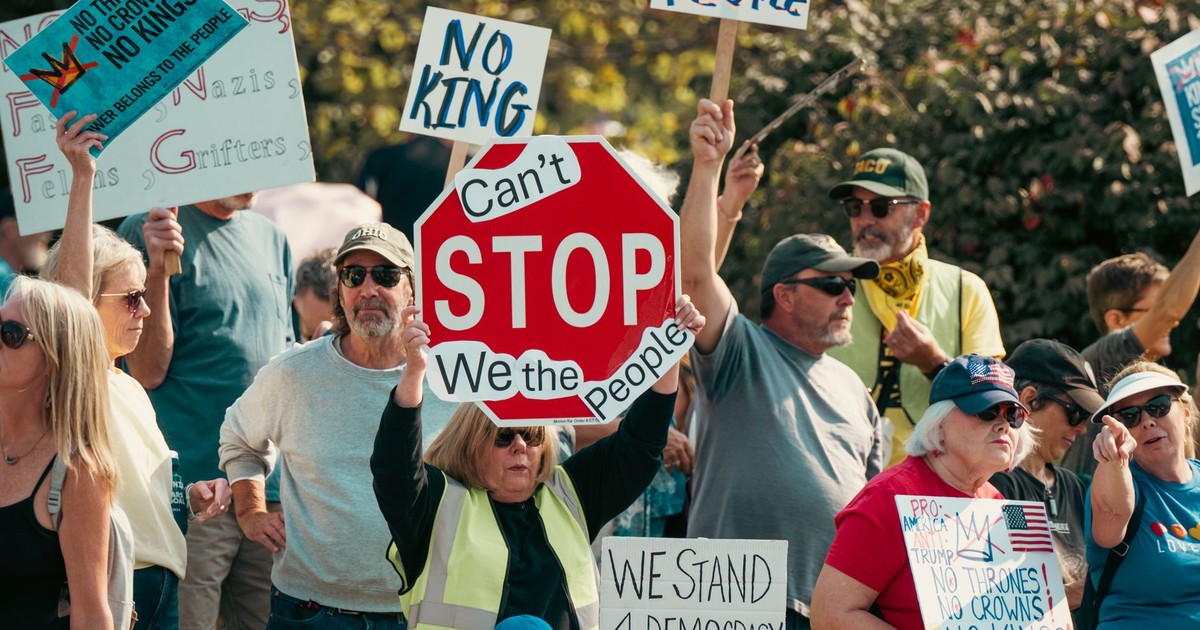
The 10 countries moving back toward democracy in 2025 share one major factor: mass mobilization. Professor Lindberg noted that “lots of people out protesting in the streets is one of the most effective ways to stop autocratization,” but added that “those protests must be sustained, frequent, and long-standing.”
The institutional picture matters too. Unlike previous periods of democratic decline, elections often remain formally intact while democratic institutions, media freedom, and checks and balances are weakened from the inside, making it harder for citizens to clearly identify the moment at which their democracy has significantly changed.
According to the V-Dem press release accompanying the Democracy Report 2026, election-specific indicators are only evaluated during national election years, so there has not been a change in those indicators for the U.S. as of 2025. “The 2026 American midterm elections will be a critical test for the quality of elections and democracy in the United States. If election indicators also decline, the U.S. will fall even further,” said Professor Lindberg.
What This Means for You
The historical leadership lessons embedded in decades of comparative political science are specific, not abstract. Democracies don’t fail because a single bad leader appears. They fail because institutions that are supposed to act as guardrails are either captured, circumvented, or simply not defended by enough people who notice what’s happening early enough to act.
Media freedom, personal expression, and due process are the three freedoms hit hardest in 20 years of global democratic decline. These aren’t peripheral rights. They are the mechanisms through which citizens discover when other rights are being removed. Protecting them – through supporting independent journalism, engaging with credible civic institutions, and applying pressure through sustained civic participation – is the specific action the evidence points toward.
The 2026 midterm elections, as Professor Lindberg noted, represent a concrete test point. Election indicators for the U.S. have not yet been officially evaluated for 2025, but Lindberg stated directly: “The 2026 American midterm elections will be a critical test for the quality of elections, and democracy, in the United States. If election indicators also decline, the U.S. will fall even further.” History has produced a clear record of what happens when those tests go unmet. What’s less certain – and what the record of Bolivia, Brazil, and Poland suggests is genuinely open – is whether the pattern has to complete itself.
AI Disclaimer: This article was created with the assistance of AI tools and reviewed by a human editor.