
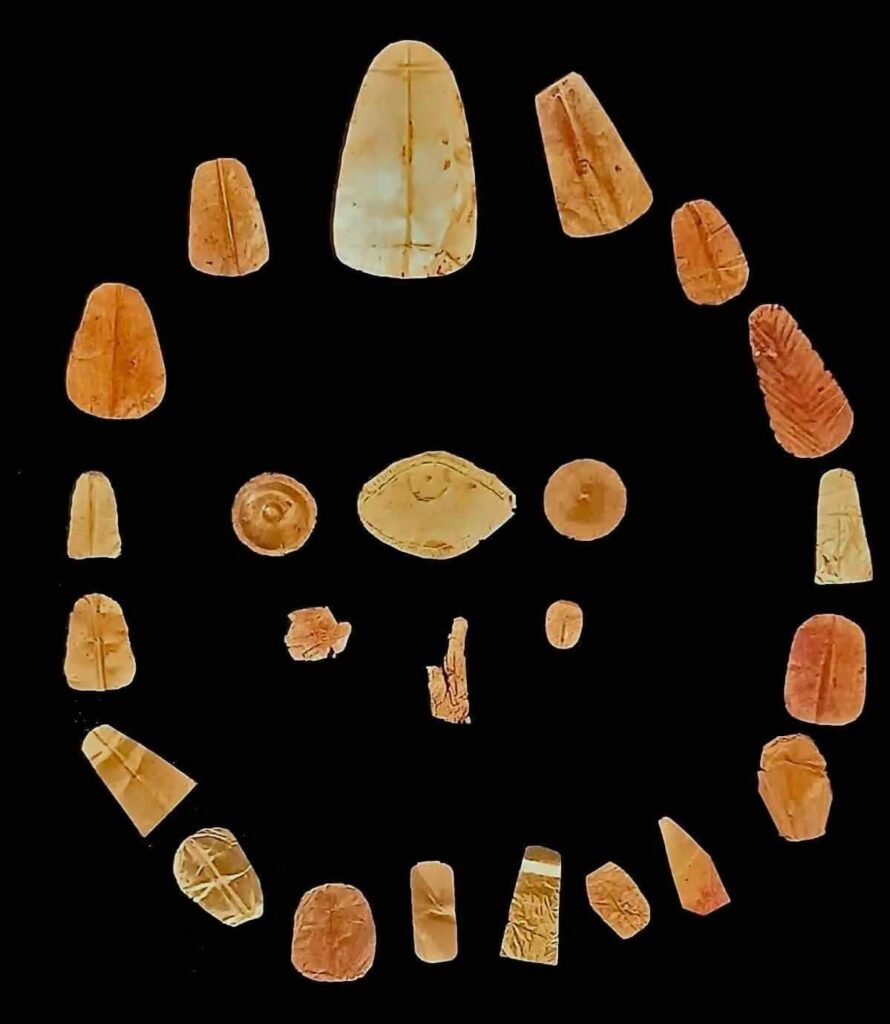
Twenty-four thin pieces of gold, each no larger than a thumbnail, were pressed into the mouths of the dead before their burial chambers were sealed with stone. That was the final act. No inscriptions explained why. No priest left a record. The objects themselves, lying undisturbed for over two millennia beneath the Egyptian desert, carried the message.
Those gold pieces are now back in the light. An Egyptian archaeological mission excavating at Marina El Alamein, a coastal site on the country’s northwestern Mediterranean shore, announced the discovery in July 2026 of 18 ancient tombs packed with burial goods – including those 24 gold tongue-shaped amulets. Eman Abdel Khalek, the mission’s head and site director, described the find as one of the most remarkable discoveries of recent years, explaining that these objects are known as “golden tongues,” a ritual believed to enable the deceased to speak in the afterlife.
The theology behind them was specific. Ancient Egyptians believed the symbolic gold tongues would allow the dead to speak before the gods, particularly Osiris, the god of the afterlife, during the final judgment. In a worldview where the dead faced a divine tribunal, being struck mute was not a minor inconvenience. Voicelessness, for the ancient Egyptians, was the worst possible fate after death. A gold tongue was insurance.
What These Discoveries Could Reveal About the Ancient World
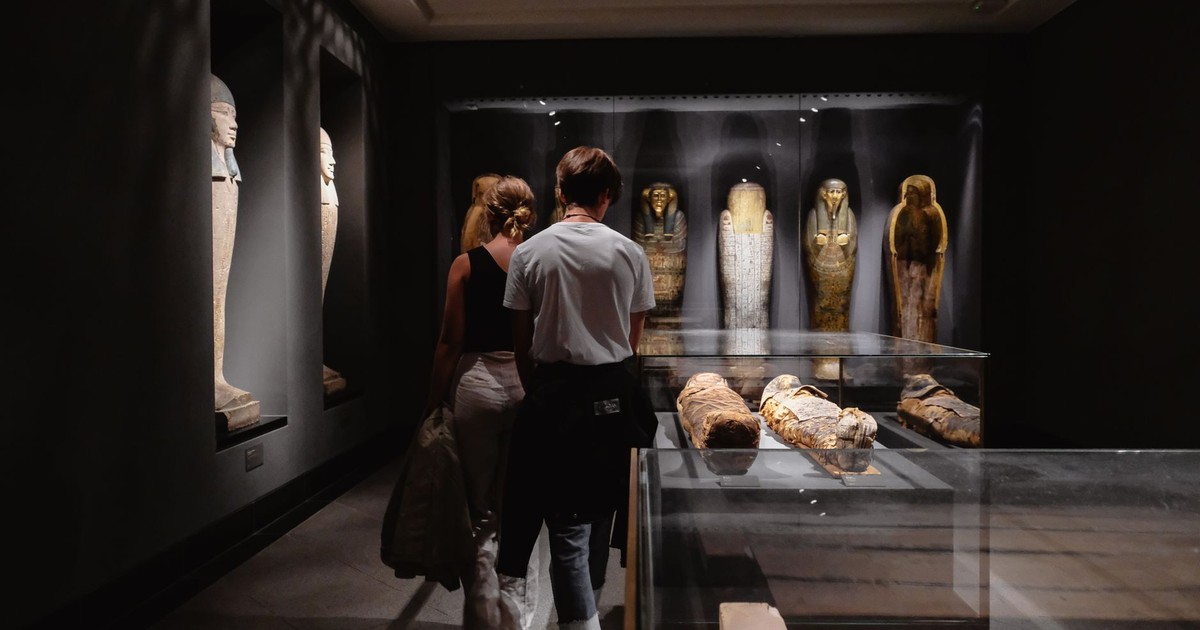
Researchers recovered 24 thin gold foils placed in the mouths of the deceased – a practice known as the “golden tongue” ritual, tied to beliefs about the ability of the dead to speak in the afterlife. This ancient custom was a widespread magical-religious practice in the Hellenistic and Roman eras, intended to enable the dead to speak with the deities of the underworld. The Ptolemaic period ran from around 322 to 30 BCE, when Greek rulers governed Egypt after Alexander the Great’s conquest. Roman rule followed, lasting until roughly 395 CE. Golden tongue amulets appear throughout both eras, showing how deeply the practice had embedded itself across centuries of changing political power.
A golden tongue would not have been uncommon in elite burials during Egypt’s Ptolemaic and Roman periods. What makes the Marina El Alamein find unusual is the number found in a single excavation campaign. Twenty-four pieces across 18 tombs suggests the practice was widespread within this particular community, not reserved for one exceptionally wealthy individual.
One of the 24 gold pieces stood apart from the rest – a rare gold Eye of Horus amulet, recognized as a significant protective symbol in ancient Egyptian belief. Its presence on a funerary gold piece signals that at least one burial combined the speech ritual with an additional layer of divine protection. Near the sarcophagus, archaeologists also found pieces of a plaster sphinx statue, providing further evidence of the enduring influence of Egyptian religious and artistic traditions within the city during the Hellenistic and Roman periods.
The City Beneath the Sand
Marina El Alamein lies about 100 kilometers west of Alexandria and is widely linked with the ancient city of Leukaspis, named by the Greek writer Strabo. According to Britannica, Strabo lived approximately 64 BCE to after 21 CE and was a Greek geographer and historian whose Geography is the only surviving work that covers the peoples and countries known to both Greeks and Romans during Augustus’ reign. His mention of Leukaspis places the city firmly within the ancient written record. The city grew from the Hellenistic period through Byzantine rule, and trade helped the port thrive between the first and third centuries CE, bringing people and ideas from Egypt and across the Mediterranean.
Located on Egypt’s Mediterranean coast and discovered in 1986 during construction work, Marina El Alamein encompasses the Greco-Roman port city of Leukaspis, which was built in the second century and was destroyed in 365 CE by a tsunami. Previous excavations have revealed a thriving coastal settlement, with streets, residential and commercial districts, public buildings, and a harbor. That violent end helps explain why so much of the site survived intact – the city was buried rapidly rather than stripped gradually over generations.
The mission also revealed additional extensions of the ancient city and its architectural remains, bringing the total number of tombs discovered at the site since its initial discovery in 1986 to 44. That cumulative number matters. A single spectacular tomb tells you what one family could afford and believe. Forty-four tombs, spanning multiple excavation seasons, begin to sketch a community – its size, its economic range, its religious commitments, its relationship to the wider Mediterranean world.
Inside the Tombs
The 18 newly excavated tombs consist of 11 rock-cut tombs reaching depths of up to 26 feet and seven surface tombs built from limestone. Several burial chambers were found still sealed with stone slabs, which had preserved their contents for over 2,000 years. The rock-cut type, known in archaeology as hypogea (singular: hypogeum), were carved directly into the bedrock rather than constructed above ground. Going eight meters down was not incidental – deeper burial meant greater protection from tomb robbers, weather, and time.
The single most dramatic object from the excavation is a sarcophagus that was still sealed when archaeologists reached it. Eman Abdel Khalek explained that a 2.5-meter-long granite sarcophagus was uncovered with its original lid still intact, containing skeletal remains currently undergoing specialized study. A sealed granite coffin of that size is not common. Granite is among the hardest stones used in ancient Egyptian construction, and its use here suggests the person buried inside had significant standing within the community.
The tombs also held an offering altar with a base designed to look like a false door – a key element in Egyptian funerary beliefs. False doors were a standard feature of ancient Egyptian funerary architecture, functioning as a symbolic threshold through which the spirit of the dead could pass between the world of the living and the world of the dead. Whether this altar’s resemblance to a false door was intentional or incidental is still being debated. Krzysztof Jakubiak, an archaeology professor at the University of Warsaw who has excavated at Marina El Alamein in the past, told Live Science he would “exercise caution in asserting a direct comparison between the iconographic motifs visible on the discovered altar and those of the false door iconography.”
Beyond the gold and the stone, the tomb assemblages included everyday objects that help paint a fuller picture of who was buried there. The excavations yielded a remarkable collection of artifacts, including complete and nearly complete pottery vessels, amphorae, oil lamps, plates, limestone altars and basins, and architectural elements associated with the tombs. These weren’t luxury goods – they were the tools of religious practice, objects that would have been used in ceremonies for the dead before the chambers were sealed.
Where Two Worlds Met
The Marina El Alamein finds are a particularly clear example of what happens when two distinct cultures share a geography for long enough. The most recent discovery offers fresh insights into how Egyptian beliefs and funerary customs persisted under Greek and Roman rule. Greek rulers controlled Egypt for nearly three centuries under the Ptolemaic dynasty, yet Egyptian religious practice didn’t simply dissolve under foreign governance. It adapted, absorbed, and persisted. Golden tongues are one expression of that persistence – a pre-Greek Egyptian practice that continued straight through into the Roman period.
Archaeologists said the discoveries illustrate how Egyptian beliefs and funerary customs persisted under Greek and Roman rule. Marina El Alamein, as a port city with direct Mediterranean connections, would have been an especially intense meeting point for those traditions. Merchants, sailors, and settlers from across the Greek and Roman worlds moved through it. The people buried in its tombs were not isolated villagers – they were connected to the wider ancient world, and their burial practices reflect that.
Sherif Fathy, Egypt’s Minister of Tourism and Antiquities, stated that the discovery represents an important scientific and archaeological contribution toward understanding the cultural identity of the inhabitants of ancient Marina El Alamein and reassessing its historical role as a cultural and commercial hub linking Egypt with the wider Mediterranean world.
What the Sealed Chambers Can Still Tell Us
Archaeologists rarely find a necropolis in this condition. Most ancient burial sites have been looted – sometimes in antiquity, sometimes in the centuries since. When burial goods are still in their original positions, undisturbed by human hands for 2,000 years, researchers can read them as a system rather than as scattered fragments. The arrangement of objects around a body, the precise placement of a gold tongue, the relationship between one tomb and its neighbors – all of that context disappears the moment a grave robber enters.
The city flourished from the Hellenistic through the Byzantine periods, reaching its peak in urban and economic development during the first three centuries CE. Its eventual destruction by tsunami in 365 CE, rather than gradual abandonment, may be precisely why so much survived. A city that empties slowly is one that gets picked clean over centuries. A city that gets buried fast is one that sometimes leaves an intact record.
The skeletal remains inside the sealed granite sarcophagus are still being analyzed. What those bones eventually reveal – the age, sex, health, and possibly the geographic origins of the person buried inside – will add another layer to a picture that is still coming into focus. Scientific techniques including isotope analysis (a method of reading chemical signatures in bone that can indicate where a person grew up) may eventually tell researchers whether the people buried at Marina El Alamein were local-born or whether some came from elsewhere in the ancient Mediterranean world.
Read More: 1,600-Year-Old Egyptian Mummy With Homer’s Iliad Inside
What This Means for Us Now
The Marina El Alamein tombs aren’t significant because ancient Egyptians put gold in their mouths – though that’s a striking enough image. They’re significant because they give researchers an intact, multi-tomb data set from a specific ancient community at a specific moment in history, when two of the ancient world’s most powerful cultural systems were actively negotiating their coexistence. The discovery has been formally announced by Egypt’s Ministry of Tourism and Antiquities, and the work at the site is ongoing. According to ARTnews, which cited Egypt’s Minister of Tourism and Antiquities directly, plans for the site include a visitor center, electric shuttles, pedestrian walkways, a museum storage facility, and administration buildings, with the project expected to be completed during the first half of 2027.
The 24 gold tongue amulets, the sealed sarcophagus, the Eye of Horus piece, and the limestone altars are now being studied and conserved. Whatever the analysis of the skeletal remains inside that granite coffin reveals, it will add to a growing body of evidence about who actually lived and died in ancient Egypt’s Mediterranean port cities – not just the pharaohs and high priests who dominate the textbooks, but the merchants, traders, and ordinary families who built their lives, and prepared their deaths, along a busy ancient coastline.
AI Disclaimer: This article was created with the assistance of AI tools and reviewed by a human editor.
Read More: Archaeologists Uncover 125,000-Year-Old Neanderthal ‘Fat Factory’ in Germany