
A TikTok video posted in 2024 racked up more than 12 million views – not because of a recipe, a life hack, or a food trend, but because it showed someone washing dishes without ever rinsing them. The video is no longer available; however, Americans flooded the comments. Brits defended themselves. And somewhere in the middle of all that noise sat a legitimate public health question that nobody on TikTok was actually qualified to answer.
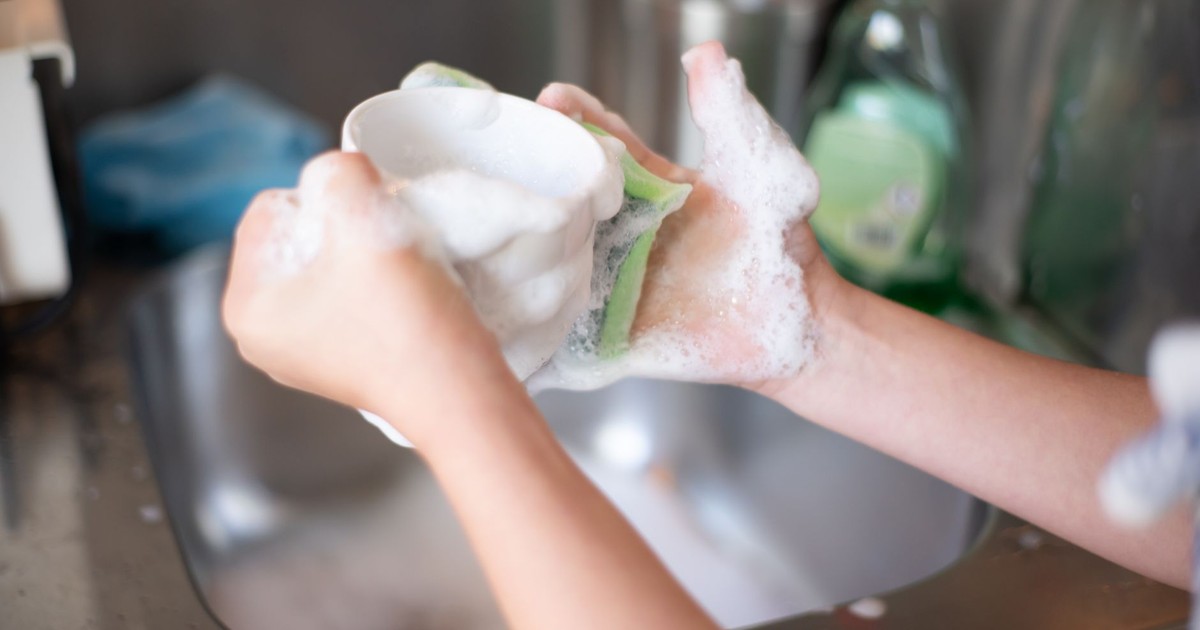
The trend, controversially nicknamed “British dishwashing,” involves filling a washing basin with soapy water, letting dirty dishes soak together, scrubbing them, and then skipping the rinse entirely, placing them straight onto the drying rack with suds still clinging to the surface. Some British commenters were baffled by the fuss. One wrote that they had never rinsed dishes and their food had never tasted soapy, insisting the remaining suds just drip off as water does. Others pointed out that access to continuous hot running water was historically limited in many British homes, making a soapy soak-and-dry the most practical option available. In plenty of older households, hot water wasn’t readily available from the faucet. Heating water meant boiling a kettle, so rinsing dishes after scrubbing wasn’t a given. You’d make a sink of hot, soapy water, clean everything in one go, and leave it to dry.
Not every Brit was on board, either. Many users on the app said they lived in the U.K. and always rinsed their soap off their plates. “No, we rinse,” one countered, while another wrote, “Don’t tar us all with the same brush… the majority of us rinse.” The British dishwashing method turns out to be far from universal in the country it’s named after, which makes the health question it raises no less worth answering.
What Dish Soap Actually Does – and What Stays Behind
Dish soap works through the use of surfactants, chemical compounds that bind to both water and grease. Without rinsing them off, those surfactants linger and end up in your food. According to Poison Control, swallowing dish soap can cause nausea, vomiting, or diarrhea, though small amounts are generally not acutely dangerous.
Toby Schulz, CEO and co-founder of Australian cleaning company Maid2Match, notes that consistent ingestion of detergent residue can pose health risks over time, including gastrointestinal irritation. The more pressing concern, though, lies in the chemistry of what you’re regularly leaving on your plates. An Environmental Working Group analysis of 326 dish soaps found that approximately 65% received a D or F rating for safety, including many conventional brands. Soap residue also doesn’t distribute evenly across all surfaces. Research found that residues remained on dishes after rinsing, with higher amounts on rougher surfaces like wood compared to smooth materials like glass. Skip the rinse entirely, and rough surfaces – wooden cutting boards, stoneware, unglazed ceramics – hold significantly more.
Three meals a day, every day, means that whatever chemistry is in your bottle of dish soap has regular access to the surfaces your food contacts. The cumulative exposure, rather than any single incident, is what makes the rinse step matter.
The Bacteria Problem Nobody Is Talking About
Soap residue concern gets most of the attention online, but skipping the rinse creates a second problem that receives far less discussion. Skipping the rinse means food particles remain on dishes after washing. Dr. Vanessa Coffman, Ph.D., Director of the Alliance to Stop Foodborne Illness, explains: “Soap residues, along with organic matter, can provide a moist environment that supports microbial growth. If you skip the rinsing step, not only are you not removing bacteria, but you’re creating a place where they may start multiplying, which can lead to illness.”
The British practice of washing all dirty dishes in the same “washing up bowl” carries additional risk, since germs can spread from dish to dish through the reused water. A glass that held raw egg goes into the basin. A cutting board that contacted raw chicken follows. The water looks soapy, but it’s also now a shared bath for whatever pathogens rode in on everything you washed.
Hot water is often cited as a defense here. In practice, most home kitchens don’t get close to the temperatures required. Water needs to reach at least 140°F before it begins to kill bacteria effectively, and most household water heaters output water between 120°F and 140°F, which is inadequate for killing pathogens reliably. The CDC notes that pathogens like Salmonella and E. coli O157:H7 die at 160°F – a temperature that standard tap water from a home faucet never reaches during hand-washing. The sensation of hot water feels effective. The thermometer tells a different story.
Why the Dishwasher Settles This Argument
A certified residential dishwasher must reach a final rinse temperature of 150°F; commercial units are required to reach 165 – 180°F. At those temperatures, the math changes. According to NSF International, NSF/ANSI Standard 184 requires dishwashers to achieve a minimum 99.999% – or 5-log – reduction of bacteria. That’s not “fairly clean.” That’s a five-decimal-place reduction in bacterial load, which is the threshold used in food service sanitation.
The rinse aid question adds a layer of complexity. A 2023 study published in the Journal of Allergy and Clinical Immunology found that alcohol ethoxylates – compounds used in commercial rinse aids – produced a strong toxic and barrier-damaging effect on gut epithelial cells, the cells that line and protect the intestinal wall. The same research found that detergent residue from professional dishwashers left a significant amount of cytotoxic, barrier-damaging rinse aid on dishes without a final water rinse. For households using a dishwasher, the type of rinse aid used – and whether your machine runs a hot water final rinse – matters more than most people realize.
For anyone interested in what’s actually in their dish soap, this guide to dish soap ingredients breaks down the chemicals most worth watching for on the label.
What the Science Says About Hand-Washing Dishes Properly
If a dishwasher isn’t available, the process for hand-washing matters. According to the CDC, soap and water, worked into a lather, trap and remove germs and chemicals from surfaces – and it’s the mechanical action of scrubbing, not hot water alone, that does the actual work of dislodging bacteria. Rinsing is the step that carries those dislodged particles off the surface and down the drain. Skip the rinse, and the scrubbing itself becomes less effective – you’ve loosened the bacteria but left them sitting on the plate.
Dr. Coffman recommends going one step further and sanitizing dishes after washing. She recommends using a sanitizing solution or submerging dishes in very hot water – approximately 171°F – for 30 seconds to achieve proper sanitation before they reach the drying rack. That 171°F figure matters: it’s the temperature at which most disease-causing pathogens, including common kitchen bacteria, are killed reliably within a short contact time.
Proper hand hygiene alone can prevent roughly 1 in 5 foodborne illness cases, according to CDC estimates on handwashing. The same principle applies to how carefully you handle the surfaces your food contacts.
Read More: Why Letting Dishes Pile Up Could Be a Sign of Something Deeper, According to Psychology
What to Do Now
The British dishwashing method – soapy scrub, no rinse, straight to the rack – isn’t going to send anyone to the emergency room after a single meal. The combination of lingering surfactant chemistry, concentrated residue on rough surfaces, and a warm moist environment that promotes bacterial growth makes it a habit worth changing.
If you’re washing dishes by hand, rinse them with running water after scrubbing to physically remove dislodged particles and soap. For genuine sanitation – especially after handling raw poultry, eggs, or meat – submerge dishes in water at approximately 171°F for 30 seconds, or use a diluted sanitizing solution. If you use a dishwasher, check that your unit is NSF-certified and that you’re using a rinse aid formulated without alcohol ethoxylates where possible, since those compounds have been linked to intestinal cell damage at residue levels left on dishes.
The viral debate framed this as a cultural quirk. The evidence frames it differently: rinse your dishes, use hot enough water, and pay attention to what’s in the soap you’re using three times a day. Those three steps cover the actual health risks – not the internet argument.
Disclaimer: The author is not a licensed medical professional. The information provided is for general informational and educational purposes only and is based on research from publicly available, reputable sources. It is not intended to constitute, and should not be relied upon as, medical advice, diagnosis, or treatment. Always consult a licensed physician or other qualified healthcare provider regarding any medical condition, symptoms, or medications. Do not disregard, avoid, or delay seeking professional medical advice or treatment because of information contained herein.
AI Disclaimer: This article was created with the assistance of AI tools and reviewed by a human editor.