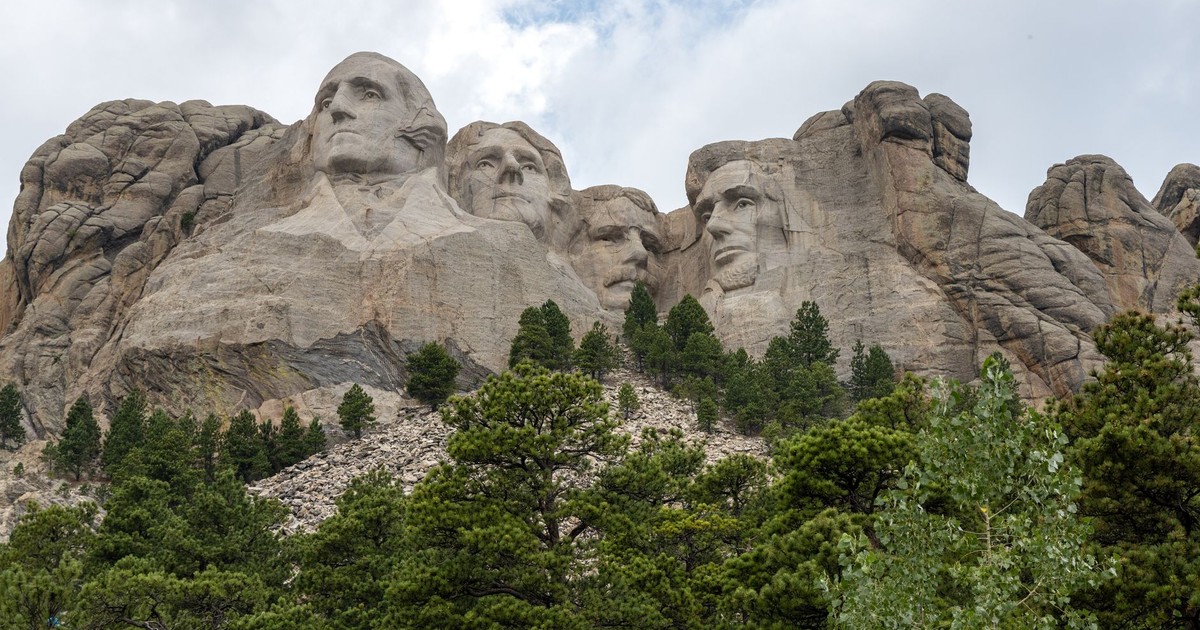

Behind Abraham Lincoln’s granite head at Mount Rushmore, buried inside the mountain itself, sits a room that most of the monument’s visitors will never see, never hear about, and cannot access even if they try. The room exists, it contains a sealed vault, and the reason it was built reveals something about one man’s obsession with how civilizations are remembered – and how they forget each other.
The man responsible was sculptor Gutzon Borglum, who conceived the Hall of Records even before he began work on the Mount Rushmore monument in 1927. Borglum operated on a colossal scale. He’d previously worked on the Confederate memorial at Stone Mountain in Georgia, and it was there that he developed the mountain-carving techniques he would later bring to Rushmore. Rushmore was meant to be a message to people who might live thousands of years from now, in a civilization that had forgotten ours ever existed.
Borglum put it bluntly. “You might as well drop a letter into the world’s postal service without an address or signature, as to send that carved mountain into history without identification,” he wrote, according to National Parks Traveler. “Each succeeding civilization forgets its predecessor. Civilizations are ghouls.” That fear of being erased by time drove everything about his plan for the Mount Rushmore secret room.
The Sculptor’s Vision for the Hall of Records
Borglum envisioned a grand 800-foot-long staircase ascending Mount Rushmore that would lead to a glorious chamber he called the “Hall of Records.” According to the National Park Service, the scale of what he planned was extraordinary: a grand hall accessible via that granite staircase that would include busts of famous Americans, as well as bronze and glass cabinets containing priceless historical documents like the U.S. Constitution and Declaration of Independence.
The entrance alone would have been a spectacle. A massive bronze eagle with a 38-foot wingspan would be mounted above the entrance, with an inscription reading “America’s Onward March” and “The Hall of Records” above the door, as History.com notes. Inside, there would be busts of more than 20 prominent Americans, ranging from Benjamin Franklin and John Hancock to Alexander Graham Bell and the Wright Brothers.
Borglum’s original idea for marking the monument had been simpler. His initial vision included an inscription carved next to the presidents that would describe nine important events in U.S. history occurring between 1776 and 1906. That plan ran into a practical wall: the text couldn’t be made large enough to read at such a distance, and after Jefferson’s head was relocated, the available stone was needed for Lincoln’s carving. The chamber idea replaced it – bigger, more permanent, and hidden from the elements inside the mountain itself.
Borglum believed that future generations might find Mount Rushmore as much a mystery as Stonehenge is to modern man, and wanted to ensure the story behind the carving would never be forgotten. The four presidents chosen – Washington, Jefferson, Lincoln, and Theodore Roosevelt – each represented a chapter of American development. George Washington led the nation as its first president; Abraham Lincoln guided it through the Civil War; Thomas Jefferson, as the primary author of the Declaration of Independence, represented the growth of the United States; and Theodore Roosevelt, who negotiated the construction of the Panama Canal, was chosen to represent its development.
How the Mount Rushmore Secret Room Was Built – and Stopped
In July 1938, workers began to cut into the rock on the north wall of a small canyon concealed by the presidential faces to build Borglum’s American shrine. The location was deliberate: tucked behind the carved heads, invisible from the main viewing plaza, protected from the elements by the natural geography of the mountain.
A year into the construction, however, the federal government – which covered nearly all the cost of constructing the monument – tightened its funding and ordered Borglum to stop work on the Hall of Records and focus his full efforts on completing the presidential profiles. Congress wasn’t willing to give Borglum a blank check for an underground archive when the faces themselves remained unfinished.
The team had blasted a 70-foot tunnel into the rock behind Lincoln’s head and begun to carve away some of the walls before construction stopped. You can still see dynamite channels drilled into the rock inside the unfinished passage – the same method used to carve the presidential faces above.
Seven months after the 73-year-old sculptor died in March 1941, Borglum’s son Lincoln led the effort to finish the carving of the four presidents. The monument was declared complete that same year. Borglum’s ultimate plan – and the Hall of Records – remained unfinished. The 14-year project to sculpt the mountain had consumed roughly $990,000, and the war that followed quickly drew all available funding and attention elsewhere.
What’s Actually Inside Mount Rushmore Today
Borglum’s hopes for the Hall of Records were at least partially fulfilled on August 9, 1998, when four generations of his family gathered in the incomplete chamber as 16 porcelain enamel panels were added to the site. The panels were not installed as wall carvings or displayed in glass cabinets, as Borglum had imagined. Instead, they were sealed away from sight entirely.
According to the National Parks Traveler’s detailed account of the vault, the 16 porcelain enamel panels were placed inside a teakwood box and titanium vault and lowered into the ground. The site was then covered by a 1,200-pound black granite capstone inscribed with a quote from Borglum delivered at the 1930 dedication of the carving of Washington. That quote, carved into the capstone, reads: “Let us place there, carved high, as close to heaven as we can, the words of our leaders, their faces, to show posterity what manner of men they were. Then breathe a prayer that these records will endure until the wind and rain alone shall wear them away.”
The panels were inscribed with the words of documents such as the Declaration of Independence, biographies of the sculptor and his presidential subjects, and histories of the memorial’s construction and the United States. The records aren’t meant for anyone alive today.
Why the Room Is Sealed Off
The chamber sits behind the head of Abraham Lincoln. Getting to it requires ascending the mountain itself, which is precisely why no member of the public is permitted to try.
Safety concerns and sheer geography make access nearly impossible: the approach involves cliff faces with no direct path. A few individuals have had the opportunity to view the chamber over the years, but strict security measures have been in place following a breach by Greenpeace activists. On July 8, 2009, 11 Greenpeace climbers scaled the monument and hung a banner next to Abraham Lincoln’s face reading “America honors leaders not politicians: Stop Global Warming.” According to a National Park Service investigation cited by National Parks Traveler, the activists exploited “glaring security lapses, breakdowns and shortcomings” at the memorial. All 11 were arrested on federal charges of trespassing and illegal climbing. Since then, access to the upper reaches of the mountain has been heavily restricted.
From the ground-level viewing areas, visitors can hike the Presidential Trail, which passes beneath the carved faces. The entrance to the Hall of Records pathway branches off from there – but it’s gated and monitored. The chamber is intended instead to serve as a repository of records to ensure the history of the monument isn’t lost to people thousands of years in the future. Its audience, as Borglum imagined it, hasn’t been born yet.
What This Means for You
The Hall of Records is one of the stranger footnotes in American history – not because its contents are mysterious, but because its purpose is so deliberately non-present. Borglum didn’t build it for tourists or politicians. He built it for whoever finds the mountain after the civilization that made it is gone.
What’s preserved inside the titanium vault – the Declaration of Independence, biographical accounts of the four presidents and the sculptor, and histories of the United States – are documents that anyone today can read online in seconds. Their value in 1998, when they were sealed into the mountain, wasn’t informational. It was archival. The point was permanence, not access.
The next time you see a photograph of Mount Rushmore, the sheer face behind Lincoln’s head contains something the image never shows: a rough-hewn tunnel ending at a sealed granite slab, with a teakwood box resting underneath it in a titanium shell, waiting for readers who don’t yet exist. Borglum planned for the granite to erode at roughly one inch every hundred thousand years. On that timeline, the records inside have barely started their journey.
AI Disclaimer: This article was created with the assistance of AI tools and reviewed by a human editor.
Read More: Shocking Net Worth of 12 U.S. Presidents, Before and After Being in Office