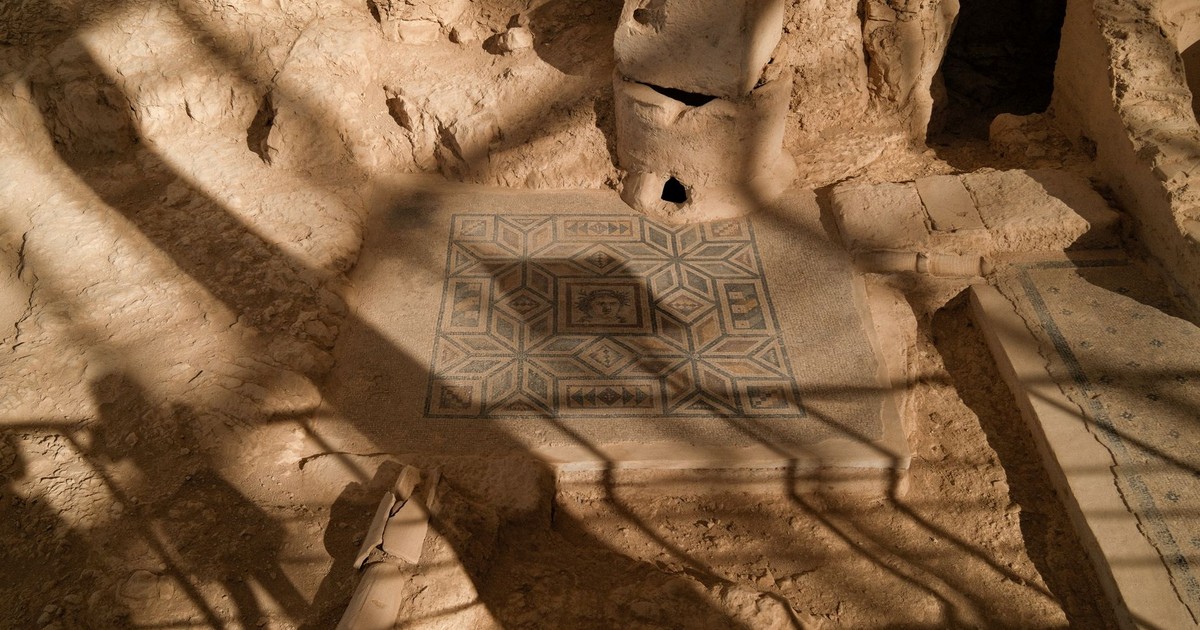

A metal detectorist walking Devon farmland in 2004 had no way of knowing he’d just set a 22-year chain of events in motion. John Hill’s discovery of scattered Roman artifacts in a field between the villages of Halberton and Sampford Peverell in Mid Devon prompted surveys, studies, and ultimately one of the most significant Roman mosaic discoveries made anywhere in Britain this century. A high-status Roman villa complex lay beneath that stretch of agricultural land, one that rewrites what historians thought they knew about the far southwestern edge of the empire.
After a two-month excavation concluding in summer 2026, archaeologists pulled back the soil to reveal not just a villa floor plan, but a 12-square-meter polychrome mosaic assembled from thousands of tiny stone cubes, an elaborately constructed bathhouse, and a collection of personal artifacts that point unmistakably to an occupant of considerable wealth and social standing. The western fringes of Roman Britain, long regarded as a sparse and relatively unromanized frontier, have just become considerably more complicated.
The project responsible for this work goes by the name SHARE, an acronym for Saving Halberton’s Ancient Roman Environment. It is a partnership led by the University of Exeter and Cotswold Archaeology, working alongside Devon County Council, the Tiverton Archaeology Group, and the Sampford Peverell Society.
A Record-Breaking Roman Mosaic Discovery in Devon
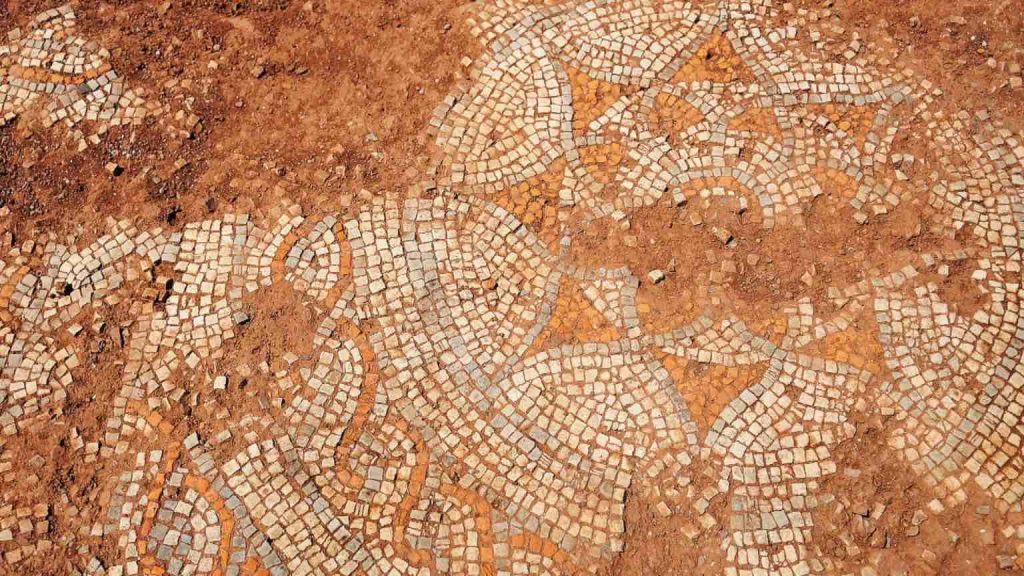
Bill Horner, County Archaeologist at Devon County Council, confirmed that “the polychrome mosaic is the most westerly example to have been found in a villa in Roman Britain.” That single designation places the Halberton find in a category of its own. Polychrome mosaics, meaning multi-colored floor tiles assembled from individually cut stone cubes, were expensive to commission, labor-intensive to lay, and reserved for households operating at the very top of Roman provincial society.
Consisting of tiny 12-millimeter square stone cubes, the mosaic forms a rare design featuring a stylized flower pattern at its heart with eight overlapping teardrop-shaped petals, built from thousands of red, white, and dark blue-grey cubes thought to have been installed as a decorative floor feature sometime in the fourth century A.D. The arrangement also incorporates interlaced squares forming a twisted braid pattern known as guilloche, a design vocabulary that ties the Halberton villa firmly to the broader aesthetic traditions of Roman Britain at its most prosperous.
By the fourth century, Roman villa culture in Britain had reached its peak of elaboration, with wealthy landowners investing heavily in mosaic floors, painted wall plaster, and underfloor heating as displays of status and cultural alignment with Rome. The Halberton example fits that chronological pattern precisely, yet its geographic location makes it an outlier that challenges settled assumptions about southwestern Britain.
Roman villas are exceptionally rare in Devon – project lead Dr. Susan Greaney of the University of Exeter’s Department of Archaeology and History noted that “very few have been found in the county – this is just the fifth.” That figure gives a precise measure of how exceptional the site is within its regional context.
The Bathhouse: Engineering and Ambition Beneath the Fields
The mosaic was not the only major structure unearthed. Away from the main villa building, excavators found a separate bathhouse complex that reveals just how serious the villa’s owners were about projecting Roman identity.
Beyond the main dwelling, the team uncovered a substantial bathhouse featuring a minimum of two plunge pools constructed from opus signinum – a waterproof Roman concrete – along with walls adorned with painted plaster. Opus signinum was made by combining lime mortar with crushed pottery, brick, or tile, producing a dense, hydraulically resistant material that was the standard Roman engineering solution for any structure designed to hold water. Its use here confirms the bathhouse was built to a professional standard, not improvised.
The villa itself was more extensive than early surveys had anticipated. Evidence shows it was extended multiple times from its original modest rectangular form, with rooms appended at both the northern and southern ends. Traces of a timber staircase hint that portions of the building may have risen to two storeys. A rainwater gulley and additional walls at the rear point to practical spaces likely used for storage or kitchens, suggesting the villa functioned as a working estate as well as a residence of display.
Combined with evidence for a possible hypocaust – the Roman underfloor heating system – the finds suggest the Halberton villa was a high-status residence occupied between the mid-second and fourth centuries CE. That span of two centuries of occupation implies continuous investment and maintenance, not a brief or temporary presence, which further reinforces the picture of an established, prosperous household embedded in Devon’s Roman-era landscape.
Dr. Greaney was direct about how much the site exceeded initial expectations: “We did not expect to find such an elaborate bathhouse, for example. This villa was undoubtedly home to people of wealth and high standing.”
Artifacts: Personal Objects of a Wealthy Household
Beyond the architecture, the portable finds from the site are individually striking and collectively revealing. Each object adds a detail to the portrait of whoever called this villa home in the late Roman period.
Among the most striking individual finds was an intaglio – a blue glass ornament carved with an image of the goddess Victory, originally mounted in a ring and employed to press seals into wax documents. Victory, shown winged and often holding a wreath or palm branch, was associated with military success and divine favor. Her appearance on a personal seal ring suggests the villa’s owner moved in official or at least aspirationally elevated social circles.
A delicate copper alloy bangle was found sitting on top of the mosaic. The placement is arresting: a personal ornament left directly on a decorated floor that would have been a prized feature of the room. Whether it was lost, left deliberately, or deposited as some form of closing gesture when the villa was abandoned cannot be determined from the find alone, but the detail is specific enough to stay with you.
A fine silver-plated spoon was also unearthed in one of the villa rooms. Silver-plated tableware in Roman Britain was not everyday equipment. It belonged to the category of objects used to signal refinement at table, and its presence alongside the mosaic floor, the bathhouse, and the seal ring reinforces a consistent picture.
As Horner stated, the polychrome mosaic “is the most westerly example to have been found in a villa in Roman Britain,” and the other trappings of Roman civilization and evidence of affluence found at Halberton “show how much even this far-flung part of the province had been integrated into the Roman Empire.”
Devon sits at the western periphery of Roman Britain, far from the major administrative centers of London (Londinium), York (Eboracum), or Bath (Aquae Sulis). The assumption has generally been that Roman culture thinned out as it moved west and southwest, with fewer villas, less elaborate material culture, and shallower integration into imperial life. The Halberton villa complicates that picture considerably.
How the Site Was Found and Who Dug It
The dig began because local metal detectorist John Hill flagged Roman remains in the area back in 2004. Since then, fieldwalking, metal detecting, and geophysical surveys revealed several phases of buried archaeology, building up a detailed picture of what lay beneath before a single spade broke ground.
Funded by a grant from The National Lottery Heritage Fund, the SHARE project has attracted scores of community volunteers as well as archaeology students from the University of Exeter, operating as a partnership with Devon County Council, Tiverton Archaeology Group, and the Sampford Peverell Society.
Scores of community volunteers took part in the excavation alongside 65 archaeology students from the University of Exeter. The SHARE project was explicitly designed to bring local people into direct contact with the excavation process, giving community members a stake in the recovery and interpretation of their own region’s buried past.
This year’s dig is the first of three annual visits to the site, with future excavations set to concentrate on neighboring land to find the wider estate. The 2026 season has produced a record-setting mosaic and a structurally significant bathhouse complex, but the surrounding estate – likely including agricultural buildings, outbuildings, and potentially more mosaic-floored rooms – remains largely unexamined.
Agricultural activity is the primary threat to preservation: Dr. Greaney noted that it’s “important to record the details of the complex and recover the mosaics before they are inevitably damaged or lost as a result of the farming of the land.” Repeated plowing and soil disturbance have already damaged portions of the site, and without systematic excavation and lifting, the mosaics would eventually be lost entirely.
Read More: A 1,600-Year-Old Mummy Was Found With Homer’s Iliad Hidden Inside
Conservation and Public Access
The mosaic will not stay buried, and it will not remain in the hands of specialists alone. Specialists are now carefully lifting the mosaic so that it can be put on display at Tiverton Museum of Mid-Devon Life, along with the other Roman artifacts found during the dig.
The team conducted an eight-week dig between May and July 2026, during which they recorded and lifted the mosaic floors, which, along with the rest of the site finds and archives, will be preserved in Tiverton Museum of Mid-Devon Life. Conservation of a 12-square-meter polychrome mosaic is a painstaking operation: each tessera (the individual stone cube) must be stabilized before the floor can be sectioned, backed, and transported without damage. The end result will be a publicly accessible display that brings one of the most westerly Roman mosaic discoveries in British history within reach of anyone visiting mid-Devon.
The other artifacts recovered, including the Victory intaglio, the copper alloy bangle, and the silver-plated spoon, will accompany the mosaic in the museum collection, providing a coherent material record of the villa’s occupation that visitors can engage with in person.
What This Means for the History of Roman Britain
The Halberton Roman mosaic discovery redraws the map of Roman villa culture in Britain in a way that affects how historians understand the entire southwestern region. The polychrome mosaic is now the westernmost of its kind discovered in any Roman villa in Britain – a record that pushes the known boundary of high-status Roman domestic architecture further into Devon than any previous find. Devon has long been treated as peripheral in accounts of Roman Britain, but a household wealthy enough to commission a 12-square-meter polychrome floor, fund an opus signinum bathhouse, and keep a Victory seal ring simply cannot be characterized as fringe.
The artifact assemblage confirms elite status with unusual specificity. A seal ring depicting Victory, a silver-plated spoon, a copper alloy bangle left on a polychrome mosaic floor: these are not the possessions of a middling provincial family. They belong to someone embedded in the economic and cultural networks of Roman Britain at their most developed. If you’re planning a visit to mid-Devon, future excavations over the next two years will switch attention to the wider estate on neighboring land, and all three digs will involve student archaeologists as well as opportunities for community volunteers, open days, and an education program. If the first season produces a 1,700-year-old mosaic that sets a new western boundary for Roman villa culture in Britain, the next two seasons beneath Devon’s farmland remain an entirely open question.
AI Disclaimer: This article was created with the assistance of AI tools and reviewed by a human editor.