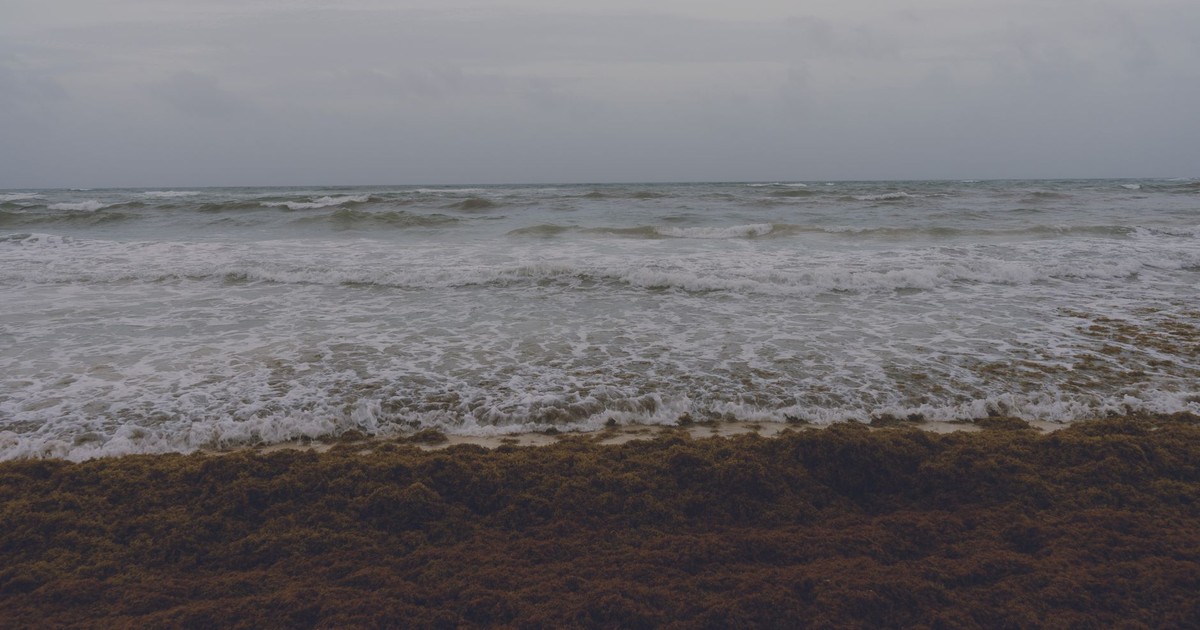

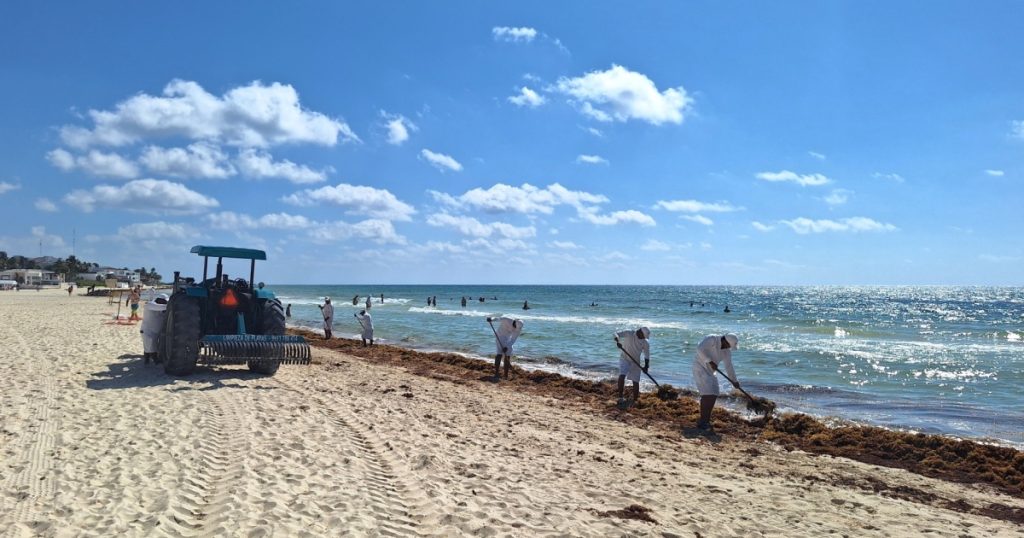
Every summer, a band of brown seaweed drifts westward across the Atlantic and piles up on beaches from Barbados to Boca Raton. Beachgoers hold their noses and move their towels. Hotel staff spend their mornings shoveling. The scale of what’s now accumulating, and what it’s releasing into the air above those beaches, goes well beyond a seasonal nuisance.
Satellite data from the University of South Florida’s Optical Oceanography Lab shows the 2026 bloom is on track to make this one of the worst sargassum years on record, with the brown algae already smothering Caribbean beaches and drifting into the Gulf. Tracked monthly totals hit 9.5 million tonnes in January 2026, rose to 13.6 million tonnes in February, and climbed to 19.1 million tonnes by the end of March – figures that had already exceeded prior records for each of those months before peak season had even arrived. USF researchers described 2026 as “set to be another major Sargassum year – and likely to be a record year by summer.”
The formation responsible is known as the Atlantic brown ribbon – formally, the Great Atlantic Sargassum Belt. Stretching nearly 5,000 miles across the open ocean, it’s not a single solid mass but a series of dense, drifting mats that follow prevailing ocean currents from the tropical Atlantic through the Caribbean Sea and into the Gulf of Mexico. The 2026 season is building earlier and faster than any before it, with measurable consequences for public health, wildlife, and coastal economies.
How the Atlantic Brown Ribbon Became a Permanent Fixture
Marine biologists first identified the Great Atlantic Sargassum Belt in 2011, recognizing a formation spanning the West African coast to the Gulf of Mexico. Except for 2013, it has returned and grown larger every year since, setting a biomass record of 37.5 million tons in 2025.
Warmer ocean temperatures combined with nutrients from agricultural waste runoff have supercharged the algae’s growth. Rivers like the Amazon and Congo carry fertilizer-heavy agricultural discharge into the tropical Atlantic, providing the nitrogen and phosphorus that sargassum needs to double and redouble. As sea surface temperatures have risen, the growing season has lengthened, and the bloom’s starting weight each January has crept consistently higher.
A self-reinforcing mechanism now sustains the bloom through internal means as well. A study published in Nature Communications found that while winds and mixing drove sargassum growth in its early years, internal nutrient recycling now controls the belt’s variability and supports forecasting. Nutrient recycling and remineralization within the mixed layer – carried out by the community of organisms living in aging sargassum mats – now make a significant and increasing contribution to the belt’s sustained growth. The belt is no longer solely dependent on land-based nutrient inputs to maintain itself.
According to USF’s March 2026 outlook, every major region tracked except the eastern Atlantic hit record-high sargassum amounts for the month, with three separate large masses continuing to drift westward across the eastern Atlantic, western Atlantic, and western Caribbean. If the trajectory holds, 2026 will surpass 2025’s already-record total before autumn.
The Gas Nobody Is Talking About
The smell is usually the first complaint – a rotten-egg stench that can clear a beach within hours of a major stranding. That odor comes from hydrogen sulfide (H₂S), a toxic gas released when sargassum decomposes in low-oxygen conditions on the shoreline. Along affected coastlines, thousands of tons can accumulate annually, releasing toxic gases during anaerobic decomposition, with hydrogen sulfide of particular concern due to its adverse effects on the respiratory, neurological, gastrointestinal, and ocular systems.
For casual beachgoers, a few hours of exposure might mean headaches and eye irritation. For the people whose jobs put them in direct contact with decomposing mats every day, the risks are measurably more serious. A study published in Harmful Algae that equipped 35 sargassum cleanup workers in the Mexican Caribbean with portable personal sensors found H₂S concentrations ranging from less than 1 to 50.8 parts per million; overall, 46.3% of readings exceeded Mexico’s occupational standard of 1 ppm for an 8-hour shift, and short-term spikes surpassed 50 ppm.
Workers reported dermatological, respiratory, neurological, ocular, and gastrointestinal symptoms consistent with known H₂S toxicology, suggesting acute health impacts even at concentrations below 5 ppm.
Longer-term population data makes the picture considerably more concerning. Clinical data collected at the University Hospital of Martinique from 850 patients between January 2018 and September 2024 – all of whom had been exposed to sargassum emissions for an average of two to three months annually – found that the most commonly reported symptoms included neurological disorders in 80% of patients, respiratory disorders in 80%, digestive disorders in 70%, and central sleep apnea in 60%.
Epidemiological research further indicates that inhalation of hydrogen sulfide and ammonia may induce chronic lung inflammation, reduced respiratory capacity, and immune dysregulation, including oxidative stress and alterations in the respiratory microbiota. A 2026 study published in Harmful Algae found that even minimal cumulative six-month exposure to sargassum-derived hydrogen sulfide and ammonia significantly increased the risk of airway obstruction – by approximately two-fold to nearly four-fold depending on exposure levels. These effects come from living near a beach during sargassum season.
Limiting time near freshly beached and actively decomposing mats – especially on windless days when gases concentrate – is the most practical protective step for anyone who lives or travels near sargassum-prone coastlines.
Sea Turtles Caught in the Middle
Sargassum plays a genuine ecological role in the open ocean. Out at sea, the floating mats provide shelter, food, and nursery habitat for juvenile fish, crabs, and sea turtles. As Emily Turla, a laboratory coordinator at Florida Atlantic University’s Marine Science Laboratory, put it: “Sargassum is an important habitat for young sea turtles when it’s out offshore in the currents because that’s where they swim out to right as they get off the beach.”
The peak season for sargassum seaweed directly overlaps with turtle nesting season. When the same mats that sustain juvenile turtles offshore wash onto nesting beaches in enormous quantities, they become barriers for the hatchlings trying to reach the water.
A team from Florida Atlantic University’s Charles E. Schmidt College of Science set out to explore whether sargassum buildup makes it more physically demanding for hatchlings to crawl to the ocean, focusing on three species common to Florida – leatherbacks, loggerheads, and green turtles – from beaches at Juno Beach, Jupiter, and Boca Raton.
Leatherbacks took 54 times longer to crawl through light sargassum and 158 times longer through heavy sargassum; loggerheads were slowed by 91% in light sargassum and 175% in heavy sargassum; green turtles were 75% slower in light sargassum and 159% slower in heavy sargassum. Despite the physical challenge, their energy stores stayed stable – suggesting the real danger lies in the delay itself. One hatchling flipped more than 20 times in a single trial, with each inversion extending the time spent on the beach and increasing the risk of predation and heat exposure.
Sargassum sitting over nests also changes the temperature at which eggs incubate. A 2021 study in the Journal of Experimental Marine Biology and Ecology found that sargassum cover caused a 0.21°C increase in incubation temperature in autumn and a 0.17°C decrease in summer – thermal shifts that can significantly affect embryonic development in all three species. Sex ratios, hatch rates, and developmental timing in sea turtles are all temperature-sensitive, making even small consistent shifts ecologically meaningful.
The Economic Toll Is Already in the Billions
A study led by researchers at the Woods Hole Oceanographic Institution (WHOI) and the University of Rhode Island, published in January 2026, provides the most comprehensive assessment to date of the economic damage caused by recurring sargassum events across U.S. coastal regions, quantifying multi-million, and in some areas potentially billion-dollar, annual losses affecting Puerto Rico, the U.S. Virgin Islands, and Florida’s Atlantic coast.
In the volumes now crossing the Atlantic, sargassum piles onto beaches, rots in the sun, and releases hydrogen sulfide gas – driving tourists off Caribbean sand and generating economic losses across multiple states. In Mexico, the costs are even more granular. According to NOAA’s National Centers for Coastal Ocean Science, sargassum cleanup efforts in Quintana Roo alone are estimated to cost as much as $1.1 million per kilometer of beach per year.
Research examining Caribbean tourist arrivals found that an average sargassum event reduces tourist arrival growth by 1.1 percentage points for up to eight months after an outbreak, with the most severe events linked to reductions of nine percentage points – figures that represent real lost income for island economies with few other industries to absorb the shortfall.
What This Means for You
The 2026 atlantic brown ribbon season is building at an unusually early pace, and satellite monitoring by the University of South Florida in collaboration with NOAA confirms that sargassum levels were already at record highs for January, February, and March – a pattern that historically signals a heavy season ahead. Three separate large sargassum masses continue expanding across the Atlantic basin, with peak season still months away.
For anyone planning travel to the Caribbean, Florida’s Atlantic coast, or the Gulf of Mexico this summer or fall, checking real-time sargassum inundation forecasts from the EPA’s Sargassum Inundation Events tracker before booking or heading to the beach is a practical first step. Beachgoers with respiratory conditions including asthma or chronic obstructive pulmonary disease should treat large sargassum strandings the same way they’d treat heavy air pollution days – the gas concentrations near actively decomposing mats can be enough to trigger symptoms.
For the broader policy picture, the evidence points clearly toward agricultural runoff as a co-driver of the Belt’s growth alongside warming ocean temperatures. Reducing nutrient discharge from river systems draining into the tropical Atlantic – particularly in South America and West Africa – is the upstream intervention that researchers at WHOI and USF say would most directly slow the bloom’s annual expansion. Beach-level cleanup is necessary and expensive, but it doesn’t address what is feeding the problem from thousands of miles away.
Disclaimer: This information is not intended to be a substitute for professional medical advice, diagnosis, or treatment and is for information only. Always seek the advice of your physician or another qualified health provider with any questions about your medical condition and/or current medication. Do not disregard professional medical advice or delay seeking advice or treatment because of something you have read here.
AI Disclaimer: This article was created with the assistance of AI tools and reviewed by a human editor.
Read More: This Ocean Superfood Is Trending in Skincare—But Does It Work?