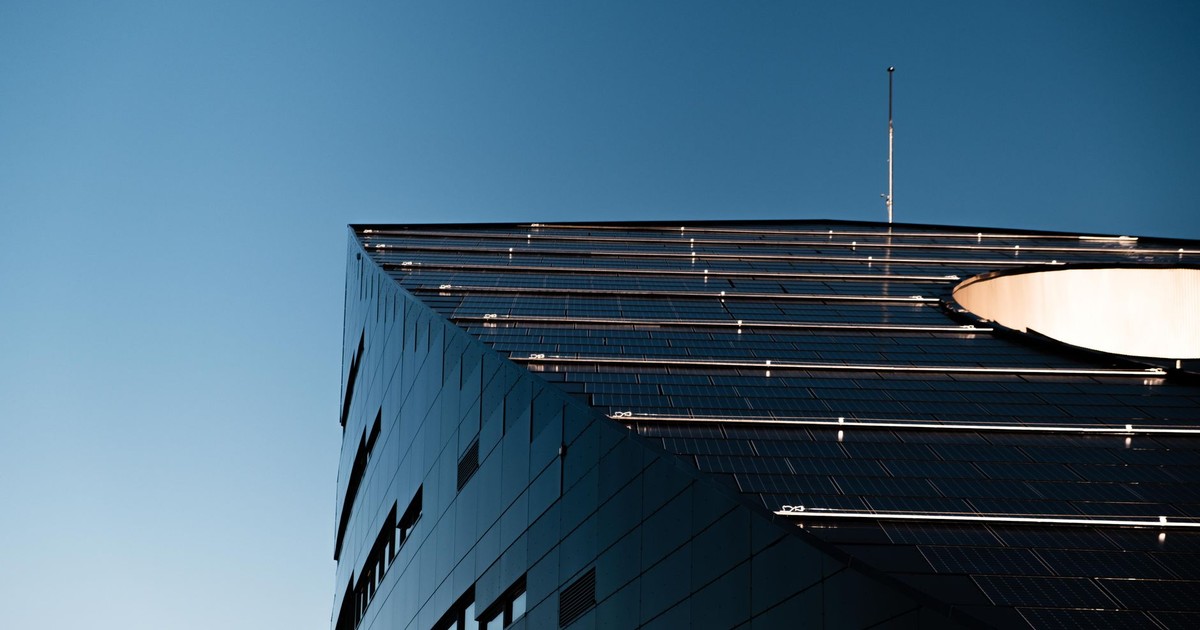

A window that generates electricity from the light inside a room is, on its face, a strange idea. Light coming in from outside makes sense as an energy source. But power from office fluorescents or an overcast afternoon sky – the kind of dim, diffuse light that most solar cells practically ignore?
That’s exactly what a team led by researchers at the UCL Institute for Materials Discovery has now demonstrated. Their semi-transparent solar windows don’t just work in bright sunshine. They generate electricity under indoor lighting, on cloudy days, and at night when the only illumination comes from the lights already on inside the building. The implications for how we think about buildings as energy systems are significant.
The study, published in Advanced Energy Materials in 2026, describes a solar window built around a material called perovskite – a synthetic crystal whose chemical composition can be fine-tuned to absorb specific wavelengths of light. That tunability is the key to everything this solar windows technology achieves.
Why Perovskite Changes the Equation
Traditional silicon solar cells are optimized for direct, intense sunlight. Their structure doesn’t respond well to the softer, narrower-spectrum wavelengths that come from LED office lighting or an overcast sky. Perovskite, by contrast, is a material that can be tuned to absorb the wavelengths of indoor light more effectively than conventional silicon. The UCL team exploited this property to build a cell that works across a wider range of lighting environments – including conditions where a conventional rooftop panel would barely register a charge.
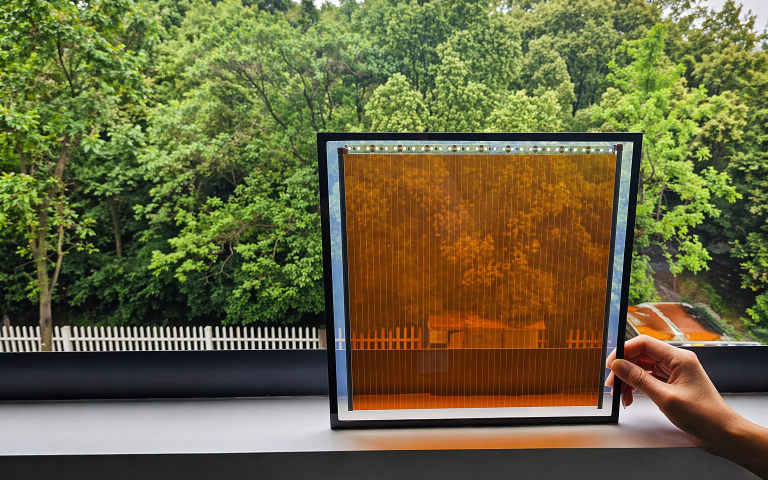
The light-absorbing perovskite layer in the device was only 185 nanometres thick – around 500 times thinner than a human hair. Getting useful power out of a layer that thin requires precision. The researchers used computer modelling to optimize how each component of the cell was arranged, balancing transparency against energy capture. To improve transparency, the team redesigned the cell’s electrode – instead of using a standard gold electrode that blocks light, they placed a thin gold layer between two transparent molybdenum oxide layers.
The result is a cell that looks like tinted glass rather than an opaque panel. The solar windows let in 30% of sunlight, compared to the 80-90% that ordinary glass allows through, while generating a record amount of energy from indoor light and efficiently harvesting energy from sunshine. That 30% transmission figure matters architecturally – it means the window is still functional as a window, admitting meaningful natural light while doing double duty as a power source.
What the Numbers Actually Show
The team reported an energy conversion efficiency of 22% under bright indoor lighting at 1,000 lux, and 14% under sunlight. The 1,000-lux indoor figure is roughly equivalent to a well-lit office or a bright retail space. For context, a typical residential living room sits between 150 and 300 lux. The 22% indoor efficiency figure is described by the researchers as a record for semi-transparent perovskite cells in that lighting category.
The 14% outdoor efficiency is lower than the best conventional silicon panels on the market today, but the cell isn’t trying to compete with a rooftop panel on a clear day. Its value lies in what it does across the full range of conditions a building window actually experiences – dawn, overcast mornings, indirect light, and nighttime indoor illumination. A rooftop silicon panel contributes nothing during those hours. These windows would.
Balancing transparency and efficiency remains a key challenge for semi-transparent perovskite solar cells, and the UCL team’s approach combined optical modelling, transparent electrode engineering, and molecular passivation to overcome this trade-off. One specific step involved adding a molecule called 3-trifluoromethyl-1H-1,2,4-triazole to the perovskite layer, which reduced structural defects that typically cause electrons to get trapped before their energy can be harvested.
Durability testing showed the device held up reasonably well under sustained use. A 30 cm x 30 cm prototype retained 80% of its original efficiency after 300 hours of continuous light exposure – a meaningful benchmark for a technology that would theoretically be embedded in permanent building fixtures. Perovskite cells have historically struggled with stability, so that result is worth noting, even if 300 hours is a modest threshold compared to the decade-plus lifespan expected of commercial building materials.
The Case for Window-Mounted Solar
The framing from Dr. Mojtaba Abdi-Jalebi, an Associate Professor in Energy Materials at UCL’s Institute for Materials Discovery and senior researcher on the study, puts the motivation plainly: “Rooftop areas are commonly fitted with solar panels, but the vast window areas of many modern buildings remain largely untapped as an energy resource.” For a glass-clad office tower or a large commercial building, that represents a substantial missed opportunity. Exterior walls of modern high-rises can be largely glass from floor to ceiling. Rooftop area, on the other hand, is finite and often contested between HVAC equipment, structural access, and solar installations.
The technology could help turn buildings into power generators at night and on cloudy days, as well as in sunshine. Beyond electricity generation, there’s a secondary benefit. Siming Huang, the lead author and a Ph.D. candidate at UCL, notes that their semi-transparent solar window provides the same function as a tinted window by helping to keep interior spaces cool, and that “this is especially important in hotter areas of the world that use a high proportion of energy on air conditioning.”
That matters because buildings are an enormous energy load. According to the National Renewable Energy Laboratory, buildings account for about 40% of all primary energy consumption in the United States, with climate control among the largest contributors. A window that simultaneously generates power and reduces the solar heat gain driving air conditioning use addresses two sides of that equation at once.
Researchers studying building-integrated photovoltaics (BIPV) – the broader category of solar technology embedded into a building’s physical structure – have found the potential savings are substantial. A review published in Energy via ScienceDirect found that transparent BIPV systems can supply yearly power savings of 18-59%, depending on the window-to-wall ratio and facade orientation. The UCL windows fall squarely within this category.
Where the Technology Could Go
The UCL team says the technology could eventually be made into flexible films that can be applied to building windows, vehicle glass, sunroofs, and other transparent surfaces. That’s a broader ambition than building integration alone. Vehicle glass represents a large, sun-facing surface area that currently contributes nothing to a car’s energy budget. Flexible film application would also mean the technology could be retrofitted onto existing windows rather than requiring replacement glazing.
The broader perovskite solar cell field continues to push efficiency boundaries. Single-junction perovskite solar cells have surpassed 27% certified power conversion efficiency, while silicon/perovskite tandem cells have cleared 34% – though those figures apply to opaque, non-transparent cells optimized purely for power output. The semi-transparent window application involves an inherent trade-off: some light must pass through, which means some energy is necessarily left uncaptured. A 2025 study in Energy & Environmental Science found that semi-transparent photovoltaics can achieve up to 28% efficiency while maintaining 70% average visible light transmission – suggesting the UCL team still has headroom to improve.
The market for building-integrated solar is expanding fast regardless of which specific technology leads. The total global installed BIPV capacity surpassed 12.6 GW in 2023, up from 7.2 GW in 2019, and by 2024 over 1.3 million buildings globally had incorporated BIPV solutions, compared to 900,000 in 2020. The BIPV market is projected to grow from US$38.9 billion in 2026 to US$142.7 billion by 2033, representing a compound annual growth rate of 20.4%.
Read More: Solar Film You Can Stick On Any Surface To Generate Power Is Almost Ready
What This Means for You
The UCL solar windows aren’t available in hardware stores yet. The team’s prototype is a 30 cm x 30 cm panel, and the path from laboratory demonstration to commercial building product typically takes years of durability testing, manufacturing scale-up, and cost reduction. Perovskite cells face known stability challenges under UV exposure and humidity, and there are ongoing questions about lead content in some formulations that will need to be resolved before widespread adoption.
That said, the performance figures here are among the most compelling to emerge from this research area. A window-integrated cell hitting 22% efficiency under indoor lighting – while remaining genuinely transparent – clears a practical threshold that earlier transparent solar attempts did not. If you’re involved in building design, renovation planning, or commercial real estate, this is a technology worth tracking closely. The first commercially available semi-transparent solar glazing products are already appearing in specialty markets; the UCL advance suggests the next generation will be significantly more capable. For homeowners, the immediate takeaway is simpler: the solar surface area on a typical building extends far beyond the roof, and the technology to use it is moving faster than most people realize.
AI Disclaimer: This article was created with the assistance of AI tools and reviewed by a human editor.