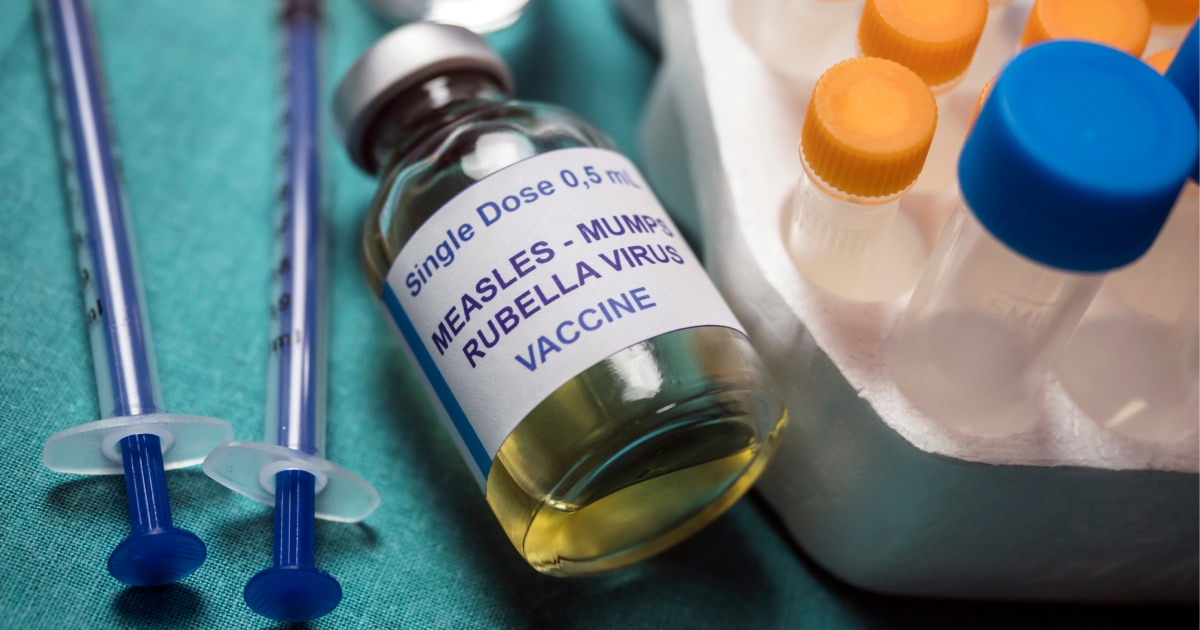

The MMR vaccine has been in continuous use for more than half a century. According to UCLA Health, it has a 97% efficacy rate against measles, and the combination format is used by 179 of the 194 WHO member states. On August 10, 2026, President Donald Trump signed an executive order calling for it to be split into three separate single-disease shots – a product that does not currently exist anywhere in the United States.
That detail cuts to the heart of what public health experts found most alarming about the Trump vaccine recommendations. The order, branded the “Gold Standard Childhood Vaccine Recommendations,” calls for lowering the number of universally recommended shots to 11 from 17. It also directs the Department of Justice to sue states that fail to provide religious and medical exemptions for mandated vaccines. And it arrives at a moment when measles – a disease the U.S. declared eliminated in 2000 – is surging at levels not seen in decades.
Trump insisted that infants should receive fewer immunizations over a longer period despite little scientific evidence supporting such sweeping changes. The order came just days after mid-year case counts confirmed that 2026 is tracking to exceed an already record-breaking 2025. The federal childhood immunization schedule remains the same as it was in July 2025, recommending routine vaccines for 16 diseases – meaning the executive order does not itself change the schedule, but sets in motion a political and legal process to do so.
What the Trump vaccine recommendations actually say
The directive calls for U.S. children to receive fewer vaccines and urges states to reconsider which vaccines they require for school attendance. It also directs the DOJ to sue states that fail to provide religious and medical exemptions for mandated vaccines.
The order states that the combined MMR vaccine should be administered in three separate single-disease shots once such products are domestically available and that, to the maximum extent feasible, all childhood immunizations should be administered at separate medical visits. That caveat – “once such products are domestically available” – is significant, because separate measles, mumps and rubella vaccines for children are not currently available in the United States.
According to Brigitte Giersing, unit head for vaccine research, development, and policy at WHO’s department of immunization, vaccines and biologicals, only 15 of the global health agency’s 194 member states vaccinate against measles, mumps and rubella using monovalent (single-disease) vaccines – all the others use the combined MMR. Giersing noted that breaking up the MMR schedule “would actually increase the number of injections and the complexity of the schedule,” and that combination shots are more acceptable to most parents and physicians.
Executive orders aren’t the legal mechanism through which vaccine recommendations are made in the U.S., according to Dr. Dorit Reiss, a professor of law at UC Law San Francisco who specializes in vaccine law and policy. Congress has laid out a different process – several Congressional laws put the power to make these recommendations on the CDC’s Advisory Committee on Immunization Practices (ACIP), with approval or rejection by the CDC director. “The President can direct CDC to convene ACIP and consider these changes, but an Executive Order is not a substitute to that process,” Reiss said.
That legal reality explains why Trump has reached for an executive order rather than a statutory process. A federal judge had already temporarily blocked the Trump administration’s changes to the U.S. childhood immunization schedule in March 2026, ruling they violated the Administrative Procedure Act. The White House acknowledged that the executive order was partly a response to that ruling.
The measles surge that frames all of this
According to UCLA Health, in 2025, 2,267 measles cases were reported nationwide, the highest annual count in more than three decades. By mid-July 2026, the U.S. had already recorded 2,318 confirmed cases, surpassing the record-breaking tally from 2025. The U.S. had declared measles eliminated in 2000.
Before the measles vaccine was introduced in 1963, approximately 500,000 cases and 500 deaths were reported annually in the United States. An estimated 48,000 people were hospitalized annually, with 400 to 500 deaths per year. The MMR vaccine – developed by Dr. Maurice Hilleman in 1971 and in continuous use for more than 50 years – changed that picture entirely. Two doses of the MMR vaccine are 97% effective at preventing measles infection.
The American Academy of Pediatrics and physician groups across the country have stated that any policy slowing or complicating access to the MMR now is medically indefensible, and that the executive order is likely to stoke fear and confusion among parents at a time when measles is raging, immunization rates are falling, and children are heading back to school. Dr. Paul Offit, a pediatrician and director of the Vaccine Education Center at Children’s Hospital of Philadelphia, said: “This is going to create confusion and chaos.”
The science behind – and against – the order
Trump falsely tied vaccines to autism at the signing ceremony, suggesting multiple times that rising rates of childhood shots have led to an increase in autism diagnoses. Decades of scientific evidence has shown no link between autism and childhood vaccines.
The autism claim traces back to a single, fraudulent study. False claims of a link between the MMR vaccine and autism were first made by British doctor Andrew Wakefield in 1998 in The Lancet. That paper was retracted in 2010, and Wakefield was struck off the UK medical register after investigators uncovered undisclosed conflicts of interest, selective and falsified data, and ethical violations. Scientific studies involving more than one million children have found no evidence that vaccines cause autism. Reviews from the Institute of Medicine and the Agency for Healthcare Research and Quality maintain, with a high strength of evidence, that there is no association between MMR and autism spectrum disorder.
Despite being stripped of his medical license, Wakefield has remained a prominent figure in anti-vaccine circles and attended Trump’s first presidential inauguration.
Health Secretary Robert F. Kennedy Jr. has been central to the administration’s vaccine skepticism. A 2021 analysis found Kennedy was responsible for 13% of COVID-19 vaccine misinformation reshares on Twitter, identifying him as a top superspreader of that content. Kennedy has tried to reshape U.S. vaccination schedules through the CDC’s advisory process, but those efforts were blocked by the federal court ruling earlier this year.
The debate over Donald Trump’s recent proposal to separate the MMR vaccine into individual measles, mumps, and rubella doses has raised questions about whether there is any scientific benefit to changing the long-established approach. In the video below, Dr Idrees Mughal (Dr Idz), a medical doctor with a master’s degree in nutritional research and board certification in lifestyle medicine, looks at the claims behind the proposal and the evidence supporting the continued use of the combined MMR vaccine, including why separating the doses may not offer the advantages suggested. Current evidence and longstanding public-health guidance support the safety and effectiveness of the combined MMR vaccine.
What this means beyond U.S. borders
Senior WHO officials, including Director-General Tedros Adhanom Ghebreyesus, criticized the Trump administration’s attempt to trigger an overhaul of U.S. vaccination policy, calling it politically motivated and contradictory to the best available science.
WHO spokesperson Tarik Jašarević told a press briefing in Geneva that vaccination recommendations were based on more than 60 years of research by WHO, national authorities, and independent expert groups. “What comes out from WHO is science-based,” Jašarević said. He added that when those standards are not upheld, “trust in vaccines, health experts and scientific institutions, like WHO, can erode.”
Public health officials say it is unlikely other governments will copy the policy directly. The deeper risk is the spread of doubt. Europe has already seen the consequences of falling vaccination coverage: six countries – Armenia, Austria, Azerbaijan, Spain, the United Kingdom, and Uzbekistan – were found to have re-established measles transmission in 2024, according to the WHO. The European Commission’s State of Vaccine Confidence report found that overall vaccine confidence has declined among the general public since 2020, with particularly notable decreases in many Central and Eastern European countries.
Senator Bill Cassidy, a physician who chairs the Senate Health, Education, Labor and Pensions Committee, criticized the order publicly. “I’m a doctor. This executive order is wrong,” he wrote. He added that breaking up vaccines “will mean children have to get more shots to get the same protection, not fewer shots. It will increase hesitancy and make children less safe.”
Countries in other parts of the world that may recommend fewer shots face different disease risks and operate under different healthcare systems – meaning a simple comparison of schedule length between countries does not tell the full public health story.
What to do now
The federal childhood immunization schedule has not changed and remains as it was in July 2025. Insurance coverage is also not likely to be affected, since childhood vaccines remain on the CDC’s schedule as recommended. Two major insurers, Blue Cross Blue Shield and CVS, said they planned to continue covering CDC-recommended pediatric vaccines without co-pays. The White House confirmed that free vaccines through the Vaccines for Children program would also not be affected, because that program relies by law on guidance from the CDC’s vaccine advisory committee.
Most families can – and should – follow their pediatrician’s current guidance without waiting for political clarity. The American Academy of Pediatrics held a press call where its president, Dr. Andrew Racine, and a member of the AAP’s Committee on Infectious Diseases both said the order’s most immediate effect would be to sow confusion among parents, rather than improve safety and health. Racine argued the executive order “will do nothing to support families of children with autism or advance understanding” of the condition, and that the new recommendations are intended to “sow confusion so that more people doubt the importance of vaccines.”
If your child is due for the MMR vaccine, the schedule is unchanged: first dose between 12 and 15 months, second between 4 and 6 years. If you’re unsure whether your child is up to date, a call to your pediatrician – or a check of your state’s immunization registry – is the fastest way to find out. With measles cases in 2026 already surpassing the record set just last year, the window for complacency is closed.
Disclaimer: This information is not intended to be a substitute for professional medical advice, diagnosis, or treatment and is for information only. Always seek the advice of your physician or another qualified health provider with any questions about your medical condition and/or current medication. Do not disregard professional medical advice or delay seeking advice or treatment because of something you have read here.
AI Disclaimer: This article was created with the assistance of AI tools and reviewed by a human editor.
Read More: COVID Vaccines: Scientists May Have Cracked the Mystery Behind Rare Blood Clots