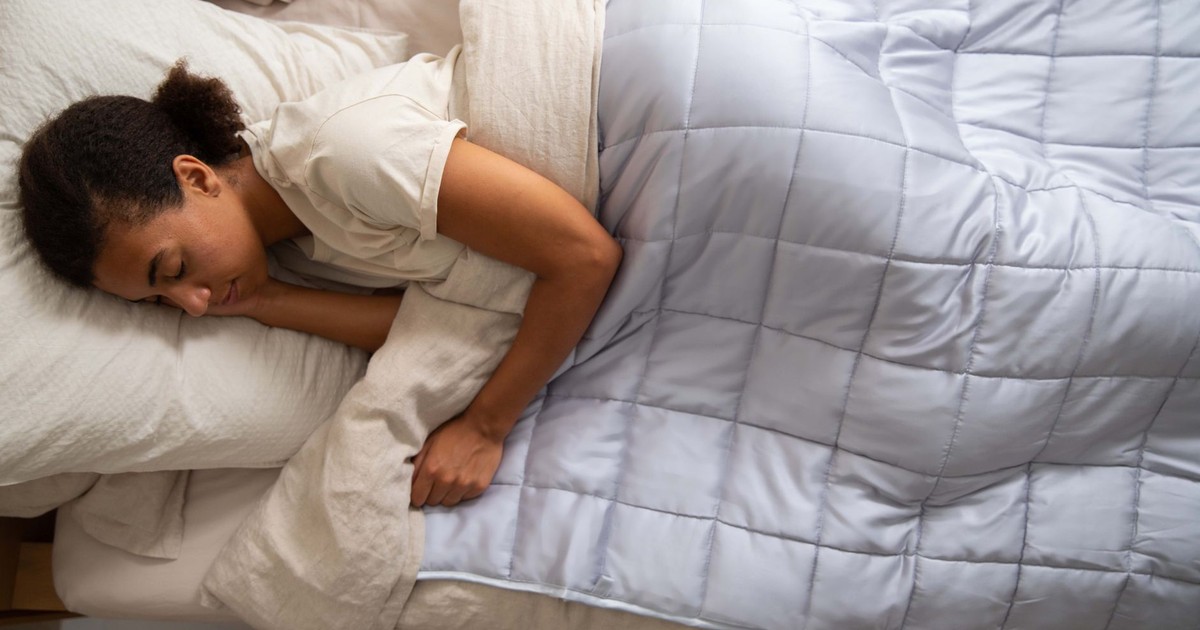

There is something strangely calming about firm, even pressure. A heavy comforter, a tight hug, or curling up under several blankets can create a sense of security that’s difficult to explain but immediately familiar to many people.
Weighted blankets are designed to recreate some of that sensation, and they’ve become increasingly popular as a way to relax, sleep better, or manage feelings of anxiety. But popularity has moved considerably faster than the science, leaving an obvious question: do weighted blankets actually calm anxiety, or do they simply feel comforting?
Researchers at Saint Luke’s Hospital in Kansas City recently put that question to the test in a particularly stressful setting. In a 2026 pilot study published in the American Journal of Critical Care, hospitalized adults spent 20 minutes under a 15-pound weighted blanket while researchers tracked changes in their anxiety.
The results suggest the calming effect may be more than anecdotal. But with only 54 participants and a very specific type of situational anxiety, the study also shows why weighted blankets are better viewed as a potentially useful calming tool than as a treatment for anxiety disorders.
What the Study Did and Found
A team of nurses, supported by biostatisticians, conducted the small pilot study at Saint Luke’s Hospital in Kansas City, Missouri, part of BJC Health West Region. The study involved 54 patients treated at Saint Luke’s Health System between 2023 and 2025, randomly assigned to one of two groups in a crossover design.
Half the group spent 20 minutes under a 15-pound weighted blanket before a 20-minute standard care period. The other half spent 20 minutes under the weighted blanket after a 20-minute standard care period. Both groups then had a final observation window to track any lingering effects. Each participant rated their anxiety on a 0 to 10 scale at baseline and then after each 20-minute block.
Patients who used the blanket reported significantly lower anxiety compared with those receiving standard care alone, with the biggest changes appearing right after the blanket period. Anxiety scores dropped by 3.6 points with the weighted blanket versus usual care.
Researchers also observed evidence of a carryover effect, with some reduction in anxiety persisting after the blanket was removed. Because the study was small, however, that finding will need to be explored in larger trials.
Exit survey results revealed practical limitations alongside the positive responses. More than 80% of participants in both groups found the blanket calming, but 26% found the temperature too hot, and 33% felt the weight was too heavy. That’s useful feedback for anyone considering trying one outside a clinical setting.
How Deep Pressure Stimulation May Calm the Body
Weighted blankets typically use glass beads or similar materials distributed across internal pockets to create gentle, relatively even pressure across the body. This is often described as deep pressure stimulation, a form of tactile input also used in some occupational therapy settings.
One proposed explanation is that this pressure may influence the autonomic nervous system, shifting the body toward the parasympathetic, or “rest and digest,” state associated with relaxation. Researchers have also explored possible effects on stress hormones and neurotransmitters, but the biological mechanisms behind weighted blankets are still not well established.
In other words, there is growing evidence that some people feel calmer while using weighted blankets. Exactly why that happens is considerably less certain.
What the Broader Research Shows
The Saint Luke’s study adds to a growing body of evidence, but that evidence remains preliminary. A 2025 scoping review in Occupational Therapy International identified 38 studies on weighted blankets, including 12 randomized controlled trials, examining their effects on anxiety and sleep outcomes across various populations. The field is still far from the large, definitive trials that establish a treatment as standard of care.
A 2024 meta-analysis in the Journal of Psychiatric Research pooled data from five studies and found that weighted blankets produced a small but statistically significant reduction in anxiety for patients with mental disorders. The effect was modest, but no serious adverse events were reported across the studies included in the analysis.
A separate 2024 systematic review found that weighted blankets may improve total sleep time and reduce insomnia severity in people with psychiatric conditions. That review also noted the occupational therapy context that long predates the current consumer market: weighted blankets have been used in sensory integration therapy to provide deep touch pressure stimulation for self-regulation.
The Sleep Foundation notes that weighted blanket research spans a range of populations and settings, with some studies reporting improvements in anxiety or sleep. However, results vary, and much of the available research remains relatively small.
Keeping the Limitations in Focus
The 2026 Saint Luke’s trial involved 54 people experiencing situational anxiety tied to a hospital admission. That’s an acute, context-driven form of stress that differs in important ways from generalized anxiety disorder or panic disorder.
The study does not show that weighted blankets treat clinical anxiety conditions, replace therapy or medication, or belong in every adult bedroom as an anxiety solution.
The research as a whole is also constrained by the populations studied. Many trials have involved psychiatric patients, people undergoing medical treatment, or individuals with conditions affecting sensory processing. Results from those groups may not translate cleanly to anxiety in otherwise healthy adults.
For those curious about non-pharmacological strategies for calming the nervous system, this piece on anxiety and sleep covers related evidence on how anxiety affects the body at night.
Practical Considerations Before You Try One
The exit survey from the Saint Luke’s study offers a useful reminder that weighted blankets aren’t necessarily comfortable for everyone. Heat and excess weight were the two most common complaints. Nearly a third of participants found the blanket too heavy, and more than a quarter found it too warm.
There is also no scientifically established “correct” blanket weight for reducing anxiety. Around 10% of body weight is commonly used as a consumer starting point, but it should be treated as a general guideline rather than a medically established formula. Comfort, mobility, temperature, and the ability to remove the blanket independently may be more important than hitting a particular number.
People with respiratory or circulatory conditions, or those with limited mobility, should consider checking with a healthcare professional before using a heavy weighted blanket. Being able to reposition and remove the blanket independently is particularly important.
A blanket that feels grounding to one person may feel hot, restrictive, or uncomfortable to another. The Saint Luke’s study itself illustrates that difference: most participants found the blanket calming, but a substantial minority thought it was either too heavy or too warm.
Read More: Top Natural Supplements and Vitamins to Help Relieve Anxiety and Stress
The Bottom Line
Weighted blankets have spent years in an unusual position: widely used for calming and sleep, but supported by a relatively small research base. The new Saint Luke’s study adds another piece of evidence that the calming sensation people report may be measurable.
After just 20 minutes with a weighted blanket, hospitalized patients reported a meaningful reduction in anxiety compared with usual care. Other small trials and reviews have also found reductions in anxiety in certain populations, suggesting the effect deserves further study.
But there are important limits. The Saint Luke’s trial included only 54 people, and hospital-related anxiety isn’t the same thing as generalized anxiety disorder, panic disorder, or chronic anxiety. The research also hasn’t established an ideal blanket weight or fully explained why weighted pressure appears calming for some people.
What weighted blankets may offer is much simpler: a low-tech way of creating a physical sensation that some people find calming. For an otherwise healthy adult who can comfortably move and remove the blanket, that may make one worth trying. It just shouldn’t be confused with a replacement for therapy, medication, or other appropriate care when anxiety becomes persistent or disruptive.
Sometimes feeling calmer doesn’t require a complicated intervention. In this small study, 20 minutes of gentle pressure was enough to make a measurable difference. The next question is whether larger studies find the same thing.
Disclaimer: The information provided here is for educational and informational purposes only and is not a substitute for professional psychological, psychiatric, or mental health advice, diagnosis, or treatment. Always seek the guidance of a licensed mental health professional, therapist, psychologist, or psychiatrist with any questions or concerns about your emotional well-being or mental health conditions. Never ignore professional advice or delay seeking support because of something you have read here.
AI Disclaimer: This article was created with the assistance of AI tools and reviewed by a human editor.
Read More: Sleeping Trick? Why Sticking One Foot Out Actually Works