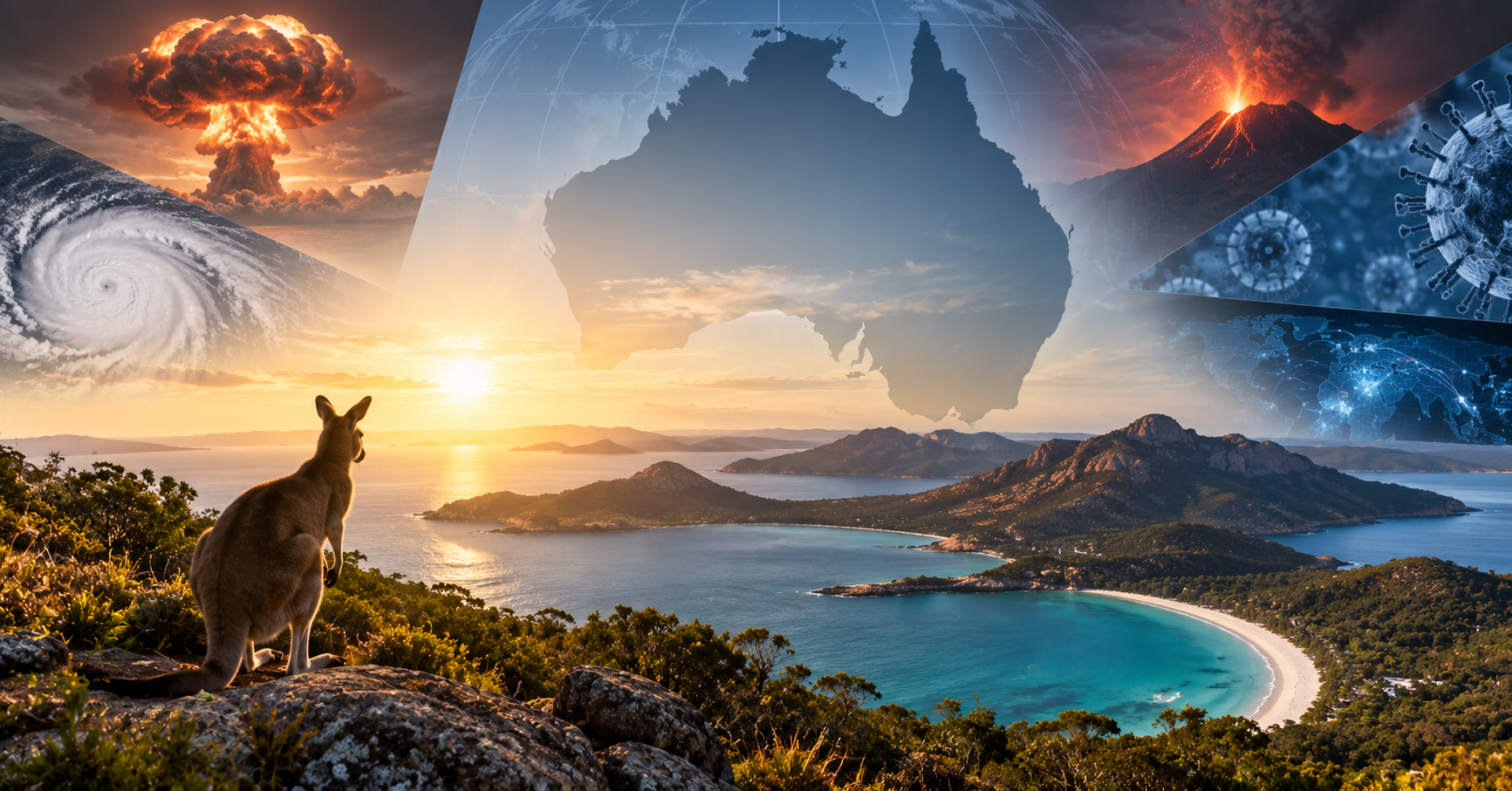

If a global catastrophe disrupted civilization tomorrow, where would you want to be?
A remote island? Somewhere capable of growing its own food? A country far from major military targets, with enough industry and infrastructure to keep functioning if international supply chains collapsed?
Researchers have been trying to answer versions of that question for years. Now, a 2026 open-access review published in Global Challenges has brought much of that research together, examining which countries appear best positioned to withstand some of the most severe threats humanity could face.
The researchers reviewed more than 200 studies and reports covering everything from nuclear war and pandemics to massive volcanic eruptions, asteroid impacts, cyberattacks, and widespread infrastructure failure.
One country appeared across more of those resilience scenarios than any other: Australia.
But before anyone starts booking a one-way flight to Sydney, there’s an important catch.
The researchers found no country on Earth that appears resilient to every type of global catastrophe. Even Australia has vulnerabilities that could become serious liabilities depending on what actually happens.
That makes the study less a search for the world’s safest hiding place and more an examination of what allows a country to keep functioning when the systems around it begin to fail.
Why Australia Came Out on Top
Australia shows resilience across the widest range of global catastrophic risk scenarios in the literature reviewed, though even for it, continued international cooperation and trade remain essential. The review covers resilience to pandemics, nuclear war, large volcanic eruptions, near-Earth object impacts, massive cyberattacks, geomagnetic storms, and high-altitude electromagnetic pulse events, organized into three pathways to harm: abrupt sunlight reduction scenarios including nuclear, volcanic, or impact winter; global catastrophic infrastructure loss, meaning the prolonged collapse of electricity, industry, and the systems they support; and global catastrophic biological risk, covering pandemics and engineered pathogens. Australia, New Zealand, and Japan are the only countries with evidence in the literature for resilience across all three pathways, with Australia named across the widest range of individual risk scenarios.
Lead author Florian Ulrich Jehn, a senior researcher in environmental science at the Center for Critical Computational Studies at Goethe University Frankfurt and the FernUniversität in Hagen, noted in the Global Challenges study that Australia “is an island, so it can more easily shut itself off and isolate itself.” In biological catastrophe scenarios, border control can determine the difference between containment and collapse. The researchers specified this resilience factor to “large islands,” since small islands are significantly vulnerable to sea-level rise, tsunamis, and near-Earth object impacts, and tend not to have the economic size to sustain essential services during prolonged disruption.
Australia’s scale adds to the advantage. It has a substantial agricultural sector, fossil fuel resources, a functioning industrial base, and a mining industry capable of producing critical materials domestically. Countries with a strong industrial base and less dependence on global trade are more resilient to catastrophes, because domestic production enables them to manufacture goods that could not be imported after international supply chains are disrupted.
The Factors That Actually Determine Resilience
Across the different catastrophic risk scenarios, the common resilience factors that appear most consistently are geographic isolation, self-sufficiency especially in food production, high governance quality including more democratic institutions and lower inequality, and decentralization to mitigate single-point catastrophic failures.
Geographic isolation reduces exposure to military conflict and slows the spread of pathogens. Food self-sufficiency becomes critical if global supply chains collapse – which could happen through infrastructure loss from a massive cyberattack or geomagnetic storm, or through agricultural failure following a sunlight-blocking event. A 2022 Carnegie Endowment analysis on governance and resilience found that “control of corruption, societal trust, and high quality political leadership” are exceptionally powerful factors enabling countries to manage through crises across multiple pathways.
Centralized systems – a single national power grid, a concentrated communications backbone, a capital-city-dependent government – create single points of failure. If any one node is destroyed or incapacitated, the entire system collapses. Distributed infrastructure means local failures stay local, which is why the review identifies decentralization as one of the most consistent resilience markers across multiple risk categories.
A large volcanic eruption, a major nuclear exchange, or an asteroid impact could each produce the same basic outcome: particulates in the upper atmosphere blocking sunlight for years and suppressing global agriculture. A regional nuclear war sending approximately 5.5 million tons of soot into the atmosphere could reduce worldwide annual corn production by 7%, while a large-scale global war injecting 165 million tons could lead to an 80% drop in annual corn yields, according to a 2025 Penn State study published in Environmental Research Letters. Countries with diverse growing regions, seed banks, and the capacity to shift crop varieties quickly would hold a meaningful advantage in that scenario – and Australia’s varied climate zones and agricultural infrastructure give it more flexibility than most.
The Countries That Came Closest
Beyond Australia, New Zealand features prominently in the global catastrophic risk resilience literature: it is remote, temperate, food-producing, democratic, rich in hydro and geothermal energy, and capable of enforcing a border. That profile tracks closely with Australia’s, but at a smaller scale, which is both a strength and a limitation.
Japan and Switzerland round out the tier of comparatively resilient nations, though each carries specific vulnerabilities. Japan sits in one of the world’s most seismically active regions and depends heavily on food imports. Switzerland is landlocked and, despite its institutional stability, relies on neighboring European countries for much of its energy and supply chain. Argentina’s large landmass and agricultural capacity are genuine assets, but its history of governance instability and economic fragility works against it in scenarios requiring sustained institutional coordination.
A fallback refuge chosen for one hazard family can be exposed in another, which strengthens the case for multiple prepared refuges rather than a single designated safe location. Being far from major population centers and military targets reduces exposure to nuclear conflict – but that same remoteness increases dependence on international trade for pharmaceuticals, fuel, and fertilizer. Being a large island makes border control easier during a pandemic – but if a prolonged global disruption collapses shipping lanes, critical imports stop arriving. The most likely civilization-scale scenarios share this same pattern: the structural qualities that protect against one threat can amplify vulnerability to another.
Where Australia’s Resilience Has Real Limits
The study’s lead author acknowledged the country has “obvious problems with the consequences of climate change.” Australia is already experiencing intensifying bushfire seasons, prolonged droughts, and coastal flooding events – conditions that erode the agricultural advantage that makes it resilient in the first place.
The Global Challenges study notes that Australia remains vulnerable to specific hazards and dependent on continued international trade for fuel, medicine, and fertilizer. Those three categories represent the precise inputs a country needs to maintain food production and basic health services. Australia doesn’t manufacture most of its own pharmaceuticals. Its agricultural sector depends on fertilizer imports. Its transport system runs almost entirely on refined petroleum products, most of which are imported.
If the catastrophe that unfolds is one that collapses global trade while leaving Australia’s domestic systems intact – a reasonable scenario for certain cyberattack or electromagnetic pulse events – Australia’s isolation becomes a liability rather than an asset. The supply chains that ordinary life depends on would stop, and the question of how long domestic reserves would last is not a comfortable one.
So, Is Australia Really the Safest Place to Be?
Not exactly.
What the research suggests is that Australia has an unusual combination of advantages: geographic isolation, enormous agricultural capacity, natural resources, a substantial industrial base, and institutions capable of continuing to function through major disruption.
But every advantage comes with a weakness.
Australia’s isolation could help during a pandemic while becoming a serious problem if global shipping collapsed. Its agricultural capacity could help feed its population during a prolonged crisis, but agriculture still depends on imported fuel, fertilizer, machinery, and other supplies. And the country remains exposed to drought, bushfires, coastal flooding, and other climate-related pressures.
That’s ultimately the more interesting finding of the review.
There may be places better positioned to withstand a global catastrophe, but there is no perfect refuge from one.
Australia simply appears to have more of the pieces needed to keep going across a wider range of scenarios than most.
And if the worst ever did happen, where you live might matter considerably less than whether the systems around you are prepared to survive it.
AI Disclaimer: This article was created with the assistance of AI tools and reviewed by a human editor.
Read More: Places Americans Are Relocating to and Living Well on About $1,000 a Month