
When doctors discovered tumors in the lungs and lymph nodes of a 41-year-old man in Colombia, cancer seemed like the obvious explanation.
He had been sick for months, suffering from fever, coughing, fatigue, and significant weight loss. Imaging revealed growths throughout his body, and when researchers examined tissue samples under a microscope, the cells behaved exactly as malignant cells would. They multiplied rapidly, crowded together, and invaded surrounding tissue, but something about them didn’t make sense.
The cells were tiny, roughly one-tenth the size of typical human cancer cells. Some were even fusing together, behavior that researchers wouldn’t normally expect from human cells. Tests for several possible cancers and infections failed to provide an answer.
It took genetic testing to finally reveal what was growing inside him. The cells weren’t human.
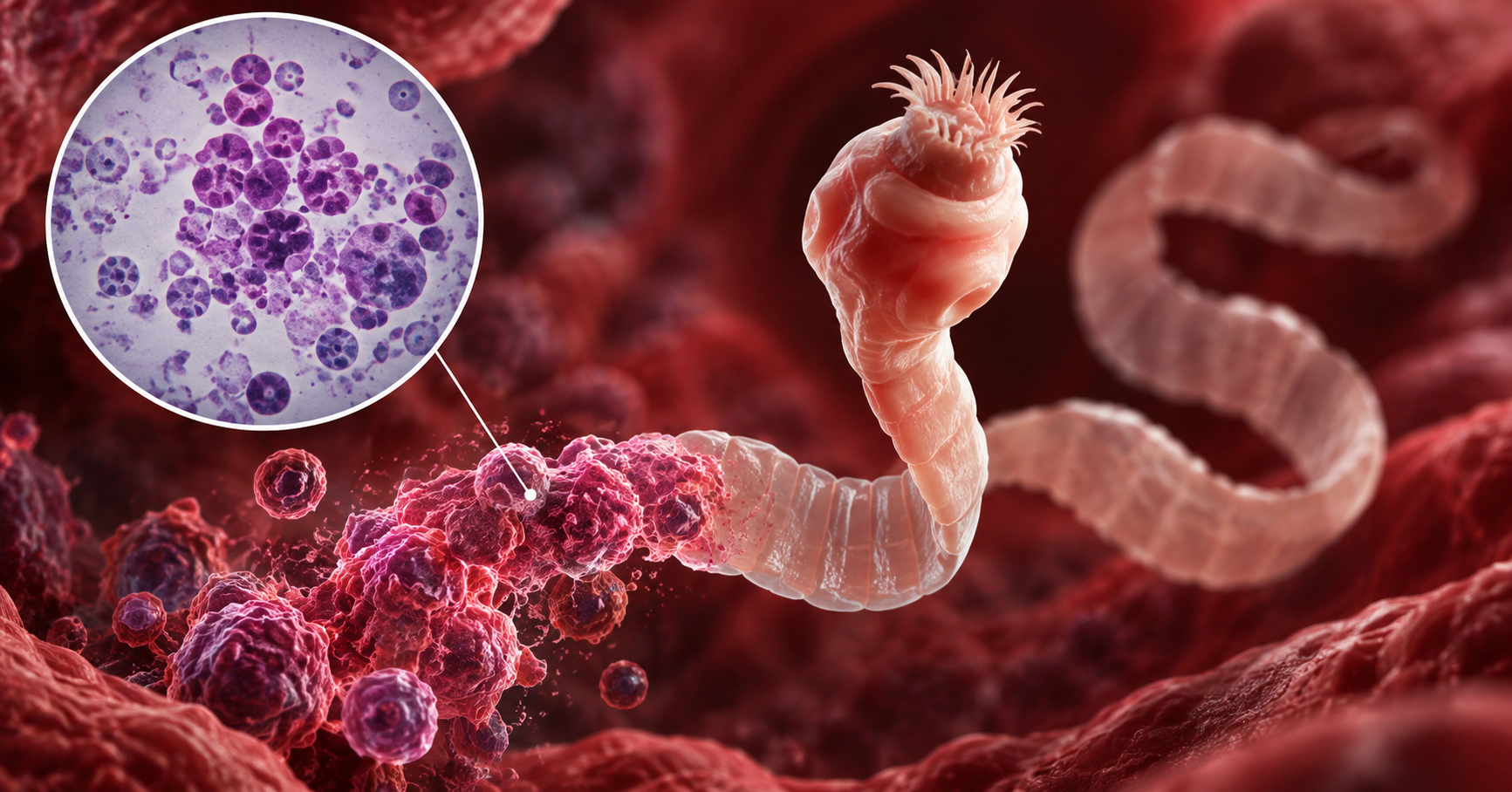
They belonged to Hymenolepis nana, better known as the dwarf tapeworm. Somehow, cells from a parasite living inside the man’s body had undergone genetic changes, begun multiplying uncontrollably, and invaded his tissues in a way that looked remarkably like cancer.
When researchers published the case in The New England Journal of Medicine in 2015, they described it as a previously unknown disease mechanism linking infection and cancer. The CDC also reported on the extraordinary case, calling it the first known instance of a person becoming sick from cancer cells that originated in a parasite.
The case has recently resurfaced on social media as a supposed new discovery. It isn’t new. But what happened inside this patient’s body remains one of the strangest examples of cancer-like disease ever documented.
What Cancer Actually Is – and Why “Non-Human” Matters
To understand why this case stopped scientists in their tracks, it helps to understand what cancer normally is. The fundamental abnormality in cancer is the unregulated, continual proliferation of cells. Rather than responding appropriately to the signals that control normal cell behavior, cancer cells grow and divide in an uncontrolled manner, invading normal tissues and organs. According to the National Cancer Institute, in normal cells, tumor suppressor genes prevent cancer by slowing or stopping cell growth, and DNA changes that inactivate those genes can lead to uncontrolled cell growth and cancer.
Cancer has always been understood as a disease of the patient’s own body – the result of genetic changes arising in normal cells that transform them to undergo unconstrained division. The repeatedly dividing cells form a tumor that expands, invades local normal tissues, and can spread to give rise to new metastatic sites. Every known case up to 2015 fit this framework. What Colombian doctors were seeing in this patient did not.
A Three-Year Diagnostic Hunt
Dr. Atis Muehlenbachs, M.D., Ph.D., staff pathologist in CDC’s Infectious Diseases Pathology Branch and lead author of the study, later told Medscape Medical News: “We have a unique case in an immunosuppressed individual where he developed tumors where the cells responsible came from a tapeworm, so that they were indeed cancer cells, but derived from the tapeworm.”
The CDC team wasn’t clear at first whether the growths were cancer, the work of an infectious agent, or some new and unrecognized pathogen. The leading hunch was that it was some form of protozoa – single-cell life forms, some of which are parasitic. Researchers ran dozens of tests. The cells, when examined under a microscope, acted like cancer cells – they multiplied quickly and crowded together. But they were about 10 times smaller than human cancer cells. The cells were also fusing with one another, something that human cells rarely do.
Eventually, using a genetic test called a PCR assay (a technique that detects and amplifies specific DNA sequences), the team found their answer. A polymerase-chain-reaction assay targeting eukaryotes identified Hymenolepis nana DNA inside the tumor. Further analysis confirmed the identity of the cells. Although the cells were unrecognizable as tapeworm tissue under a microscope, immunohistochemical staining and probe hybridization labeled the cells in the samples. Comparative deep sequencing then identified H. nana structural genomic variants compatible with mutations described in cancer.
The conclusion the team published in the New England Journal of Medicine was stark: “Invasion of human tissue by abnormal, proliferating, genetically altered tapeworm cells is a novel disease mechanism that links infection and cancer.”
The patient died just 72 hours after researchers determined that the tumors were caused by H. nana.
How a Tapeworm’s Cells Started Behaving Like Cancer
Researchers hypothesized that, because the man had HIV, the tapeworm kept growing in the body unchecked by the immune system. Eventually, mutations developed in the tapeworm’s cells that turned them cancerous. This mirrors the process by which human cancer develops: a cell accumulates enough genetic errors that it loses normal growth controls – except in this case, the cell belonged to a parasite, not the patient.
The man’s immunological state was almost certainly a prerequisite. Without antiretroviral treatment for his HIV, his immune defenses were severely compromised. The tapeworm had been left to proliferate unchecked for years, creating conditions in which damaged, mutating cells could take hold and spread. A functioning immune system would normally keep a tapeworm infection contained, limiting the parasite’s ability to multiply freely and reducing the time available for cancer-driving mutations to accumulate.
The Parasite at the Center of the Case
Hymenolepis nana – the dwarf tapeworm – is the most common tapeworm in humans, infecting up to 75 million people worldwide at any given time. According to the CDC’s parasite resource page, most infections are typically asymptomatic – people carry the parasite without knowing it.
One biological trait sets H. nana apart from other tapeworms: according to the Merck Manual, its life cycle does not require an intermediate host. Every other tapeworm needs to pass through a second animal – typically a rodent or insect – before it can complete its development. H. nana can go from egg to reproductive adult entirely within a single human intestine. In someone with a working immune system, the body keeps this in check. In someone whose defenses are down, the parasite can multiply far beyond normal levels, seeding large numbers of organisms throughout the gut.
People typically pick up the infection through food contaminated with mouse droppings or insects, or through contact with feces from an infected person. Children are most commonly affected. For the vast majority of those infected, it passes without consequence. The Colombian man’s case represents an extreme biological outlier – one enabled by the specific combination of an uncontrolled infection, a devastated immune system, and what appears to have been years of unchecked parasite proliferation.
What the Genetic Evidence Revealed
The deep sequencing data pointed to a process that looked, at the genomic level, remarkably like cancer development in a human. The tapeworm cells found in the man’s tumors carried structural genetic variants – the same kinds of chromosomal rearrangements and mutations seen in human malignancies. These weren’t normal tapeworm cells; they had accumulated genetic damage, lost normal growth regulation, and acquired the ability to invade foreign tissue.
The tapeworm established itself in the man’s intestine. His immune system, suppressed by untreated HIV, could not mount an effective response. The parasite multiplied in unusually large numbers. Within that large, long-lived population of dividing cells, mutations began accumulating until some cells crossed a threshold, acquiring the ability to proliferate beyond normal boundaries, escape the intestine, and invade the man’s lungs and lymph nodes. The resulting tumors were so unlike normal tapeworm tissue that pathologists initially had no idea what they were looking at.
An Exceptional Case, Not a New Epidemic
Dr. Muehlenbachs was explicit about the rarity of what he and his colleagues had found: “We think this type of event is rare,” he said in the CDC’s official press release on the case. Tens of millions of people carry H. nana at any given time, and the scientific literature contains no documented cases of this phenomenon occurring in immunocompetent individuals – people with normally functioning immune systems.
Carrying a tapeworm does not put you at risk of developing tapeworm cancer cells. The Colombian man’s case required an extraordinarily specific convergence: a common parasite, an immune system devastated by years of untreated HIV, and what appears to have been an unusually heavy, long-standing parasitic burden.
The case does raise a practical concern for clinicians working in parts of the world where both HIV and H. nana are common. Drugs that treat tapeworm infections may not be effective against cancer cells derived from tapeworms. Whether human cancer treatments might work against parasite cancer cells remains an open question – in part because there are so few cases to study.
Read More: Finger Test For Lung Cancer Could Determine Cancer Risk
What This Extraordinary Case Taught Scientists
Nearly everyone infected with H. nana will never experience anything remotely like this. The dwarf tapeworm is common, and according to the CDC’s information on hymenolepiasis, infections are often asymptomatic. Researchers believe this patient’s severely weakened immune system created an exceptional environment in which the parasite could proliferate and its abnormal cells could survive.
That makes this case important not because it revealed a new cancer threat to the general population, but because it challenged something much more fundamental.
As the National Cancer Institute explains, cancer normally develops when a person’s own cells acquire changes that allow them to grow uncontrollably and invade surrounding tissue. In this case, cells from an entirely different organism appeared to do something remarkably similar.
Genetic testing showed that the invading cells belonged to the tapeworm and carried structural genetic changes compatible with those seen in cancers. They had become so abnormal that pathologists could no longer recognize them as ordinary tapeworm tissue.
Researchers still consider what happened extraordinarily rare. The CDC researchers who investigated the case emphasized its rarity, and there are no documented cases of the phenomenon occurring in people with normally functioning immune systems. Ordinary tapeworm infections should not be interpreted as a cancer risk.
But the case demonstrated something scientists hadn’t documented in a human before: under extraordinary circumstances, cells belonging to a parasite could acquire cancer-like characteristics and invade the person carrying it.
The story may be more than a decade old. The biology that made it remarkable hasn’t gotten any less strange.
Disclaimer: This information is not intended to be a substitute for professional medical advice, diagnosis, or treatment and is for information only. Always seek the advice of your physician or another qualified health provider with any questions about your medical condition and/or current medication. Do not disregard professional medical advice or delay seeking advice or treatment because of something you have read here.
AI Disclaimer: This article was created with the assistance of AI tools and reviewed by a human editor.
Read More: Some People Claim to ‘Smell Cancer’ Before Diagnosis — Here’s the Science