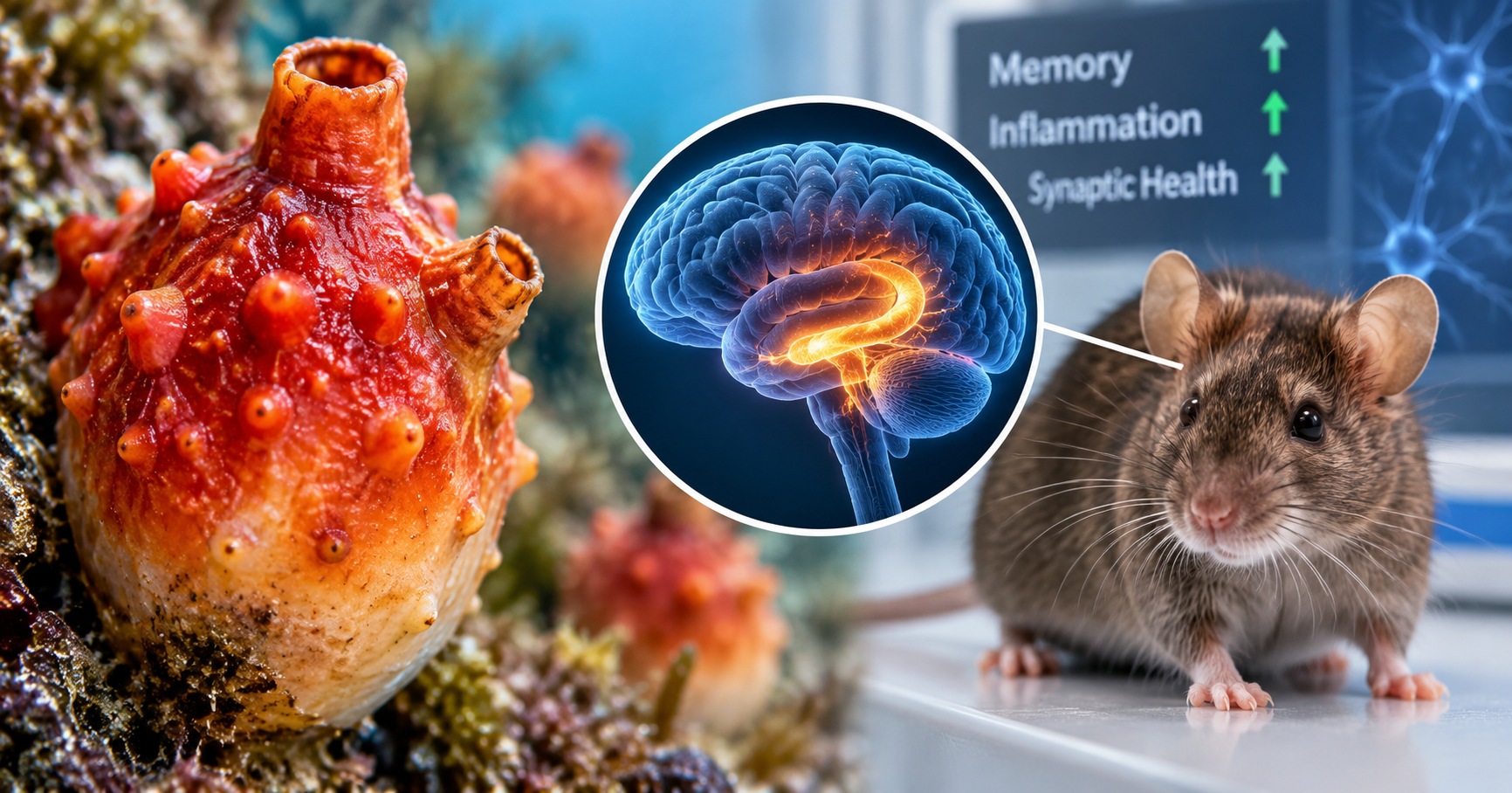

Scientists studying brain aging turned to an unlikely source: a strange marine animal known as the sea squirt.
In an experiment involving naturally aging mice, researchers found that compounds extracted from sea squirts appeared to improve memory, reduce signs of brain inflammation, and support healthier connections between brain cells. The mice even developed thicker, darker, glossier coats.
The study, published in Frontiers in Molecular Biosciences, focused on compounds called plasmalogens, naturally occurring fat molecules that are particularly abundant in the brain. Their levels tend to decline with age, leading researchers to investigate whether restoring them could influence some of the biological changes associated with aging.
The findings are intriguing, but they come with an important limitation: the experiment was conducted in mice, and researchers have not established that eating sea squirts or taking plasmalogen supplements produces the same effects in people.
What are plasmalogens, and why do they matter for an aging brain?
Plasmalogens are glycerophospholipids – a class of fat molecules with a specific chemical structure – that constitute approximately 18 to 20 percent of the total phospholipids in cell membranes. Roughly one in five membrane fat molecules in human cells is a plasmalogen, and their structural role is active rather than passive. Plasmalogens strengthen lipid membranes and lower their fluidity, both of which are connected to cellular functions, and they also scavenge reactive oxygen species – unstable molecules that damage cells – at specific chemical linkages.
They are predominantly abundant in the brain, retina, leukocytes, sperm, heart, and skeletal muscle in mammals. The brain’s dependence on plasmalogens is especially significant. The ethanolamine class of plasmalogens is involved in membrane fusion during synaptic transmission because it easily forms a specific molecular configuration at body temperature; these molecules help nerve cells physically transfer information to one another.
Plasmalogen levels tend to decline as people grow older. That decline is not uniform. Human studies show that plasmalogen levels fall with age, and the drop is even sharper in Alzheimer’s disease, suggesting a link between dietary lipids and neurodegeneration. Reduced plasmalogen levels have also been observed in Parkinson’s disease. The previously mentioned 2022 review published in Frontiers in Molecular Biosciences noted that ether phospholipid compositions are altered in the plasma or brain of patients with brain disorders such as Alzheimer’s and Parkinson’s disease, including those with psychiatric disorders like schizophrenia and bipolar disorder.
Plasmalogen levels typically begin to fall after midlife, with a sharper decline observed in older age. Peroxisomal dysfunction, oxidative stress, and dietary insufficiencies can accelerate this process. The peroxisome is the cellular structure responsible for synthesizing plasmalogens. As it becomes less efficient with age, output drops – and the protective effects of these molecules on brain tissue diminish alongside it.
Sea squirts as a dietary source
Sea squirts are soft marine animals that attach themselves to rocks and other surfaces. They are eaten as seafood in parts of Asia and contain relatively high levels of plasmalogens – molecules that are also naturally present in the human body. Their unusually high plasmalogen concentration, compared to land-based protein sources, is what attracted the researchers’ attention. Unlike omega-3 fatty acids, which most Western consumers now recognize as a brain-supporting nutrient found in fish, plasmalogens remain almost entirely outside mainstream nutritional awareness.
Marine resources contain unique glycerophospholipid plasmalogens and various valuable nutrients that may be relevant to age-associated diseases. According to News-Medical, marine-derived plasmalogens could improve lipid metabolism in ways that may counter age-related brain deterioration, though clinical evidence in humans remains limited.
The researchers chose to test this premise directly, using plasmalogens sourced from sea squirts and administering them orally to aging mice.
The study design: aging mice, oral supplements, two months
The mice were female and naturally aged – not genetically engineered to develop a specific disease – making the model more directly relevant to the normal aging process. Treatment began at 16 months of age, which in mouse biology corresponds roughly to late middle age to early old age. After two months of daily oral plasmalogen supplementation, the mice were assessed for changes in memory, behavior, and brain biology. Three groups were compared: young mice, untreated aged mice, and aged mice that had received the plasmalogen supplement.
The Morris water maze: measuring memory in real time
The primary cognitive test was the Morris water maze, a standard and well-validated tool in neuroscience. First established by neuroscientist Richard G. Morris in 1981 to test hippocampal-dependent learning, the maze was designed to assess both the acquisition of spatial memory and its long-term retention. The hippocampus is the brain region most closely associated with forming and retrieving memories; damage or deterioration there correlates strongly with the memory problems seen in Alzheimer’s disease and normal cognitive aging.
The maze consists of a pool of water with a small platform submerged just below the surface. The animal must use visual cues around the pool to remember where the platform is located. Aged mice typically perform poorly on this test, making it a sensitive instrument for detecting cognitive changes in older animals.
Lei Fu, a professor of Medicinal Chemistry and Pharmacy at Xi’an Jiaotong-Liverpool University and the corresponding author of the study, noted: “Our research suggests that plasmalogens may not just stop cognitive decline, but may reverse cognitive impairments in the aging brain.” Treated aged mice found the hidden platform significantly faster than untreated aged mice, and the researchers concluded that “the oral intake of plasmalogens could be a feasible therapeutic strategy to improve cognitive function in older people.” These conclusions are drawn from animal data and would require human trials to confirm.
What the brain tissue revealed
After the behavioral testing, the researchers examined hippocampal tissue from all three groups of mice to understand the biological reasons behind the memory differences.
Synaptic connections and brain plasticity
Plasmalogens are a structural component of cell membranes and are especially concentrated in the brain, heart, and immune system. At the synapse level – the junctions where one nerve cell communicates with another – their structural role becomes critical. Healthy brains constantly form and reform synaptic connections, a capacity known as synaptic plasticity that underlies learning and memory. Aging tends to erode it.
Plasmalogen-treated mice showed improved synaptic connections in the hippocampus and more signs of new synapse formation. The researchers detected greater activity in biological pathways linked to neuroplasticity – the brain’s ability to reorganize and strengthen its own connections. Better-connected and more responsive nerve cells would allow information to move through memory networks more efficiently, which provides a mechanistic explanation for the observed memory improvement.
Neuroinflammation: the microglia factor
Alongside the synaptic findings, the researchers identified a second biological mechanism: changes in the brain’s immune environment. Plasmalogen-treated mice showed less age-related activation of microglia – the brain’s resident immune cells. According to a 2021 journal publication, neuroinflammation typically correlates with the activation of microglia, the resident macrophages and innate immune cells of the brain.
Under normal conditions, microglia remove cellular debris, respond to injury, and support healthy neural tissue. When microglial activation becomes chronic – as it tends to with aging – the resulting persistent inflammation can damage the synaptic environment the brain needs for clear thinking. Plasmalogen treatment appeared to moderate that inflammatory state, producing brains that were, at the molecular level, less aged-looking.
The gut-brain axis: a possible third mechanism
The researchers also flagged a third pathway that may help explain the observed effects: the microbiota-gut-brain axis, a bidirectional communication network integrating neural, endocrine, immune, and metabolic pathways through which gut microbes can influence brain function and inflammation. The hypothesis is that dietary plasmalogens may alter the composition or activity of gut microbes, which then send anti-inflammatory or neuroprotective signals to the brain. The researchers identified this as a possibility, not a confirmed mechanism, and it aligns with broader research connecting lipid nutrition to gut microbial behavior.
The hair finding: striking, but interpret with caution
One of the most visually arresting findings in the study has nothing to do with cognitive testing. Aged mice fed plasmalogens grew new black hair that was thicker and glossier compared to untreated aged mice of the same age. Fur quality in aging rodents typically mirrors what happens in aging humans: coats become thinner, lighter, and less lustrous as melanin production and follicle activity decline.
The mechanisms underlying this change remain unclear. It could reflect an improvement in overall metabolic function, reduced oxidative stress at the level of skin tissue, or changes in hormonal or nutritional signaling. The researchers were cautious on this point. Improved fur in mice does not straightforwardly translate to any particular benefit in humans, and it tells researchers nothing direct about dementia prevention or memory restoration in aging people.
Read More: Over 40? These 2 Popular Supplements May Support Different Parts of Healthy Aging
What this study cannot tell us
These findings should not be interpreted as evidence that eating sea squirts or buying plasmalogen supplements can reverse aging in people. This was a mouse experiment with relatively small groups, and the animals received a controlled dose of plasmalogens rather than simply eating ordinary servings of seafood.
Human aging is far more complicated than performance in a mouse memory test or changes in fur. Clinical trials would be needed to determine whether plasmalogens improve memory in older people, what dose might be useful, and whether long-term supplementation is safe. The effective dosage administered to the mice was measured and controlled in laboratory conditions – a precision that cannot be replicated by eating sea squirts from a menu in Seoul or Osaka.
There is also a bioavailability question that the study does not resolve. Plasmalogens have a vinyl ether bond and polyunsaturated fatty acids and are abundant in marine- and animal-derived foods. How efficiently those structures survive digestion, reach the bloodstream, and cross the blood-brain barrier in humans is not established by this research.
The burden of chronic neurodegenerative conditions is projected to grow significantly in coming decades, and public demand for effective interventions creates fertile ground for overselling preliminary findings. The sea squirts aging study is genuinely interesting science, and it merits further investigation. Marketers may not wait for that investigation to conclude.
The road to human trials
For this research to translate into clinical practice, several stages of study are required. Phase I trials would need to establish safe dosing ranges for oral plasmalogen supplements in humans. Phase II trials would test whether the supplements produce any measurable cognitive or biological effects in older adults. Phase III trials would require large populations, controls for diet and lifestyle, and long-term follow-up – potentially running for years.
None of that work has been completed yet. The sea squirts aging study has provided a biologically plausible hypothesis, a credible mechanistic framework (synaptic preservation plus neuroinflammation reduction), and a behavioral signal in animals that justifies moving to the next research phase. A 2026 narrative review flagged plasmalogens as an emerging area for functional foods and precision nutrition, noting that potential mechanisms linking plasmalogens to Alzheimer’s disease pathology include amyloid-beta metabolism, oxidative stress, neuroinflammation, synaptic dysfunction, and myelin integrity – and that emerging uses in functional foods and precision nutrition offer a framework for dietary plasmalogens as part of neuroprotective strategies.
What to do with this information
None of this means eating sea squirts will improve your memory or make gray hair disappear. The mice received a controlled plasmalogen supplement, and whether similar effects would occur in humans remains unknown.
What makes the study interesting is the number of changes that appeared together. The treated mice didn’t simply perform better on a memory test. Researchers also found differences in synaptic connections and neuroinflammation, while the unexpected changes in their coats provided a visible reminder that aging affects far more than one organ or biological pathway.
Plasmalogens are already a normal part of human biology, and their levels tend to decline with age. They have also attracted attention because altered levels have been observed in conditions including Alzheimer’s disease. Researchers are now trying to understand whether that decline simply accompanies aging and disease or whether restoring plasmalogens could meaningfully influence some of those processes.
This mouse study can’t answer that question. But it gives researchers a reason to keep asking it.
And for an animal most people have probably never heard of, the humble sea squirt may have provided a surprisingly interesting place to start.
Disclaimer: This information is not intended to be a substitute for professional medical advice, diagnosis, or treatment and is for information only. Always seek the advice of your physician or another qualified health provider with any questions about your medical condition and/or current medication. Do not disregard professional medical advice or delay seeking advice or treatment because of something you have read here.
AI Disclaimer: This article was created with the assistance of AI tools and reviewed by a human editor.
Read More: Could Your Daily Coffee Boost Healthy Aging? New Research Says Yes