
Pick up a carton of coconut water and you may notice two words tucked somewhere on the label: “from concentrate.”
Another brand might advertise exactly the opposite: “not from concentrate.”
It’s easy to assume one is fresh and nutritious while the other has been heavily processed into something barely resembling what comes out of a coconut. Social media posts have reinforced that idea, describing coconut water being boiled into syrup, shipped around the world, and mixed back together with water at a bottling plant.
There’s some truth buried in that description. But it also makes the process sound considerably more alarming than it actually is.
Coconut water concentrate is real, and making it does involve removing much of the original water before adding water back later. The process can affect flavor and some of the more delicate compounds found in coconut water.
But “from concentrate” doesn’t necessarily mean a coconut water is unhealthy, watered down, or loaded with additives.
In fact, if you’re trying to choose between two cartons at the grocery store, there may be something else on the label that’s far more useful to look at.
How Concentration Actually Works
Coconut grows in tropical regions, and the water you drink – whether fresh or packaged – has almost certainly traveled a long way to reach you. Shipping large volumes of liquid across oceans is expensive, so the practical solution is to reduce volume through concentration.
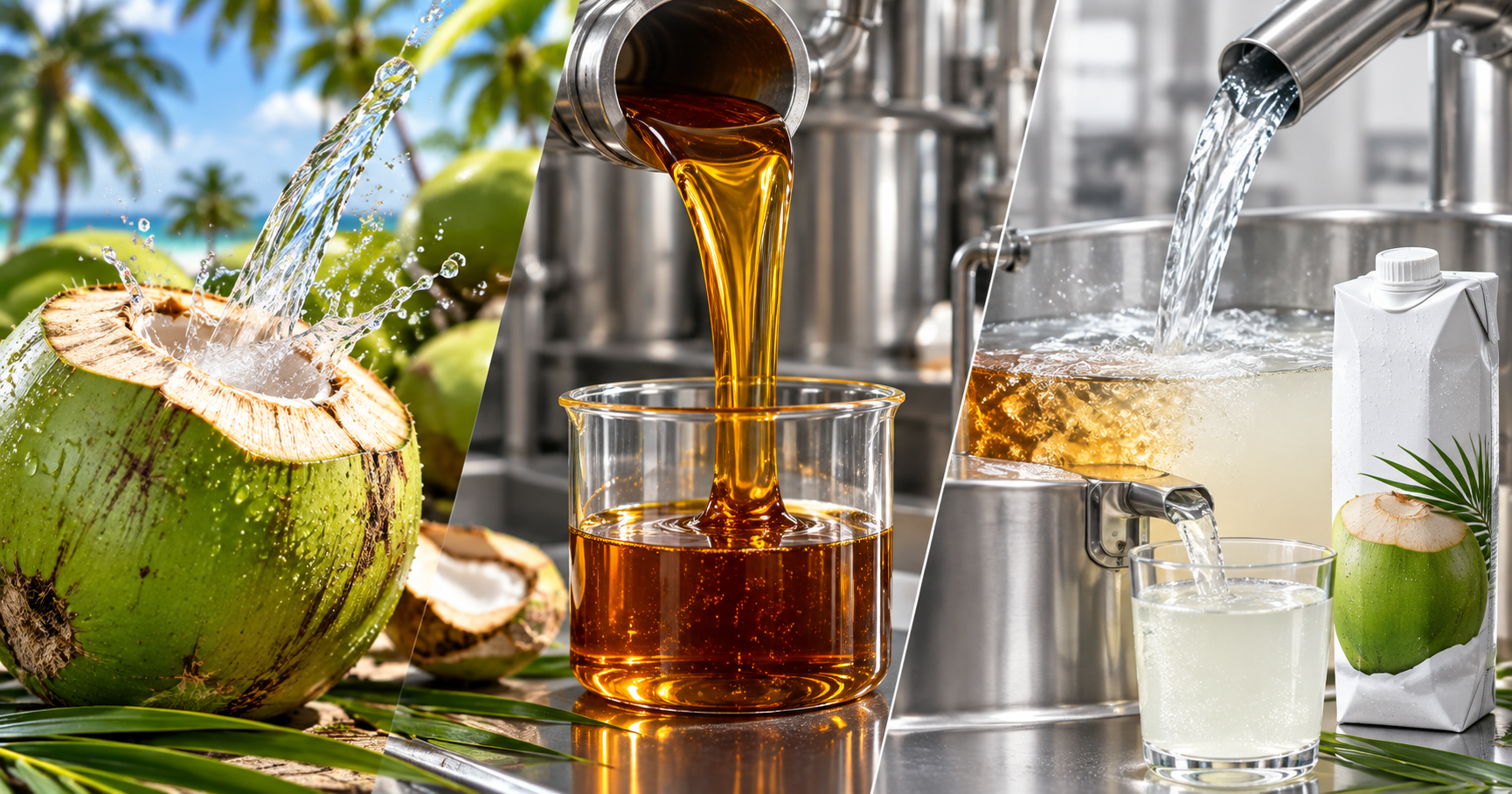
Fresh coconut water is collected from young coconuts, filtered, and then most of its water content is removed through controlled evaporation. The resulting concentrate typically reaches around 60 to 65 degrees Brix – Brix being the measure of dissolved sugars in the liquid, so a higher number means a denser, more reduced product. That concentrated form is cheaper to ship. At the bottling facility, often in the destination country, water is added back to reconstitute the liquid to its original concentration before it’s packaged and sold.
No mystery ingredient is involved. The water removed during concentration is added back later to return the juice to its intended strength. Juice and juice concentrates sold in the U.S. are subject to FDA food-safety requirements, including applicable Juice HACCP regulations. FDA labeling rules also require juices reconstituted from concentrate to identify that fact using wording such as “from concentrate” or “reconstituted.”
What Processing Does – and Doesn’t – Change
Concentration affects some things and leaves others nearly intact. The mineral content, which accounts for much of coconut water’s hydration benefit, is relatively heat stable – potassium, magnesium, and sodium survive the concentration process largely intact, so from a pure electrolyte standpoint, the two types are fairly comparable.
The gap is real but modest in more delicate compounds. Vitamin C degrades significantly with heat exposure, and certain enzymes that may aid digestion or have antioxidant properties are denatured during evaporation. Cytokinins – a class of plant compounds in fresh coconut water that have attracted some research interest for their potential antioxidant properties – are also among the heat-sensitive constituents that concentrated processing affects.
Not-from-concentrate coconut water skips the evaporation and reconstitution step entirely. It’s extracted and pasteurized without that reduction step, generally preserving more of the original flavor and nutrients, but it often costs more. Flavor is where the difference is most noticeable to many people. Products made from concentrate can taste slightly flatter, and some manufacturers add natural flavors or adjust formulations to compensate – though that’s a separate formulation choice, not something that happens automatically because a product went through concentration.
Shelf life works differently for the two formats. Fresh, unpasteurized coconut water must be refrigerated and has a shelf life of typically just a day or two at room temperature before bacterial growth becomes an issue. Both from-concentrate and not-from-concentrate products sold in shelf-stable cartons have been pasteurized to extend their usable life, which introduces its own trade-offs regardless of whether concentration was used. Some heat-sensitive nutrients are still affected by pasteurization.
High-pressure processing (HPP) is a newer method that some premium brands use. Research published in 2025 found that combining forward osmosis concentration with HPP showed potential for reducing volume while retaining more of the attributes of fresh coconut water, suggesting that future concentrate processing methods may narrow the nutritional gap further.
For people who drink coconut water regularly and use it in smoothies – where subtle flavor differences are masked by other ingredients – the cost savings of concentrate products can be meaningful over time.
Is Coconut Water From Concentrate Bad for You?
Concentration is a logistics and processing method. The finished product still contains the electrolytes that make coconut water useful for hydration. The trade-off is real but limited: some vitamin C is lost, some enzymes don’t survive, and the flavor may differ slightly. None of that makes it a health risk.
What does matter is what else is in the bottle. A coconut water from concentrate with no added sugar, no artificial flavors, and a single-ingredient list is a reasonable product. A not-from-concentrate coconut water loaded with added sugars or natural flavoring to mimic mango or pineapple has been changed far more meaningfully than any evaporation step could produce. The label phrase “from concentrate” doesn’t tell you whether sugar was added – that’s a separate question answered by the ingredient list and nutrition facts panel.
A 2025 review published in the journal Foods by researchers at China Agricultural University examined coconut water’s nutritional composition and processing methods and concluded that its electrolyte content, particularly potassium, remains relevant for hydration support – while noting that processing choices affect the preservation of more delicate bioactive compounds. Coconut water from concentrate isn’t stripped of its value, but it isn’t identical to fresh either.
Coconut water suits some situations better than others. The Mayo Clinic notes it is no more hydrating than plain water for the average person, and someone who exercises at moderate intensity and eats a balanced diet is already getting adequate electrolytes from food. A 2012 study in the Journal of the International Society of Sports Nutrition found no significant differences between coconut water and carbohydrate-electrolyte sports drinks for post-exercise rehydration measures. That finding applies regardless of whether the product was made from concentrate.
What the Viral Claims Get Right and Wrong
Social media has circulated vivid descriptions of how coconut water concentrate is made – the general narrative being that coconut water gets “boiled down into syrup” near its source, shipped across the world, and then mixed with whatever water is on hand at a bottling plant. Coconut water is indeed reduced near its origin to cut shipping costs, then reconstituted at its destination – that part is accurate.
The more alarming framing drifts from the facts. The evaporation used in concentration is a controlled industrial process. Coconut water concentrate is produced by collecting fresh coconut water, filtering it, and removing excess water through controlled evaporation – not boiled carelessly or combined with unregulated water. Facilities producing coconut water for export markets operate under food safety standards including HACCP protocols, and the water used for reconstitution is subject to the same requirements as any food-grade manufacturing process.
Added sugars, artificial flavors, and stabilizers do appear in some coconut water products – but they are separate formulation decisions made by the manufacturer, not automatic byproducts of concentration. A product can be from concentrate and contain nothing but coconut water. Equally, a not-from-concentrate product can include added sugar and flavor. Concentration describes how the liquid was transported and handled, not what a manufacturer chose to add to it.
How to Read the Label and Choose Well
Start with the ingredient list. A clean coconut water product, whether from concentrate or not, should list coconut water – or “coconut water from concentrate” – as the only ingredient. If you see added sugar, cane juice, natural flavors, or citric acid toward the top of the list, you’re looking at a more formulated product, and those additions matter more to the overall quality than whether concentration was involved.
Check for the phrase “100% coconut water.” Under FDA labeling rules, manufacturers are required to disclose when a product has been made from concentrate – so “coconut water from concentrate” or “reconstituted coconut water” will appear in the product name if that’s how it was made. If neither phrase appears and the label says “not from concentrate,” you’re getting the less-processed version.
Look at the nutrition facts panel, specifically the sugar figure. Fresh young coconut water naturally contains roughly 10 grams of sugar per cup. If a carton shows significantly more than that, added sugars are likely present. The panel now separates “added sugars” from total sugars, so that’s where to check directly.
The nutritional edge of not-from-concentrate is real but modest for most practical purposes, and from-concentrate coconut water is almost always less expensive at retail. For most people drinking coconut water as an everyday hydration choice rather than a therapeutic supplement, the difference in vitamin C content or enzyme activity is unlikely to be clinically meaningful.
The Bottom Line
So, should you avoid coconut water from concentrate?
Probably not.
Concentration is primarily a way of making coconut water easier and cheaper to transport. It can change the flavor and reduce some heat-sensitive compounds, but the minerals that make coconut water an appealing source of electrolytes largely remain.
That doesn’t mean not-from-concentrate is meaningless. If you prefer a fresher taste and want to minimize processing, it may be worth paying more for. But the difference isn’t nearly as dramatic as some of the online warnings make it sound.
At the grocery store, the better comparison may be surprisingly simple: turn the carton around.
Look at the ingredient list and added sugars rather than relying on “from concentrate” as a shortcut for good or bad. A coconut water made from concentrate with no added sugar may be a perfectly reasonable choice, while a heavily formulated not-from-concentrate product isn’t automatically healthier simply because of those three words.
Sometimes the front of the carton is selling you a story. The back tells you what you’re actually drinking.
Disclaimer: This information is not intended to be a substitute for professional medical advice, diagnosis, or treatment and is for information only. Always seek the advice of your physician or another qualified health provider with any questions about your medical condition and/or current medication. Do not disregard professional medical advice or delay seeking advice or treatment because of something you have read here.
AI Disclaimer: This article was created with the assistance of AI tools and reviewed by a human editor.
Read More: Regular Water isn’t Cool Anymore, But Hydration Supplements Are In. Do They Really Work?