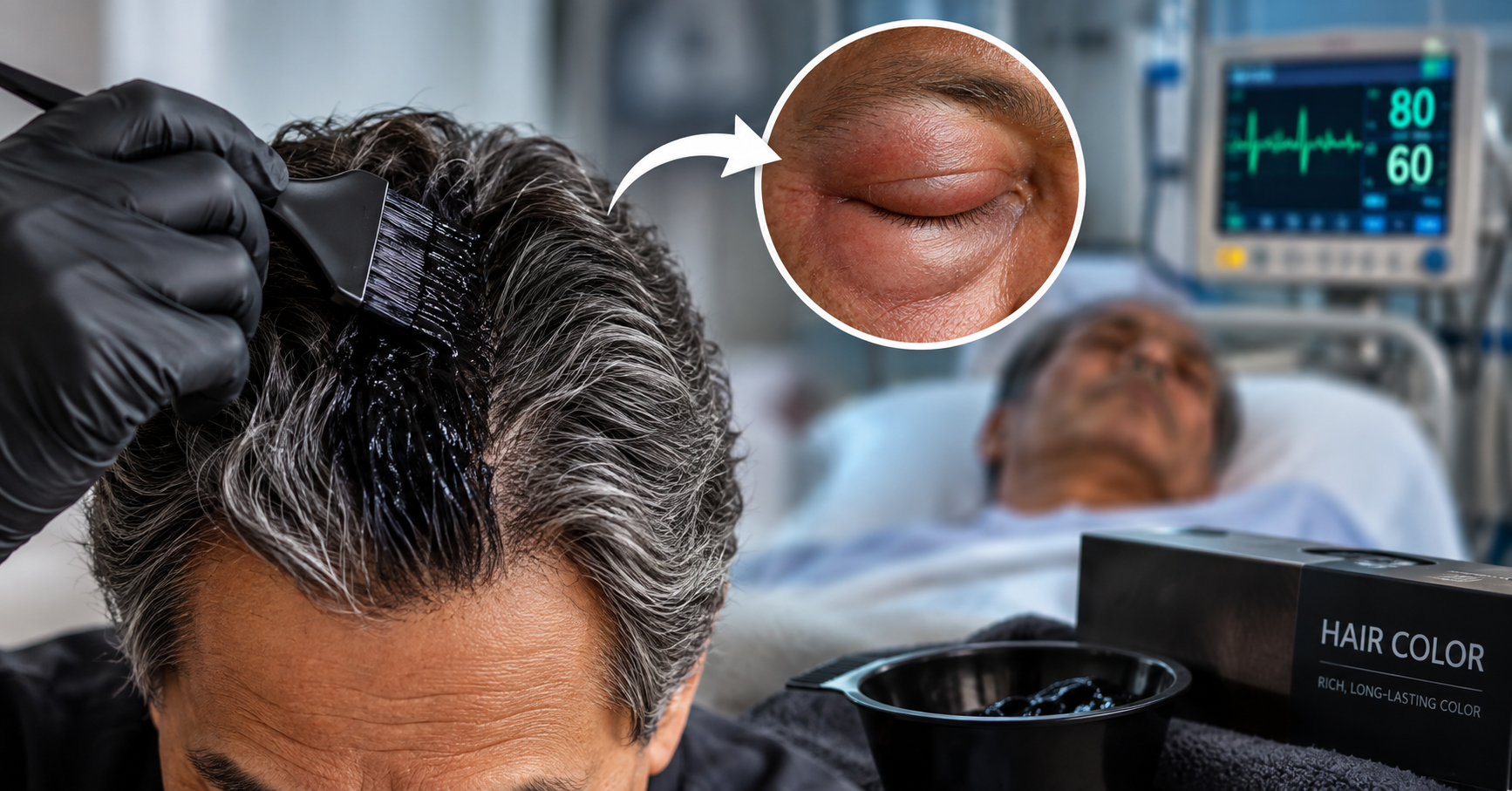

A 61-year-old man arrived at an emergency room in Bengaluru, India, after fainting twice. His blood pressure had fallen dangerously low, and doctors began looking for the kinds of problems that might explain a sudden collapse.
Brain scans and heart tests came back normal.
But there was another clue. The area around his right eye had begun to swell, and the swelling was spreading across his face. When doctors dug deeper into what he had been doing in the days before his collapse, one seemingly ordinary detail suddenly became much more important.
He had dyed his hair two days earlier.
The man’s doctors at Fortis Hospitals concluded that he had likely experienced a rare and unusually delayed case of anaphylaxis linked to hair dye. His initial symptoms had been mild enough that he treated some scalp itching at home with an over-the-counter antihistamine. Days later, however, his blood pressure had dropped to 80/60 mm Hg and he required intensive treatment.
The case, described in the Indian Journal of Case Reports and covered by Live Science, illustrates an important but easily overlooked fact about hair dye allergies: while most reactions involve the skin, severe reactions can look very different.
What hair dye anaphylaxis actually looks like
Most people who develop a reaction to hair dye experience what medicine calls allergic contact dermatitis, a delayed immune response that plays out on the skin. Para-phenylenediamine, known as PPD, is a well-known hair dye component that can act as a skin irritant and sensitizer, with contact dermatitis being the most common reaction it triggers. Severe systemic reactions following topical PPD exposure, including anaphylaxis, are documented in medical literature, though far less common than skin reactions.
Anaphylaxis and other immediate hypersensitivity reactions from hair dye contact are extremely rare, with only a few cases reported worldwide. The Bengaluru case stands out even within that small body of literature because of how long the reaction took to escalate. The man had spent two to three hours outdoors daily in the sun after applying the dye, and his treating physicians raised the possibility that ultraviolet light exposure may have intensified the reaction. Doctors cited previous research suggesting that ultraviolet light can enhance the allergy-triggering effects of para-phenylenediamine.
The man also had pre-existing cardiovascular disease, including prior coronary artery bypass surgery. His body was not well-positioned to manage a sudden drop in blood pressure. When his pressure kept falling despite intravenous fluids, doctors started an intravenous epinephrine infusion that ran continuously for 16 hours. His blood pressure stabilized gradually over the following 24 to 36 hours, and he was moved out of intensive care after 48 hours. He left the hospital with a five-day course of oral medications and a referral to a dermatologist.
Why anaphylaxis doesn’t always announce itself
The conventional image of anaphylaxis involves hives, throat swelling, and rapid-onset collapse within minutes of allergen contact. According to the Merck Manual, late-phase reactions may occur four to eight hours after the exposure or later. This phenomenon, known as biphasic anaphylaxis, affects a subset of patients, with the incidence described in the literature ranging from 1% to 20% of episodes.
The skin symptoms that most people associate with anaphylaxis can also be absent entirely. Cardiovascular collapse can occur without respiratory or other symptoms, which is precisely what made this case so easy to misread as a cardiac or neurological emergency on arrival. The man’s blood pressure on admission, 80/60 mm Hg, met the World Allergy Organization’s diagnostic threshold for hypotension, which for adults is a systolic blood pressure below 90 mm Hg.
Treatment for confirmed anaphylaxis centers on epinephrine. According to the Merck Manual, epinephrine is typically administered intramuscularly in the anterolateral thigh at a dose of 0.01 mg/kg of 1:1000 solution, with a maximum dose of 0.5 mg. The Bengaluru patient received this first-line injection, plus intravenous hydrocortisone and antihistamines, before the care team escalated to a sustained epinephrine drip because his blood pressure refused to respond to fluids alone. The treating physicians noted explicitly: when patients arrive with unexplained fainting, facial swelling, and persistently low blood pressure, a detailed history of recent cosmetic use belongs in the workup.
The chemistry behind the sensitivity
PPD is absorbed rapidly through the skin, peaking in plasma just two hours after application, and is almost undetectable at 24 hours. That speed of absorption means the immune system encounters the compound quickly, even though the visible reaction may be delayed for a day or more.
PPD, an aromatic amine, is a well-known hair dye component that can act as a skin irritant and sensitizer. Hair dyes are a common cause of allergic contact dermatitis among cosmetics, with PPD being the most important sensitizing ingredient in permanent hair dyes. The American Contact Dermatitis Society designated PPD its Contact Allergen of the Year for 2006, reflecting how consistently it appears in allergy patch test results.
Hair dye contact dermatitis is a delayed-type hypersensitivity reaction that commonly affects the scalp, hairline, and neck, with PPD being the most common allergen implicated. The first exposure typically produces no visible reaction – the immune system registers the compound without triggering symptoms. On subsequent exposures, sometimes after years of uneventful dyeing, the allergic response emerges.
The “PPD-free” label doesn’t guarantee safety
The Bengaluru case report raised a specific warning about cross-reactivity that consumers who switch to PPD-free products need to understand. Anaphylaxis from a PPD-containing dye can recur following use of a commercially marketed “PPD-free” dye, most likely due to cross-reactivity with structurally related phenylenediamine derivatives, including toluene-2,5-diamine sulfate and m-aminophenol.
There are case reports of hair dye allergy to PPD-free products because individuals can develop allergic reactions to cross-reacting chemicals such as toluene-2,5-diamine, which is commonly present in PPD-free formulations. The American Contact Dermatitis Society named toluene-2,5-diamine sulfate the Society’s Allergen of the Year for 2025, reflecting growing clinical concern about its prevalence in patch test results of people who believed they had found a safe alternative to PPD. PPD-allergic patients need clear information to avoid unintentional exposure from potentially misleading labeling on hair dye packaging.
Published case reports have documented severe anaphylaxis triggered by PPD-containing hair dye that then recurred when patients switched to products marketed as PPD-free, with cross-reactivity to toluene-2,5-diamine the suspected mechanism.
When the patch test misses the problem
The FDA advises consumers to apply a small amount of dye inside the elbow or behind the ear, leave it for two days, and skip the dye if any rash appears, and recommends repeating this before every use, including at salons. That guidance is sound for catching delayed-type contact allergy. For the rarer category of immediate hypersensitivity reactions, however, a patch test may not be sufficient.
Hair dyes can also cause anaphylactic reactions, and the diagnosis can be established with in vitro testing despite negative skin tests. Doctors at Geneva University Hospitals described a patient with severe hair dye anaphylaxis whose skin prick tests to both toluene-2,5-diamine and PPD were negative; the diagnosis came instead from laboratory blood cell tests that were strongly positive for toluene-2,5-diamine, as reported in Contact Dermatitis by Janušonytė and colleagues. A negative patch test result does not rule out severe anaphylactic sensitivity in someone who has experienced prior reactions.
The UK’s National Health Service confirms that a serious allergic reaction, including anaphylaxis, to hair dye is possible, though rare. Symptoms warranting immediate emergency care include swelling of the lips, mouth, throat, or tongue; difficulty breathing; confusion or sudden dizziness; and skin or lips turning blue or grey. These can emerge minutes after exposure, or, as in the Bengaluru case, not until days later.
Read More: ‘Napalm Girl’ Kim Phuc Phan Thi, receives final burn treatment 50 years after iconic image
What to do now
For most people who react to hair dye, the problem is much less dramatic than what happened in Bengaluru. Itching, redness, swelling, or a rash around the scalp, hairline, face, or neck are more typical signs of an allergic reaction.
But even a previous mild reaction can be worth discussing with a dermatologist or allergist before using hair dye again. Sensitivity can develop after earlier exposures that caused no obvious problems, and people who are allergic to PPD may also react to related ingredients found in some products marketed as PPD-free.
More severe symptoms are a different matter. Fainting, rapidly spreading facial swelling, difficulty breathing, swelling of the mouth or throat, confusion, or severe dizziness after exposure to hair dye warrant emergency medical attention.
What made this case unusual was not simply that hair dye triggered a severe reaction. It was how easily that reaction could have been mistaken for something else. The man’s collapse and dangerously low blood pressure initially pointed doctors toward his heart or brain, while the connection to a cosmetic product used two days earlier was much less obvious.
That is ultimately what makes the case worth reporting. Sometimes the detail that explains a medical emergency isn’t found on a scan or blood test. It comes from asking what happened before the symptoms began.
Disclaimer: This information is not intended to be a substitute for professional medical advice, diagnosis, or treatment and is for information only. Always seek the advice of your physician or another qualified health provider with any questions about your medical condition and/or current medication. Do not disregard professional medical advice or delay seeking advice or treatment because of something you have read here.
AI Disclaimer: This article was created with the assistance of AI tools and reviewed by a human editor.