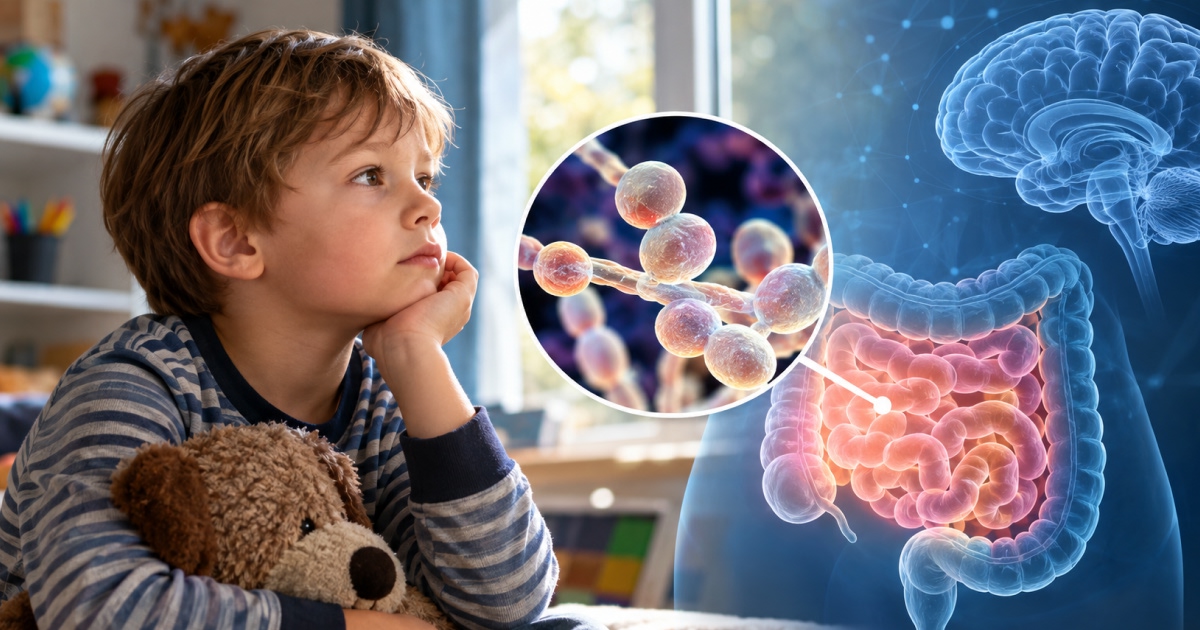

Candida albicans lives in the digestive tract of many healthy people, usually without causing any problems. But several small studies have found something intriguing: the yeast appears to be detected more often in children with autism spectrum disorder (ASD) than in children without it.
One finding in particular has attracted attention. In an Egyptian study of 83 children with autism, stool samples from 68 of them, or 81.9%, tested positive for Candida albicans. When researchers later pooled that study with three others involving children from different countries, they found that children with ASD had substantially higher odds of testing positive for Candida than children without the diagnosis.
Those numbers sound dramatic, but they come with an important caveat. Finding more Candida in children with autism does not mean the yeast causes autism, nor does it show that treating Candida would affect the condition. Candida is already a normal member of the human gut microbiome, and researchers are still trying to understand whether the differences observed in ASD could contribute to the condition, result from other biological or dietary differences, or simply accompany them.
So what has the research actually found, and what might the connection mean? The answer is more complicated, and more interesting, than the 81.9% figure alone suggests.
Where the 81.9% Figure Actually Comes From
The number originates from a single Egyptian study – one of four studies pooled in a 2023 meta-analysis published in African Health Sciences. Stool cultures from that Egyptian cohort, reported in the Journal of Clinical Medicine, found C. albicans in 68 of 83 children diagnosed with ASD (81.9%), a substantially higher rate than in children without autism. A single cohort from one country, using one testing method in one clinical setting, cannot tell us what proportion of children with autism broadly have detectable Candida in their gut.
The meta-analysis drew on 254 children diagnosed with ASD and 161 healthy controls across four studies. Pooling those results, the authors calculated a combined odds ratio of 7.21 – meaning children with ASD were more than seven times as likely to test positive for Candida as children without a diagnosis. That is a large association. Epidemiological studies of this type can demonstrate associations but cannot establish causation.
The meta-analysis has significant limitations. Only four studies were included, with a total of 415 children. The populations spanned different countries, and the methods used to detect Candida varied between studies – differences that affect how directly the results can be compared. The authors themselves acknowledged that the small number of available studies limits how firm any conclusions can be.
The Fungal Side of the Gut-Brain Axis
The gut microbiota-brain axis operates through three primary pathways: the immune pathway, the neuronal pathway, and the endocrine/systemic pathway. Disruptions to that network have been studied in the context of numerous neurological and psychiatric conditions. Most gut-brain research has focused on bacteria; fungi receive far less attention despite also being permanent residents of the gastrointestinal tract.
A 2026 study in Frontiers in Cellular and Infection Microbiology noted that Candida albicans shifts from a commensal organism to a potentially problematic state when gut barriers are disrupted and host immune function is compromised. Children with autism have consistently shown differences in gut microbial composition compared to typically developing children, based on studies of altered microbiota profiles in this population.
Specifically regarding Candida, a 2024 study published in Nutrients examining gut bacterial and fungal microbiota in children with ASD and their non-autistic siblings found increased Candida albicans in the ASD group compared to siblings. A separate Tunisian study published in Journal of Fungi found that Candida was detected in 46.4% of children with autism, compared to 30.4% of controls, with C. albicans being the most common species identified.
Why the Association Doesn’t Equal a Cause
Even a seven-fold difference in detection rates doesn’t tell researchers which came first, or what is driving what. Several competing explanations exist for why Candida might appear more frequently in children with ASD, and the research cannot yet separate them.
Children with autism commonly experience gastrointestinal difficulties, including constipation, abdominal pain, diarrhea, and food selectivity. Factors involved include genetic elements, imbalances in intestinal microbiota, and immune system dysfunction. Dietary selectivity matters here: a narrower diet can alter gut microbial composition in significant ways, including the balance of fungi.
Antibiotic use is one of the primary ways that healthy bacterial populations in the gut are disrupted, which in turn can allow Candida populations to expand. Differences in immune function, which are documented in ASD, are another plausible explanation – Candida shifts toward a more pathogenic state specifically when immune function is compromised.
One hypothesis proposes a more direct mechanism. A 2022 paper in the Journal of Clinical Medicine proposed that excess Candida albicans may produce ammonia that interacts with propionic acid in the gastrointestinal tract to form compounds structurally similar to GABA – a major inhibitory neurotransmitter in the brain. GABA signaling is disrupted in autism. Whether this biochemical chain plays a role, or whether Candida is simply a downstream consequence of gut differences already present in ASD, remains unknown.
A 2026 review in the Journal of Clinical Medicine identified short-chain fatty acids and tryptophan-derived compounds produced by gut microbiota as potential mediators linking gut disruption to neuroinflammatory processes – another pathway researchers are investigating in ASD, though causal direction remains unclear.
The available studies on intestinal Candida colonization and ASD do not lead to clear conclusions, and nothing in this body of research supports antifungal treatments, restrictive diets, probiotic regimens, or supplement protocols as interventions that can prevent or treat autism.
ASD’s Known Risk Factors Remain Complex
Autism arises from a combination of genetic and environmental influences. A 2025 review in the Journal of Clinical Investigation found that genetics account for approximately 40% of heritable risk in ASD. Among documented environmental contributors are advanced parental age, maternal autoimmune disease, hypertension, obesity, diabetes, and certain infections during pregnancy.
The gut microbiome’s relationship to ASD is real but complex, and research has produced inconsistent results that reflect the disorder’s heterogeneity and the need for more rigorous experimental designs. Autism is not one condition with one biological signature – it is a spectrum that includes people with dramatically different presentations, genetic profiles, and co-occurring health differences. Microbiome findings that hold in one population do not always replicate in another.
The National Institute of Mental Health reports that, drawing on CDC surveillance data published in 2025, approximately 1 in 31 eight-year-old children in the US were identified with ASD in 2022, with the condition being 3.4 times as prevalent among boys as girls. With millions of children affected, understanding how altered gut microbial profiles in ASD develop – and what they mean – is an active area of research, even as firm answers remain elusive.
You can explore more about how gut health intersects with neurological differences in physical traits linked to autism, including what the gut microbiome’s “second brain” connection actually looks like in practice.
What the Research Tells Us So Far
The Candida findings are intriguing because they have appeared in more than one population. Studies from different countries have reported higher rates of Candida in children with ASD, and a 2023 meta-analysis found substantially higher odds of Candida detection among children with autism than among controls. That makes the association worth investigating.
What remains unresolved is what sits behind it. Differences in diet, gastrointestinal health, antibiotic exposure, immune function, or the broader gut microbiome could all influence Candida populations. It is also possible that fungal differences interact with other biological processes researchers are only beginning to understand. Current studies cannot establish which direction the relationship runs.
That distinction matters. Nothing in this research shows that Candida causes autism, and the findings do not provide evidence for treating autism with antifungal medications, restrictive diets, probiotics, or supplements.
What the research does show is that the gut microbiome story in autism extends beyond bacteria. A 2024 study published in Nutrients found differences involving both bacterial and fungal communities in children with ASD, highlighting an area of the microbiome that has received comparatively little attention.
For now, Candida is a clue, not an answer. Whether it contributes to biological differences associated with ASD, develops partly because of those differences, or reflects other factors shared among some children with autism remains an open question.
Disclaimer: This information is not intended to be a substitute for professional medical advice, diagnosis, or treatment and is for information only. Always seek the advice of your physician or another qualified health provider with any questions about your medical condition and/or current medication. Do not disregard professional medical advice or delay seeking advice or treatment because of something you have read here.
AI Disclaimer: This article was created with the assistance of AI tools and reviewed by a human editor.