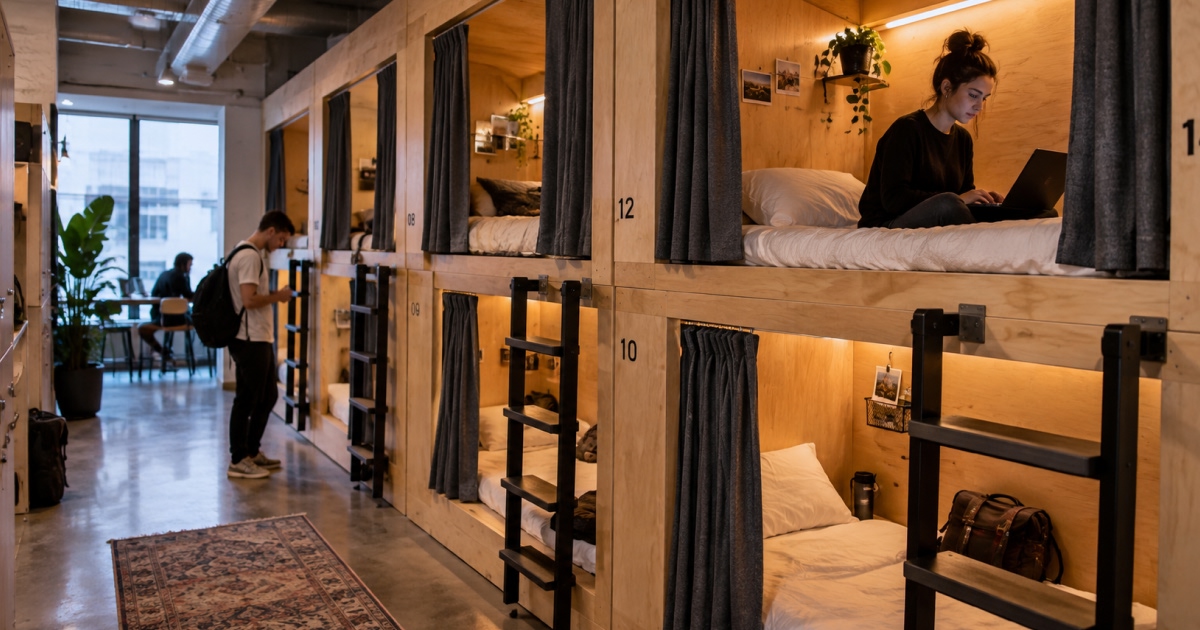

A bed, a curtain, and 30 roommates. In downtown San Francisco, that’s one version of what $700 a month gets you.
At Brownstone Shared Housing, residents sleep in compact pods rather than conventional bedrooms, trading private space for a much lower price in one of America’s most expensive rental markets. But elsewhere, particularly on university campuses, “pod living” looks surprisingly different.
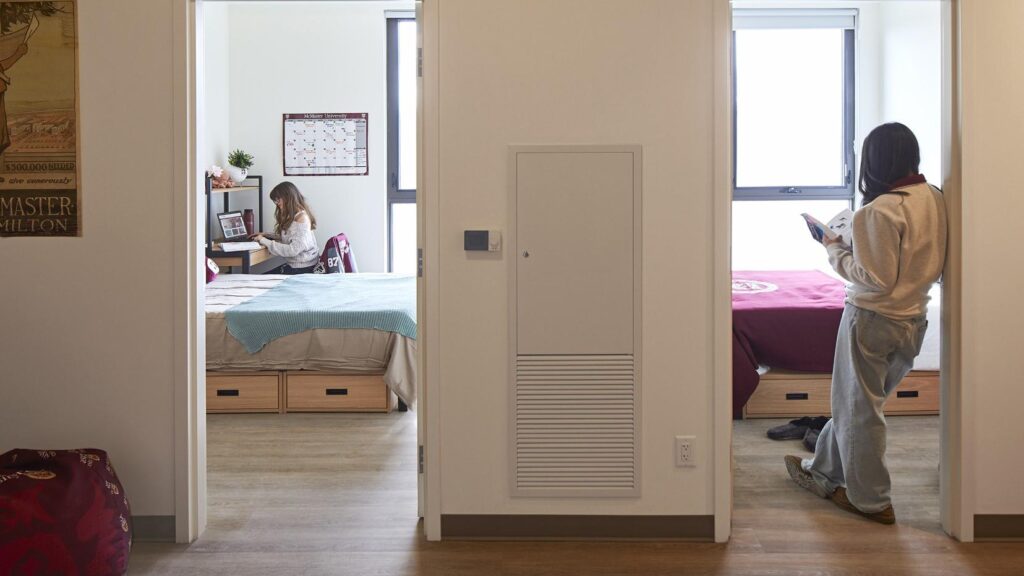
Students at schools including McMaster University and the University of Victoria can have private bedrooms while sharing kitchens, bathrooms, lounges, and other common spaces with a larger group. Purdue is building new pod-style housing, and other universities are investing millions to retrofit residences around similar designs.
What once attracted attention as an extreme response to expensive urban housing is becoming a much more mainstream approach to housing students and young adults.
So why are institutions building more of it, and why are some young people choosing pods over more conventional housing? The answer involves affordability, convenience, community, and a willingness to rethink just how much of a home actually needs to be private.
What “living in pods” actually means
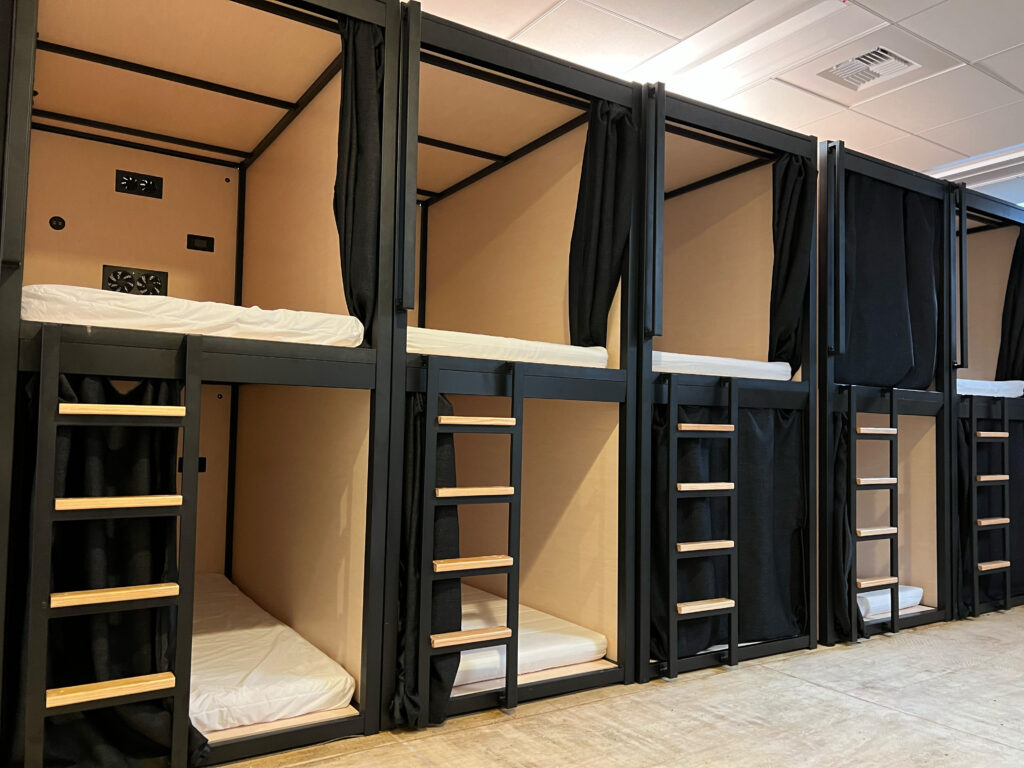
The concept was already attracting attention by 2019, when NPR profiled a young professional living in a Los Angeles sleeping pod while renting his workspace and owning few possessions. At the time, co-living companies were pitching capsule-style shared housing as an alternative to conventional rentals in expensive cities. The model borrowed from Japanese capsule hotels: a dedicated sleeping space, minimal private amenities, and an emphasis on communal areas for everything else.
In San Francisco, Brownstone Shared Housing has taken that idea considerably further. In April 2026, KQED spent several days inside Brownstone’s Mint Plaza location, where residents were paying $700 a month for a twin-sized sleeping pod with a privacy curtain, thermostat, and light. Bathrooms, workspaces, and a small central kitchen are shared among roughly 30 residents. There is no deposit, one-year lease, background check, or proof-of-income requirement. Several residents told KQED they had arrived in San Francisco for work and needed an inexpensive place to get established.
Brownstone has much bigger ambitions. The company has secured a downtown building where it hopes to create a roughly 400-pod residence. However, the project remains a proposal rather than an operating second location. As of April 2026, San Francisco’s Planning Department told KQED that permits had not yet been sought or granted for the facility. Brownstone CEO James Stallworth has described pod housing as something that can fill gaps at particular stages of life rather than necessarily serving as a permanent home.
But not all “pod housing” means sleeping behind a curtain. On university campuses, the term often describes something much closer to a conventional dorm. Students may have their own locking bedroom while sharing bathrooms, kitchens, lounges, and other common spaces with a small group of residents.
That distinction matters. A $700 bunk in San Francisco and a private university bedroom may both be called pods, but they offer very different levels of privacy and personal space.
Why institutions keep building them
The case for pod housing starts with demand. On-campus housing occupancy at many universities exceeds 95 percent, a figure that signals a genuine supply problem. When nearly every bed on campus is filled, designs that can efficiently accommodate students while providing shared amenities become attractive to administrators.
Pod layouts accomplish this by grouping student rooms around community spaces in a way intended to encourage connection and social interaction while still maintaining some individual privacy. Designers have increasingly emphasized community-oriented spaces in student housing, particularly as universities look for ways to support students living away from home for the first time.
Rather than relying on long corridors lined with individual rooms, pod layouts funnel residents toward shared kitchens, lounges, and other communal areas, creating more opportunities for everyday interaction. Whether that translates into stronger friendships will depend on the residents and how those spaces are actually used, but encouraging interaction is a deliberate part of the design.
The appeal for students and young adults
Cost is one of the most obvious attractions. In an expensive city, giving up space can dramatically reduce the price of having somewhere to live.
Brownstone offers an unusually stark example. Its Mint Plaza sleeping pods cost $700 a month, while KQED reported that the average San Francisco apartment rent was about $3,650 per month. For someone arriving in the city for a new job, internship, school, or other short-term opportunity, that difference can make an otherwise unaffordable move possible.
But the comparison isn’t apples-to-apples. Brownstone residents aren’t getting a $700 apartment. Their private space is essentially large enough to lie down and sit up, while bathrooms, workspaces, and a small kitchen are shared with roughly 30 other people. In a less expensive city, splitting a conventional apartment with roommates could provide substantially more private space for a similar monthly cost.
Price also isn’t the only attraction. Pod-style housing can simplify moving to a new city. Furnishings, utilities, and common areas may already be provided, and arrangements can be more flexible than signing a conventional year-long lease. Brownstone, for example, doesn’t require a deposit or proof of income at its Mint Plaza location. Several residents interviewed by KQED described the pods as a way to get established in San Francisco without immediately committing to the city’s much higher conventional rents.
University pods offer a different version of the same trade. Students can retain a private bedroom while sharing expensive amenities such as kitchens, bathrooms, lounges, and study areas. For universities facing pressure to house more students, clustering private rooms around shared facilities can also allow residences to accommodate students differently than traditional dorm or apartment layouts.
The trade-offs nobody leads with
The obvious trade-off is privacy. Sharing kitchens, bathrooms, lounges, and other common areas means residents have far less control over noise, cleanliness, schedules, and personal space than they would in a conventional apartment.
At Brownstone, those compromises can be particularly extreme. A KQED reporter who stayed at the Mint Plaza location for several nights described having little private space beyond the sleeping pod itself. Changing clothes might mean using the pod or a restroom, while the small communal kitchenette and shared food-storage areas presented some of the familiar frustrations of living with roommates.
The arrangement can work for some residents, particularly those who spend much of their time outside the home or see it as temporary. But it may become harder to tolerate over time. KQED interviewed a former pod resident who moved into her own apartment after nine months, saying that working full time increasingly left her wanting more privacy. The setup also presents obvious limitations for couples, families, some people with disabilities, light sleepers, and anyone who simply values having substantial space to themselves.
University-style pods address some of these concerns by giving students private bedrooms. Even then, much of daily life still happens in shared spaces. The experience can depend heavily on how many people share those spaces, how the residence is managed, and whether residents actually enjoy that degree of communal living.
Pod layouts are designed to create more opportunities for interaction than traditional corridor-style dorms by funneling residents toward shared kitchens, lounges, and other communal spaces. Whether that produces a stronger sense of community in practice will depend on the residents themselves.
A shifting definition of home
For many young adults, buying a home remains financially out of reach, while renting independently can consume a substantial share of an entry-level income. That puts greater emphasis on what actually constitutes “having a space of your own.”
For some people, a private bedroom and a locking door may be enough. Others may consider extensive shared facilities a reasonable trade-off for living close to school or work, avoiding a lengthy commute, or paying less than they would for an apartment of their own.
The continued investment in pod-style housing suggests that institutions see demand for managed, community-oriented housing remaining strong. Industry estimates also project substantial growth in the broader co-living market over the coming decade, although forecasts of market size should be treated as projections rather than guarantees.
In 2019, coverage of young professionals living in capsule-style arrangements often framed the choice as an extreme response to urban housing costs. By 2026, universities are deliberately incorporating versions of the same shared-space philosophy into new residences.
The pod hasn’t necessarily replaced the apartment. But the idea that every resident needs a private kitchen, bathroom, living room, and other amenities of their own is increasingly being reconsidered.
Are Pods Really the Future of Housing?
The real question may not be whether young people want to live in pods, but whether rising housing costs are changing what counts as having a place of your own.
Pod living isn’t one thing. A $700 bunk behind a curtain in San Francisco is very different from a private university bedroom connected to a communal kitchen and lounge. Putting both under the same label can obscure just how different the experience can be.
What they share is the idea that less space needs to belong exclusively to one person. Kitchens, lounges, bathrooms, and sometimes even bedrooms can be traded for lower costs, greater convenience, or access to spaces residents might struggle to afford on their own.
For students considering pod housing, that makes the details more important than the label. How many people share the kitchen and bathroom? Do you have a locking bedroom door or a curtain? What’s included in the price? How much privacy are you actually giving up?
In 2019, capsule-style living attracted attention because it seemed like an extreme response to soaring housing costs. Seven years later, universities are deliberately incorporating versions of the same shared-space philosophy into new residences.
That doesn’t necessarily mean young people suddenly prefer having less space. It may say just as much about the housing choices available to them.
AI Disclaimer: This article was created with the assistance of AI tools and reviewed by a human editor.
Lead image for representational purposes only. Image credit: The Hearty Soul / AI-generated image
Read More: Places Americans Are Relocating to and Living Well on About $1,000 a Month