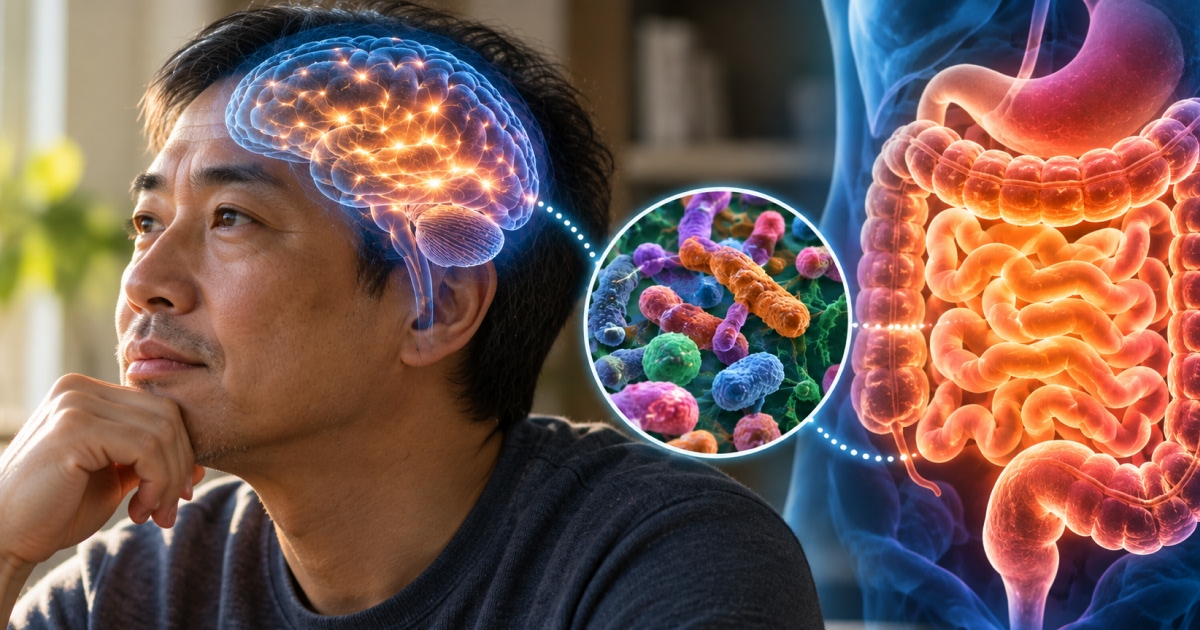

What if some of the biological changes associated with an aging brain begin long before memory problems appear?
A 2026 UCLA Health study suggests researchers may be able to detect signs of these differences surprisingly early, even among younger and middle-aged adults without diagnosed neurological disease.
Using brain scans and machine learning, researchers estimated how “old” each participant’s brain appeared compared with their actual age. People whose brains appeared older than expected tended to perform worse on tests involving working memory and executive function, and they also reported more symptoms of depression.
Then researchers found another intriguing connection: some of those brain-aging differences were associated with bacteria and metabolic compounds found in the gut.
That doesn’t mean a stool sample can tell you how quickly your brain is aging, and the study doesn’t show that gut bacteria are causing the brain to age faster. But it adds to growing research on the gut-brain axis and raises a much bigger question: could biological clues about brain aging begin appearing decades before cognitive symptoms become obvious?
How Researchers Measured Brain Age – and What the eBioMedicine Study Found
To investigate whether brain aging could be detected in younger, generally healthy adults, the UCLA team analyzed brain scans from nearly 1,500 participants across three separate groups.
Rather than looking only for visible changes in brain structure, researchers used a technique called resting-state functional MRI, which measures how different regions of the brain communicate while a person is resting.
A machine learning model then estimated each participant’s brain age based on those communication patterns. Researchers compared that estimate with the person’s actual age to calculate what they called the Brain Aging Index (BAI).
For example, if a 35-year-old’s brain showed activity patterns more typical of someone older, their Brain Aging Index would be higher. That doesn’t necessarily mean their brain is damaged or that they will develop dementia. It simply indicates that certain features of their brain activity resemble those typically seen at an older age.
The researchers tested this approach across three groups: 674 participants in the initial group, 444 in a replication group, and another 344 in an independent validation group.
Across the groups, a consistent pattern emerged. People whose brains appeared older than their actual age tended to perform worse on tests of working memory and executive function, which involve everyday abilities such as remembering information, concentrating, planning, and organizing tasks.
They also reported more symptoms of depression.
Some of the most consistent differences involved brain networks associated with memory and self-reflection, including the ability to recall personal experiences and think about oneself.
These findings don’t establish that a higher Brain Aging Index will lead to dementia or other neurological conditions. However, they suggest that differences associated with brain aging may already be measurable well before a person develops obvious cognitive problems.
The Gut Connection: What Stool Samples Revealed
In one study group, researchers also analyzed stool samples to look for connections between brain aging and gut biology. A higher Brain Aging Index was associated with particular gut bacteria and several metabolic substances, including certain fat molecules, a cholesterol-related compound, and lower levels of the hormone estetrol. Estetrol is a naturally occurring estrogen produced primarily during pregnancy; its presence at lower concentrations in both men and women is being actively studied for effects on the nervous system and brain cell function.
The researchers also identified biological pathways involving immune activity, blood vessel health, communication between nerve cells, and cellular energy production. These findings suggest several possible routes through which gut health and brain aging could be connected, though the study cannot establish which direction the influence runs.
Why the Gut and Brain Are Always in Conversation
The gut-brain axis is a bidirectional communication network linking the gastrointestinal tract and the central nervous system via neuronal, hormonal, and immune signaling pathways. Substances produced by gut bacteria can enter the bloodstream; certain nerves connect the gut directly to the brain, allowing microbial signals to travel upward to the central nervous system.
An imbalance in gut microbiota, known as dysbiosis, has been linked to neurological and psychiatric conditions including anxiety, depression, and cognitive decline. Dysbiosis means the gut’s microbial ecosystem has shifted out of balance, with fewer beneficial bacteria and more potentially harmful ones. Neuroinflammation – low-level inflammation in the brain – has been linked to cognitive decline and mood disorders in prior research.
Aging reshapes the structure and function of the gut microbiota through physiological changes, immune remodeling, lifestyle factors, dietary habits, and medication use. These shifts include altered microbial diversity, changes in bacterial communities, and differences in microbial metabolic activity. For more on how dietary patterns affect this system, this overview from The Hearty Soul examines how ultra-processed foods disrupt the gut microbiome and accelerate neuroinflammation.
What This Means for Younger Adults
Previous research on brain age mostly recruited participants who were older or already showing signs of neurological disease. Dr. Arpana Church, the study’s senior author and co-director of the Goodman-Luskin Microbiome Center at UCLA Health, stated that brain aging doesn’t begin suddenly in old age – biological signals may be detectable decades earlier. The study’s participants were younger and middle-aged adults with no existing brain diagnoses, which makes that conclusion particularly relevant outside clinical settings.
By linking early brain changes with the gut microbiome and its metabolites, researchers are beginning to identify pathways that could help clarify who may be at risk and where intervention might support healthier brain aging. However, the study is cross-sectional – it captured a snapshot in time rather than following participants forward. The findings cannot yet determine which comes first: whether gut differences influence the brain, whether early brain changes affect the gut, or whether a third factor such as chronic stress, diet quality, or genetic predisposition drives changes in both systems simultaneously.
Read More: 6 Common Foods That Could Be Quietly Wrecking Your Gut Health
What the Research Says About Changing Your Gut
Gut bacteria produce metabolites, including short-chain fatty acids, that affect immune signaling, antigen presentation, and neuronal function. Fiber, polyphenols found in berries, olive oil, and dark leafy greens, prebiotics, and probiotics have all been associated with shifts in microbiome composition that support beneficial bacterial communities. A 2026 journal article found that dietary interventions show the strongest evidence for improving microbiome composition compared to other lifestyle factors – stronger than supplements and stronger than stress management alone.
Physical activity also plays a measurable role. A 2026 review described exercise as “a promising non-pharmacological modulator of microbial ecology,” meaning regular movement changes the gut microbiome in ways that don’t require medication or clinical intervention.
The evidence does not support the idea that probiotics alone, or any single supplement, can reverse accelerated brain aging. The UCLA researchers noted that longer studies are needed – ones that follow participants over years and test whether actively changing the gut changes brain function in measurable ways.
What Does This Mean for Your Brain?
The most interesting part of the UCLA research isn’t that scientists have discovered a gut treatment for brain aging. They haven’t.
It’s that measurable differences in how old a person’s brain appears may already be present in younger and middle-aged adults who don’t have diagnosed neurological disease. And some of those differences appear to coincide with measurable differences in the gut microbiome and the substances it produces.
What researchers don’t yet know is which direction that relationship runs.
Gut microbes could potentially influence the brain through metabolic, immune, hormonal, or nervous-system pathways. Changes elsewhere in the body could affect both systems simultaneously. Diet, stress, physical activity, medications, genetics, and other factors could also help explain the association.
Because this study captured participants at a single point in time, it can’t answer those questions. Researchers will need to follow people for years to determine whether a higher Brain Aging Index actually predicts future cognitive decline and whether changing the gut microbiome can meaningfully alter that trajectory.
For now, there’s no evidence that taking a particular probiotic, eating one “brain food,” or attempting to manipulate your microbiome can reverse accelerated brain aging.
That doesn’t make familiar healthy habits irrelevant. Fiber-rich foods, regular physical activity, adequate sleep, and a varied diet can support overall metabolic and cardiovascular health as well as a healthy gut microbiome. But that’s different from saying they can make an older-looking brain younger.
The new research instead offers something more fundamental: another indication that brain aging may be a process that can be studied long before dementia or obvious memory problems appear.
The next challenge is figuring out whether these early gut-brain signals merely reflect that process, help drive it, or could eventually give researchers an opportunity to change it.
Disclaimer: This information is not intended to be a substitute for professional medical advice, diagnosis, or treatment and is for information only. Always seek the advice of your physician or another qualified health provider with any questions about your medical condition and/or current medication. Do not disregard professional medical advice or delay seeking advice or treatment because of something you have read here.
AI Disclaimer: This article was created with the assistance of AI tools and reviewed by a human editor.
Read More: Cutting Out Sugar Completely May Have Unexpected Effects on Gut Health, Study Finds